

Malaysia is a Southeast Asian country located on the Malay Peninsula and the island of Borneo. The country shares borders with Thailand to the north and is separated by the South China Sea from Vietnam to the northeast and Indonesia to the south and southwest. Malaysia also shares maritime boundaries with the Philippines to the northeast and Brunei to the east. The Malay Peninsula, which extends southward from mainland Asia, is the larger landmass of Malaysia. It borders the Strait of Malacca to the west, which connects the Indian Ocean to the east with the Andaman Sea to the west.
To the east of the Malay Peninsula is the island of Borneo, which is shared with Indonesia and Brunei. The Malaysian part of Borneo, known as East Malaysia, consists of two states: Sabah and Sarawak. Borneo is the third-largest island in the world and is characterized by dense rainforests, rugged mountains, and abundant wildlife. It is separated from the Malay Peninsula by the South China Sea.
Malaysia’s geographical location near the equator gives it a tropical climate, with high temperatures and humidity throughout the year. The country is known for its diverse ecosystems, including lush rainforests, mangrove swamps, and coral reefs
Malaysia has a rich and complex history that spans thousands of years. The region has been inhabited since prehistoric times, and over the centuries, it has been influenced by various indigenous cultures, Indian and Chinese traders, and European colonial powers.
Early civilizations in the Malay Peninsula and Borneo can be traced back to the 2nd and 3rd centuries BCE. The Malay kingdom of Srivijaya emerged in the 7th century, becoming a powerful maritime empire that controlled trade routes in the region. It was followed by other influential Malay kingdoms, such as the Malacca Sultanate in the 15th century, which played a crucial role in the spice trade and attracted traders from around the world. In the 16th century, European powers arrived in the region, with the Portuguese being the first to establish a presence. They were followed by the Dutch, who gained control over some territories. However, it was the British who ultimately dominated the region. The British East India Company established trading posts in Penang, Malacca, and Singapore in the late 18th century.
The Japanese occupation of Malaysia during World War II from 1942 to 1945 marked a significant turning point. After the war, there was a surge in nationalist sentiment, leading to the formation of the Malayan Union in 1946. However, it faced strong opposition from various ethnic groups, eventually leading to the establishment of the Federation of Malaya in 1948.
The Federation of Malaya gained independence from British colonial rule in 1957 and became the precursor to present-day Malaysia. The country experienced political and social changes, including the formation of the Malaysian Federation in 1963, which included the inclusion of Singapore, Sabah, and Sarawak. However, Singapore separated from Malaysia in 1965 and became an independent nation.
Since its independence, Malaysia has achieved significant economic growth and development. It has become a multi-ethnic and multicultural society, with Malays, Chinese, and Indians forming the largest ethnic groups. The country has embraced modernization while preserving its cultural heritage and natural beauty.
The total area of Malaysia is 330,803 sq. km. and the estimated population is 33.2 million (2023 est.).
Capital City: Kuala Lumpur.
Population 8,911 thousand of inhabitants (2023 est.). Other big cities include Johor Bahru, George Town and Ipoh.
Real GDP
growth for 2021 – 3.1% GDP growth (annual %) – Malaysia | Data (worldbank.org)
Country Calling Code: +60
Official languages
The sole official language of Malaysia is Malay. English remains an active second language.
Currency
The Malaysian ringgit (symbol: RM; currency code: MYR) is the currency of Malaysia.
Political system
Malaysia is a federal parliamentary constitutional monarchy. Its political system is characterized by a unique blend of democratic principles, a constitutional monarchy, and an emphasis on the rights and privileges of the Malay majority. Malaysia is headed by a constitutional monarch, known as the Yang di-Pertuan Agong, who is chosen from among the nine hereditary sultans of the Malay states. The position of the king is largely ceremonial, with limited powers, and the monarch is elected every five years by the Conference of Rulers. The executive power is vested in the Prime Minister, who is the head of government. The Prime Minister is appointed by the King from among the members of the Parliament. The Prime Minister is responsible for leading the government, making policy decisions, and implementing laws. The Parliament of Malaysia is the legislative body, consisting of two houses: the Dewan Rakyat (House of Representatives) and the Dewan Negara (Senate). The Dewan Rakyat comprises elected members from single-member constituencies, while the Dewan Negara consists of appointed members. The Parliament is responsible for making laws, approving the national budget, and providing oversight of the government.
Malaysia has a multi-party system. The two major political coalitions are the Barisan Nasional (National Front) and the Pakatan Harapan (Alliance of Hope). These coalitions are made up of various political parties representing different interests and ethnic groups. Malaysia practices a policy known as the Bumiputera policy, which aims to promote affirmative action for the majority Malay population and other indigenous groups. This policy grants special privileges in various areas, such as education, employment, and business, to help address historical economic and social imbalances.
It is important to note that the political system in Malaysia has evolved over time, and the country has experienced significant political developments and changes since its independence in 1957.
Legal system
The legal system of Malaysia is a combination of different legal traditions, primarily influenced by English common law, Islamic law (Shariah), and customary law. The legal system is based on a hierarchical structure with different courts and a constitution that serves as the supreme law of the land. The Federal Constitution of Malaysia is the supreme law that establishes the fundamental rights and freedoms of the citizens, outlines the structure and powers of the government, and sets the framework for the legal system. It also provides for the separation of powers among the executive, legislative, and judicial branches. Malaysia inherited its common law system from the British colonial era. The principles of English common law are applied in civil and criminal matters, and court decisions are considered as precedents for future cases. Malaysian courts often refer to English legal principles and judicial decisions as persuasive authority.
Malaysia has a dual legal system, with Islamic law (Shariah) coexisting with civil law. Shariah courts have jurisdiction over Muslims in matters such as family law, marriage, divorce, and inheritance. The application of Shariah law is limited to Muslims, and non-Muslims are subject to civil law.
The judiciary in Malaysia functions independently and is responsible for interpreting and applying the law. The hierarchical structure includes various courts:
- the Federal Court is the highest court and deals with constitutional matters, important questions of law, and appeals from lower courts.
- the Court of Appeal hears appeals from the High Courts and other specialized courts.
- the High Court has jurisdiction over civil and criminal cases, and it is the court of first instance for major cases.
Specialized courts, such as the Syariah Courts and Native Courts, handle specific areas of law and cater to the Muslim and indigenous communities, respectively.
1. Options of Doing Business in Malaysia for a foreign entity expanding abroad
Foreign entities looking to expand their business in Malaysia have several options available to them. Here are the common ways for foreign entities to do business in Malaysia:
- Private Limited Company (Sendirian Berhad): Setting up a private limited company is a popular option for foreign entities. It provides limited liability protection to shareholders, and the company has a separate legal identity. Foreign entities can own 100% of the shares in most industries, subject to certain restrictions in specific sectors.
- Limited Liability Partnership (LLP): An LLP is a business structure where the foreign entity can form a partnership with local or foreign partners. It provides limited liability protection to its partners and allows for flexibility in managing the business.
- Subsidiary: Foreign entities can set up a subsidiary company in Malaysia, which is a separate legal entity from the parent company. The subsidiary company can be wholly owned by the foreign entity and provides limited liability protection. It allows for independent management and operations in Malaysia.
- Branch Office: Foreign entities can establish a branch office in Malaysia, which is an extension of the parent company. The branch office can engage in commercial activities, enter into contracts, and earn income. However, the parent company remains fully responsible for the branch’s liabilities.
- Representative Office: Foreign companies can establish a representative office in Malaysia to conduct market research, promote their products or services, and establish business contacts. However, representative offices are not allowed to engage in any commercial activities or generate revenue.
- Sole proprietor / Individual contractor: In Malaysia, a sole proprietorship is a business structure in which an individual operates a business on their own without partners or shareholders. It is the simplest form of business entity and is often chosen by small businesses and individual contractors. As a sole proprietor, the individual has unlimited
- GEOR (Global Employer of Record) – a B2B service provider that acts as the legal employer of workers on behalf of a business worldwide. GEOR enables foreign companies to employ workers in a foreign country without establishing a legal entity in that country. They act as the legal employer, handling employment-related responsibilities while the client company maintains operational control over the employees.
Each type of business vehicles has its own advantages and disadvantages, and the choice of business entity will depend on various factors, such as the size and nature of the business, the level of liability protection required, and the tax and regulatory environment in Malaysia.
1.1 A company
1.1.1 Private Limited Company
Setting Up a Private Limited Company in Malaysia
Setting up a private limited company, also known as a Sendirian Berhad (Sdn. Bhd.), is a common business structure in Malaysia. Here are the steps involved in setting up a private limited company in Malaysia:
- Company Name Reservation: Choose a unique name for the company and submit it to the Companies Commission of Malaysia (SSM) for name reservation. The proposed name should comply with SSM guidelines and not infringe upon any existing trademarks or intellectual property rights.
- Directors and Shareholders: A minimum of one director and one shareholder is required to set up a private limited company. The director(s) must be at least 18 years old, residing in Malaysia, and not bankrupt or disqualified from being a company director. Shareholders can be individuals or corporate entities, and there is no restriction on foreign ownership.
- Paid-Up Capital: Determine the amount of paid-up capital for the company. There is no minimum requirement, but it is advisable to have a sufficient capital amount for the intended business operations.
- Company Constitution: Prepare the company’s constitution, also known as the Memorandum and Articles of Association (M&A). The M&A outlines the company’s objectives, share capital, internal governance rules, and other relevant provisions.
- Representative Office: Foreign companies can establish a representative office in Malaysia to conduct market research, promote their products or services, and establish business contacts. However, representative offices are not allowed to engage in any commercial activities or generate revenue.
- Incorporation Documents: Prepare the necessary documents for company incorporation, including Form 13A (Declaration of Compliance), Form 48A (Statutory Declaration by a Director or Promoter), and Form 6 (Notice of Registration). These documents will require details such as the company’s registered office address, directors’ and shareholders’ information, share capital, and the company constitution.
- Incorporation Documents: Prepare the necessary documents for company incorporation, including Form 13A (Declaration of Compliance), Form 48A (Statutory Declaration by a Director or Promoter), and Form 6 (Notice of Registration). These documents will require details such as the company’s registered office address, directors’ and shareholders’ information, share capital, and the company constitution.
- Post-Incorporation Procedures: After incorporation, complete other post-incorporation procedures such as opening a bank account, obtaining necessary licenses or permits, registering for taxes, and fulfilling any industry-specific requirements.
It is recommended to seek guidance from professionals such as company secretaries or business consultants who are familiar with the incorporation process in Malaysia.
Costs
The costs associated with registering a Private Limited Company (Sdn. Bhd.) in Malaysia can vary depending on various factors, such as the authorized share capital, professional fees, and any additional services required. Here are some of the common costs involved:
- Name Reservation: The fee for reserving a company name with the Companies Commission of Malaysia (SSM) is around MYR 50
- Incorporation Fee: The SSM charges a registration fee for incorporating a company. The fee is based on the authorized share capital and ranges from MYR 1,000 to MYR 70,000. The authorized share capital can be determined based on the requirements and needs of the business.
- Stamp Duty: Stamp duty is payable on the company’s share capital. The stamp duty rate is MYR 1 for every MYR 1,000 or part thereof of the authorized share capital. For example, if the authorized share capital is MYR 100,000, the stamp duty would amount to MYR 100.
- Stamp Duty: Stamp duty is payable on the company’s share capital. The stamp duty rate is MYR 1 for every MYR 1,000 or part thereof of the authorized share capital. For example, if the authorized share capital is MYR 100,000, the stamp duty would amount to MYR 100.
- Professional Fees: Engaging the services of a company secretary and professional service providers to assist with the incorporation process may involve professional fees. These fees can vary depending on the scope of services provided and the complexity of the requirements.
- Additional Costs: There may be additional costs related to post-incorporation procedures, such as obtaining business licenses, permits, or engaging services for tax registration, accounting, and compliance requirements. The costs for these additional services can vary based on the specific needs of the business.
It’s worth noting that the above costs are approximate and can vary depending on the individual circumstances and any changes to the relevant regulations.
Timelines
The timelines for setting up a branch or representative office in Malaysia can vary depending on various factors, including the completeness of documentation, responsiveness of the authorities, and the complexity of the registration process. While the actual timelines may differ based on the specific circumstances, a generaly estimated timelines are from 2 to 4 weeks.
Closing of a Private Limited Company in Malaysia
Closing a Private Limited Company (Sdn. Bhd.) in Malaysia involves several steps and compliance with legal requirements. Here are the general steps for closing a company:
- Board Resolution: Hold a board meeting and pass a resolution to propose the closure of the company. The resolution should be recorded and documented in the company’s minutes.
- Extraordinary General Meeting (EGM): Convene an EGM to obtain shareholders’ approval for the closure. Shareholders must be provided with sufficient notice of the meeting, and a special resolution must be passed to approve the closure.
- Settlement of Liabilities: Settle all outstanding debts, liabilities, and obligations of the company. This includes settling creditors’ claims, paying employee salaries, taxes, and other outstanding dues. It is crucial to ensure that all financial obligations are addressed before proceeding with the closure.
- Settlement of Liabilities: Settle all outstanding debts, liabilities, and obligations of the company. This includes settling creditors’ claims, paying employee salaries, taxes, and other outstanding dues. It is crucial to ensure that all financial obligations are addressed before proceeding with the closure.
- Advertisement: Place an advertisement in a local newspaper to announce the company’s intention to be dissolved. The advertisement must run for at least 30 days from the date of submission of the dissolution application.
- Objections and Striking Off: If there are no objections or issues raised during the advertisement period, the SSM will proceed with striking off the company from the register. The company will be considered dissolved upon the issuance of the gazette notification.
- Tax Clearance: Obtain tax clearance from the Inland Revenue Board (IRB) by submitting the necessary forms and settling any outstanding tax obligations.
- Cessation of Operations: Cease all business activities and wind up the company’s affairs, including the disposal of assets and settlement of any remaining legal or contractual matters.
It is important to consult with a professional company secretary, accountant, or legal advisor experienced in company closures to ensure compliance with all legal requirements and procedures.
Costs
The costs associated with closing a Private Limited Company (Sdn. Bhd.) in Malaysia can vary depending on factors such as the complexity of the company’s affairs, outstanding obligations, and the services required. Here are some potential costs to consider:
- Professional Fees: Engaging the services of a professional company secretary, accountant, or legal advisor to assist with the company closure can incur professional fees. The fees can vary based on the scope of services required and the complexity of the company’s affairs. It is advisable to discuss and agree upon the fees with the service provider beforehand.
- Tax Clearance: There may be costs involved in obtaining tax clearance from the Inland Revenue Board (IRB). This can include fees related to the submission of necessary forms and any outstanding tax obligations that need to be settled.
- Advertisement: Placing an advertisement in a local newspaper as part of the dissolution process incurs advertising costs. The cost can vary depending on the newspaper and the duration of the advertisement required (usually at least 30 days).
- Miscellaneous Costs: Depending on the specific circumstances of the company, there may be additional costs associated with fulfilling any outstanding obligations, settling creditors’ claims, finalizing contracts, and disposing of assets. These costs can vary widely depending on the individual situation.
It is important to note that the above costs are approximate and can vary depending on the specific circumstances and any changes to the relevant regulations. The complexity of the company’s affairs and the amount of work required can also influence the overall costs.
Timelines
Overall, the estimated timeline for closing a Private Limited Company (Sdn. Bhd.) in Malaysia can range from three to six months, depending on settling the liabilities, handling objections and striking off and tax clearance. It is important to note that this is just an estimate, and the actual timeline may vary based on individual circumstances.
1.1.2 Limited Liability Partnership
Setting Up a Limited Liability Partnership in Malaysia
Setting up a Limited Liability Partnership (LLP) in Malaysia involves several steps and compliance with legal requirements. Here is a summary of the process:
- Name Reservation: Choose a unique name for your LLP and submit it to the Companies Commission of Malaysia (SSM) for name reservation. The proposed name should comply with SSM guidelines and not infringe upon any existing trademarks or intellectual property rights.
- LLP Agreement: Prepare an LLP Agreement, which is a legally binding document that outlines the rights, responsibilities, and obligations of the partners. The LLP Agreement should include details such as capital contributions, profit-sharing ratios, decision-making processes, and procedures for adding or removing partners.
- Registered Office and Compliance Officer: A registered office address in Malaysia must be provided for official correspondence. Additionally, appoint a Compliance Officer who meets the prescribed qualifications, such as being a member of a professional body approved by the SSM.
- Partners: LLPs require a minimum of two partners and can have both individual and corporate partners. The partners must be at least 18 years old, of sound mind, and not disqualified from being a partner.
- Registration Documents: Prepare the necessary registration documents, including Form 1 (Application for Registration of LLP), Form 2 (LLP Agreement), and Form 3 (Particulars of Partners). These forms will require details such as the LLP’s registered office address, partners’ information, capital contributions, and profit-sharing ratios.
- Submission to SSM: Compile all the required documents and submit them to the SSM, along with the applicable registration fees. The SSM will review the documents, and upon approval, issue the Certificate of Registration.
- Post-Registration Procedures: After registration, complete other post-registration procedures such as obtaining necessary licenses or permits, registering for taxes, and fulfilling any industry-specific requirements.
It is recommended to seek guidance from professionals such as company secretaries or business consultants who are familiar with the LLP registration process in Malaysia.
Costs
The costs associated with setting up a Limited Liability Partnership (LLP) in Malaysia can vary depending on several factors, such as the complexity of the LLP structure, the services required, and the engagement of professional assistance. Here are some potential costs to consider:
- Name Reservation: There is a fee for reserving the name of the LLP with the Companies Commission of Malaysia (SSM) of approximately EUR 7.
- LLP Agreement: Engaging a lawyer or professional firm to assist in drafting the LLP Agreement may incur professional fees. The fees can vary based on the complexity of the agreement and the level of customization required.
- Registration Fees: The registration fee for an LLP in Malaysia varies depending on the capital contribution. The fee is based on a sliding scale, with a minimum fee for LLPs with a capital contribution below a certain threshold and increasing fees for higher capital contributions. The registration fee for an LLP with a capital contribution of up to RM1,000,000 (approximately EUR 202,000) is RM500 (approximately EUR 100).
- Professional Fees: Engaging the services of a professional company secretary or business consultant to assist with the LLP registration process can incur professional fees. The fees can vary depending on the scope of services required and the complexity of the LLP structure.
- Miscellaneous Costs: Depending on the specific circumstances of the LLP, there may be additional costs such as obtaining necessary licenses or permits, registering for taxes, and fulfilling any industry-specific requirements. These costs can vary widely depending on the nature of your business and the specific obligations involved.
It is important to note that these costs are approximate and can vary based on factors such as the service providers you engage, changes in regulations, and the complexity of your LLP structure.
Timelines
The timeline for setting up a Limited Liability Partnership (LLP) in Malaysia can vary depending on factors such as the completeness of documentation, the responsiveness of authorities, and the efficiency in fulfilling requirements. Here is a general overview of the estimated timeline:
- Name Reservation: The process of reserving the name with the Companies Commission of Malaysia (SSM) typically takes 1 to 2 working days. However, it may take longer if the proposed name requires additional review or clarification.
- LLP Agreement: Drafting the LLP Agreement can take a few days to several weeks, depending on the complexity of the agreement and the discussions among partners.
- Preparation of Documents: The preparation of incorporation documents, including the completed forms, statutory declarations, and supporting documents, can take a few days to a week, depending on the availability and completeness of the required information.
- Submission to SSM: After all the necessary documents are prepared, they should be submitted to the SSM for registration and incorporation. The processing time by the SSM can vary, but typically takes around 1 to 2 weeks or longer depending on the workload and any issues that may arise.
- Certificate of Registration: Once the SSM approves the application, a Certificate of Registration will be issued. The timeline for receiving the Certificate of Registration can take 1 to 2 weeks or longer, depending on the SSM’s processing time and the mode of delivery chosen (e.g., physical or digital copy).
- Post-Registration Procedures: After obtaining the Certificate of Registration, additional post-registration procedures may be required, such as obtaining necessary licenses, permits, tax registrations, and compliance with regulatory requirements. The timeline for these procedures can vary depending on the specific requirements and the responsiveness of the relevant authorities.
It’s important to note that these timelines are approximate and can vary based on various factors, including the completeness and accuracy of the documentation, the efficiency of the service providers, and any changes in regulations or workload at the relevant authorities.
1.2 Subsidiary, branch, or representative office of a foreign company
1.2.1 A Subsidiary
Setting Up a Subsidiary in Malaysia
Registering a subsidiary in Malaysia as a foreign company requires careful planning and adherence to legal and regulatory procedures. Here are the key steps and requirements to consider:
- Company Name Reservation: Choose a unique name for the subsidiary and ensure it complies with the guidelines set by the Companies Commission of Malaysia (SSM). Conduct a name search to confirm its availability and reserve the name for the company.
- Appointing Local Directors and Shareholders: Malaysian law requires every company to have at least one director who is a resident of Malaysia. One will need to appoint a local director who meets the eligibility criteria. Additionally, the founders must determine the shareholding structure of the subsidiary, which can be entirely owned by the foreign parent company or in partnership with local shareholders.
- Engage with a Company Secretary: Hire a qualified company secretary who is registered with the SSM. The company secretary plays a crucial role in ensuring compliance with legal requirements and maintaining proper corporate records.
- Minimum Paid-Up Capital: Determine the minimum paid-up capital requirement for the subsidiary. The amount varies depending on the industry and the nature of the business activities. It is advisable to consult with professionals or legal experts to determine the appropriate capital amount.
- Legal Documentation: Prepare the necessary legal documents for registration, including the Memorandum and Articles of Association (MAA) and statutory declarations. The MAA outlines the objectives, structure, and rules governing the subsidiary, while the statutory declarations provide information about the directors, shareholders, and share capital.
- Registered Office Address: Establish a registered office address for the subsidiary in Malaysia. This address will be used for official communications and must be a physical location within Malaysia.
- Submission and Approval: Submit the required documents to the SSM for registration. Upon submission, the SSM will review the application and supporting documents. If everything is in order, they will issue a Certificate of Incorporation, indicating the successful registration of the subsidiary.
- Tax Registration: Register for tax purposes with the Inland Revenue Board of Malaysia (IRBM). Obtain a tax identification number and comply with the relevant tax regulations, including corporate income tax, goods and services tax (GST), and employee-related taxes.
- Licenses and Permits: Depending on the industry, one may need to obtain specific licenses or permits to operate legally in Malaysia. Research the regulatory requirements related to the business activities and ensure compliance with applicable laws.
- Employment and Immigration: If it is planned to hire foreign employees, the founders will need to obtain work permits or visas through the relevant authorities, such as the Malaysia Expatriate Services Division (ESD) or the Malaysia Digital Economy Corporation (MDEC). Comply with immigration and employment laws when hiring both local and foreign staff.
- Compliance and Reporting: After registration, the subsidiary must comply with ongoing statutory requirements, including annual financial reporting, tax filings, and submission of other relevant documents to the authorities.
It’s important to consult with professional service providers, such as legal firms or company secretarial services, to guide you through the process of registering a subsidiary in Malaysia.
Costs
The registration costs for setting up a branch or representative office in Malaysia can vary depending on several factors, including the type of office, professional fees, and other associated expenses. While the actual costs may vary in practice, here are some potential expenses to consider:
- Name Reservation: The fee for reserving a name with the Companies Commission of Malaysia (SSM) is approximately MYR 50 (Malaysian Ringgit) or more, depending on any additional services or expedited processing options chosen.
- Registration Fee: The registration fee for a branch office is based on the authorized capital. The fee ranges from MYR 1,000 to MYR 70,000, depending on the proposed capital structure. On the other hand, a representative office does not require paid-up capital, so the registration fee is generally lower.
- Professional Service Fees: Engaging legal professionals, company secretaries, and other professional services providers to assist with the registration process will incur professional fees. These fees can vary depending on the complexity of the case, scope of services, and the service providers’ rates. It is advisable to obtain quotes from multiple providers to compare the costs.
- Bank Account Opening: Opening a corporate bank account may involve certain charges and initial deposit requirements set by the chosen bank. The fees and minimum deposit can vary depending on the bank and the type of account chosen.
- Licenses and Permits (if applicable): Certain industries or activities may require specific licenses or permits. The costs associated with obtaining these licenses can vary depending on the type of license, the industry, and the requirements set by the relevant authorities.
- Tax Registration: Registering with the Inland Revenue Board of Malaysia (IRB) for tax purposes is generally free of charge. However, one may need to engage tax consultants or accountants to assist with tax-related matters, which can incur professional fees.
- Other Miscellaneous Expenses: There may be additional expenses to consider, such as translation and notarization fees, government fees for obtaining documents, office space rental, utilities, and other operational costs.
It is important to note that the above estimates are provided as a general guideline, and the actual registration costs for setting up a branch or representative office in Malaysia can vary significantly based on the specific circumstances.
Timelines
It is important to note that the above estimates are provided as a general guideline, and the actual registration costs for setting up a branch or representative office in Malaysia can vary significantly based on the specific circumstances.
While the actual timelines may differ based on the specific circumstances, a generaly estimated timelines are from 2 to 4 weeks.
Closing a branch or a representative office.
Closing a branch or representative office in Malaysia involves several steps and compliance with legal and regulatory requirements. Here is an overview of the process:
- Decision and Planning: The parent company should make a formal decision to close the branch or representative office in Malaysia. Plan the subsequent steps and allocate resources accordingly.
- Notification and Communication: Notify relevant stakeholders, including employees, shareholders, creditors, and authorities, about the closure. Communicate the timeline and any necessary information regarding the closure process.
- Compliance and Documentation: Prepare the necessary documents and comply with regulatory requirements for the closure. This includes gathering financial records, conducting audits, and preparing the necessary reports and filings.
- Settlement of Obligations: Settle outstanding debts, taxes, and employee compensation. Notify creditors and work towards mutually agreeable settlements. Ensure compliance with tax regulations and make the necessary tax payments.
- Asset Disposal or Transfer: Determine the disposal or transfer of remaining assets. This may involve selling assets, transferring them to the parent company or other parties, or following specific guidelines based on legal requirements.
- Cancellation of Licenses and Permits: Cancel any licenses or permits obtained for the branch or representative office. Notify the relevant authorities and complete any necessary documentation or processes for the cancellation.
- Employee Termination and Repatriation: Terminate employment contracts in compliance with labor laws and regulations. Settle final payments, benefits, and repatriation arrangements for employees.
- Deregistration and Dissolution: Prepare the necessary documents for the formal dissolution and deregistration of the branch or representative office. Submit these documents to the Companies Commission of Malaysia (SSM) to initiate the deregistration process.
- Clearance and Completion: Obtain necessary clearances from tax authorities and other relevant government agencies. Ensure compliance with all outstanding regulatory requirements and obtain final clearances.
Costs
The costs associated with closing a branch or representative office in Malaysia can vary depending on several factors, including the specific circumstances of the office, the complexity of the closure process, and any outstanding obligations. While the actual costs may differ in practice, here are some potential expenses to consider:
- Liquidator Fees: If owners engage a licensed liquidator to oversee the winding-up process, their fees will be a significant cost. The fees can vary based on factors such as the complexity of the case, the size of the subsidiary, and the scope of work required. It is advisable to obtain quotes from multiple liquidators and negotiate the fees based on the specific circumstances.
- Professional Service Fees: the owners may require the services of legal professionals, accountants, and other professionals to assist with the closure process. The fees for these services can vary depending on the complexity of the case, the level of involvement required, and the service providers’ rates.
- Tax and Audit Fees: It is essential to engage tax consultants and auditors to finalize the subsidiary’s financial statements, complete tax obligations, and obtain necessary clearances. The fees for tax consultations, final tax returns, audit services, and related activities will depend on the size and complexity of the subsidiary’s financials.
- Outstanding Obligations: Closing a subsidiary involves settling outstanding debts, taxes, employee compensation, and other financial obligations. The costs associated with these obligations will depend on the specific amounts owed and negotiations with creditors, employees, and other stakeholders.
- Regulatory Fees: There may be certain regulatory fees and charges associated with the winding-up process. These fees can include deregistration fees with the Companies Commission of Malaysia (SSM) and other applicable government agencies.
- Disposal of Assets: If there are remaining assets to be disposed of, there may be costs associated with asset valuations, appraisals, and the actual disposal process. These costs will depend on the nature and value of the assets being sold or transferred.
- Miscellaneous Expenses: There may be additional miscellaneous expenses involved in the winding-up process, such as communication costs, postage fees, courier services, and administrative charges.
It is important to note that the above estimates are provided as a general guideline, and the actual costs of closing a subsidiary in Malaysia can vary significantly based on the specific circumstances
Timelines
The process of closing a subsidiary in Malaysia can take from 2 months to half a year depending on the entity’s structure, the complexity of the subsidiary’s financials, the efficiency of document preparation, the responsiveness of the authorities and the complexity of compliance requirements.
1.2.2 A Branch and a Representative office
Setting Up a Branch and a Representative office in Malaysia
Setting up a branch or representative office in Malaysia involves a formal process that requires compliance with legal and regulatory requirements. Here are the key steps and considerations involved in establishing a branch or representative office:
- Legal Structure: Founders shall determine whether they plan to establish a branch office or a representative office in Malaysia. A branch office operates as an extension of the foreign company, while a representative office serves as a liaison and marketing office without engaging in commercial activities.
- Name Reservation: Reserve a name for the branch or representative office. This involves submitting a name reservation application to the Companies Commission of Malaysia (SSM) and awaiting confirmation of name availability.
- Documentation: Prepare the necessary documents, including the following: a. Certified copy of the parent company’s constitutional documents (e.g., Memorandum and Articles of Association). b. Statutory declaration or statement made by the parent company’s authorized representative declaring compliance with registration requirements. c. Details of the principal officers of the branch or representative office in Malaysia. d. Registered address in Malaysia for the branch or representative office. e. Other supporting documents as required by the SSM.
- Registration and Approval: Submit the required documents to the SSM for registration and approval. The SSM will review the application and supporting documents to ensure compliance with legal requirements.
- Bank Account Opening: Open a corporate bank account in Malaysia for the branch or representative office. This step involves providing the necessary documentation and fulfilling the requirements set by the chosen bank.
- Licenses and Permits (if applicable): Depending on the nature of the business activities, certain industries may require specific licenses or permits. Identify if any licenses or permits are necessary for the branch or representative office and apply for them from the relevant authorities.
- Tax Registration: Register with the Inland Revenue Board of Malaysia (IRB) for tax purposes. This includes obtaining a tax identification number and fulfilling tax-related obligations.
- Employment and Immigration: Comply with employment and immigration requirements for hiring local or foreign employees. This may involve obtaining work permits or visas for foreign staff and registering with relevant employment agencies.
- Compliance and Reporting: Ensure ongoing compliance with legal and regulatory requirements, such as filing annual returns, financial statements, and tax returns. Understand the reporting obligations and timelines set by the SSM and other relevant authorities.
It is important to consult with legal professionals or business advisors familiar with the Malaysian legal framework to guide one through the process of setting up a branch or representative office.
Costs
The registration costs for setting up a branch or representative office in Malaysia can vary depending on several factors, including the type of office, professional fees, and other associated expenses. While the actual costs may vary in practice, here are some potential expenses to consider:
- Name Reservation: The fee for reserving a name with the Companies Commission of Malaysia (SSM) is approximately MYR 50 (Malaysian Ringgit) or more, depending on any additional services or expedited processing options chosen.
- Registration Fee: The registration fee for a branch office is based on the authorized capital. The fee ranges from MYR 1,000 to MYR 70,000, depending on the proposed capital structure. On the other hand, a representative office does not require paid-up capital, so the registration fee is generally lower.
- Professional Service Fees: Engaging legal professionals, company secretaries, and other professional services providers to assist with the registration process will incur professional fees. These fees can vary depending on the complexity of the case, scope of services, and the service providers’ rates. It is advisable to obtain quotes from multiple providers to compare the costs.
- Bank Account Opening: Opening a corporate bank account may involve certain charges and initial deposit requirements set by the chosen bank. The fees and minimum deposit can vary depending on the bank and the type of account chosen.
- Licenses and Permits (if applicable): Certain industries or activities may require specific licenses or permits. The costs associated with obtaining these licenses can vary depending on the type of license, the industry, and the requirements set by the relevant authorities.
- Tax Registration: Registering with the Inland Revenue Board of Malaysia (IRB) for tax purposes is generally free of charge. However, one may need to engage tax consultants or accountants to assist with tax-related matters, which can incur professional fees.
- Other Miscellaneous Expenses: There may be additional expenses to consider, such as translation and notarization fees, government fees for obtaining documents, office space rental, utilities, and other operational costs.
It is important to note that the above estimates are provided as a general guideline, and the actual registration costs for setting up a branch or representative office in Malaysia can vary significantly based on the specific circumstances.
Timelines
The timelines for setting up a branch or representative office in Malaysia can vary depending on various factors, including the completeness of documentation, responsiveness of the authorities, and the complexity of the registration process.
While the actual timelines may differ based on the specific circumstances, a generaly estimated timelines are from 2 to 4 weeks.
Closing a branch or a representative office.
Closing a branch or representative office in Malaysia involves several steps and compliance with legal and regulatory requirements. Here is an overview of the process:
- Decision and Planning: The parent company should make a formal decision to close the branch or representative office in Malaysia. Plan the subsequent steps and allocate resources accordingly.
- Notification and Communication: Notify relevant stakeholders, including employees, shareholders, creditors, and authorities, about the closure. Communicate the timeline and any necessary information regarding the closure process.
- Compliance and Documentation: Prepare the necessary documents and comply with regulatory requirements for the closure. This includes gathering financial records, conducting audits, and preparing the necessary reports and filings.
- Settlement of Obligations: Settle outstanding debts, taxes, and employee compensation. Notify creditors and work towards mutually agreeable settlements. Ensure compliance with tax regulations and make the necessary tax payments.
- Asset Disposal or Transfer: Determine the disposal or transfer of remaining assets. This may involve selling assets, transferring them to the parent company or other parties, or following specific guidelines based on legal requirements.
- Cancellation of Licenses and Permits: Cancel any licenses or permits obtained for the branch or representative office. Notify the relevant authorities and complete any necessary documentation or processes for the cancellation.
- Employee Termination and Repatriation: Terminate employment contracts in compliance with labor laws and regulations. Settle final payments, benefits, and repatriation arrangements for employees.
- Deregistration and Dissolution: Prepare the necessary documents for the formal dissolution and deregistration of the branch or representative office. Submit these documents to the Companies Commission of Malaysia (SSM) to initiate the deregistration process.
- Clearance and Completion: Obtain necessary clearances from tax authorities and other relevant government agencies. Ensure compliance with all outstanding regulatory requirements and obtain final clearances.
Costs
The costs associated with closing a branch or representative office in Malaysia can vary depending on several factors, including the specific circumstances of the office, the complexity of the closure process, and any outstanding obligations. While the actual costs may differ in practice, here are some potential expenses to consider:
- Professional Service Fees: Engaging legal professionals, company secretaries, and other professional service providers to assist with the closure process will incur professional fees. The fees can vary depending on the complexity of the case, scope of services, and the rates charged by the service providers. It is advisable to obtain quotes from multiple providers to compare costs.
- Employee Settlements: Settling outstanding employee obligations, including final salaries, benefits, and repatriation costs, may incur expenses. The costs will depend on the number of employees, the employment terms, and any contractual obligations.
- Debt and Obligations Settlement: Settling outstanding debts, taxes, and other financial obligations of the branch or representative office may involve expenses. This can include paying off creditors, settling tax liabilities, and fulfilling any contractual obligations.
- Asset Disposal or Transfer: The costs associated with disposing or transferring assets of the office will vary depending on the nature and quantity of assets involved. This may include costs related to appraisals, sales commissions, legal fees, and any taxes or duties associated with the disposal or transfer.
- Deregistration Fees: The deregistration process with the Companies Commission of Malaysia (SSM) may involve certain fees. These fees can vary depending on the type of office and the applicable regulations.
- Other Miscellaneous Expenses: There may be additional expenses to consider, such as translation and notarization fees, government fees for document submissions, outstanding utility bills, and any other outstanding obligations specific to the office.
It is important to note that the above estimates are provided as a general guideline, and the actual costs of closing a branch or representative office in Malaysia can vary significantly based on the specific circumstances. It is advisable to consult with professionals such as lawyers, company secretaries, and business advisors to obtain accurate cost projections based on your office’s requirements and the current fee structures.
Timelines
The timeline for closing a branch or representative office in Malaysia can vary depending on various factors, including the complexity of the winding-up process, the cooperation of stakeholders, and compliance with regulatory requirements.
It is important to engage professionals such as lawyers, company secretaries, and business advisors to guide owners through the process and ensure compliance within the desired timelines.
Legislation: MyGOV – MANAGING BUSINESS | Starting Business (malaysia.gov.my)
Useful links: PwC-Doing-Business-Guide-2020.pdf
1.3 Sole Proprietor
In Malaysia, a sole proprietorship is a business structure where an individual operates a business on their own without partners or shareholders. It is also known as an individual proprietorship. Here are the specifics of a sole proprietor or individual contractor in Malaysia:
- Registration: Registering a sole proprietorship is a straightforward process. The individual must register the business with the Companies Commission of Malaysia (SSM) under the Registration of Businesses Act 1956. The registration involves providing personal details, business name, and business address.
- Business Name: The individual can choose a business name, which should not infringe on any existing trademarks or violate any laws or regulations. It is advisable to conduct a name search with the SSM to ensure the proposed name is available.
- Liability: In a sole proprietorship, the individual owner has unlimited personal liability for the business’s debts and obligations. This means that the owner’s personal assets can be used to satisfy business liabilities.
- Taxation: A sole proprietorship is not treated as a separate legal entity for tax purposes. The business income is considered the owner’s personal income, and the owner is responsible for reporting and paying taxes on the business income under their personal tax return.
- Financing and Capital: As a sole proprietor, the owner is personally responsible for financing the business. They may use personal funds, loans, or other sources of capital to start and operate the business.
- Decision-Making: The sole proprietor has complete control and authority over the business. They make all the business decisions, such as pricing, operations, and strategy.
- Compliance: A sole proprietor must comply with all relevant laws and regulations applicable to their business activities. This includes obtaining any necessary licenses or permits, maintaining proper records, and fulfilling tax obligations.
- Business Closure: Closing a sole proprietorship involves ceasing business operations and settling any outstanding liabilities. The owner must inform the SSM about the closure and comply with any regulatory requirements.
It is important to note that while a sole proprietorship is a relatively simple and cost-effective business structure, the individual owner assumes personal liability for the business’s debts and obligations. It may be advisable to consult with legal and financial professionals to understand the implications, assess the risks, and consider alternative business structures that provide limited liability protection, such as a private limited company (Sendirian Berhad or Sdn Bhd).
Costs
The costs of registering as a sole proprietor or individual contractor in Malaysia can vary depending on several factors, including the specific services requires, the complexity of the business activities, and any additional services one choose to opt for. While the actual costs may differ in practice, here are some potential expenses to consider:
- Registration Fee: The registration fee for a sole proprietorship can range from approximately MYR 30 to MYR 60 (Malaysian Ringgit), depending on the scope of registration and any additional services requested.
- Name Search Fee: Conducting a name search with the Companies Commission of Malaysia (SSM) to ensure the availability of the desired business name typically incurs a fee of approximately MYR 30 or more.
- Professional Service Fees: Engaging professionals such as lawyers, company secretaries, or business registration service providers to assist with the registration process may involve professional service fees. The fees can vary depending on the scope of services required and the rates charged by the service provider.
- Licenses and Permits (if applicable): Depending on the nature of the business activities, one may need to obtain specific licenses or permits from relevant authorities. The costs associated with obtaining these licenses can vary depending on the type of license and the requirements set by the respective authorities.
It is important to note that the above estimates are provided as a general guideline, and the actual costs of registering as a sole proprietor or individual contractor in Malaysia can vary based on the specific circumstances and any unforeseen requirements.
Timelines
Registering as a sole proprietor in Malaysia can be a relatively quick process. The timeline for registration can vary depending on the efficiency of the registration authorities and the completeness of the required documentation. Here is a general outline of the registration timeline:
- Name Reservation: The first step is to conduct a name search to ensure the availability of the desired business name. This can typically be done online through the Companies Commission of Malaysia (SSM) website. The name search results are usually provided instantly or within a few minutes.
- Registration Application: Once the name is confirmed as available, one can proceed with the registration application. The registration forms and required documents can be submitted online through the SSM portal or physically at an SSM counter.
- Processing Time: The processing time for the registration application can vary, but typically it takes around 1-2 working days for the SSM to process the application and issue the registration certificate.
Employee Misclassification Risk
Employee misclassification is the practice of companies inappropriately classifying workers as independent contractors rather than employees to avoid costs and administrative burdens associated with the latter. Companies do this to save money on things like benefits, payroll taxes, and unemployment insurance. Employee misclassification refers to an employment situation in which either an employer or an employee intentionally misrepresents the true nature of their working relationship.
The distinction between independent contractors and full-time employees is important because it affects issues such as tax obligations, benefits, and labor laws. Here are some factors that can help distinguish between the two:
1. Control over Work
Does the company have the right to direct how, when, and where the worker does his or her job? If the worker is free from control and direction in carrying out the duties under the contract and in practice, then the worker is likely an independent contractor. At the same time, full-time employees typically have more control and are subject to the direction and control of their employer.
2. Skill Level
How much training was required for a position? – The more training a company requires its employees to have, the less likely that company is going to hire an independent contractor. The skill level of an independent contractor is often directly related to the type of work they do, in that there’s a certain expectation that they have a more specialized level of expertise than a full-time employee. An independent contractor is hired with their specialized skills in mind, while a full-time employee is generally hired to perform a specific job function within your company.
3. Financial Control & Tax Obligations
Are the business aspects of a worker’s job controlled by an employer or are they in control of their own finances? Tax obligations are one of the major differences between independent contractors and full-time employees. Independent contractors are responsible for paying their own taxes, while employers are required to withhold taxes from the pay of full-time employees.
4. Benefits
Full-time employees are often eligible for benefits such as health insurance, retirement plans, and paid time off. When an employee is misclassified, that person may not have access to various benefits, such as health insurance and pension plans. Independent contractors are typically responsible for their own benefits and social security.
5. Duration of Work
Full-time employees are typically hired for a longer period of time, while independent contractors are often hired for specific projects or short-term work.
6. Type of Relationship
Is there a written contract or agreement that outlines what will be done and how much will be paid? When you treat someone as an independent contractor, they are not part of your company’s payroll. Rather, they operate as freelancers paid for their services—no matter how many hours they log in an average week. Independent contractors are often hired for specific projects or jobs that will end at some point and are not an ongoing source of work.
In Malaysia, there are guidelines and tests to determine the classification of employment status, although they may not be explicitly referred to as “employment misclassification tests.” The classification of employment status is important as it determines the rights, benefits, and legal obligations for both employers and employees. The main factors considered in determining employment status in Malaysia are:
- Control Test: This test examines the level of control and supervision exercised by the employer over the worker. If the employer has significant control over the worker’s tasks, working hours, and methods of work, the worker is more likely to be classified as an employee.
- Integration Test: This test assesses the degree to which the worker is integrated into the employer’s business. If the worker is an integral part of the employer’s operations and is economically dependent on the employer, they are more likely to be considered an employee.
- Multiple Engagement Test: If a worker is engaged by multiple employers for different tasks or projects, it may indicate that they are self-employed or an independent contractor.
- Entrepreneurial Test: This test evaluates whether the worker assumes financial risks and enjoys profit-sharing opportunities. If the worker operates independently, takes financial risks, and has the potential to make a profit or loss, they may be classified as self-employed or an independent contractor.
It is important to note that the determination of employment status in Malaysia is based on the interpretation of various labor laws, regulations, and court decisions. The specific circumstances of each employment relationship will be considered in assessing the classification. The Industrial Relations Department, the Ministry of Human Resources, and the Social Security Organization (SOCSO) are among the government bodies responsible for labor and employment matters in Malaysia.
Misclassifying employees as independent contractors can result in various consequences and liabilities for employers, including:
- Back taxes: Employers may have to pay back taxes at the national, state, and local levels.
- Back benefits: Employers may be responsible for providing backdated benefits to the employee, such as medical insurance, worker’s compensation, vacation pay, and sick leave.
- Legal penalties: Employers may be subject to legal fines, including liquidated damages and attorney fees. In some cases, misclassification can lead to class action lawsuits.
- Damage to reputation: In addition to financial and legal repercussions, employers risk damage to their reputation among peers and potential hires.
How Global Employer of Record Can Help Address Worker Misclassification Risk?
Global Employer of Record (EOR) service providers can help employers operating internationally address the risk of worker misclassification by providing expert guidance and support on compliance with local labor laws and regulations. Here are some ways that EOR service providers can help.
1. Compliance with Local Laws in 190 Countries
Global Employer of Record has expertise in local labor laws and regulations and can help employers ensure compliance with worker classification rules in different jurisdictions. They can guide whether a worker should be classified as an employee or an independent contractor. They can also assist with the necessary paperwork and documentation to ensure compliance.
2. Worker Misclassification Risk Management
Global EOR service providers can help employers manage the risks associated with worker misclassification by supporting tax compliance, workers’ compensation insurance, and other regulatory requirements. They can also help employers stay up-to-date with changes to labor laws and regulations in different countries.
3. Flexibility
A Global EOR can offer flexible employment solutions for international workers, such as short-term assignments, contract work, or permanent employment, depending on the needs of the employer and the worker. This flexibility can help employers manage their workforce more effectively while minimizing the risk of worker misclassification.
4. Administrative Support
A Global Employer of Record can handle administrative tasks related to employment, such as payroll processing, benefits administration, and compliance reporting. This can help employers focus on their core business activities while ensuring that their international workforce is managed effectively and compliantly.
Global EOR can help employers navigate the complex and ever-changing landscape of worker classification laws and regulations across different jurisdictions. By leveraging the expertise and support of a Global EOR, employers can reduce the risk of worker misclassification and ensure compliance with local labor laws and regulations.
Permanent Establishment (PE) Risks
Permanent Establishment (PE) is a concept in international taxation that refers to a fixed place of business through which an enterprise carries out its business activities. A PE can be a branch, office, factory, warehouse, or any other fixed place of business where the enterprise carries out its business activities, either wholly or partially.
When an enterprise operates through a (Permanent Establishment) PE in a country other than its home country, it may become subject to the tax laws of that country. This means that the income generated by a PE is potentially taxable in the country where the business is located and in the country where the business is incorporated. Only income attributable to local activity should be subject to local tax, which can be determined through a profit attribution exercise. However, consideration must also be given to whether there is an applicable double tax treaty between the two countries. If an enterprise is found to have a PE in a foreign country, it may be subject to tax on the profits earned in that country, as well as penalties and interest for failing to comply with the tax laws of that country. To avoid permanent establishment risk, enterprises must carefully assess their business activities in foreign countries and ensure that they do not create a fixed place of business or exceed the allowable time limit for employee presence in that country. They should also seek professional advice to understand the tax laws of foreign countries where they operate.
An organization will have a permanent establishment (PE) if any of the following applies:
- The business has a physical presence in a foreign country.
- The business is regularly present through employees or agents.
- A sale is made from a fixed place of business.
- The business is engaged in continuous and systematic activities in the foreign country.
If an enterprise wants to maintain direct control over everything from accounting procedures to staff management, it may choose to establish a foreign legal entity. This option allows the enterprise greater control over its operations in the foreign country, including hiring and managing employees, implementing its accounting procedures, and maintaining its banking relationships. However, establishing a foreign legal entity can be costly and time-consuming. In addition, it requires the enterprise to comply with the legal and regulatory requirements of the foreign country, which may differ significantly from those of the home country.
Alternatively, an enterprise may choose to outsource some of its operations, except for managing assets and collecting profits. This option allows businesses to focus on their core competencies while outsourcing non-core activities to specialized service providers.
Using a Global Employer of Record (EOR) can be an effective way for multinational employers to prevent or address Permanent Establishment (PE) risks. This third-party global employment solution enables compliance with local employment and tax laws while avoiding the establishment of a legal entity and taxable presence in the country.
1.4 A Global Employer of Record
A Global Employer of Record (GEOR) is a B2B service provider that acts as the legal employer of workers on behalf of a business worldwide. The GEOR takes on the responsibility of hiring and managing the employees, including handling payroll, benefits, taxes, and compliance with local labor laws and regulations across the globe. Essentially, a GEOR assumes the role of the employer of the workers in the target countries, while the business retains control over the work that the employees do.
When a business engages a GEOR, it enters into an agreement with the GEOR that outlines the terms of the relationship, including the services to be provided, the fees to be paid, and the responsibilities of each party. The business typically provides the GEOR with information about the workers it wishes to hire, such as their job duties and compensation, and the GEOR handles the administrative and legal aspects of employing the workers.
Below are some typical benefits for leveraging the Global EOR model:
Compliance: GEOR ensures compliance with local labor laws and regulations in different countries and across jurisdictions.
Payroll Management: a reliable GEOR provides payroll management services that include tax management, social security, employee benefits, and payment processing.
Recruitment and Onboarding: GEORs can also manage the recruitment process for you, from sourcing candidates, conducting interviews, and managing the onboarding process.
Risk Management: Under GEOR, the client company has a reduced risk of exposure to employment-related claims and lawsuits in countries where they have no legal entity.
Flexibility: It offers flexibility for companies to expand or reduce their workforce in various countries, depending on their business needs.
Cultural Adaptation: GEORs provide support and guidance on cultural adaptation and local norms, which helps companies better navigate the unique HR complexities in different countries.
HR Back-Office Support: GEORs offer additional HR back-office support services that include employee handbooks, performance management, and termination support.
Expertise: GEORs bring expertise in global employment laws and regulations, with a team of local experts in various fields to ensure compliance and legal requirements are met for each employee.
A GEOR can play a strategic role in advising businesses on which new markets to enter and how to test those markets. With their expertise and knowledge of local employment laws, regulations, and business practices across multiple jurisdictions, a GEOR can help businesses make informed decisions about which markets to prioritize and how to navigate the labour, tax, or immigration law complexities of entering those markets.
For example, a GEOR can provide businesses with insights into local labor markets, such as talent availability, compensation levels, mandatory benefits, employer burden, ongoing tax intelligence, ongoing compliance intelligence, multi-country payroll budgeting, talent location intelligence, helping them identify the most promising markets to enter and develop a competitive hiring strategy to attract and retain top global talent.
Additionally, a GEOR can advise businesses on the regulatory and compliance landscape in new markets, including local labor laws, employment tax regulations, and employment-related liabilities. This can help businesses avoid global payroll budgeting errors, mitigate permanent establishment, employee misclassification, and under-taxation risks and ensure compliance with local regulations, avoiding potential negative legal and financial consequences. A GEOR like Acumen International can take on all the responsibilities of hiring an employee for you, including the legal and bureaucratic hurdles, and manage the entire employment process.
GEOR services can be highly beneficial for businesses expanding abroad, especially if they are looking to establish a presence in a new country quickly and cost-effectively.
A GEOR can provide businesses with access to local networks and resources, including local vendors, service providers, and industry associations. This can help businesses build relationships and establish a presence in new markets more quickly and efficiently. By working with a GEOR, businesses can focus on their core operations and growth strategies, rather than getting bogged down in administrative and legal details.
A Global Employer of Record (GEOR) can act as a temporary global employment vehicle for businesses exploring new markets or establishing a legal entity in a target country. By providing access to its in-country employment infrastructure, a GEOR can help ensure a smooth and successful transition to a new legal entity.
International businesses without subsidiaries may also use this service if they hire only one employee abroad for specialized roles, such as business development managers who scout for new business opportunities in foreign markets or sales directors who manage sales teams working remotely from other countries.
On the other hand, here are the services not included in GEOR solutions:
- Quality control of employees’ work and their promotion;
- Decisions regarding contract termination and compensation, except for legal document processing;
- Project management.
A company expanding into a new country may find that an GEOR is not the best solution for more than 15 employees. It may consider incorporating an entity and hiring local experts to help manage the payroll process. In that case, the GEOR may only be an interim solution to get employees hired quickly.
Suppose you plan on hiring foreign workers to provide services or generate sales over $100,000 annually in any country. In that case, you should consider setting up an overseas subsidiary or branch office. Doing so will help to mitigate the risk of permanent establishment.
Acumen International’s mission is to provide services that make the world a smaller place. It aims to help businesses of all sizes in any industry reach international growth and expansion through various services.
Looking to hire employees quickly and efficiently in any of 190 countries? Acumen International can help with our Express Global Employment solution. Comprehensive Global EOR Service Portfolio of Acumen International supports employment cycle, guaranteeing compliance and 24/7 support at each of its’ steps:
Recruitment: talent skilled in highly specialized areas, executive search, contingency workforce
Global mobility: employee work visa and work permit sponsorship, dependent visa, visa extensions, application for a sponsor license for a foreign national, relocation assistance
Checks: health, criminal record, background, education
Onboarding: employee agreement drafting, compliant worker onboarding on your behalf, account setup in the payroll and HR systems, employee data entry and records maintenance, probation periods management
Payroll administration: in-country registration with statutory bodies, day-to-day payroll management, pay slips with required frequency, accruals, allowances, 13th and 14th salary
Working time and PTO processing: working hours, overtime, public holidays, annual leave, parental leave, sick leave, additional leave
Benefits administration: health insurance, workers’ compensation, unemployment insurance, share plans for executives, bonuses and equipment provision, expenses reimbursement and business trips processing, dental treatment.
Tax administration and reporting: employer and employee taxes and contributions, withholding tax, local tax payments and reporting to local authorities, end of financial year reporting.
Offboarding: employment agreement termination, dismissal – by the employer, resignation – by the employee, termination by mutual agreement, notice period handling, final settlement and severance payment, de-registration with statutory bodies.
Get in touch with our team, follow the links below:
2. Taxation
2.1 Taxes on corporate income
The corporate income tax (CIT) is paid by resident companies on their income sourced in Malaysia and on certain foreign-source income, by nonresident companies – only on their income sourced in Malaysia.
The standard CIT rate is 24%.
The increased CIT rate of 38% applies to petroleum companies.
The reduced CIT rate of 15% applies to small and medium-sized companies on the first MYR100,000. Small and medium-sized companies are companies with paid-up capital of not more than MYR2.5 million and gross income from business sources of not more than MYR50 million.
No additional municipal or local income taxes are levied on corporate income.
2.2 Value added tax or local sales taxes
The sales tax and service tax apply to certain taxable goods and services in Malaysia.
The standard CIT rate is 24%.
The reduced sales tax rates of 5% and 0% apply in the following cases:
- 5% on certain basic foodstuffs, building materials, telecoms and IT, etc.
- 0% on motor vehicles, trucks, bicycles, meat, seafood, vegetables, unprocessed food, antibiotics, tiles, bricks, etc.
The standard service tax rate is 6%.
The specific service tax rate of MYR25 per year applies to the provision of credit card or charge card services.
2.3 Withholding tax
The general withholding tax (WHT) rates are:
- 15% on interest paid to nonresident individuals and nonresident companies (certain interest are exempt from WHT)
- 10% on royalties paid to nonresident individuals and nonresident companies
- 10% on technical service fees paid to nonresident individuals and nonresident companies
The above rates can be reduced or eliminated by double tax treaties if certain conditions are met.
Dividends paid to both residents and nonresidents, interest, royalties, technical service fees paid to resident companies and resident individuals are exempt from WHT.
There is no branch remittance tax in Malaysia.
2.4 Employment related taxes
Employee taxes and contributions
Personal income tax
The personal income tax (PIT) is paid by resident and nonresident individuals on their income sourced in Malaysia. Income sourced outside Malaysia is only taxable if it is received by a resident individual through a partnership in Malaysia.
The rates
PIT is imposed on employment income at the following tax rates (for 2023 Year of Assessment):
- exempt from PIT annual income up to MYR5,000
- 1% for annual income above MYR5,000 and up to MYR20,000
- 3% for annual income above MYR20,000 and up to MYR35,000
- 6% for annual income above MYR35,000 and up to MYR50,000
- 11% for annual income above MYR50,000 and up to MYR70,000
- 19% for annual income above MYR70,000 and up to MYR100,000
- 25% for annual income above MYR100,000 and up to MYR400,000
- 26% for annual income above MYR400,000 and up to MYR600,000
- 28% for annual income above MYR600,000 and up to MYR2,000,000
- 30% for annual income above MYR2,000,000
Muslim employees in Malaysia are required to contribute Zakat levied on their employment income (approx. 2.5%).
The taxable base and deductions
The taxable base for PIT is calculated from the gross employment income. Resident individuals are entitled to certain personal deductions and personal reliefs, which reduce the taxable base for PIT. Personal deductions include (among others):
- employee SOCSO contributions (up to MYR250)
- employee EPF contributions (up to MYR4,000)
The personal relief for single individuals is MYR9,000 per year.
The tax residence
A tax resident is an individual who:
- is physically present in Malaysia for at least 182 days during a calendar year, or
- is physically present in Malaysia for at least 182 days during the second half of the immediately preceding year or the first half of the immediately following year, or
- is physically present in Malaysia for at least 90 days during a calendar year and for at least 90 days in any three of the four preceding years, or
- has been a resident for the three preceding years.
Employees Provident Fund (EPF) contributions
The EPF contributions are paid only by Malaysian citizens and permanent residents working in Malaysia. Foreign nationals and non-permanent residents are exempt from EPF contributions (can be paid voluntarily).
The rates for the employee EPF contributions are the following:
- 11% for employees below 60 years of age
- 5.5% for permanent residents 60 years of age and above
- 0% for Malaysian citizens 60 years of age and above
The base of the EPF contributions is calculated from the gross employment income of the employee. There is no maximum base (payroll cap) for calculating the EPF contributions.
Social Security Organization (SOCSO) contributions
The SOCSO contributions are paid only by Malaysian citizens and permanent residents working in Malaysia. Foreign nationals and non-permanent residents are exempt from SOCSO contributions (can be paid voluntarily).
SOCSO contributions consist of the Employment Injury Scheme (EIS) and the Invalidity Scheme (IS) contributions.
The rates for the employee SOCSO contributions are the following:
- 0.5% for employees below 60 years of age
- 0% for employees 60 years of age and above
The base of the SOCSO contributions is calculated from the gross employment income of the employee. The maximum monthly base for calculating the SOCSO contributions is MYR3,950, if the employee’s monthly employment income exceeds MYR4,000.
Employment Insurance System (EIS) contributions
The EIS contributions are paid only by Malaysian citizens and permanent residents working in Malaysia.
The rate of the employee EIS contributions is 0.2%.
The base of the EIS contributions is calculated from the gross employment income of the employee. The maximum monthly base for calculating the EIS contributions is MYR3,950, if the employee’s monthly employment income exceeds MAYR4,000.
Tax treatment for nonresidents
The employment income of nonresidents is subject to PIT at a flat rate of 30%. Nonresidents are not eligible for personal deductions and personal reliefs.
Foreign nationals and non-permanent residents are exempt from mandatory EPF, SOCSO, and EIS contributions. They may contribute voluntarily.
Nonresidents employed for not more than 60 days in a calendar year in Malaysia can be exempt from PIT on their employment income sourced in Malaysia.
Employer taxes and contributions
Employees Provident Fund (EPF) contributions
The rates for the employer EPF contributions are the following (for employees below 60 years of age):
- 12% for employees with a monthly employment income of more than MYR5,000
- 13% for employees with a monthly employment income of up to MYR5,000
The rates for the employer EPF contributions are the following (for employees 60 years of age and above):
- 4% for Malaysian citizens
- 6% for permanent residents with a monthly employment income of more than MYR5,000
- 6.5% for permanent residents with a monthly employment income of up to MYR5,000
The base of the EPF contributions is calculated from the gross employment income of the employee. There is no maximum base (payroll cap) for calculating the EPF contributions.
Social Security Organization (SOCSO) contributions
The rates for the employer SOCSO contributions are the following:
- 1.75% for employees below 60 years of age
- 1.25% for employees 60 years of age and above
The base of the SOCSO contributions is calculated from the gross employment income of the employee. The maximum monthly base for calculating the SOCSO contributions is MYR3,950, if the employee’s monthly employment income exceeds MAYR4,000.
Employment Insurance System (EIS) contributions
The rate of the employer EIS contributions is 0.2%.
The base of the EIS contributions is calculated from the gross employment income of the employee. The maximum monthly base for calculating the EIS contributions is MYR3,950, if the employee’s monthly employment income exceeds MAYR4,000.
Human Resource Development Corporation (HRD Corp) levy
The rate of the employer HRD Corp levy is 1% – for employers with at least ten employees, and 0.5% – for employers with five to nine employees.
The base of the HRD Corp levy is calculated from the gross employment income of the employee. There is no maximum base (payroll cap) for calculating the HRD Corp levy.
3. Employment Regulation
3.1 Sources of employment law
The main sources of employment law in Malaysia are as follows:
- the Constitution of Malaysia
- the international treaty(s) and convention(s)
- the statutes and acts of the Parliament
- the ministerial orders or regulations
- the case law
- the employment agreement(s)
- the collective bargaining agreement(s)
The main labor laws and regulations in Malaysia include the following:
- the Employment Act, as amended (‘EA’)
- the Industrial Relations Act
- the Employees Provident Fund Act
- the Employees Social Security Act
- the Employment Insurance System Act
- the Holidays Act
- the Weekly Holidays Act
- the Employment (Part-time Employees) Regulations
- the Employment (Limitation of Overtime Work) Regulations
- the Minimum Wages Order
- the Employment (Termination and Lay-Off Benefits) Regulations
- the Personal Data Protection Act
Effective January 2023, the EA applies to all categories of employees. Employees whose wages exceed MYR4,000 per month are exempt from certain sections of the EA regulating overtime payments, work on rest days and public holidays, allowance for shift-based work, statutory entitlement to termination and lay-off benefits.
3.2 Hiring of employees
Types of employment agreements
There are two main types of employment agreements in Malaysia:
- Indefinite employment agreements
- Fixed-term employment agreements
The indefinite employment agreement has no termination date. Under the indefinite employment agreement, an employee can be terminated according to the termination procedure specified in the employment agreement or envisaged by the law. The parties should serve a notice to terminate the indefinite employment agreement. The notice period should be the same for both the employer and the employee.
The written form is not mandatory for the indefinite employment agreement.
Under the indefinite employment agreement, an employee can be hired full-time or part-time. Part-time employees are granted the same rights and protection as full-time employees.
The fixed-term employment agreement can be concluded if the parties have agreed on a temporary period of employment. Under the fixed-term employment agreement, an employee is employed for a specific term or for the duration of completion of a project. The law does not set limitations on the maximum duration of the fixed-term employment agreement. Fixed-term employment agreements concluded for a specific period longer than one month or for a particular project that may take more than a month to complete must be in writing.
The fixed-term employment agreement ends on the termination date specified in the agreement or when the project specified in the agreement is completed.
In addition to the above types of employment arrangements, the law recognizes the apprenticeship agreement. The apprenticeship agreement is concluded between the employee and employer, under which the employer agrees to provide systematic training to the employee for a set period of time. The duration of apprenticeship programs is limited to a minimum of six months and a maximum of 24 months. The apprenticeship agreement must be concluded in writing.
Legislation: Sections 2, 10, 11, 12 of the EA, the Employment (Part-time Employees) Regulations.
Minimum provisions of the employment agreement
The law does not specify the minimum provisions that must be included in the employment agreement. At the same time, the law specifies that if any terms and conditions of the employment agreement are less favorable than what is outlined in the law or any associated regulations, they are considered void. These unfavorable terms should be replaced by those specified in the law.
The written employment agreement must include a provision setting out the manner and the procedure, according to which the employment agreement will be terminated.
Legislation: Sections 7, 10 of the EA.
E-employment agreement
Electronic signatures are legally recognized in Malaysia.
Employment agreements can be signed with electronic signatures in compliance with the Digital Signature Act and the Electronic Commerce Act.
Employment agreements signed using an e-signature are as legally binding as employment agreements signed with a handwritten signature, provided that certain requirements for e-signatures are met.
Legislation: the Digital Signature Act and the Electronic Commerce Act.
Language requirement for employment agreement
There is no legal requirement for the employment agreement to be written in the official language of Malaysia (Malaysian).
The employment agreement should be written in any language the employer and the employee can understand. In practice, employment agreements are often concluded in English. The employment agreement can be bilingual (e.g., written in the Malaysian language and in English).
Hiring checks
Medical check
There is no legal requirement for conducting a medical check. However, a medical check can be conducted to assess whether the employee’s state of health is appropriate to do work for certain positions. Medical checks must be made by the employer in full compliance with the Personal Data Protection Act.
Criminal background check
Criminal background checks are not addressed in labor law. In practice, s criminal background check can be performed for certain categories of employees if this condition is stipulated in the employment agreement. The employer must conduct a criminal background check in full compliance with the personal data protection laws and privacy restrictions.
References and education background checks
Background checks are not addressed in labor law. However, the employer can carry out reference and education background checks to the extent necessary to assess the employee’s qualifications, experiences, and skills directly linked to the position. Reference and education background checks are subject to the data protection laws and privacy restrictions.
Legislation: the Personal Data Protection Act.
Probation period
There is no legal requirement to establish a probation period. However, the parties can agree on a probation period. It is a common practice that the probation period lasts from one to three months for non-executive employees and up to six months – for executive employees. The details of a probation period are usually written in the employment agreement.
During the probation period, employees are granted the same rights and protection as permanent employees, and they cannot be terminated without just cause or excuse.
If the employee’s employment has not been terminated or confirmed at the end of the probation period, they remain a probationer even after the period has ended.
3.3 Working time and time off
Regular working hours
The regular working hours are 8 hours per day and 45 hours per week.
If the employee works less than 8 hours per day, the parties can agree to make up the remaining hours on other normal working days, but not more than 9 hours in one day and not more than 45 hours in a week.
Employees are entitled to a rest period of:
- a minimum of 45 minutes per day after six consecutive hours of work,
- a minimum of one day per week.
If an employee is engaged in work that must be performed continuously, they may be obligated to work for eight consecutive hours, provided that they are given a meal break of at least 45 minutes.
Under the Employment (Part-time Employees) Regulations, part-time employees are employees who work between 30 and 70% of the working hours of full-time employees. Part-time employees are granted the same rights and protection as full-time employees (i.e., overtime payment, annual and sick leave, public holidays).
Legislation: Section 60A of the EA, the Employment (Part-time Employees) Regulations.
Overtime working hours
Employees may be required to work overtime or on a rest day under the following circumstances:
- work needs to be performed that is essential to the community, national defense, or security,
- there has been a workplace-related accident or a risk of potential accidents,
- urgent work needs to be performed on the workplace premises or equipment,
- there has been an unforeseeable disruption of work.
The overtime work must not exceed 72 hours per month.
Work above normal working hours must be paid as overtime work at the following rates:
- at least 150% of the normal hourly wage – for overtime work on ordinary working days,
- at least 300% of the normal hourly wage – for work outside normal working hours (in excess of 8 hours of work) on public holidays,
- full day’s pay – for work up to a half day on scheduled rest days and weekends,
- two days’ pay – for work between a half day and a full day on scheduled rest days and weekends.
The above statutory overtime regulations may not apply to employees who are not covered by the EA. For these employees, overtime regulations may depend on the company policy or applicable collective bargaining or employment agreement.
Legislation: Section 60A of the EA, the Employment (Limitation of Overtime Work) Regulations.
Annual leave
The entitlement to annual leave depends on the employee’s length of continuous employment, as follows:
- eight days for every twelve months of continuous employment if the employee has worked for the employer for less than two years,
- twelve days for every twelve months of continuous employment if the employee has worked for the employer for two years or more but less than five years,
- sixteen days for every twelve months of continuous employment if the employee has worked for the employer for five years or more.
Employees with less than one year of employment are entitled to paid annual leave on a pro-rata basis.
At their discretion, employers can grant more days of paid annual leave than envisaged by the law.
By agreement between the employee and the employer, the unused days of annual leave can be accumulated and carried forward to the following year. It is allowed to make the payment in lieu of the untaken annual leave, provided that there is written consent from the employee.
In case of employment termination, employees are entitled to the payment in lieu of the untaken annual leave prorated accordingly.
Legislation: Section 60E of the EA.
Additional leave
There are no additional statutory leaves. However, employers can grant additional leaves at their discretion in the following cases:
- employee’s marriage,
- death of a close relative,
- education purposes, etc.
Sick leave
Employees are entitled to sick leave paid by the employer. The entitlement to sick leave depends on the employee’s length of continuous employment, as follows:
- 14 days in a calendar year – if the employee has worked for less than two years,
- 18 days in a calendar year – if the employee has worked for at least two years but less than five years,
- 22 days in a calendar year – if the employee has worked for at least five years and more.
If hospitalization is required, employees are entitled to 60 days of paid sick leave in a calendar year in addition to the above sick leave.
To be eligible for paid sick leave, the employee must provide the employer with a medical certificate confirming their incapacity to work.
Legislation: Section 60F of the EA.
Parental (maternity/ paternity) leave
Maternity leave
Female employees are entitled to 98 days of paid maternity leave for each child. To be eligible for maternity leave, an employee must meet the following requirements:
- to be employed for a period of at least 90 days during nine months prior to the delivery date, and
- to be employed at any time within the four months immediately prior to the delivery date.
Employees who already have five children or more are not eligible for maternity leave.
The employee is obliged to inform her employer about the date on which they plan to commence maternity leave at least 60 days in advance. The notification can be written or oral. If the employee fails to notify the employer, the payment of a maternity benefit can be postponed until the notice is submitted.
Paternity leave
Male employees are entitled to 7 days of paid paternity leave for each child.
To be eligible for paternity leave, an employee must meet the following requirements:
- to be the spouse of the birth mother of a child,
- to be employed with the same employer for a minimum of 12 months immediately before his paternity leave begins,
- to inform his employer about the pregnancy within 30 days of the expected delivery date or as soon as possible after childbirth.
Employees who already have five children or more are not eligible for paternity leave.
Public holidays
The public holidays in Malaysia are as follows:
- New Year – 1 January
- Chinese New Year (2 days) – dates variable
- Federal Territory Day – 1 February
- Thaipusam – date variable
- Hari Raya Puasa (2 days) – dates variable
- Labour Day – 1 May
- Wesak Day – date variable
- Birthday of Seri Paduka Baginda Yang di-Pertuan Agong – date variable
- Hari Raya Haji – date variable
- Awal Muharram – date variable
- Independence Day (Hari Merdeka) – 31 August
- Malaysia Day (Hari Malaysia) – 16 September
- Prophet Muhammad’s Birthday – date variable
- Deepavali – date variable
- Christmas Day – 25 December
Legislation: Section 60D of the EA.
3.4 Compensation & Benefits
Compensation
Statutory minimum salary
All employees are entitled to statutory minimum salary of MYR1,500 per month (for employers with more than five employees) and MYR1,200 per month (for employers with less than five employees located in a city council or municipal area).
Legislation: the Minimum Wages Order.
Mandatory bonus / 13, 14th salaries
There is no legal requirement to pay 13th and 14th salaries in Malaysia. The employer can pay the 13th and 14th salaries at their discretion. It is customary to pay the 13th salary at the end of the year.
Voluntary bonus
Employers can pay voluntary bonuses at their discretion. The payment of bonuses is usually stipulated in the employment agreement, and the conditions for payment are defined in the agreement.
Payroll frequency
The payroll frequency is at least monthly. Salary should be paid not later than the seventh day after the last day of any salary period.
Legislation: Sections 18, 19 of the EA.
Salary currency
Salary is paid in a local currency – the Malaysian ringgit (MYR).
Benefits
Mandatory benefits
Employees are provided with the following mandatory statutory benefits covered by the Employees Provident Fund (EPF) and the Employment Insurance System (EIS):
- retirement pension benefit
- unemployment benefits and re-employment placement programs
- medical benefits
- temporary and permanent disablement benefits
- dependent’s benefit or survivor’s pension
- invalidity pension
- rehabilitation benefits
- funeral benefits
- educational benefits
Legislation: the Employees Provident Fund Act, the Employees Social Security Act, the Employment Insurance System Act, the Workmen’s Compensation Act.
Voluntary benefits
In addition to the mandatory benefits, employers usually provide their employees with the following benefits:
- private health insurance
- life insurance
- accident insurance
- parking or gas allowance
- housing, transport allowances, school fees, etc. (for expatriate employees)
- participation in the company’s incentive schemes (e.g., performance bonuses or rewards, profit-sharing schemes, etc.).
3.5 Termination of employees
Grounds for termination
Employment relations can be terminated:
- at the employer’s initiative
- at the employee’s initiative
- on the expiry date of a fixed-term employment agreement
The employment agreement must include a written provision setting out the manner and the procedure, according to which the employment relationship will be terminated.
Employment relations can be terminated at the employer’s initiative based on the following grounds:
- with notice
Employment relations can be terminated at the employer’s initiative by serving the notice to the employee (employment is terminated after the specified period) or by making a payment in lieu of notice (employment is terminated immediately). Both employers and employees should have equal notice periods for terminating employment relations, regardless of whether the periods are specified in the employment agreement or not. If the employment agreement does not specify the notice period, then statutory periods for notice must be observed.
Generally, an employer can terminate the employment relations without the need for any specific reason or grounds for dismissal. However, this freedom should not be misunderstood as giving employers the right to do so based on prohibited grounds. Prohibited grounds could include discrimination based on gender, race, religion, or any other protected characteristic. Therefore, while the law may not require a specific ground for termination, the termination of employment relations cannot be based on discriminatory or prohibited grounds.
- without notice
Employment relations can be terminated by the employer without notice and without payment in lieu of notice based on the following grounds:
- willful breach of the employment agreement,
- grounds of misconduct,
- unjustified absence from work,
- the employee has been found guilty of sexual harassment.
Employment relations can be terminated at the employee’s initiative by serving notice to the employer. If the employment agreement does not specify the notice period, then statutory periods for notice must be observed. Instead of giving the required notice period, employees have the option to make a payment equal to the amount of wages that they would have received during the notice period.
The employee can terminate their employment agreement without prior notice in case of an immediate threat of violence or disease to the employee or their dependents, which was not known at the time of employment, or in case of willful breach of the employment agreement by the employer.
The fixed-term employment agreement that is concluded for a specific duration or for the accomplishment of a particular task will end when either the duration of the contract has expired, or the specified work has been completed.
Legislation: Sections 11-15 of the EA.
Notice period
Both employers and employees should have equal notice periods for terminating employment relations, regardless of whether the periods are specified in the employment agreement or not. If the employment agreement does not specify the notice period, then the following statutory periods for notice must be observed:
- four weeks – if the employee has been employed for less than two years,
- six weeks – if the employee has been employed for two years or more but less than five years,
- six weeks – if the employee has been employed for five years or more.
Both parties have the option to make the payment in lieu of notice.
The employment relations can be terminated without the notice period or payment in lieu of notice in the cases envisaged by the law.
Legislation: Section 12 of the EA.
Severance payment
There is a legal requirement to provide the employee with a severance payment in case of termination. The amount of severance payment depends on the employee’s length of employment, as follows:
- 10 days’ basic salary for the first two years of employment,
- 15 days’ basic salary for each year of two to five years of employment,
- 20 days’ basic salary for each year of employment exceeding five years.
The payment of severance payment is not required in case of dismissal on the ground of the employee’s misconduct or if the employee’s length of employment is less than one year.
In addition to the severance payment, employees are entitled to the following termination payments:
- outstanding salary and bonuses,
- payment in lieu of advance notice, if no notice is given,
- payment in lieu of untaken days of annual leave prorated accordingly.
Legislation: Sections 3, 4, 6 of the Employment (Termination and Lay-Off Benefits) Regulations.
4. Immigration procedure for expatriate employees
4.1 Permits to hire expatriate employees
Employment Pass, Residence Pass-Talent, Professional Visit Pass, Dependant Pass, Long-Term Social Visit Pass, and Social Visit (Temporary Employment) – Foreign Maid Pass.
The Employment Pass (EP) is a work permit that enables an expatriate to take up employment with an organisation in Malaysia. The pass is subject to the contract of employment (up to 60 months). The Expatriate Committee (EC) or relevant authorities must give approval for the foreign talent to fill a position before the issuance of an expatriate Employment Pass can be made by the Immigration Department of Malaysia.
Restricted sector for foreign involvement under the Guidelines on Foreign Participation in the Distributive Trade Services Malaysia
- Supermarket / mini market (less than 3,000 square sales floor area)
- Provision shop / general vendor
- Convenience store (that opens for business for 24 hours)
- News agent and miscellaneous goods store
- Medical Hall (inclined towards traditional alternative medicines plus general dry foodstuff) 6. Fuel station with convenience store
- Fuel station without convenience store
- Permanent wet market store
- Permanent pavement store
- National Strategic Interest
- Textile, restaurant (non-exclusive), bistro, jewellery shops.
4.2 Procedure & Timeline
Employers must submit expatriate-related immigration applications to the Expatriate Services Division (ESD) through their integrated data platform. Employers should secure approval for work permits for the expatriates they are hiring.
Companies need to be registered with the ESD before they can apply for an expatriate Employment Pass or other expatriate related immigration pass. Applications for these passes can be made online.
There are two requirements needed before companies can proceed with the ESD registration.
Company must be registered with:
- The Companies Commission of Malaysia (SSM) under Companies Act 1965; or
- The Registry of Societies Malaysia under the Organisation Act 1966; or
- Associations/Cooperatives registered under the laws of Malaysia.
Company Paid-up capital*
- 100% Local Owned with Paid Up Capital: RM250,000
- Joint Venture (minimum foreign equity is 30%) with Paid Up Capital: RM350,000
- 100% Foreign Owned with Paid Up Capital: RM500,000
- Licensed foreign owned companies running Wholesale, Retail and Trade (WRT) with Paid Up Capital: RM1,000,000
* Not applicable to incorporated and limited companies, and associations/organisations under the laws of Malaysia.
The company registration process flow is as below:
- Creating account (registering online)
- Submitting application online
- Processing by Immigration officer
- Status Update notification
- Company account created and activated.
Following the submission of all required documents are in order, it usually takes fourteen (14) working days for the process to be completed.
Expatriates are not allowed to apply for their own immigration passes. The application must be done by the company that intends to hire the expatriate.
The minimum requirements for Expatriates / Skilled Workers are as follows:
- Degree and above, with at least 3 years’ experience in the relevant field.
- Diploma, with at least 5 years’ experience in the relevant field.
- Technical Certificate or equivalent, with at least 7 years’ experience in the relevant field
4.3 Documents
Employers:
Applications can be made via the ESD website at esd.imi.gov.my The following documents are required to proceed with registration:
- Company directors’ IDs (MyKad) or their passports copy.
- Company Profile
- Copy of Company’s Phone Bill
- Tenancy Agreement/Sales & Purchase Agreement (S&P)
- e-SSM Printout
- SSM Form 9
- SSM Form 24
- SSM Form 49
- Recent Financial Report
- Copy of Local Authorities License – Lesen Pihak Berkuasa Tempatan (PBT) (if applicable)
- Other business licenses (WRT, CIDB, other SSM forms, or any other supporting documents)
Employees:
- Recent passport photo
- Copy of passport (full booklet with cover)
- Copy of higher educational certificates (Professional certificate (if applicable)
- Latest comprehensive Resume
- Release letter from previous employer in Malaysia (for change of employer only)
- Copy of Employment Contract (duly stamped by Malaysia Inland Revenue Board)
- Supporting document from Approving Agency / Regulatory Body (if applicable)
- Detailed Job Description on company’s letterhead
- Latest 3 months salary slips (for Employment Pass renewal and change of position)
- Latest e-BE /e-M tax filing (for Employment Pass renewal or change of position or change of employer)
- Tax payment receipts (if any)
- Latest EA Form (for Employment Pass renewal or change of position or change of employer) Account statement from Malaysia Inland Revenue Board (Note: upon request)
- Other documents specified upon request.
4.4 Costs
Immigration fee for endorsement
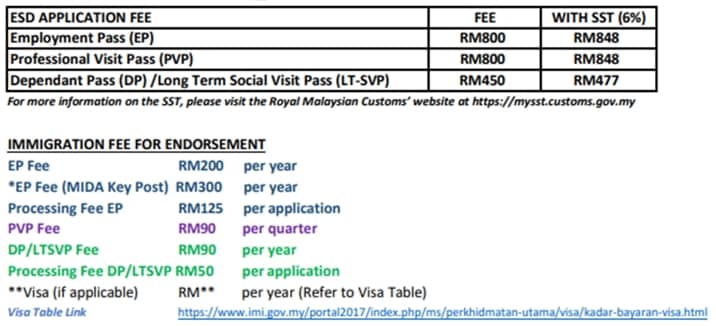
Visa Charges – Journey Performed Visa and Multiple Entry Visa
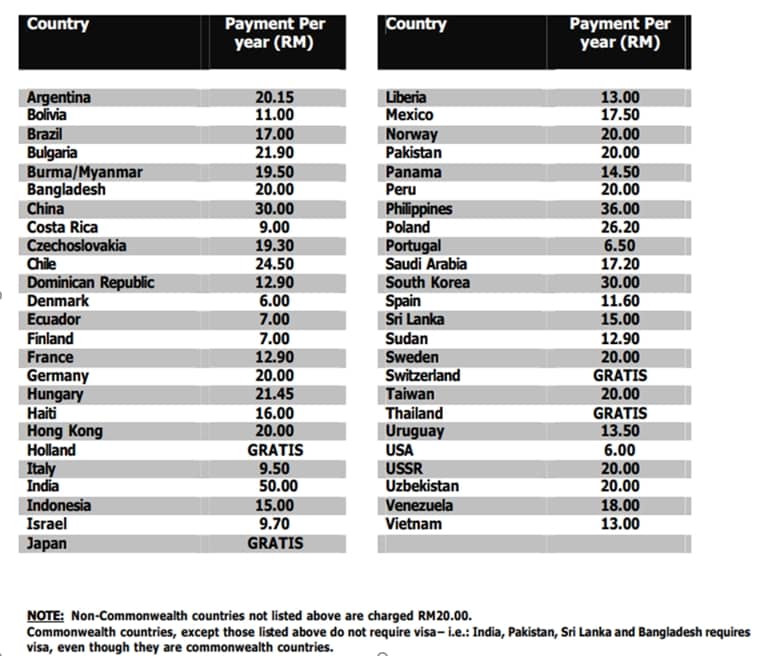
More information – https://esd.imi.gov.my/portal/faq/esd-company-registration/