
Send Email
Blog

Global Employment Tax and Compliance Newsletter. December 2023

Welcome to the final 2023 edition of the Global Employment Tax and Compliance Newsletter. This year has been a journey of discovery and adaptation in the world of global employment, and our 12th edition is no exception. We’ve consistently strived to bring cutting-edge insights and analysis to the forefront, empowering global employment professionals to navigate… Read more Global Employment Tax and Compliance Newsletter. December 2023

7 views 0 Comments

Welcome to the final 2023 edition of the Global Employment Tax and Compliance Newsletter. This year has been a journey of discovery and adaptation in the world of global employment, and our 12th edition is no exception. We’ve consistently strived to bring cutting-edge insights and analysis to the forefront, empowering global employment professionals to navigate the complexities of an ever-evolving landscape.

As we culminate this year’s series, this edition encapsulates the latest legislative updates and reflects on the strides we’ve collectively made in shaping effective global employment strategies. The diverse changes and challenges we’ve examined throughout the year, from tax reforms to visa policies, have enhanced our collective expertise.

Our ambition has always been to transcend beyond mere compliance updates. We aim to provoke thought, foster innovation, and inspire strategic thinking in managing global workforces. The remarkable increase in our LinkedIn community and subscriber base is a testament to the value we’ve created together.

As we enter a new year, we carry insights, experiences, and lessons from 2023. Let’s continue to collaborate, innovate, and elevate the standards of global employment practices.

🇧🇪-🇳🇱 Clarifying Permanent Establishment in Remote Work: New Belgium-Netherlands Agreement

Legislation Adopted

On 23 November 2023, Belgium and the Netherlands ratified a Competent Authority Agreement to interpret Article 5 of their Income Tax Treaty, specifically addressing the impact of remote working on establishing a permanent tax presence.

Key Provisions in a Nutshell

  • Scope of Agreement: Guidelines on how remote working affects the creation of a permanent establishment for taxation. Determining if home-working leads to a permanent establishment is crucial, impacting cross-border employees’ corporate and income tax calculations.
  • Home-Working Scenarios: Differentiation between occasional, regular, and consistent home-working and their impact on establishing a permanent establishment.
  • Practical Guideline: Working from home 50% or less of the time does not constitute a permanent establishment. Over 50% may lead to a permanent establishment, dependent on certain conditions.
  • Effective Date: Applicable from 8 December 2023.

Understanding the Impact

This Agreement marks a crucial development in the growing hybrid work model, offering clarity on tax obligations and permanent establishment related to remote working for cross-border employees between Belgium and the Netherlands.

Implications for Employers & Immediate Actions

  • Policy Review: Assess remote working policies in light of these new guidelines.
  • Tax Compliance: Adjust tax reporting and compliance strategies for employees working remotely.
  • Individual Assessment: Examine the working patterns of cross-border employees to understand potential tax implications under the new Agreement.
  • Ongoing Discussions Monitoring: Stay informed about ongoing discussions between Belgium and the Netherlands, particularly regarding income tax implications for cross-border employees. These talks may lead to future changes that could impact cross-border employment arrangements.
  • Assessment of Permanent Representative Status: The Agreement does not address situations involving a permanent representative. Employers must assess if employees working from home with the authority to conclude or negotiate employment contracts could be classified as permanent representatives. This is crucial as it has significant implications for establishing a permanent establishment and the related tax obligations.

🇨🇿 Czech Republic’s Revisions in Taxation of Employee Stock Plans

Legislation Adopted

The Czech Republic is considering a bill to revise the taxation on employee stock options and shares. Set for potential implementation on 1 January 2024, if passed, the bill is directed at employer-provided stock benefits.

Key Provisions in a Nutshell

  • Scope of the Bill: Adjusts taxation on employee stock options and shares, focusing on those acquired in a business corporation that is the employer or a related entity.
  • Taxation Timing: The amendment specifies when the non-monetary benefit, i.e., employment income from these plans, becomes taxable for the employee.
  • Defined Taxable Events: Includes termination of employment, changes in tax residency, share or option transactions, option exercises, and reaching a 10-year limit from acquisition.
  • Option Type Applicability: The bill’s current form does not specify a distinction between transferable and non-transferable options.
  • Transferable vs. Non-Transferable Options: The amendment does not distinguish between freely transferable and non-transferable options in its current wording.

Understanding the Impact

This legislative change is significant, particularly regarding when and how employee stock options and shares are taxed, affecting both employers and employees, especially in cross-border employment situations.

Implications for Employers & Immediate Actions

  • Review Employee Plans: Examine existing stock options and share plans for alignment with the new taxation rules.
  • Inform Employees: Clearly communicate the changes in taxation timing to employees to help them understand the impact on their income.
  • Legislative Monitoring: Keep track of the bill’s progress to adapt swiftly and ensure compliance.
  • Seek Clarification on Ambiguities: Consult local tax and employment experts to understand how the lack of distinction in option types affects plan administration.

🇨🇾 Cyprus 2024 Update: Social Insurance Contribution Rates Rise

Legislation Adopted

Effective 1 January 2024, Cyprus has mandated an increase in the Social Insurance Fund contribution rates, per the Social Insurance Law of 59(I)/2010 and its amendments.

Key Provisions in a Nutshell

  • Employed Persons: Contribution rates for both employers and employees will rise from 8.3% to 8.8% on insurable earnings.
  • Self-Employed Persons: The contribution rate will increase from 15.6% to 16.6% on insurable earnings.
  • Insurable Earnings Ceiling: For 2024, the maximum insurable earnings are set at €1,209 per week, €5,239 per month, and €62,868 per annum.
  • Contribution to Other Funds: Rates for the Redundancy, Training and Development Funds, along with the Social Cohesion Fund (which has no cap on earnings).

Understanding the Impact

These changes will affect cost projections and budgeting for international assignments to and from Cyprus. Employers must consider these rate increases in payroll adjustments and hypothetical tax calculations, particularly for tax-equalised assignees.

Implications for Employers & Immediate Actions

  • Payroll Adjustment: Update payroll systems to reflect the new contribution rates for both employed and self-employed individuals.
  • Budget Revisions: Revise budgeting for international assignments in Cyprus to account for increased social insurance contributions.
  • Communication: Inform stakeholders, including assignees, about the changes to ensure understanding and compliance.
  • Consultation: Employers and self-employed individuals should seek advice from tax professionals for optimal management of these changes.

Social Insurance Contribution Rates for 2024

FundEmployer RateEmployee RateCap
Social Insurance8.80%8.80%€5,239/mo
Redundancy1.20%€5,239/mo
Training and Development0.50%€5,239/mo
Social Cohesion2.00%No Cap
Total12.50%8.80%

🇸🇰 Slovakia’s Tax Legislation Overhaul Post-Government Change

Legislation Adopted

Following its recent formation, the Slovak government rapidly introduced a tax reform, leading to the passage of the Amendments Act on 19 December 2023. This act revises several existing tax laws, including the Slovak Income Tax Act, and is set for implementation from the start of 2024, pending presidential approval.

Key Provisions in a Nutshell

  • Dividend Income Tax Hike: Tax on dividends rises from 7% to 10% for profits accruing in tax periods beginning 1 January 2024 onwards.
  • Revocation of Tax Exemptions: Specific exemptions on securities sales, company shares disposals, and virtual currency transactions are eliminated.
  • Adjustment in Self-Employed Taxable Income Cap: The threshold for a 15% tax rate for self-employed individuals increases from €49,790 to €60,000.
  • Higher Health Insurance Contributions: Employer health insurance contributions are set to rise from 10% to 11% (5.5% for employing disabled persons).

Understanding the Impact

These rapid legislative developments introduce significant changes in Slovakia’s tax landscape. Employers, particularly those under the Slovak social security regime, and individuals with investment income will face higher taxation.

Implications for Employers & Immediate Actions

  • Prepare for Increased Operational Costs: Factor in the raised healthcare insurance rates in budgeting and payroll.
  • Investment Income Reassessment: Reevaluate the financial impact due to the removal of specific tax exemptions and increased dividend taxation.
  • Policy Revision: Update internal tax-related policies, including for international assignees, to align with the new tax regime.
  • Individual Tax Planning: Advise employees to review their tax situation, especially those with investments affected by the changes.

🇨🇳 China’s Expanded Visa Exemption for Select Countries

Legislation Adopted

China’s Ministry of Foreign Affairs announced an expansion of its unilateral visa exemption policy, effective from 1 December 2023 to 30 November 2024, for travellers from six additional countries.

Key Provisions in a Nutshell

  • Beneficiary Countries: Germany, France, Italy, the Netherlands, Spain, and Malaysia.
  • Eligibility Criteria: Visa exemptions apply to citizens holding ordinary passports visiting for business, tourism, visiting relatives, and transit for up to 15 days.
  • Existing Exemptions: This expansion builds on existing visa exemptions for Singapore and Brunei citizens.

Understanding the Impact

These visa exemptions ease entry into China for short-term stays from the specified countries, promoting business, tourism, and cultural exchanges. However, the duration under visa exemption cannot be extended within China.

Implications for Employers & Immediate Actions

  • Inform Relevant Stakeholders: Update mobile employees, frequent travellers, and students about the new visa exemption opportunities.
  • Compliance: Ensure understanding and adherence to the visa exemption conditions, including duration limitations.
  • Monitor Updates: Stay informed about further immigration policy changes in China and reciprocal visa policies from the affected countries.

Reciprocal Visa Policies

  • France’s Policy for Chinese Citizens: France now offers a five-year multiple-entry visa for Chinese citizens who have completed a master’s degree and at least one semester of study in France.
  • Malaysia’s Visa Exemption for Chinese Citizens: From 1 December 2023, Chinese citizens with ordinary passports are exempted from needing a visa for tourism visits to Malaysia for up to 30 days.
  • China-Singapore Visa Waiver Agreement: An agreement for visa waivers for ordinary passport holders of China and Singapore is under finalisation, with specifics yet to be announced.

🇧🇷 Brazil’s Comprehensive Tax Reform: Impacting Income and Overseas Investments

Legislation Adopted

Brazil’s government has enacted Law No. 14.754/2023, bringing significant changes to the taxation of individual income, including earnings from employment and financial investments abroad, effective from January 1, 2024. This law also includes key reforms in the trust regime and alters the valuation and taxation of foreign assets for Brazilian tax residents.

Key Provisions in a Nutshell

  • Trust Regime Reforms: Introduces important changes to how trusts are handled for tax purposes.
  • Valuation of Foreign Assets: Alters rules for valuing foreign assets held by Brazilian tax residents, impacting their tax liabilities.
  • Broad Tax Treatment Changes: Affects various forms of income, including employment and overseas investments.

Understanding the Impact

The Law marks a significant shift in Brazil’s tax policy, affecting individuals with diverse income sources and investments overseas. The new valuation rules for foreign assets are especially noteworthy.

Implications for Employers & Immediate Actions

  • Inform and Prepare Assignees: Discuss the applicable tax rates, thresholds, exemptions, and changes in the valuation and reporting of overseas assets with new Brazil-inbound assignees.
  • Review Assignment Policies: Employers should reassess assignment policies, considering the increased tax responsibilities and potential impacts on assignees.
  • Seek Expert Guidance: It’s crucial for employers and employees to consult with tax professionals or a Global Mobility Services team to understand the implications and ensure compliance with the new laws.

🇨🇿 Comprehensive Tax and Social Security Reforms in the Czech Republic

Legislation Adopted

The Czech government has enacted significant personal income tax and social security reforms, effective January 1, 2024. These changes come as part of a government consolidation package to address financial imbalances.

Key Provisions in a Nutshell

  • Income Tax Rate Changes: The threshold for a 23% tax rate is lowered, impacting higher earners.
  • Non-Monetary Benefit Limits: Introduction of limits on exemptions for non-financial benefits, including managerial accommodations and meal allowances.
  • Tax Deductions Removed: Removal of specific tax deductions and credits affecting students, families, and union members.
  • Cap on Securities and Share Exemptions: Restriction on tax exemptions for sales of securities and shares, with a new cap set.
  • Social Security Contribution Adjustments: Increase in employee and self-employed contribution rates.

Understanding the Impact

These reforms will likely lead to increased taxation for employees, especially international assignees, and heightened social security contributions, affecting the Czech Republic’s employees and self-employed individuals.

Implications for Employers & Immediate Actions

  • Budget and Policy Adjustments: Employers should reassess their budgeting for assignments and consider revising policies to accommodate increased tax and social security costs.
  • Employee Communication: Clearly communicate these changes to employees, especially those on international assignments, to manage expectations and ensure compliance.
  • Monitor Further Developments: Stay alert to any additional guidance or modifications to these reforms.

🇪🇺 EU’s New Directive on Platform Work: Ensuring Fair Employment Status

Legislation Adopted

The European Parliament and Council reached a provisional agreement on the Platform Work Directive on 13 December 2023. This directive, pending formal adoption, targets improved working conditions for individuals engaged in tasks through digital platforms.

Key Provisions in a Nutshell

  • Employment Status Clarification: Presumption of employment based on certain control indicators.
  • Algorithmic Transparency: Mandated disclosure of algorithmic decision-making impacting workers.
  • Human Oversight in Decision-Making: Requirement for human involvement in significant platform decisions.
  • Data Protection Enhancements: Restrictions on processing sensitive personal data of platform workers.
  • Intermediary Regulation: Measures to prevent circumvention of rules through intermediaries.

Understanding the Impact

The proposed EU Platform Work Directive can significantly transform the platform economy’s landscape. It’s poised to shift the classification of a substantial number of workers from self-employed to employee status. This change isn’t just a label alteration; it has profound implications for taxation and social security contributions. The directive’s reach extends across various segments of the gig economy, notably impacting sectors like food delivery services. With this shift, many individuals operating as independent contractors could gain full employee rights and protections, altering the financial and operational dynamics for workers and platform operators.

Implications for Employers & Immediate Actions

  • Reassess Employment Classifications: Review and update employment status in line with new criteria.
  • Adapt to Transparency Requirements: Revise systems to ensure algorithmic decision-making is transparent.
  • Incorporate Human Review in Decision Processes: Establish procedures for human oversight in critical decision-making areas.
  • Monitor and Prepare for Compliance: Keep abreast of developments and prepare for the directive’s effective implementation.

Additional Considerations

  • Potential Directive Adoption: The directive, likely to be adopted, addresses the employment status of platform workers, with court cases often leading to reclassification from self-employed to employed.
  • Economic Implications: Observations highlight that the directive may align with the financial strategies of certain member states where service provision taxes are less than those for employment. The anticipated shift from self-employed to employed status for many workers could increase overall tax and social security contributions.
  • EU Commission’s Analysis: Over 5 million platform workers might be misclassified, and reclassification could significantly increase state revenues.

🇬🇧 United Kingdom HMRC Releases Guidance on Digital Platform Reporting Rules

New Reporting Obligations for Digital Platforms

HMRC’s updated guidance, detailed in the International Exchange of Information Manual (IEIM), outlines the UK’s implementation of the OECD’s model reporting rules for digital platforms. These new requirements, effective from 1 January 2024, compel UK-based digital platforms to gather and report to HMRC annual income information for sellers providing personal services, selling goods, or renting out property or transport on their platforms. The initial data reporting is scheduled for January 2025.

Compliance for UK and EU Platforms

The guidance is particularly relevant for UK digital platforms that are also active in the EU. These platforms must be aware of their dual reporting responsibilities, as the EU’s Directive on Administrative Cooperation (DAC7) enforces similar rules from 1 January 2023, a year earlier than the UK’s timeline. The first EU reporting deadline falls in January 2024. Platforms operating in both regions should prepare for each jurisdiction’s nuanced requirements and timelines.

🇬🇧 New UK Tax Treaties with Luxembourg 🇱🇺 and San Marino 🇸🇲

Legislation Adopted

The UK has recently ratified new double tax treaties with Luxembourg and San Marino. The UK-Luxembourg treaty, signed on 7 June 2022, and the UK-San Marino treaty, signed on 17 May 2023, have both been formally ratified and entered into force on 22 November 2023 and 30 November 2023, respectively.

Key Provisions in a Nutshell

Understanding the Impact

These treaties are pivotal in preventing double taxation and fiscal evasion and enhancing trade and investment between the UK and these countries. They provide clarity on tax obligations for businesses and individuals engaging in cross-border activities.

Implications for Employers & Immediate Actions

  1. Review International Transactions: Employers with cross-border transactions between the UK and Luxembourg or San Marino should review their structures and transactions to align with the new treaty provisions.
  2. Tax Planning: Consider tax planning opportunities under the new treaties, particularly regarding withholding taxes, capital gains, and corporate taxes.
  3. Update Tax Compliance Protocols: Ensure that payroll and taxation systems are updated to reflect the changes, especially regarding withholding tax obligations.
  4. Communicate with Employees and Stakeholders: Inform employees and relevant stakeholders about how these changes might affect their tax liabilities.
  5. Seek Expert Advice: Consult with tax professionals to understand the detailed implications of these treaties on your business operations.
  6. Monitor Implementation: Keep abreast of how these treaties are implemented in practice, especially in their initial years, to ensure full compliance and to take advantage of potential benefits.

🇺🇸 U.S. Visa Bulletin January 2024: Key Updates

Legislation Adopted

The U.S. Department of State’s January 2024 Visa Bulletin announces significant updates in employment-based visa categories, particularly for EB-1 and EB-3 visas for certain nationalities.

Key Provisions in a Nutshell

  • EB-1: Progression in cut-off dates for China and India.
  • EB-2 and EB-3: Changes in cut-off dates for China, India, and other countries.
  • Other Categories: Adjustments in EB-4, Certain Religious Workers, and EB-5 categories.

Understanding the Impact

These updates reflect ongoing adjustments to the U.S. immigration system, addressing the backlog and demand for employment-based visas. The shift in cut-off dates is a response to changing immigration trends and the need to manage visa allocations efficiently.

Implications for Employers & Immediate Actions

  • Monitoring Visa Bulletins: Employers should closely monitor monthly bulletins for changes affecting their workforce’s visa status.
  • Planning and Compliance: Adjustments may be required in workforce planning and compliance strategies, especially for those employing a significant number of employees from China and India.
  • Communication with Employees: It’s essential to keep affected employees informed about their visa status and potential eligibility or application timeline changes.

Cut-Off Dates for Dates of Final Action Chart for January 2024

This table concisely summarises the cut-off dates for the final action per visa category, as per the January 2024 Visa Bulletin. It’s a helpful guide for employers and individuals planning their visa applications.

Visa CategoryAll Countries (except China & India)ChinaIndia
EB-1CurrentJuly 1, 2022September 1, 2020
EB-2November 1, 2022January 1, 2020March 1, 2012
EB-3 (Professional & Skilled)August 1, 2022September 1, 2020June 1, 2012
EB-3 (Other Workers)September 1, 2020January 1, 2017June 1, 2012
EB-4May 15, 2019
Certain Religious WorkersMay 15, 2019
EB-5CurrentDecember 8, 2015December 1, 2020

🇬🇧 United Kingdom HMRC’s New IR35 Off-Payroll Working Rules Guidance

Legislation Adopted

Key Provisions in a Nutshell

  • Target Audience: Aimed at businesses managing IR35, involving workers who provide services through their own intermediaries. Note: IR35 off-payroll working rules are a set of tax legislation in the UK designed to combat tax avoidance by workers supplying their services to clients via an intermediary, such as a limited company, but who would be an employee if the intermediary was not used. These workers are often referred to as ‘disguised employees’ by HMRC.
  • Structure: The guidance is divided into 14 distinct sections, each detailing aspects of IR35 compliance.

Understanding the Impact

  • Purpose: The guidance is designed to clarify good practices for IR35 compliance, helping organisations understand HMRC’s expectations.
  • Format: Features practical examples of systems and processes deemed effective for adhering to IR35 rules.

Implications for Employers & Immediate Actions

  • Complementary Nature: These guidelines are to be read alongside existing HMRC off-payroll working guidance, not in isolation.
  • Integration with Current Practices: Employers should incorporate the guidance into their existing IR35 compliance strategies.
  • Review and Implementation: Thoroughly review the GfC4 guidelines and integrate the recommended practices for a comprehensive IR35 compliance approach.
  • Ongoing Compliance: Regularly update and refine IR35 compliance processes in line with HMRC’s evolving guidelines and practices.

A-Z Guide to Global Employment

Ready to empower your global journey? Dive into our new A-Z Guide to Global Employment!

From A to Z, we’ve covered it all – from international hiring strategies to visa processes, cultural diversity, and tax reporting. Whether you’re an HR professional, a business owner, or a global executive, this guide is your ultimate resource for success in the global workforce.

  • Explore expert insights on managing a diverse global team.
  • Navigate the complexities of international employment with ease.
  • Leverage the strength of Global EOR for streamlined operations.
  • Achieve compliance, quality, and efficiency on a global scale.

Embracing the Future of Global Employment

As we draw the curtains on this year’s final edition of the Global Employment Tax and Compliance Newsletter, we want to extend our heartfelt gratitude to each one of you. Your engagement, insights, and feedback have been the driving force behind our continuous evolution and success.

Looking ahead, the landscape of global employment continues to evolve at an unprecedented pace. The challenges and opportunities it presents will undoubtedly require us to stay agile, informed, and proactive.

We eagerly anticipate continuing this journey with you in 2024, further expanding our horizons and deepening our understanding of global employment intricacies. Until then, we wish you a successful wrap-up of this year and a fantastic start to the next.


Blog, News

Insights from Ukraine at Forbes Tech 2023

Forbes Tech 2023 in Lviv emerged as a pivotal gathering for business leaders and tech innovators, offering fresh perspectives on technology’s evolving role in these challenging times. The event brought together tech industry leaders and experts to share insights into digital transformation and the challenges and achievements within their sectors. The strategic panels and sessions… Read more Insights from Ukraine at Forbes Tech 2023

17 views 0 Comments

Forbes Tech 2023 in Lviv emerged as a pivotal gathering for business leaders and tech innovators, offering fresh perspectives on technology’s evolving role in these challenging times. The event brought together tech industry leaders and experts to share insights into digital transformation and the challenges and achievements within their sectors.

The strategic panels and sessions at ForbesTech 2023 centred on AI’s transformative impact and its practical applications across various industries, business domains, and everyday life. Amidst the backdrop of war, the conference highlighted the country’s rapid emergence as an innovator in defence technology, reflecting on the vital role of tech advancements.

The discussions illuminated several key trends:

Roman Prokofiev, co-founder of Jooble, emphasised the increasing shift towards continuous learning. He noted that people are currently changing careers approximately 2.5 times in their lifetimes, a rate expected to multiply by 5 to 7 times over the next two to three decades. Roman also reflected on Ukraine’s unique position in the IT sector. ‘We are the IT underdogs,’ he stated, emphasising the extraordinary achievements made in Ukraine despite the challenges.

Vitaly Sedler, co-founder and CEO of Intellias, brought a unique perspective on Ukraine’s role in technology, particularly in defence tech. ‘Ukraine has rapidly emerged as an innovator in defence technology,’ he stated, emphasising the sector’s explosive growth. He further added, ‘Considering our advancements in engineering, I believe we’re on our way to becoming a centre of innovation.’

Oleksandr Konotopskiy, founder and CEO of Ajax Systems, spoke about the significant changes reshaping Ukraine. ‘We’re witnessing tectonic shifts in our country, not just in its demographic composition but in its industrial focus as well,’ he observed. Konotopskiy pointed out Ukraine’s emerging role as a major arms producer, an unimaginable development just two years ago.

Navigating Challenges and Envisioning the Future

In the session titled “First Things First: Challenges, Solutions, Forecasts” at ForbesTech 2023, moderated by Maria Shevchuk, CEO of IT Ukraine Association, Ukrainian tech industry leaders gathered to reflect on the challenging year of 2023 and to share their forecasts for 2024 and beyond.

Our team was inspired by Enkelejd Zotaj, CIO of Raiffeisen Bank Ukraine, after his enlightening session on business digitalisation.

Vitaly Sedler, co-founder and CEO of Intellias, initiated the dialogue with insights into the evolving business environment in Ukraine. He stressed the necessity for businesses to deepen their competencies and innovate to gain new competitive edges.

Oleksandr Konotopskiy, CEO of Ajax Systems, gave a balanced view of Ukraine’s tech future. He sees Ukraine as a rising global innovation hub but admits there are big challenges to overcome. ‘We’re on our way to that status,’ he said, stressing Ukraine needs to look at its global role and attract international talent to become a true innovation hub.

Taras Kytsmey, co-founder and board member of Softserve, then shifted the focus to the interplay between state responsibilities and business roles. He underscored the importance of the state in providing education and businesses in creating employment opportunities and ensuring fair compensation. This, Kytsmey argued, is essential for fostering a sustainable and thriving economic landscape.

The session also featured Volodymyr Krasotin, digital transformation director at the pharmaceutical company Darnitsa, who brought a unique perspective. He humorously introduced Darnitsa as a “well-known IT company that produces medicines,” highlighting the ubiquitous nature of digital transformation across various industries. Volodymyr shared his comprehensive approach to digital transformation, extending beyond his company to include partners and collaborators in shaping the future.

The session concluded by exploring Darnitsa’s approach to handling workforce challenges amid the situation in Ukraine, particularly focusing on its strategy for digital transformation and global hiring practices.

Express Global Employment Solutions for Ukrainian Businesses

In these challenging times, our team at Express Global Employment is dedicated to helping Ukrainian companies navigate the complexities of workforce displacement. We specialise in the Global Employer of Record (EOR) model, which is an essential service for businesses affected by the current situation.

Media Head Iryna Oprya and Sales Manager Dmytro Koshkin from Express Global Employment highlighted the practical ways our comprehensive global employment services are helping Ukrainian businesses adapt and ensure business continuity. Iryna Oprya, shares:


In these challenging times, Express Global Employment serves as a strategic ally to Ukrainian companies with dispersed workforces worldwide. Our Global Employer of Record (EOR) service provides a crucial lifeline, ensuring seamless business continuity and maintaining connections between Ukrainian companies and their global employees.

Express Global Employment solutions are designed to effectively address this issue. We streamline the re-hiring, management, and retention of employees for Ukrainian businesses, even when these workers have had to relocate internationally. Our expertise in handling the complexities of international employment law and administrative processes relieves companies from the burdensome task of establishing their own legal entities in every country where their workforce is now based. Our all-in-one Express Global Employment service is more than just a convenience; it’s a critical component for sustaining business operations.

When key Ukrainian staff members are globally dispersed, Express Global Employment ensures they remain employed and productive within their original Ukrainian companies. This approach is essential in keeping businesses operational and uninterrupted, adapting seamlessly to the workforce’s new geographical distribution. We provide a vital bridge that connects Ukrainian companies with their employees worldwide, maintaining continuity and stability.

Blog

Global Employment Tax and Compliance Newsletter. November 2023

Welcome to our November 2023 Global Employment Tax and Compliance Newsletter. This edition is crafted for forward-thinking employers and global employment solution providers, offering a lens into the latest shifts and trends in the global employment landscape. November 2023 has been a month of pivotal changes and strategic adaptations. The global employment domain continues to… Read more Global Employment Tax and Compliance Newsletter. November 2023

10 views 0 Comments

Welcome to our November 2023 Global Employment Tax and Compliance Newsletter. This edition is crafted for forward-thinking employers and global employment solution providers, offering a lens into the latest shifts and trends in the global employment landscape.

November 2023 has been a month of pivotal changes and strategic adaptations. The global employment domain continues to evolve rapidly from Italy’s revamped expatriate regime to Australia’s innovative pathways to permanent residency and Belgium’s updated salary thresholds. 

These changes, crucial insights from the ILO’s digital employment guidelines, and more are dissected here to provide you with actionable intelligence.

Join us as we navigate these developments, understanding their impact, and exploring strategies for effective compliance and operational agility in the global marketplace.

Thank you for choosing us as your guide in the dynamic world of global employment. Let’s dive in!

Global EOR vs. Local Legal Entity

Explore the “Global Employer of Record vs. Local Legal Entity” Guide

Navigating the complexities of international expansion requires a strategic approach. Our guide, “Global Employer of Record vs. Local Legal Entity,” offers a comparative analysis and strategic insights. It’s an invaluable asset for decision-makers weighing the advantages of an Employer of Record against setting up a local legal entity. Access this essential resource for your global expansion plans here.

🇬🇧 United Kingdom Autumn Statement 2023: Key Updates on National Insurance and Tax Rates

Legislation Adopted

Chancellor Jeremy Hunt’s Autumn Statement, delivered on 22 November 2023, introduces several changes impacting both employees and employers in the UK. Among the most significant is the reduction in National Insurance rates.

Key Provisions in a Nutshell

  1. National Insurance Contributions (NIC): A reduction for employees from 12% to 10% starting 6 January 2024. Employer NIC rates remain unchanged.
  2. Income Tax Rates and Thresholds: No changes have been announced; rates and thresholds remain as previously set.
  3. Scotland and Wales Tax Rates: Updates for 2024/25 to be announced in December 2023.
  4. Self-employed NIC: Class 2 contributions were abolished, and Class 4 was reduced from 9% to 8% from 6 April 2024.
  5. Other Tax Measures: Implementation of Making Tax Digital for Income Tax Self-Assessment in April 2026, abolition of the pension lifetime allowance from April 2024, and adjustments to capital gains and dividend allowances from April 2024.
Tax Category2023/242024/25
Personal Allowance£12,570 (0%)£12,570 (0%)
Basic Rate£0 – £37,700 (20%)£0 – £37,700 (20%)
Higher Rate£37,701 – £125,140 (40%)£37,701 – £125,140 (40%)
Additional RateOver £125,140 (45%)Over £125,140 (45%)

Understanding the Impact

These changes are crucial for employers managing globally mobile employees in the UK. While the overall tax burden in 2024/2025 is expected to remain stable, individuals liable for UK National Insurance will see a noticeable reduction in contributions.

Implications for Employers & Immediate Actions

  • Budgeting: Employers should adjust their financial planning and payroll systems to accommodate the new NIC rates.
  • Communication: It’s vital to inform employees, especially those on international assignments, about these changes and their potential impact on net pay.
  • Compliance: Ensure alignment with the updated tax and NIC rates to maintain compliance and avoid penalties.
  • Consultation: Consider consulting with tax professionals to understand the broader implications of the Autumn Statement on your business operations.

To ensure full compliance with the evolving UK tax landscape, employers should stay vigilant for further announcements, especially regarding Scottish and Welsh tax rates.

🇬🇧UK Introduces Electronic Travel Authorisation for Non-Visa Nationals

Legislation Adopted

The UK government is rolling out an Electronic Travel Authorisation (ETA) requirement for non-visa nationals planning to visit, transit, or enter the UK for short stays, including up to three months as a Creative Worker.

Key Provisions in a Nutshell

  1. ETA Requirement: Non-visa nationals need an ETA before travelling to the UK.
  2. Exemptions and Initial Roll-Out: Irish residents are exempt. Qatari nationals require an ETA from 15 November 2023, with other non-visa nationals following in 2024.
  3. Cost and Validity: An ETA costs GBP 10 and is valid for two years or until the passport expires, whichever comes first.

Understanding the Impact

This change marks a significant shift in the UK’s travel and immigration policy to enhance security and streamline entry processes.

Implications for Employers & Immediate Actions

Inform and Prepare Travellers: Employers should inform non-visa national employees of this new requirement, especially those frequently travelling to the UK.

Plan for Additional Costs and Time: Factor in the ETA cost and application process time into travel plans and budgets.

Monitor Roll-Out Dates: Stay updated on the phased implementation dates for different nationalities in 2024.

🇪🇺EU Takes Action Against Greece and Italy for Non-Compliance with Family Benefits Rules

Legislation Adopted

The European Commission (EC) has initiated infringement procedures against Greece and sent a reasoned opinion to Italy for failing to comply with EU rules on family benefits.

Key Provisions in a Nutshell

🇬🇷Greece: Current laws require EU nationals to reside in Greece for at least five years and non-EU nationals for 12 years to qualify for family benefits.

🇮🇹Italy: Italy’s law, introduced in March 2022, mandates a minimum two-year residence for eligibility for the new family allowance for dependent children.

EU Regulation Violation

Both countries’ requirements contravene EU rules prohibiting residence conditions for social security benefits, including family benefits.

Understanding the Impact

Amendments to these laws in Greece and Italy would be retroactive, allowing mobile workers previously disqualified due to residence requirements to claim family benefits retrospectively.

Implications for Employers & Immediate Actions

  • Monitoring Legislative Changes: Stay informed on Greece and Italy’s legislative responses to the EC’s actions.
  • Advising Mobile Workers: Keep mobile employees updated on potential changes and assist them in filing for retroactive family benefits claims.
  • Compliance Readiness: Prepare for the administrative aspects of supporting claims if legislative amendments occur.

🇮🇪 Ireland Streamlines Stamp 4 Immigration Permission Process

Legislation Adopted

In collaboration with the Department of Enterprise, Trade and Employment, Ireland’s Department of Justice has announced changes to the Stamp 4 immigration permission process, effective 30 November 2023.

Key Provisions in a Nutshell

  1. Elimination of Stamp 4 Support Letter: The need for a Stamp 4 support letter from DETE for certain permit holders will be discontinued.
  2. Direct Application Process: Applications for Stamp 4 immigration permission can be made directly to the Registration Office, ISD.
  3. Eligibility Requirement: Applicants must complete 21 months under an IRP Stamp 1 card in Ireland.
  4. Application Timeline: Applications for Stamp 4 can be submitted 12 weeks before the current IRP Stamp 1 permission expires.

Understanding the Impact

This change simplifies the transition from Stamp 1 to Stamp 4 immigration permission for critical permit holders, making it a single-step process. Stamp 4 permission allows holders to work and live in Ireland without a separate employment permit.

Implications for Employers & Immediate Actions

  • Inform Relevant Employees: Alert employees holding Critical Skills Employment Permits, Researchers on Hosting Agreements, and Non-Consultant Hospital Doctors about the new process.
  • Guide Through Application Changes: Assist eligible employees in understanding the streamlined application process and its timeline.
  • Monitor Application Submissions: Ensure applications are submitted within the new 12-week window before IRP Stamp 1 expiry.
  • Stay Updated on Processing: Keep track of any further updates from the Department of Justice and the Department of Enterprise, Trade and Employment.

🇫🇮 Finland Responds to Security Concerns with Eastern Border Closure

Legislation Adopted

The Finnish government has announced the closure of specific border-crossing points along its eastern border, effective from 18 November 2023 to 18 February 2024, as a security measure against illegal entries.

Key Provisions in a Nutshell

  1. Closed Border Points: Key entry points at Vaalimaa, Nuijamaa, Imatra, and Niirala are closed.
  2. Alternative Crossing Points: Four northeastern border points remain open (Rajajooseppi, Salla, Kuusamo, and Vartius).
  3. Asylum Application Processing: Applications for international protection are now concentrated at Vartius and Salla crossing points.

Understanding the Impact

This closure is a response to the rise in illegal entries, particularly in southeastern Finland. It affects individuals and employees who frequently travel between Finland and Russia, requiring them to adjust to the remaining open border points.

Implications for Employers & Immediate Actions

  • Communicate Changes: Inform employees, especially those frequently travelling or commuting between Finland and Russia, about the border closures and alternative routes.
  • Adjust Travel Plans: Reorganize travel logistics and schedules for employees affected by the closures, considering alternative border crossings.
  • Stay Informed: Keep updated with Finnish government announcements and border security measures, as the situation is subject to ongoing evaluation and potential changes.

🇪🇺 Council of the EU Approves Digitalisation of Schengen Visa Application Process

Legislation Adopted

The EU Council has endorsed new regulations to digitalise the Schengen visa application process, allowing travellers to apply online for visas to the Schengen area, which comprises 27 European countries with minimal internal border controls.

Key Provisions in a Nutshell

  1. EU Visa Application Platform: A centralised platform for Schengen visa applications where applicants can submit data, upload documents, and pay fees.
  2. Reduced In-Person Requirements: In-person consulate visits are mainly required for first-time applicants or those with expired biometric data or new travel documents.
  3. Digital Visa Format: Replacing traditional visa stickers with a cryptographically signed barcode.

Understanding the Impact

This digital transformation streamlines the visa application process, making it more efficient for travellers and national administrations. It enhances the speed and effectiveness of application processing.

Implications for Employers & Immediate Actions

  • Update Travel Policies: Employers should revise their travel policies and guidelines to reflect these new digital visa procedures.
  • Inform Travelers: Communicate these changes to employees who travel frequently to the Schengen area, emphasising the new platform and reducing the need for in-person visits.
  • Monitor Implementation: Stay updated on the rollout and implementation timeline of the new digital visa platform to ensure seamless travel planning.

🇺🇸 United States Advances U.S — 🇹🇼Taiwan Double-Tax Mitigation Bill

Legislation Adopted

The “United States-Taiwan Expedited Double-Tax Relief Act” has been approved by the U.S. House Committee on Ways and Means as of November 30, 2023, signalling a significant step towards resolving double taxation issues between the U.S. and Taiwan.

Key Provisions in a Nutshell

  1. Primary Focus: The bill specifically targets permanent establishment, income from employment, and residency issues to mitigate double taxation.
  2. Bilateral Cooperation Required: The bill’s effectiveness hinges on Taiwan’s enactment of reciprocal legislation.

Understanding the Impact

This legislative move is pivotal in alleviating double taxation challenges for American and Taiwanese tax residents. It aims to streamline cross-border financial activities and provide clarity for businesses and individuals engaged in U.S.-Taiwan exchanges.

Implications for Employers & Immediate Actions

  • Anticipate Taxation Changes: Employers should prepare for potential tax liabilities and compliance changes for U.S. and Taiwanese employees.
  • Advisory Consultation: Consulting with tax professionals is advisable to understand the implications of the bill’s provisions on your organisation’s operations.
  • Inform Stakeholders: Keep relevant stakeholders, especially those involved in U.S.-Taiwan operations, updated on this legislation’s progress and potential impacts.

🇨🇱 Chile Approves Tax Treaty with the 🇺🇸 United States

Legislation Adopted

The Chilean Senate has approved the income tax treaty with the United States, completing its legislative journey. This followed its prior approval by the Chilean Chamber of Deputies.

Key Provisions in a Nutshell

  1. Final Approval: The treaty received final legislative approval on November 15, 2023.
  2. Ratification Process: Awaiting ratification by the President of Chile and the exchange of diplomatic letters between Chile and the U.S.
  3. Expected Enforcement: Anticipated to be in force by January 2024.

Understanding the Impact

The approval of this tax treaty marks a significant development in the economic relationship between Chile and the United States. It is expected to ease cross-border commerce and mobility of employees between the two nations.

  • Double Taxation Mitigation: The treaty aims to alleviate double taxation issues faced by international assignees, enhancing tax efficiency for individuals and businesses.
  • Pension Plan Relief: Potential relief for contributions to pension plans, benefiting globally-mobile employees.

Implications for Employers & Immediate Actions

  • Policy Review: Employers should review their tax and payroll policies for employees working between Chile and the U.S. to align with the new treaty provisions.
  • Communicate Changes: Inform affected employees, especially those on international assignments, about how the treaty may impact their taxation.

🇨🇭Switzerland Upholds Protection for Ukrainians Until March 2025

Legislation Adopted

Following the European Union’s decision, the Swiss Federal Council has extended protection status for Ukrainians until 4 March 2025, aligning with the EU’s temporary protected status.

Key Provisions in a Nutshell

  1. Extension of Protection Status: Switzerland will maintain protection status S for Ukrainian displaced people until 4 March 2025, subject to changes in the situation.
  2. Current Beneficiaries: Approximately 66,000 Ukrainians hold protection status S in Switzerland.
  3. Labour Market Integration: The Federal Council aims to increase the employment rate of Ukrainians from 20% to 40% by the end of 2024.
  4. Cantonal Policy Updates: Cantons will face stricter requirements in utilising federal funding, including providing language support and assessing individual support needs.

Criteria for Discontinuing Temporary Protection S Status

Temporary Protection S Status may not be renewed when there is no longer a significant risk for the individuals upon their return to their home countries. This applies when conditions in their country of origin have substantially and lastingly improved, allowing for their safe repatriation.

Understanding the Impact

This extension provides stability and clarity for Ukrainian citizens and Swiss employers. It ensures continued access to education, labour market opportunities, and language courses for Ukrainians in Switzerland.

🇨🇿 Czech Republic Enacts Comprehensive Personal Income Tax and Social Security Reforms

Legislation Adopted

The Czech Republic has passed new legislation impacting personal income tax and social security contributions. The changes, approved by the president and the Czech Senate, are set to take effect from 1 January 2024.

Key Provisions in a Nutshell

  1. Income Tax Rate Changes: The threshold for the higher tax rate of 23% is lowered to CZK 1,582,812 annually.
  2. Adjustments in Exemptions and Reliefs:
  3. Limits set on non-monetary benefits exemption to half the average wage (CZK 21,983 per year in 2024).
  4. Abolition of the exemption for managers’ accommodations. Restriction on monetary meal allowances and benefits from the cultural and social fund.
  5. Tax Credit Changes: Abolition of certain tax credits, including for students and child pre-school facilities.
  6. Sales of Securities and Shares: Exemptions capped for sales of securities and shares meeting the time test, with an annual limit of CZK 40 million per taxpayer from 1 January 2025.
  7. Other Income Exemption Limit: An annual limit of CZK 50,000 for other income exemptions.
  8. Social Security Contributions: For employees, reintroduction of sickness insurance paid at 0.6%, increasing total contributions to 7.1%. For self-employed persons, an increase in the minimum assessment base and percentage for insurance contributions.

Understanding the Impact

These reforms aim to address financial imbalances in the Czech economy. They will notably impact the taxation of employees, including international assignees, potentially leading to higher taxation and affecting the cost of assignments.

Implications for Employers & Immediate Actions

  • Review Payroll Policies: Employers should update their payroll systems to accommodate the new tax rates and social security contributions.
  • Inform Employees: Communicate these changes to employees, particularly those affected by the altered exemptions and increased tax burden.
  • Tax Planning: Reassess tax planning strategies, especially for tax-equalised assignees, to account for the changes in tax credits and reliefs.
  • Compliance Check: Ensure all practices comply with the new legislation, paying close attention to the revised thresholds and exemptions.

🇧🇪 Belgium Announces 2024 Minimum Salary Requirements for Non-EEA Nationals

Legislation Adopted

Belgium’s Flemish, Walloon, and Brussels Regions have set new minimum salary thresholds for 2024, applicable to non-European Economic Area (EEA) nationals working in these regions.

Key Provisions in a Nutshell

  1. Effective Date: The new salary requirements are enacted on 1 January 2024.
  2. Regional Variations: Each region has specified different salary thresholds for various categories of employees.
  3. Categories and Salary Thresholds:
  •  Highly-Skilled Employees: €50,310 (Brussels, Wallonia); €46,632 (Flanders)
  • Management Personnel: €83,936 (Brussels, Wallonia); €74,611 (Flanders)
  • Intra-corporate Transferee (Specialist): €52,042 (Brussels, Wallonia); €46,632 (Flanders)
  • Intra-corporate Transferee (Trainee): €32,526 (Brussels); €32,327 (Wallonia); €46,632 (Flanders)
  • Intra-corporate Transferee (Management): €65,053 (Brussels, Wallonia); €74,611 (Flanders)
  • EU Blue Card: €65,053 (Brussels, Wallonia); €55,958 (Flanders)
  • Medium-Skilled Employees in Bottleneck Professions: Minimum salary as per the sector (Flanders).

Understanding the Impact

Meeting these minimum salary requirements is crucial for obtaining legal work permits for non-EEA nationals in Belgium. Non-compliance can result in significant penalties, including fines and possible imprisonment.

Implications for Employers & Immediate Actions

Review Salary Structures: Employers must ensure their pay scales meet or exceed these new thresholds for non-EEA employees.

Budgeting: Plan for potential salary increases to maintain compliance.

Stay Informed: Keep abreast of any further regional variations or updates to these requirements.

Risk Management: Understand the consequences of non-compliance and implement measures to avoid legal and financial penalties.

ILO Releases Guidelines for Assessing Digital Employment

Key Document Published:

The International Labour Organization (ILO) has published comprehensive Digital Employment Diagnostic Guidelines for evaluating and understanding the complex nature of digital employment.

Key Provisions in a Nutshell

  1. Purpose of Guidelines: To provide a structured approach for policymakers, researchers, statisticians, and practitioners to assess the impact of digitalisation on employment.
  2. Scope of the Document: Covers various aspects, including data collection, impact measurement, and policy development for decent work conditions in the digital economy.
  3. Research and Collaboration: Developed through extensive research, global consultations, and expert collaboration, including a pilot study.

ILO’s Digital Employment Diagnostic Guidelines: Significance and Strategic Response

  • Awareness and Education: Employers and stakeholders should familiarise themselves with the nuances of digital employment as outlined by the ILO guidelines.
  • Strategic Planning: Utilise the guidelines to inform strategic planning and decision-making in adapting to the digital economy.
  • Policy Implementation: Develop or revise internal employment policies and practices per the guidelines to ensure fair and decent working conditions in the digital employment sector.
  • Data-Driven Approach: Leverage the methodologies suggested by the ILO for accurate data collection and analysis to assess the impact of digitalisation on employment.
  • Collaboration and Consultation: Engage in multi-stakeholder dialogues and consultations to address the challenges and opportunities presented by digital employment.

🇳🇬 Nigeria Announces Increase in Visa-on-Arrival Biometric Fees

Legislation Adopted

The Nigeria Immigration Service (NIS) has implemented an increase in biometric fees for Visa-on-Arrival (VOA) applications.

Key Provisions in a Nutshell

  1. Biometric Fee Increase: A flat rate increase of USD 80 for VOA biometric fees.
  2. Exemption for U.S. Nationals: U.S. nationals are exempt from this fee increase due to the visa fee reciprocity agreement with Nigeria.
  3. New Total Fee: Non-U.S. nationals will now pay USD 170 for VOA, excluding other visa and transaction fees.

Understanding the Impact

This fee increase affects the overall cost for foreign nationals (except U.S. nationals) seeking to enter Nigeria via the VOA program, impacting business travel expenses for individuals and organisations.

Implications for Employers & Immediate Actions

  • Budget Adjustments: Employers should prepare for increased costs associated with sending representatives to Nigeria.
  • Inform Travellers: Update travelling employees about the new fee structure to avoid surprises or delays.
  • VOA Approval Process: Ensure that travellers know the documentation and approval process for VOA, including extensions and associated fees.

🇮🇹 Italy Modifies Expatriate Regime Effective January 2024

Legislation Adopted

The Italian government has announced changes to the expatriate regime, set to take effect from 1 January 2024, as outlined in a new Legislative Decree.

Key Provisions in a Nutshell

  1. Reduced Relief: Relief under the expatriate regime will be limited to 50%, with a maximum income eligibility cap of EUR 600,000.
  2. Residency Requirements: Beneficiaries must have been non-residents for three years prior and commit to a five-year residency in Italy.
  3. Eligibility Criteria: The relief is now restricted to highly qualified or specialised individuals, similar to those eligible for a Schengen Blue Card.
  4. Duration of Relief: The relief applies from the year of establishing tax residency in Italy and for the next four fiscal years.
  5. Condition for Extension: The facility to extend the relief for an additional five years appears to apply only to residents in Italy as of 31 December 2023.

Implications for Employers & Immediate Actions

  • Policy Review: Employers should reassess their assignment policies for Italy, considering the altered tax relief and residency requirements.
  • Employee Briefing: Inform current and potential expatriates about the new conditions and how they might affect their tax liabilities.
  • Eligibility Checks: Establish procedures to ascertain the eligibility of employees for the revised expatriate regime.
  • Tax Planning: Update tax planning strategies for expatriates in Italy to align with the new regime and avoid potential financial surprises.

🇦🇺 Australia Enhances Employer-Sponsored Permanent Residence Pathways

Legislation Adopted

Following a year-long review and consultations, the Australian government has announced changes to its Migration Program, particularly affecting the Temporary Skill Shortage (Subclass 482) Visa and the Employer Nomination Scheme (Subclass 186). 

These changes aim to provide more flexibility and certainty for employers and visa holders, enhancing Australia’s ability to attract and retain skilled workers amid skills shortages.

Key Provisions in a Nutshell

Temporary Skill Shortage (TSS) Visa (Subclass 482) Changes

  1. Removal of the limit on onshore applications under the Short-Term Skilled Occupation List stream.
  2. Previous holders of two Short-Term stream TSS visas must apply outside Australia for a third visa before 25 November 2023.
  3. Onshore renewal is now possible for more than one TSS visa under the Short-Term stream.

Employer Nomination Scheme (Subclass 186) Adjustments

  • Open to all TSS visa streams, including the Short-Term stream.
  • Nominated occupations must be listed in the ANZSCO without requiring skilled migration occupation list assessment.
  • Employment requirement with the nominating employer reduced to two years within the three years before nomination.
  • Age exemptions are modified for regional medical practitioners and high-income earners over 45 years, with a two-year pathway to permanent residence.
  • Certain COVID-19-related age exemptions will be phased out.

Implications for Employers & Immediate Actions

Policy Review: Employers should reassess their immigration and workforce strategies in light of these changes.

Inform and Assist Employees: Update current and potential TSS visa holders about the new application and renewal processes.

Prepare for Permanent Residence Applications: Plan for nominating eligible TSS visa holders under the modified Employer Nomination Scheme.

Stay Updated: Keep abreast of the full details of the changes, especially regarding age exemptions and other adjustments, as they are released.

Tackling Remote Workforce Complexities with Global EOR

Delve into the strategic realms of global employment with our latest guide. This essential resource, tailored for navigating the complexities of international workforce management, is now available. Packed with expert insights, it’s a pivotal tool for businesses expanding globally. Access the Global Talent Acquisition Guide and master the art of global talent acquisition and management with Express Global Employment.

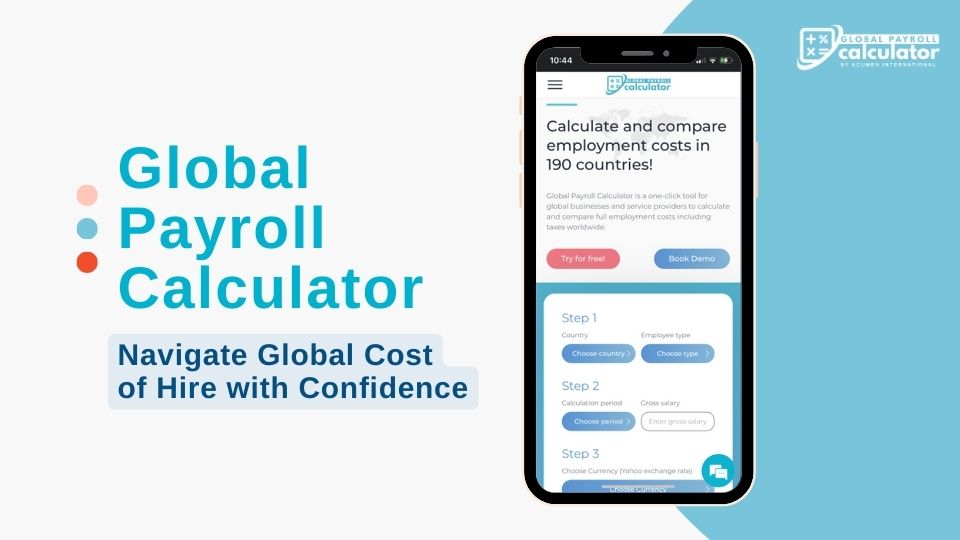
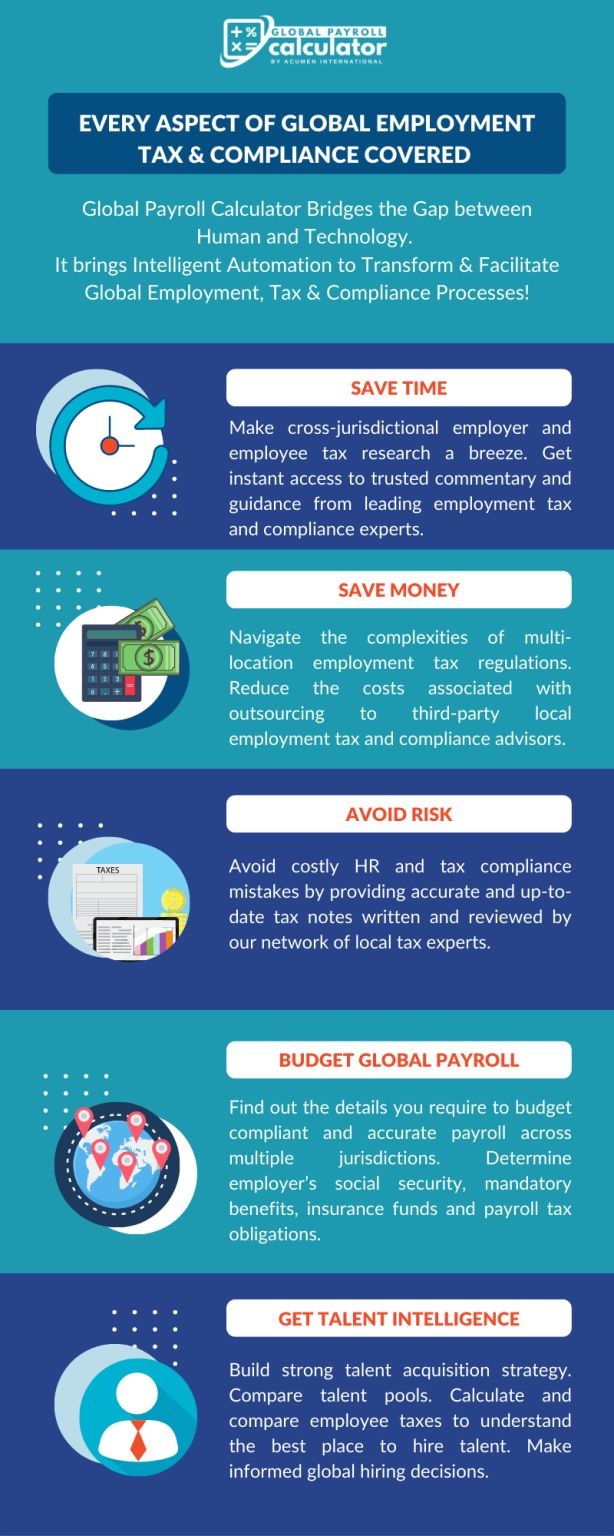
Global Payroll Calculator

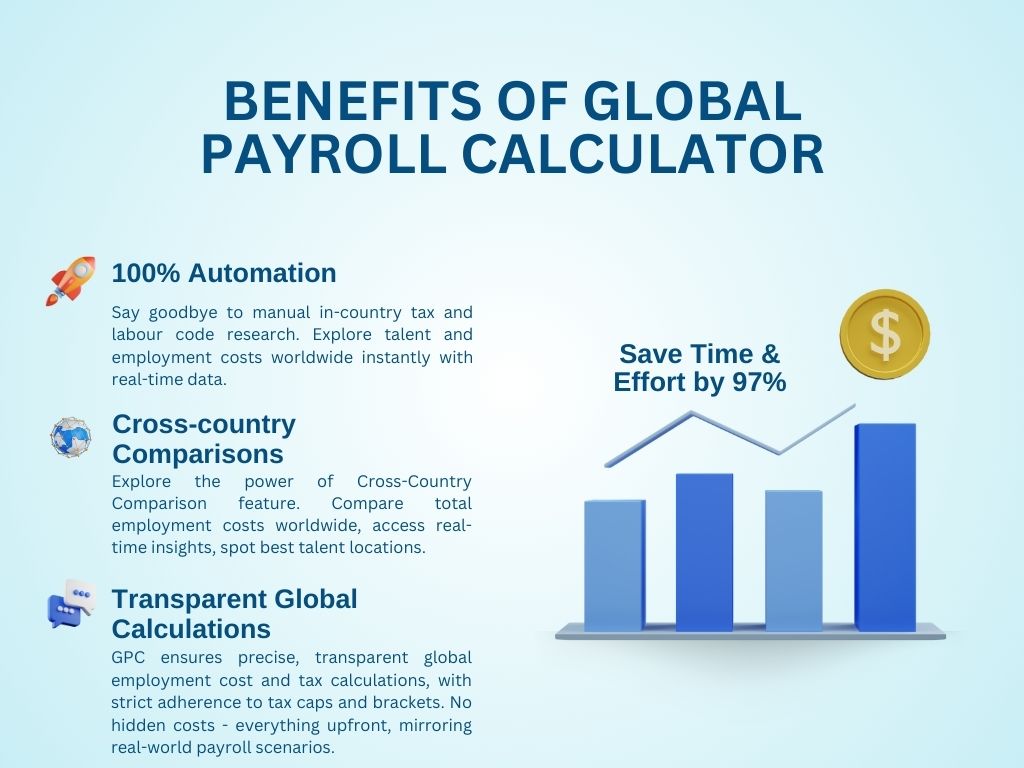
Global Payroll Calculator (GPC) is a game-changer for global employers. It empowers you to benchmark and validate vendor quotes precisely and confidently.

In today’s dynamic business landscape, it’s crucial to ensure that the services and pricing offered by vendors align with real-world payroll scenarios and comply with tax and labour laws. GPC does just that, providing you with accurate and up-to-date employment cost estimates.

With Global Payroll Calculator, you can say goodbye to the guesswork and uncertainty of vendor quotes. Make informed decisions and select vendors that offer the best value without compromising compliance or accuracy.

Watch our latest video to learn how Global Payroll Calculator can transform your global expansion strategy!

Wrap-Up

As we conclude this November 2023 edition of our Global Employment Tax and Compliance Newsletter, we hope the insights and updates provided have been enlightening and valuable in guiding your strategic decisions in the ever-evolving global employment landscape.

We encourage you to reach out with any questions or for further discussions on how these changes might impact your business. Stay tuned for our next edition, where we will continue to bring you the latest and most relevant information on global employment.

Thank you for joining us on this informative journey. Until next time, we wish you successful and compliant business operations in the dynamic world of global employment.

Blog, Sub Blog

Ideas for High Returns on Investment

Technology has come a long way and still has a long way to go in many respects.

“The use of apps in investment ideas is a great way to enjoy the convenience. ”

– Beeige Lunmis

Have you ever thought about a guarantee in which you invest your money and get returns? While people tend to have different ideas on the best ways to invest, some options are now made simpler so that you increase the chances of getting your returns on investment. 

Blog

Test Post 3

Technology has come a long way and still has a long way to go in many respects. It has revolutionised the lives of people all over the world and made life easier in a variety of ways. In the world of business especially, technology has played an undeniable role.

Technology has come a long way and still has a long way to go in many respects. It has revolutionised the lives of people all over the world and made life easier in a variety of ways. In the world of business especially, technology has played an undeniable role.

Blog, News

Test Post 2

Lorem Ipsum… Technology has come a long way and still has a long way to go in many respects. It has revolutionised the lives of people all over the world and made life easier in a variety of ways. In the world of business especially, technology has played an undeniable role.

Technology has come a long way and still has a long way to go in many respects. It has revolutionised the lives of people all over the world and made life easier in a variety of ways. In the world of business especially, technology has played an undeniable role.

Blog, News

Test Post 1

Technology has come a long way and still has a long way to go in many respects. It has revolutionised the lives of people all over the world and made life easier in a variety of ways. In the world of business especially, technology has played an undeniable role.

Technology has come a long way and still has a long way to go in many respects. It has revolutionised the lives of people all over the world and made life easier in a variety of ways. In the world of business especially, technology has played an undeniable role.

Blog, News

How Technology Made Businesses More Efficient

Technology has come a long way and still has a long way to go in many respects. It has revolutionised the lives of people all over the world and made life easier in a variety of ways.

Technology has come a long way and still has a long way to go in many respects. It has revolutionised the lives of people all over the world and made life easier in a variety of ways. In the world of business especially, technology has played an undeniable role.

Blog, News

Data Secure on Transitioning to a New Office

It is far wiser to do your own installations and ensure that all data flowing through the organization has end-to-end encryption. …

It is very exciting moving into a new office because it often means that your business is expanding or moving up in class to attract high end clients. Whatever the reason it is absolutely critical to keep in mind the necessity of protecting your business data not just for your sake but also for the sake of your employees and clients who have placed their trust in you.

Blog

Global Employment Tax and Compliance Newsletter. October 2023

Welcome to the October 2023 edition of the Global Employment Tax and Compliance Newsletter. This month, we have curated a selection of topics at the forefront of regulatory shifts and strategic planning across the world. We’re thrilled to announce that our newsletter now reaches 993 subscribers. Your trust motivates us to keep delivering precise and… Read more Global Employment Tax and Compliance Newsletter. October 2023

11 views 0 Comments

Welcome to the October 2023 edition of the Global Employment Tax and Compliance Newsletter. This month, we have curated a selection of topics at the forefront of regulatory shifts and strategic planning across the world.

We’re thrilled to announce that our newsletter now reaches 993 subscribers. Your trust motivates us to keep delivering precise and actionable insights to help you navigate the complexities of international employment, tax, and compliance.

Whether you are an employer adjusting to newly minted regulations or a global employment solutions provider, this edition aims to equip you with the insights you need for operational excellence in a dynamic environment.

🇮🇹Italy Announces Work Visa Quotas for 2023–2025

Overview

In a recent development, the Italian government has published a decree outlining the number of non-EEA workers allowed in the country for the period of 2023 to 2025. The cap is set at 450,000, with 136,000 quotas allocated for 2023 alone. This has important implications for organisations planning their staffing strategies in Italy.

Key Dates

  • Quota Announcement: 27th September 2023
  • Official Gazette Publication: 3rd October 2023

Application Timelines

  • Cooperative Agreement Countries: Subordinate work permit applications from 9am, 2nd December 2023
  • Other Subordinate Work: Applications from 9am, 4th December 2023
  • Seasonal Work: Applications from 9am, 12th December 2023

Quota Categories

The 136,000 quotas for 2023 are distributed as follows:

Seasonal Work: 82,550 quotas, focused on agriculture and the hospitality and tourism sectors, reserved for certain nationalities.

Subordinate & Self-Employed Work: 53,450 quotas, further broken down as 52,770 for employee work and 680 for self-employment.

Specific Nationalities: 25,000 quotas for nationals of designated countries, including Albania, Egypt, and India, among others.

Cooperative Agreement Countries: 12,000 quotas reserved for future cooperation agreements.

Special Categories: Specific quotas for Italian ancestry holders in Venezuela, stateless persons, refugees, family care and support services, and more.

Strategic Considerations

Planning ahead in line with these quotas can significantly streamline your immigration and staffing strategy in Italy.

🇪🇺EU Extends Temporary Protection for War-Displaced Ukrainians Through March 2025

Overview

The European Council has agreed to extend temporary protection status for Ukrainians displaced by the ongoing war in their homeland. Initially activated on 4 March 2022, this status has now been extended through 4 March 2025, providing clarity and assurance for both affected individuals and their employers within the EU.

Key Extension Details

Extended Duration: From 4 March 2024 to 4 March 2025

Governing Directive: EU Directive 2001/55/EC

Eligibility: Specific to Ukrainians displaced on or after 24 February 2022 due to military actions.

Why Matters

This decision has immediate and significant consequences:

  • Labour Market Access: Individuals with this temporary status can work in the EU immediately.
  • State Benefits: Includes access to social welfare, housing, healthcare, and education.
  • Employer Assurance: Businesses employing these individuals can plan better, knowing their staff have secured status through March 2025.

Categories Covered

The directive covers:

  • Ukrainian Nationals: Those residing in Ukraine before the war began on 24 February 2022.
  • Stateless and Third-Country Nationals: Who had protection in Ukraine prior to the war.
  • Family Members: Of both the above categories.

Future Considerations

The temporary protection is slated to end in March 2025. Discussions are ongoing about subsequent steps, and organisations should stay alert for updates that may impact staffing strategies.

🇬🇧United Kingdom Issue Updated Travel Advisories for Israel

Overview

In the wake of escalating conflicts between Israel and Hamas, the United Kingdom has updated the travel advisories concerning Israel. To safeguard their citizens, government-supported flights have been organised for the repatriation or relocation to safe third countries of U.K. nationals currently in Israel.

State of Emergency

The U.K. government has announced that a state of emergency is in effect across Israel. Unexpected border closures, both air and land, are a possibility in Israel and the Occupied Palestinian Territories (OPTs).

U.K. Advisory

The U.K. government has updated its travel advice and is requesting British nationals currently in Israel to inform the government and to comply with plans for their safe exit from the country.

Why It’s Important

  • Security Concerns: The situation is volatile and sudden changes in operational conditions can occur.
  • Corporate Responsibility: Companies with employees who are U.K. nationals, or third-country nationals, currently in Israel should be vigilant regarding updates in government policies related to safety and travel.
  • Communication Is Key: It’s crucial for employers to communicate the next steps to their workforce in Israel and to implement emergency plans to ensure their safety.

Key Points to Note

  • No reported closures of consular offices or embassies.
  • Israelis can use a valid foreign passport for travel until 31 December 2023.
  • Work permit applications may face delays due to staffing shortages at Israel’s immigration authorities and consulates.
  • Israelis have visa-free entry to Schengen countries for a maximum of 90 days in any 180-day period. The legality of remote work during this period should be verified country-by-country.
  • As the situation remains fluid, it’s advised to watch updates from travel agents, immigration counsel, and global mobility professionals for the most current information.
  • Operations continue at Ben Gurion Airport, though passengers should be aware that some commercial flights have experienced delays or cancellations.

🇦🇺Australia – U.K. Innovation and Early Careers Skills Exchange Pilot (IECSEP)

Overview

The Innovation and Early Careers Skills Exchange Pilot (IECSEP) is an initiative designed to offer short-term employment opportunities in Australia for innovative and early-career professionals from the United Kingdom. This programme is part of the Australia-United Kingdom Free Trade Agreement (A-UKFTA).

Initially, there will be 1,000 visas made available during the first-year pilot of the IECSEP. This allocation will double to 2,000 visas in the second year, at which point the programme will also be reviewed.

Two Key Streams

  • Early Careers Stream

Age: 21-45 years

Qualifications: Tertiary education required

Work Experience: At least 3 months in the current organisation

Duration: Up to one year in Australia

  • Innovation Stream

Age: No age limit

Expertise: Must demonstrate innovative contributions

Sectors: R&D, Renewable Energy, AI, Medical Tech, etc.

Duration: Up to three years in Australia

Application Steps

  • Initial Endorsement: Apply to the Department of Foreign Affairs and Trade (DFAT) for an initial endorsement. Submit employment proof and additional documents based on your stream.
  • Letter of Support: If endorsed, DFAT issues a Letter of Support.
  • Visa Application: Submit the Letter of Support when applying for the Temporary Work (International Relations) Government Agreement stream (subclass 403) visa.
  • Eligibility Factors
  • Financial Self-Sufficiency: Must demonstrate financial ability to support oneself and accompanying family.
  • Health & Character: All applicants and families must meet standard requirements.
  • Processing Timelines: DFAT processing times to assess IECSEP applications are currently unavailable.  Current processing times for the subclass 403 visa, following lodgement with the Department of Home Affairs, are estimated to be 11 days.

OECD Update on International Tax Reform Provided to G20 Finance Ministers (October 2023)

Understanding the Latest Multilateral Convention by the OECD/G20 Inclusive Framework on International Taxation

Highlights

The OECD/G20 Inclusive Framework on Base Erosion and Profit Shifting has released a new Multilateral Convention. This marks a significant step toward the finalisation of the Two-Pillar Solution, designed to tackle tax issues emerging from the digitalisation and globalisation of the economy.

Overview

The Multilateral Convention to Implement Amount A of Pillar One (MLC) is the latest development from the OECD/G20 Inclusive Framework, aiming to align international tax policies with 21st-century realities. It will soon be discussed at a meeting of G20 Finance Ministers and Central Bank Governors in Morocco.

What MLC Achieves

  • Reallocation of Tax Rights: Pillar One focuses on reallocating taxing rights over profits to market jurisdictions, targeting large multinational corporations (MNEs) irrespective of their physical presence there.
  • Elimination of Digital Services Taxes: The MLC works toward repealing and preventing the proliferation of digital services taxes.
  • Mechanisms Against Double Taxation: It also establishes systems to avoid double taxation, contributing to stability and certainty in international taxation.

Ongoing Discussions

There is a broad consensus on most aspects of the MLC. However, a few issues are still under negotiation among a small number of jurisdictions, who are constructively working to resolve them.

Financial Implications

Pillar One is expected to affect about USD 200 billion in profits annually, leading to global tax revenue gains of between USD 17-32 billion. Low and middle-income countries stand to benefit the most from this redistribution.

Developments on Pillar Two

  • Subject to Tax Rule (STTR): This treaty-based rule allows developing countries to “tax back” certain intra-group payments taxed at nominal rates below 9%.
  • Global Minimum Tax: Pillar Two introduces a universal minimum tax of 15% on large MNEs, irrespective of where they operate.

Closing Remarks

The release of the MLC is a monumental step in modernising international tax law. It aligns closely with the Two-Pillar Solution’s objectives to tackle tax complexities arising from globalisation and digitalisation. OECD Secretary-General Mathias Cormann calls it a “fundamental reform” in making international taxation fairer and more relevant in today’s digital age.

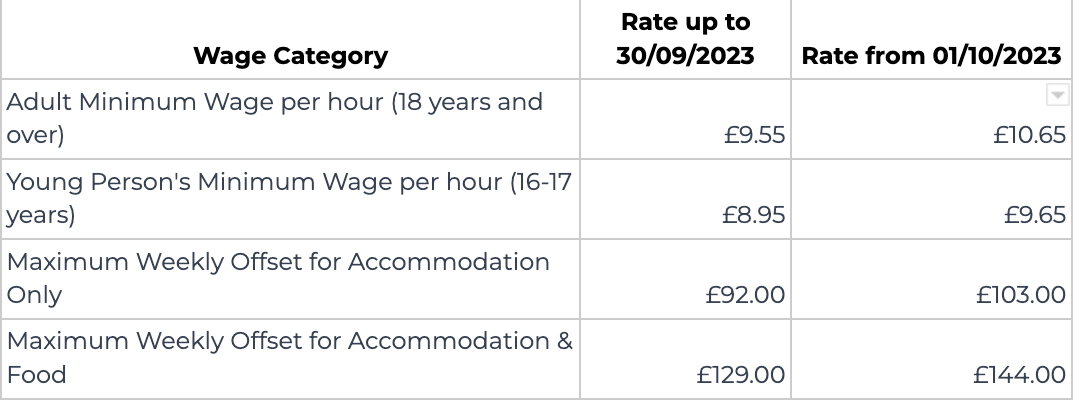
🇬🇬New Statutory Minimum Wage Rates in Guernsey Effective from 1 October 2023

Effective from 1 October 2023, Guernsey has updated its statutory minimum wage rates for adults and young persons. These changes also include adjustments to the maximum weekly ‘offset’ rates for accommodation and food provided by employers.

Additional Information

Entitlement: Under Guernsey Law, almost all workers are entitled to a minimum wage. The rules apply uniformly regardless of business size or if a private individual employs the worker.

🇬🇧Navigating Employment Practices Under UK Competition Law: CMA Guidance

Introduction:

The UK’s Competition and Market Authority (CMA) has outlined how competition law impacts employment practices, specifically regarding wage-setting and employee recruitment and retention. The advisory is aimed to help employers stay on the right side of the law.

Risky Behaviours in Labour Markets

  • No-poaching Agreements: Employers should avoid agreements that promise not to recruit from each other’s staff pools.
  • Wage-fixing Agreements: Any form of collusion with other businesses to set a standard rate for employee wages is considered illegal.
  • Information Sharing: The disclosure of sensitive employment conditions between businesses can be a violation of competition law.

Preventive Measures

To avoid breaking the law, the CMA recommends that employers:

  • Understand the applicability of competition law on no-poaching and wage-fixing agreements.
  • Educate HR and recruitment staff about competition law.
  • Implement robust internal reporting mechanisms.

Consequences for Violation

Fines can amount to as much as 10% of a business’s global annual turnover. Individuals may also face penalties, including imprisonment for up to 15 years.

Reporting

The CMA encourages reporting of anti-competitive behaviours and offers leniency options, including reduced fines and immunity from prosecution under certain conditions.

🇳🇱Dutch Senate Turns Down ‘Work Where You Want’ Act

The Dutch Senate has rejected the ‘Work Where You Want’ Act a year after its approval by the Dutch parliament. Despite its dismissal, current law mandates employers to consider requests for remote work, as outlined in the existing Flexible Working Act.

What Was the ‘Work Where You Want’ Act?

The rejected bill aimed to strengthen employees’ rights to work remotely within the European Union. If enacted, employers would have been required to permit remote work, so long as the request aligned with reasonableness and fairness, considering all involved circumstances.  

Ambitions of the Rejected Bill

The bill, formally known as the Act Working Wherever You Want, had the ambitious goal of revolutionising workplace flexibility. It was crafted to compel employers to accommodate requests from employees wishing to work remotely within the EU. The requirement for employer compliance hinged on a set of nuanced criteria, namely the balance between employer interests and employee needs, evaluated against a framework of reasonableness and fairness.

Reasons for Senate Rejection

Despite its transformative aims, the Senate struck down the bill, citing multiple concerns. The legislative body argued that the bill’s prescriptive nature would corner employers into an inflexible operational model, hampering their ability to manage business activities effectively. The Senate also questioned the potential adverse effects on employee productivity and workplace morale if the bill were enacted.

Government Commitment to Remote Work Flexibility

Despite the setback, the Dutch government has reaffirmed its commitment to enhancing remote work options. In a recent statement, it declared a vested interest in simplifying remote work conditions for employees while maintaining managerial effectiveness for employers.

Recommendations for Employers

The act could have had far-reaching implications for Dutch businesses. Employers would need to consider foreign employment law and navigate complex tax and social security issues, especially if employees sought to work from other countries. Despite the act’s rejection, employers should still assess workplace adjustment requests as per the Flexible Working Act. Employers should formulate a clear hybrid working policy, including guidelines on how to handle remote work requests.

Spooktacular Feature: Navigate the “Haunted House” of Global Employment with Laughter!

This Halloween, take a break from the ghouls and ghosts to dive into a different kind of adventure—the labyrinth of global employment! If you’ve ever felt navigating international employment laws is like walking through a haunted house 👻, you’ll love our featured video, “Global Employment Adventure: The Fun & Frustration Comedy!”

From the tricks of payroll budgeting in foreign currencies 💱 to the threats of making sense of complex employment laws, this comedy video tackles it all. Think hiring contractors is the magic potion for avoiding complexity? Think again! Misclassifying workers can lead to a real witch-hunt.

But don’t fret; our video introduces you to Express Global Employment, your guiding light 🌟 for compliant and headache-free global expansion.

Watch and learn how to make your employment journey more treat than trick 🍬!

Global Employment Adventure: Fun & Frustration Comedy

Wrapping Up This Spooktacular Edition 🎃👻

As we draw the curtains on this Halloween edition of our newsletter, we’d like to extend a big thank you for joining us on this global employment adventure 🌍🎬.

We hope the insights and resources we’ve shared, including our feature video, have been enlightening and entertaining.

As the nights grow longer, remember: global expansion doesn’t have to be a haunting experience. Armed with the right information, you can turn any challenge into an opportunity 🌟.

So, here’s to a Halloween filled with more treats than tricks and to a global employment journey that’s more sweet than spooky! 🍬👻

Blog

Global Employment Tax and Compliance Newsletter. September 2023

Welcome to the September 2023 Global Employment Tax and Compliance Newsletter edition. This newsletter is tailored for employers operating across jurisdictions and global employment solution providers who play a pivotal role in their success. In the dynamic landscape of global employment, governments worldwide aim to enhance, streamline, harmonise, and customise labour, tax, and immigration laws… Read more Global Employment Tax and Compliance Newsletter. September 2023

16 views 0 Comments

Welcome to the September 2023 Global Employment Tax and Compliance Newsletter edition. This newsletter is tailored for employers operating across jurisdictions and global employment solution providers who play a pivotal role in their success.

In the dynamic landscape of global employment, governments worldwide aim to enhance, streamline, harmonise, and customise labour, tax, and immigration laws to align with the evolving needs of their populations and adapt to global trends, such as the rise of remote work. This ongoing process unfolds as employers navigate the complexities of international employment, seeking agile solutions to meet compliance requirements and an ever-changing workforce’s demands.

This edition focuses on the latest developments in employment tax, labour, and immigration laws that emerged by September 2023. Each country’s spotlight dissects these changes, examines their implications for employers, and provides actionable steps for compliance and operational excellence.

Whether you are an employer seeking clarity on a new regulation or a global employment solution provider looking to enhance your client services, this newsletter is designed to meet your needs. 

Poland: Home Office and Permanent Establishment (PE) Concerns 🇵🇱

Legislation Adopted

Polish tax authorities (PTA) and administrative courts have recently addressed the risk of creating a Polish permanent establishment (PE) by a Polish employee working in a home office model. This issue has led to key developments in Polish tax regulations.

In recent individual tax rulings, the PTA has argued that an employee’s private home address, when used as a consistent place of work, could be deemed a fixed place of business at the disposal of a foreign enterprise. This interpretation hinges on the intent to work from home regularly. Additionally, the PTA is actively pursuing PE exposure under the dependent agent concept, especially when Polish employees are involved in contract negotiations, offer presentations, or marketing functions on behalf of the enterprise.

Why It Matters

Understanding the implications of home office arrangements on PE status in Poland is crucial for foreign enterprises. This interpretation by the PTA and supported by recent court judgments underscores the material risk of Polish PE exposure for businesses employing Polish workers.

Implications for Employers & Immediate Actions

  • Businesses should exercise caution when allowing employees to work from home regularly.
  • Employers should consider home office arrangements’ potential tax and legal implications.
  • It’s essential to assess the role of Polish employees in contract-related activities and marketing functions.
  • Seek professional advice to ensure compliance with evolving tax regulations and mitigate PE risks in Poland.

Read our Guide on Preventing Permanent Establishment Risk

United Kingdom: Immigration and Nationality Fee Increases 🇬🇧

Legislation Adopted

Legislation was introduced in the UK Parliament on September 15, 2023, paving the way for a series of immigration and nationality fee adjustments scheduled for October 4, 2023.

Key Provisions

These fee adjustments, ranging from 15% to 20%, impact various visa application fees and Certificate of Sponsorship fees in the UK.

The UK government’s decision to increase these fees is a response to the recommendations of independent pay-review bodies, accepted following the Public Sector Pay debate in Parliament. This decision includes raising visa and Immigration Health Surcharge (IHS) fees to support public sector pay rises.

Why It Matters

For employers recruiting and employing foreign nationals in the UK, these fee increases affect multiple immigration and nationality “routes,” encompassing individuals coming to the UK for work, study, and residence.

Assessing the impact of these fee hikes on recruitment, talent acquisition, and budgetary considerations is essential for employers.

Implications for Employers & Immediate Actions

Employers should evaluate the financial implications of the fee increases on their recruitment and talent management strategies.

Considerations include budget adjustments to accommodate higher immigration and nationality fees and potential effects on workforce planning.

Keep a close eye on forthcoming increases to the Immigration Health Surcharge (IHS) and prepare for potential changes in autumn.

Further Details

The fee adjustments, effective from October 4, 2023, vary based on visa categories, with the IHS increases scheduled for later in the autumn due to the associated legal process.

Impacted visas include those for short stays (up to 6 months), longer-term visits (2-, 5-, and 10-year visas), work, study, and residence. The changes also affect fees for indefinite leave to enter or remain, travel documents, health and care visas, Certificate of Sponsorship, and more.

Be aware of adjustments to priority service fees and reduced fees for the “settlement priority” service. Individuals seeking British citizenship through registration and naturalisation and users of the User Pays Visa Application service will also encounter fee changes.

U.S.-Taiwan Tax Relief: A Step Towards Cross-Border Harmony  🇺🇸 – 🇹🇼

Legislation Adopted

On September 14, 2023, the U.S. Senate Committee on Finance unanimously passed the U.S.-Taiwan Expedited Double-Tax Relief Act, marking a significant development in cross-border taxation.

Key Provisions

This bipartisan bill aims to mitigate double taxation challenges faced by American and Taiwanese tax residents while addressing permanent establishment and residency issues.

It contains a critical reciprocity clause, requiring Taiwan to enact reciprocal legislation to activate its measures.

Why It Matters

The bill promotes cross-border commerce, relieving businesses, investors, and workers of international tax complexities. Including the reciprocity clause ensures fairness in tax treatment for U.S.-based companies and individuals investing and working in Taiwan.

Implications for Employers & Immediate Actions

Employers engaged in cross-border activities between the U.S. and Taiwan should closely monitor this legislation’s progress.

If the bill becomes law, businesses operating in these regions should be prepared to adapt their tax strategies to benefit from reduced double taxation.

Italy Extends Remote Work Provisions 🇮🇹

Effective July 2023, Italy has extended remote work provisions to provide support and flexibility to specific groups of employees:

Vulnerable Employees

Individuals suffering from specified illnesses or conditions are now entitled to work remotely or be assigned different duties based on their job until 30 September 2023. A list of these conditions can be found in the Decree of the Minister of Health from 4 February 2022.

Parents with Children Under Age 14

Parents with children under 14 whose job duties allow remote work can continue working remotely until 31 December 2023. This provision applies when no parent is available to care for the child. Parents who are unemployed or receiving income support benefits are considered available for this purpose. Unlike the 2022 regulations, these parents must not sign an individual remote work agreement.

Labour Law Compliance Requirements

Employers must provide these employees with health and safety information annually. Additionally, they must inform the Ministry of Labor about which employees will be working remotely.

Czech Republic’s ‘Digital Nomad’ Program: Simplifying Work Visas 🇨🇿

The Czech Republic has launched a ‘Digital Nomad’ program, effective from July 1, 2023, to facilitate the entry and stay of highly-skilled IT professionals from specific countries, including Australia, Japan, Canada, South Korea, New Zealand, the United Kingdom, the United States, and Taiwan.

What Employers and IT Professionals Should Know

Previously, digital nomads faced a conundrum when seeking visas to work remotely from the Czech Republic. The absence of a dedicated visa category meant relying on business visas, which often didn’t align with the nature of their work. This led to frequent rejections from Czech authorities due to insufficient justification for their stay or non-compliance with stringent conditions.

The ‘Digital Nomad’ program seeks to simplify the entry and work processes for specific worker categories, aligning them more accurately with their intended purpose of stay. The new program aims to streamline this process.

Changes and Aims of the Digital Nomad Program

The program differentiates between two types of digital nomads: those employed by foreign companies working remotely through telecommunications and computerised means and self-employed freelancers holding a Czech trade license.

In both cases, IT specialists must demonstrate a higher education degree in natural sciences, engineering, technology, mathematics, or three years of relevant IT experience. Additionally, they need to prove a minimum income equivalent to 1.5 times the gross annual salary in the Czech Republic.

This initiative ushers in a new era of economic migration in the Czech Republic, providing a streamlined pathway for IT professionals to contribute their skills while embracing the flexibility of the digital age.

France Enhances Bereavement and Parental Leave 🇫🇷

The French government has recently made significant amendments to the Labor Code, focusing on government-paid bereavement and parental leave. These changes, which took effect on 19 July 2023, aim to support employees during challenging times better.

Bereavement Leave

Government-paid bereavement leave after losing an employee’s child has been extended. Parents with children under 25 now receive 14 days of leave, while parents aged 25 years or older are entitled to 12 business days. This extension acknowledges the diverse needs of parents facing this difficult situation.

Leave for Child’s Diagnosis

The government-paid leave that can be taken following the diagnosis of a child’s disability or serious health condition, such as cancer or neuromuscular diseases, has also been extended. This leave, designed to support parents in managing medical and administrative matters, has increased from two to five business days. It complements the current compassionate leave, which can go up to 310 working days.

Teleworking and Flexible Arrangements

The new law grants working parents the right to request teleworking and flexible working arrangements. While employers can refuse these requests, such refusals must be justified in writing.

Next Steps for Employers

Employers are encouraged to review these changes and ensure compliance by adjusting their HR internal policies, employment agreements, company-level collective bargaining agreements, and family-related benefits and policies as necessary. It’s essential to stay informed and adapt to these enhancements in leave provisions.

European Commission Proposes Digitalization of EU Social Security Coordination 🇪🇺

Legislation Adopted

On September 6, 2023, the European Commission unveiled a dedicated Communication proposing advancements in the digitalisation of social security coordination within the European Union (EU). The primary objective of this proposal is to streamline access to cross-border social security services, making the process faster and more straightforward.

Why It Matters for Employers

The digitalisation of EU social security coordination aims to alleviate administrative burdens linked to social security for individuals and businesses. This initiative is expected to enhance information exchange between national administrations, including healthcare providers and labour inspectorates, especially when processing claims for benefits across borders.

Implications for Employers & Immediate Actions

Companies with employees who frequently travel across EU countries for business or leisure should consider revising or establishing compliance processes for social security. One key point of the digitalisation effort is the issuance and verification of documents like A1 certificates for social security coverage.

Proposed Key Measures

The European Commission has called upon member states to take several actions:

  1. Accelerate EESSI Implementation: Ensure full operation of the Electronic Exchange of Social Security Information (EESSI) by the end of 2024. EESSI facilitates instant cross-border communication between local administrations, reducing reliance on paper-based communication.
  2. Digitalise Access to Benefits: Deliver more social security coordination procedures online, simplifying access to eligible benefits for individuals and businesses.
  3. Introduce EUDI Wallets: Implement EU Digital Identity (EUDI) wallets, enabling EU citizens to carry digital versions of entitlement documents such as A1 certificates and the European Health Insurance Card, instantly verifying them by local authorities.

Employee Benefits Guide

Unlock the world of employee benefits with our ‘Employee Benefits Guide for Global Employers.‘ This resource is your compass for understanding and optimising employee benefits on a global scale.

UK Announces Tripling of Penalties for Employers and Landlords on Illegal Migrants 🇬🇧

Legislation Adopted

On August 7, 2023, the U.K. Home Secretary unveiled plans to triple fines for employers and landlords who knowingly hire or house illegal migrants in the United Kingdom, effective early 2024.

Key Provisions

This announcement is a significant step in the government’s efforts to combat illegal employment and housing of migrants. Minister for Immigration Robert Jenrick emphasised the need for proper checks, stating, “There is no excuse for not conducting the appropriate checks.”

Why It Matters for Employers

Businesses employing overseas nationals in the U.K. will face substantially increased penalties for hiring illegal workers. The consequences include larger fines, potential downgrading or revocation of their sponsorship licenses, and damage to their reputation as offending employers’ details will be made public by the Home Office.

It’s essential to note that illegal workers encompass employees, business travellers, students, and others working in violation of their visa conditions. To mitigate these risks, robust compliance systems must be in place, including conducting thorough pre-travel due diligence and correct right-to-work checks.

Implications for Employers & Immediate ActionsCurrent PenaltiesPenalties Effective 2024
Employers Hiring Illegal WorkersUp to £15,000 per illegal worker (First Offense)Up to £45,000 per illegal worker (First Breach)
Up to £20,000 per illegal worker (Repeat Offenses)Up to £60,000 per illegal worker (Repeated Offenses)
Landlords Housing Illegal Lodgers or Renting Illegally£80 per lodger or £1,000 per occupier (First Offense)£5,000 per lodger or £10,000 per occupier (First Offense)
£10,000 per lodger and £20,000 per occupier (Repeated Offenses)

Action Steps for Employers

Employers must prioritise compliance with the Home Office right-to-work checking requirements. This includes conducting proper checks on all prospective employees before employment begins and retaining relevant information in the prescribed format.

Ensuring compliance with these measures is essential to avoid the significant penalties associated with employing illegal workers in the U.K.

Employment Contracts Guide

We’re excited to introduce our ‘Employment Contracts Guide for Global Employers.’ This invaluable resource is designed to assist HR professionals, legal teams, and business leaders in understanding the intricacies of employment contracts across different jurisdictions.

Inside this guide, you’ll find:

🌍 Insights into key elements of employment contracts, including terms and conditions, termination clauses, and more.

Whether you’re expanding your workforce into new territories or simply seeking to enhance your understanding of global employment practices, our Employment Contracts Guide is an indispensable tool.

Conclusion

As we conclude this September 2023 edition of our Global Employment Tax and Compliance Newsletter, we hope that the insights and updates provided have been valuable in navigating the ever-evolving landscape of employment laws and regulations around the world.

As we look ahead to the final months of 2023, we encourage you to reach out to our experts for personalized guidance on specific compliance challenges your organization may face. We’re here to support your global employment needs, offering solutions that empower your business to succeed.

Thank you for choosing Express Global Employment as your trusted partner in global workforce management. We look forward to continuing this journey together and assisting you in achieving your international employment goals.

Stay compliant, stay competitive, and stay connected with Express Global Employment.

🚀 Get Express Quote Today: https://bit.ly/47bskpY

Blog

Global Payroll Calculator for Global Business Expansion

As businesses venture into international markets and consider employing a global workforce, they often grapple with the complexities of calculating payroll across multiple jurisdictions. Different countries have distinct laws, regulations, and tax-reporting frameworks, creating a labyrinth of challenges for companies. Express Global Employment has developed an innovative solution to facilitate global expansion: Global Payroll Calculator.… Read more Global Payroll Calculator for Global Business Expansion

14 views 0 Comments

As businesses venture into international markets and consider employing a global workforce, they often grapple with the complexities of calculating payroll across multiple jurisdictions. Different countries have distinct laws, regulations, and tax-reporting frameworks, creating a labyrinth of challenges for companies. Express Global Employment has developed an innovative solution to facilitate global expansion: Global Payroll Calculator. This tool streamlines international expansion by accurately computing the in-country employment costs for local and expatriate staff in over 190 countries.

Utilising the calculator is straightforward. Enter the essential information, such as the target country, tax year, payment frequency, and expected gross salary and currency for the prospective employee. The tool immediately provides a comprehensive breakdown of the payroll calculations. This includes anticipated employer contributions, standard deductions for the employee, and additional notes tailored to the chosen settings within the calculator.

Designed for diverse professionals, the Global Payroll Calculator is an invaluable asset for companies aiming to globalise their operations or those of their clients. It caters to various sectors, including International HR, Global Recruitment and Staffing Agencies, global talent and HR professionals, Global Employers of Record, Global PEOs, global mobility companies, compensation and benefits specialists, executive search consultants, department heads, financial and budgeting experts, and business owners.

Global Payroll Calculator: Budget Your Global Payroll Accurately

Global Employment: Payroll Challenges & Employer Obligations

Operating a business in foreign markets comes with unique human resources challenges, unlike anything you may have encountered in your domestic markets. Factors such as national health care, work visas, work permits, compliant employment contracts, and risks of unfair dismissal claims can vary significantly from country to country. Understanding these issues is critical to successfully expanding your business into new markets.

When expanding your business into overseas markets, you’ll need to consider your talent engagement strategy carefully. Depending on international and local regulations, you may use local hires, ex-pats, independent contractors, full- and part-time employees, or a mix for your business. Different countries have different employment practices, so research what would work best for your company. Remember that your home country’s practices may not apply in other countries. 

Challenge 1: Overseas Employment Contracts

Maintaining accurate employee documentation is critical, as the lack of it could result in unwittingly getting slapped with penalties and fees. When drafting employee contracts, it is crucial to seek legal advice to ensure that they comply with host-country labour laws. In many countries, an employment contract must be written in a language other than English. While a cost may be associated with having a translation, the contract written in the host country’s language will take precedence.

Challenge 2: Employee Misclassification Risk

As an employer, knowing the employment laws and regulations of the country you are doing business is crucial. This is especially true when classifying workers as independent contractors or employees. Independent contractors may seem like a cost-effective solution for businesses. Still, companies should be aware that local authorities in many countries may deem them de facto benefits-eligible employees. Misclassifying a worker can result in significant fines and damage your company’s reputation. This can result in significant fines and reputational damage, so it’s important to ensure you are clear on the legal distinctions between contractors and employees before hiring anyone and budget for full-time employees under host-country laws to avoid those penalties.

Challenge 3: Tax Protection Policies for the Global Workforce

The costs of sending employees on overseas assignments can quickly add up, often totalling two to three times the employee’s salary in their home country. Many businesses establish tax protection policies to alleviate personal tax burdens and attract and retain top international talent. These policies can be complex and costly to manage. 

Challenge 4: Budgeting Immigration Cost

International business travel can be an excellent opportunity for employees to broaden their horizons and gain new skills. However, it can also be a logistical nightmare for employers.

Cross-border employee relocation can be a costly and time-consuming process. Planning and budgeting for immigration, relocation expenses, and allowances are essential to ensuring a smooth transition for all involved.

Challenge 5: Budgeting Termination Cost

As an employer operating globally, you must know the laws and regulations regarding employee rights in different countries. Depending on the country, there may be different rules regarding termination of employment, severance pay, and collective bargaining agreements. In some Western European countries, for instance, terminating an employee can cost up to 12 to 18 months of severance. Global employers must plan for this possibility when budgeting for international talent acquisition.

Challenge 6: Budgeting Employee Payroll and Benefits

As more and more companies expand their operations overseas, they are often surprised to learn that the costs of employee benefits can be much higher in foreign countries than at home. Different countries have different laws regulating payroll, extending beyond the typical health insurance contributions, statutory withholdings, and other benefits that can take a big bite out of a company’s bottom line when operating in a new country.

Local labour, tax, and social security laws may also come into play.  This can be a significant burden for companies operating in multiple countries. 

Challenge 7: Budgeting Taxable Voluntary Benefits 

As an overseas employer, you may be required to offer additional compensation in salary increases, profit sharing, holiday payments, bonuses, car allowances, and more. These voluntary benefits can significantly impact your employment contracts, compensation structure, and payroll operations.  

Depending on the country where you operate, these benefits may be taxed under different schemes than regular salary. Therefore, reviewing and understanding these benefits is essential to ensure compliance with local and international laws and regulations. For employers, it’s often a matter of getting the budget right: how much can you afford to pay for each of these perks?

This is where the global payroll budget comes in. It takes into account every single employee, every payroll period, and every benefit. You should be able to get a rough estimate of the figures involved without too much effort—but it’s worth getting advice from a payroll advisor or a Global Employer of Record if you need a more detailed breakdown.

Challenge 8: Budgeting Paid Time Off 

In today’s economy, being mindful of your company’s payroll budget is more important than ever. Unexpected costs can add up, such as employee vacation and overtime pay. In many countries, employees are entitled to several vacation days and paid time off each year.  When you factor in public holidays, paid time off in some countries in Western Europe can come to nearly two months per year for each employee, plus additional time off for overtime worked. Sick leave benefits can also be a considerable cost for employers operating in multiple jurisdictions. In other countries, for example, employees can collect 70 per cent of their salary for up to 105 weeks of sick leave.

Payroll Budgeting Solution: Global Payroll Calculator 

How is your global talent compensation policy competitive, and how much will it cost? Global Payroll Calculator (GPC) is a SaaS tool that can help you do this. 

Global Payroll Calculator provides a more intelligent way of global talent acquisition and compensation. With detailed data on employer and employee taxes and contributions in 190 countries, Global Payroll Calculator gives users a complete picture of total employment costs. With high accuracy, no hidden costs, and 100% compliance around the world guaranteed, the GPC tool enables users to make intelligent, fast, and informed decisions about locating their businesses or acquiring talent.

So whether you are an employer with a foreign, local, or hybrid workforce that spans multiple countries, an Employer of Record, PEO, or an agency (service provider) assisting with international staffing and recruitment, you can use the Global Payroll Calculator to get accurate worldwide payroll budgeting data and cross-country comparisons in 190 countries. The Payroll Calculator is a valuable resource to get the job done right.

Global Payroll Calculator by Acumen International has been named the Payroll Innovation Award winner for 2022 by the Global Payroll Association. Don’t let the uncertainties of international tax compliance and exposure to foreign labour laws sidetrack your global expansion plans.

Blog

Boundless Hiring: Nick Ganzha’s Vision for Global Employment

To see further than others and act purposefully and confidently to achieve the goal is Nick Ganzha’s roadmap to success. From an early age, he admired the boundlessness and freedom of the Ukrainian nature, and today, his company, Express Global Employment (Acumen International), allows others to be boundless in their global growth and expansion. His… Read more Boundless Hiring: Nick Ganzha’s Vision for Global Employment

7 views 0 Comments

To see further than others and act purposefully and confidently to achieve the goal is Nick Ganzha’s roadmap to success. From an early age, he admired the boundlessness and freedom of the Ukrainian nature, and today, his company, Express Global Employment (Acumen International), allows others to be boundless in their global growth and expansion. His international talent acquisition and management organisation, Express Global Employment, provides global HR and employment solutions that enable companies to hire overseas personnel easily and risk-free (in compliance with all legal norms) without establishing their own legal entities in each country. Global Employer of Record Solutions changes the way companies operate internationally. 

The Birth of a Global Employment Industry Pioneer

Nick Ganzha’s business journey began with a Ukrainian staffing and recruitment agency in 2001 when a request came in from Procter & Gamble. The task was challenging because, at that time, the concept of personnel outsourcing didn’t exist in Ukraine. However, Nick had a strong background thanks to his experience at PricewaterhouseCoopers and Accenture, and he created a business model that helped to win the client. As a result, Nick Ganzha is considered the pioneer of staff outsourcing projects in  Ukraine. 

In fact, what started as a local company has grown into a leading global Employer of Record Solutions provider, operating in 190 countries worldwide.

“Serving our clients, I recognised that companies expanding globally need a trusted partner who could help them navigate the complexities of global employment, tax, and compliance. The critical factor that has contributed to the success of Express  Global Employment over the years was my decision 12 years ago to internationalize our business. The journey  continued with a simple yet powerful idea: to help  businesses achieve global growth.” 

From Local to Global

By 2012, Acumen International covered 33 countries where Ganzha’s team provided a complete employment cycle in compliance with local labour legislation. And by 2017, it had already grown into  Express Global Employment, covering 190 countries. 

It was exciting and challenging as the company built its global network. Nick maintains that international business is always difficult and risky,  but with a trusted partner, it turns gratifying. 

We Are the Uber of the Global Employment Industry

And Nick Ganzha loves facing challenges. Today,  his company is a powerful organization that enables businesses of any size, budget, or growth stage to operate anywhere in the world via global personnel hiring: “Employ based on skills, not on geography. The whole world is now your talent pool,” he says. “It’s vital for businesses to expand their limits to become successful. Finding the right people is crucial for your company’s success. Don’t let your city or country  boundaries limit your talent pool.” 

One of the factors that makes Nick’s company stand out is that they excel in exotic countries, areas that are either underserved or hard to operate in. 

We have a well-established infrastructure in these countries, a global knowledge base, and we can provide services there. This is our strength,”  he says. He highlights that this factor enables the company to build partner relationships with competitors: “Express Global Employment offers a very robust and integrated Global EOR solution that even our competitors come to us when they need excellent global HR and compliance support in the most underserved or hard to hire locations. 

Nick Ganzha invested much of the company’s efforts,  time, and money in gaining expertise and creating a  global knowledge base. It was a future-focused investment, so they would be prepared to face any challenges.  “A successful person stands out from the rest by being  ready to seize opportunities when they arise.” 

Express Global Employment provides unique services and tools, such as allowing companies to officially onboard and payroll staff in any of 190 countries within 3-10 working days. Thanks to their Express services, clients can start operating worldwide almost immediately without establishing their own business entities. 

Global Payroll Calculator

Moreover, the company has created the innovative  Global Payroll Calculator that allows businesses to instantly estimate total employment costs across countries to compare and assess various market entries easily. The Calculator was innovative and won the prestigious GPA Award 2022  for Payroll Innovation. In addition, GPA recognized  Acumen International as the 2020 PEO (Professional  Employer Organization) of the Year. 

The Global Payroll Calculator is a SaaS tool by Express Global Employment that the company has been developing for almost four years. Express Global  Employment developed its Global Payroll Calculator covering 190 countries to simplify their sales and service teams’ lives and the daily payroll calculations they make for clients to foster their efficiency. With this, the company streamlined its order-taking and quote formation, making Express Global Employment a client of themselves. “The best possible quality test and success story ever, self-evaluated”, is their tag-line.  Today, offering the Calculator to a global audience,  Ganzha’s team helps clients automate the way they get  their global payroll calculations, providing them with instant insights to:  

• Make informed decisions about global hiring;

• Save time & cost on cost-of-hire estimation in 190  countries; 

• Allocate budgets for planned global expansion –  easily comparing the cost-of-hire in 190 countries  and choosing the best to expand their business; 

• Attract top global talent, regardless of location:  attractive job offers with employees’ net take-home salary calculations. 

Innovating the Future of Global Employment

Gradually, Nick’s ideas drew like-minded individuals to work with him, resulting in a powerful team that helps to develop the company – and Express Global Employment is always on the lookout for new talent. Nick says, “When new people come, they bring fresh perspectives, innovative ideas, and a gust of change.” The company’s headquarters is in London, the UK, with a global operations centre in Nicosia, Cyprus. The company also has offices in Ukraine, Estonia, and the United States. Express Global Employment is pioneering in the global employment industry, transforming how international business and hiring are conducted. Today, its solutions support their clients’ global expansion strategies via international talent acquisition and management and
revolutionize the global HR and payroll field in 190 countries. Nick Ganzha aims to realize his ideas, helping others experience greater freedom.

International business is always challenging and risky, but with a trusted partner it turns very rewarding. We are your reliable partner in ensuring compliant global talent management in 190 countries. 

A Beacon of Corporate Social Responsibility: From Childhood Dreams to Global Impact

Since childhood, he has strived to achieve something remarkable and seemingly unmeasurable, inspired by the great Ukrainian pasture in front of his grandparents’ country house in the Poltava region. Today, Nick Ganzha dreams of peace in Ukraine and helps to bring Victory closer through his unwavering support of Ukrainians during these challenging times. Along with his company, Nick has donated over $200,000 and will continue to donate until the Victory is achieved. What started as Nick’s personal drive has now transformed into the collective engagement of the entire Express team, showcasing their corporate social responsibility as a business before the Ukrainian people and the entire free world.

Since February 24, 2022, Express Global  Employment has been assisting Ukrainian and international companies in retaining the talents that were forced to leave Ukraine due to the full-scale russian invasion. With the company’s solid global  HR solutions, their client companies can continue to legally employ and pay their employees abroad without establishing a physical office. Thus,  they prevent the loss of key personnel, ensure business continuity, and avoid project breaks.  

The Victory of Ukraine is inevitable, as the entire  Ukrainian nation stands for it, and Nick Ganzha strives to represent this through his business and his life. He is a Ukrainian who is changing the perception of what is possible, globalising business and uniting the world. 

This article was initially featured in the book Top USA Entrepreneurs with Ukrainian Origins.

Further Reading: The Global Employer of Record: Ukraine’s Beacon in Turbulent Times

Blog

The Ultimate Guide to EOR, PEO, and GEO

Global Employment Solutions — EOR, PEO, and GEO. How to Mix and Match Them What are the key differences between an EOR, a PEO, and a GEO? This Ultimate Guide to EOR, PEO, and GEO provides a brief overview of some critical differences between three of the most popular global employment solutions helping you decide which option… Read more The Ultimate Guide to EOR, PEO, and GEO

15 views 0 Comments

Global Employment Solutions — EOR, PEO, and GEO. How to Mix and Match Them

What are the key differences between an EOR, a PEO, and a GEO? This Ultimate Guide to EOR, PEO, and GEO provides a brief overview of some critical differences between three of the most popular global employment solutions helping you decide which option is best for your company. 

Acumen International provides an easy guide to give you the confidence that your company will have success expanding globally and is ready for global expansion and international workforces. This Global Employment Solutions Guide will tell you what to expect and how to navigate the challenges and help you create an effective global employment strategy. With our Global Employment Guide, companies can avoid common pitfalls and set themselves up for success in their new venture.

EORs, PEOs, and GEOs are global employment solutions that help companies hire and retain talent around the globe faster and more efficiently. Each operates differently and suits a unique set of hiring and business needs. Each solution has advantages and disadvantages, making it better suited for specific business strategies. 

Your company needs to grow its global presence, and you’re wondering how you can do it without risking your current business model, resources, and capital.

Hiring employees worldwide is a big responsibility, so some businesses choose to engage talent through third parties. You could try to go it alone and hire an international team from scratch. Or, you could partner with a professional employment organization, such as PEO (Professional Employment Organization), GEO (Global Employment Organisation), or EOR (Employer of Record). Payroll, HR, legal, and immigration processes are often complex for businesses, but these third-party options can take the administrative burden off companies. So why might a business want to hire through one of these solution providers?

The Ultimate Guide to EOR, PEO, and GEO global talent engagement models covers different aspects. It briefly overviews some critical differences between PEOs, EORs, and GEO — three of the most popular hiring solutions helping you decide which model fits your company best. Finally, it outlines Acumen International’s service portfolio— from the initial planning stages to the implementation of any employment model.

Get Express Quote

9 Steps to Help You Navigate Through Global Expansion Journey

  1. Determine Your Global Expansion Strategy
  2. Building a Global Expansion Team
  3. Choose the most business-friendly and cost-effective countries
  4. Determine the most effective mode of entry, keeping the ease of exit in mind.
  5. Determine the right talent engagement model
  6. Develop a robust global talent acquisition strategy. Find an experienced and reliable partner
  7. Compliantly hire local and foreign talent in multiple jurisdictions
  8. Create Global HR Compliance and Employment Risk Management Strategies
  9. Maintain reliable talent management systems. Adhere to local labour laws and HR compliance regulations.
  10. Global Talent Retention Programs.

7 Global Employment Challenges to Consider

If you’re thinking about expanding your operations to a global level, you’ll want to consider all the details that go into that decision. That includes everything from choosing the most cost-effective country and the right entity type to preparing for business challenges across borders. Choosing a location that works with your overall strategy and offers lower taxes could be one way to help improve profitability.

As you prepare to expand internationally, it’s crucial to understand how each factor impacts the overall success of your business. Here are some global expansion challenges.:

  1. Every country in the world has its own set of unique laws for businesses.
  2. The legislative and regulatory landscape is ever-evolving. Keeping track of changes is cumbersome.
  3. Global HR Compliance (labour, tax, immigration) laws are ever-evolving and hard to track.
  4. Need to understand the local labour market to hire compliantly and risk-free.
  5. Need to understand local employment and business practices.
  6. Need to understand local competition and benchmark against standard business practices
  7. Working with different languages, time zones, customs, and cultures

No matter which countries you expand to or what type of operation you open, there are some significant issues you will always have to deal with. 

Global expansion decisions come with a lot of moving parts. The decision to expand internationally can significantly impact your business, so it’s essential to make sure you handle it correctly.

3 Options for Multi-jurisdiction International Employment

Businesses establishing a global presence face the challenge of managing and scaling an employee base with no common borders or language. To successfully expand abroad, companies have several options for enabling hiring in international markets. 

There are six key things to consider when choosing an employment method for your company’s global expansion:

  1. Budget and time frame
  2. Tax implications
  3. Compliance
  4. Employment liability
  5. IP protection
  6. Asset acquisition.

The most commonly used ways are by doing the following: 

  1. Overseas Permanent Establishment (a representative office, a branch, a subsidiary, and other foreign legal entity types )
  2. Selecting independent contractors to handle tasks remotely.
  3. Work with a global EOR (Employer of Record) and GEO (Global Professional Employer Organisation) Partner. 

Employer of Record: What, Why, How, and When?

What Is an Employer of Record (EOR)?

A professional employer organization (PEO) helps businesses by taking on many employee responsibilities and liabilities. This includes payroll, compensation, benefits administration, and employment taxes. A PEO allows businesses to outsource their human resource functions and focus on their core competencies while accessing their needed workforce.

Why Use an Employer of Record Solution?

Now, more than ever, startups and large corporations alike are struggling with how to hire remote employees and scale their teams globally without running into local labour and tax laws. Employers of Record can help companies achieve their goals while avoiding these legal and HR compliance risks – foreign specialists and knowledge workers fill positions as a service, which gives companies flexible access to talent without hiring them directly.

An Employer of Record (EOR) can also provide a registered entity for running a local, compliant payroll, managing payroll taxes, benefits, deductions, and employee information. An EOR can advise the client on the host country’s required notice periods, termination rules, and severance pay.

An Employer of Record (EOR) like Acumen International can take on all of the responsibilities of hiring an employee for you, including the legal and bureaucratic hurdles, and manage the entire employment process.

The EOR is solely responsible for paying salaries and benefits to employees and ensuring compliance with the host country’s local labour and employment laws. All HR aspects related to hiring an employee abroad are handled by an Employer of Record, which means that the client company does not have to establish a subsidiary or branch office in the target country where it needs to place its employees or contractors. EORs facilitate immigration policies, permits, and work visas for both employers and employees, depending on the conditions of the engagement.

What Services Does Employer of Record (EOR) Provide?

Summing up, the employer of record usually handles part of BPO services, particularly human resources-related issues regarding global remote personnel. These issues include but are not limited to:

  • Payroll management;
  • Compliance with local tax rules (file & deposit) of the country where the EOR company is located;
  • Handling employment contracts: 
  • Background, education, and other checks; 
  • Onboarding and termination processes, as well as employee’s compensation;
  • Arranging visas and work permits for employees;
  • Ensuring the working process is organized under local labour laws;
  • Processing workers’ medical insurance and other benefits (day-offs, bonuses, and more);
  • Process maps, employment guides, and other documentation.

What Services Does an Employer of Record Not Provide? 

On the other hand, here are the services not included in EOR solutions:

  • Quality control of employees’ work and their promotion;
  • Decisions regarding contract termination and compensation, except for legal document processing;
  • Project management.

Who Can Use EOR Services? 

An EOR can be hired by any company that wants to expand internationally but does not want to establish a legal entity abroad due to time constraints or high costs associated with setting up an office abroad. International businesses without subsidiaries may also use this service if they hire only one employee abroad for specialized roles, such as business development managers who scout for new business opportunities in foreign markets or sales directors who manage sales teams working remotely from other countries. 

Companies that want to hire contractors outside their home jurisdiction can also use employers of record to handle contractual obligations such as compensation packages, tax or benefits administration, and immigration permits required by employees worldwide.

Get Express Quote

Benefits of Using an Employer of Record

1. EOR Allows to Skip Incorporation and Avoid The Pitfalls of Setting Up a Local Subsidiary

So you can’t be bothered with local incorporation in your target countries. There is no need to go through the hassle and expense of setting up a local entity via incorporation and registration when you can utilize an Employer of Record. The EOR already has a legal entity that can handle all aspects of payroll, employment, and immigration requirements in the host country, negating the need for your company to do so. In addition, the EOR has the network and in-house expertise to ensure full compliance with local labor laws and regulations, making it the best choice for handling these matters.

2. No Immigration Compliance Issues

Immigration compliance is a top concern for multinational companies. With constantly changing immigration policies and increased scrutiny from foreign governments, it is essential to maintain compliance to avoid legal consequences. 

If you want to avoid the hassle and stress of constantly changing immigration laws and regulations, consider using a GEO solution with a local EOR. The EOR eliminates any risks associated with remote payroll, overuse of business visas, or multiple entries into the country. The EOR takes care of all work permit and visa requirements, ensuring a hassle-free experience with no complications from immigration authorities.

3. EOR Runs Local Payrolls in The Host Country

As an employer, it is crucial to follow local standards for running payroll and withholding deductions for pensions, health insurance, and taxes. Assigning employees abroad requires setting up a registered entity in the host country to comply with these regulations. The EOR can help ensure a smooth transition for employees.

EOR Solution by Acumen International: Global Employment Done Right and Fast

Acumen International’s EOR solution lets customers tap into the local workforce without setting up a new office or bank account. Acumen will take care of the employee onboarding, payroll, and compliance with local tax laws and regulations, freeing customers to focus on the employee’s day-to-day tasks. 

Our global employment cost estimation technology, coupled with our global presence, experience in managing global payroll & local compliance and immigration regulations, and knowledge of local benefits and taxes, allows our clients to optimize the management of their extended workforce. Acumen’s global  EOR services are delivered leveraging a single global platform that ensures data accuracy across all countries of operation.

Get Express Quote

Drawbacks to Using an Employer of Record

A few potential drawbacks to using an EOR may depend on a company’s employment needs and business strategy. Despite the advantages, companies should be aware of these potential limitations before deciding whether or not to use an EOR.

1. It May Not Be Suitable for More Than 10 Employees or Generating over 100K in Sales

A company expanding into a new country may find that an EOR is not the best solution for more than 15 employees. It may consider incorporating an entity and hiring local experts to help manage the payroll process. In that case, the EOR may only be an interim solution to get employees hired quickly.

Suppose you plan on hiring foreign workers to provide services or generate sales over $100,000 annually in any country. In that case, you should consider setting up an overseas subsidiary or branch office. Doing so will help to mitigate the risk of permanent establishment.

2. Employers Give Up Control of Host Country Payroll Process

Many employers are reticent to cede control of payroll processes in the host country to a local EOR, although this is purely for administrative reasons. This may be a completely novel concept against conventional business thinking regarding direct employment for some companies. While it may be a new concept for some companies, using a local EOR can provide greater business flexibility and freedom. 

3. Indirect Relationship between Company and Its Employee

The company relies on the EOR to handle claims since the employment contract is between the EOR and the employee rather than between the company and the employee. While the company does have the rights under its agreement with the employee, these rights are secondary.

Impersonal

PEOs can give your business the personalized attention and care needed to thrive. However, many PEOs are large companies that serve thousands of small businesses. This means that your company and employees could potentially get lost in the shuffle. When looking for a PEO, choose a company that treats its clients right — and gives them the tools, support, and services they need to grow their business. Remember, you always have the option to cancel your services if unsatisfied.

PEO (Professional Employer Organisation): What, Why, How, and When?

What is PEO (Professional Employer Organisation)?

A professional employer organization, or PEO, is a company that provides human resource management services and managed solutions to small, mid-size, and growth businesses. PEOs help businesses grow by taking on many HR-related tasks and responsibilities. Their services include payroll, benefits, HR, tax administration, and regulatory compliance assistance.

PEOs typically enter into a joint-employment relationship with an employer, which gives the PEO responsibility for many employee-related functions such as employee benefits, compensation and payroll administration, workers’ compensation, and employment taxes. PEOs allow businesses to outsource their human resources functions and gain economies of scale by having more benefits options, sometimes at lower rates.

With PEOs, your HR department can function at total capacity. Rather than limiting its scope to the traditional functions of HR, a PEO provides a comprehensive range of HR services tailored to your business needs. With a professional workforce of experts in multiple locations, PEOs ensure that employees work compliantly according to host country laws.

PEO Differentiator

PEOs typically enter into a joint-employment relationship with an employer and generally operate within a single jurisdiction or country, such as PEOs located in the United States. A crucial part of PEO services is assuming responsibility for complying with the laws and regulations governing the payment and reporting of federal and state taxes paid on employee wages.

What Services Does PEO Provide?

If you’re planning to expand your business, you’ll need the help of an expert services partner that can guide you along the way. The team at PEOs usually provides strategic guidance and a wide array of high-quality, cost-effective services tailored to your specific requirements that can help your company grow and scale up safely. Here are some of them:

  • Human resources administration, including payroll, taxes, and benefits administration; employee training and development; recruitment; employee relations; compliance training; background or education checks; timekeeping services; 
  • Regulatory compliance assistance, including payroll tax law and reporting requirements;
  • IP protection and offboarding;
  • Hiring and HR compliance services, helping you navigate through local regulations and avoid prohibited HR practices, including discriminatory job listings, Illegal criminal background checks, misclassified workforce, inaccurate payroll, and tax payments;
  • Human resource support;
  • End-to-end talent management, including recruiting, onboarding, engagement, performance management, and termination (upon employer approval); 
  • Liaison with legal counsel on employment issues such as discrimination, wrongful termination, sexual harassment, whistleblower protection, non-compete agreements, severance agreements, and other employment law matters.

Get Express Quote

Benefits of Using PEO (Professional Employer Organisation)

There are many benefits to partnering with a PEO for businesses expanding to new locations. Perhaps the most significant benefit is that PEOs can provide access to cutting-edge global employment solutions that are usually beyond the reach of many organizations. This can give your organization a significant competitive advantage.

Businesses can benefit from the value propositions that PEOs bring to the table in five different ways

  1. Improving clients’ ability to attract and retain talent.
  2. Enabling clients to focus on their core businesses while PEOs handle HR matters.
  3. Expert HR knowledge and resources to improve their overall business performance.
  4. Reducing HR-related overhead costs. 
  5. Eliminating the need to deal with legal compliance and HR issues.
  6. Legal protection
  7. Reduced payroll administration costs.

The primary benefit of partnering with a PEO, Professional Employer Organization, is a co-employment relationship that gives you the flexibility to focus your attention on the direction and growth of your business. 

A PEO assumes administrative and HR compliance tasks, enabling you to invest more time in strategic decision-making. Professional employer organizations can provide services to business owners and management teams that they wouldn’t otherwise have the time or expertise to run independently.

Co-employment is an excellent way for growth companies to enjoy the benefits of a professional HR solution on a long-term basis while maintaining direct control over day-to-day operations. A PEO is an organization that provides HR and payroll services but doesn’t hire or terminate employees independently. Those responsibilities are shared between the employer and the PEO.

PEOs typically offer Employment Practices Liability Insurance (EPLI) to their clients, which can offer protection if a former employee sues for wrongful termination or discrimination. This type of insurance can be invaluable for businesses, as it can help cover the costs of litigation and potential damages that may be awarded.

Statistically Proven Benefits of PEO

The National Association of Professional Employer Organizations (NAPEO) has shown in its whitepaper that:

  • Businesses in a PEO arrangement grow 7-9 percent faster, have 10-14 percent lower turnover, and are 50 percent less likely to go out of business.
  • PEOs can offer a broad array of HR services at a lower cost and offer access to retirement plans to small businesses that may not otherwise sponsor them.
  • PEOs provide services to 173,000 small and mid-sized businesses, employing 4 million people.
  • There are 487 PEOs in the United States.
  • The total employment represented by the PEO industry is roughly the same as the combined number of employees for Walmart (the United States only), Amazon, Kroger’s, and Home Depot.
  • The PEO industry’s 173,000 clients represent 15 percent of all employers with 10 to 99 employees.
  • The ROI of using a PEO (in cost savings alone) is 27.3 percent.

Drawbacks to Using PEO (Professional Employer Organisation)

PEOs can be a good fit for businesses of all types and sizes. While this model offers many benefits, it also has drawbacks. Here are some of the disadvantages of using PEOs:

1. Higher costs 

The main reason why PEOs cost more than traditional employment is the administrative fees they charge. These fees cover the cost of managing your payroll and other expenses related to hiring employees. On average, these fees range between 10 and 15 percent annually.

2. Lack of control of HR processes and employees

PEOs can be very helpful in managing employee-related activities, but they also lack the flexibility and strength of an in-house team. If you need to change processes or policies, you may have to go through multiple levels of approval before implementing them.

3. No influence on your company culture

A PEO might be able to help you with HR issues, but it probably won’t be able to solve cultural problems that arise within your business. For example, suppose an employee is acting up or causing issues in the office. In that case, an outsourced HR provider may not be able to help you address these issues as effectively as an in-house human resources department would be able to do. The same goes for any other internal problems that arise within your business.

4. The lower value of the In-house HR department

The main disadvantage of using PEO is that you might lose the value of your in-house HR department. You still employ the employees, so all internal policies and procedures are still in effect. If you want to change any of these policies, you must involve the PEO.

Your employees won’t know who’s looking out for them. When an employee has an issue or concern, they might not always know who they should contact at their company or PEO — especially if their employer has multiple locations or works with various providers. This could lead to confusion and frustration among employees who don’t feel like they’re being heard.

Another potential downside is a lack of control and indirect communications. For example, if an employee has a question about their benefits or wants to file a claim for some compensation, they might call their HR representative at the PEO’s office instead of yours. This could mean losing contact with key employees and missing valuable information about your company’s performance.

5. Lack of process customization

A significant advantage of having an in-house HR department is that they can customize people-related processes to fit company culture and needs. With a PEO, these processes will change depending on which partner you select (and whether or not they’ve developed customized processes). If this is important to your company culture or strategy, it may be worth keeping your HR team rather than outsourcing payroll and other services to a PEO.

6. Limited flexibility

Many PEOs have strict rules about when and how you can terminate an employee’s contract with them. In most cases, you must give at least 30 days’ notice before terminating an employee’s agreement with you and pay any applicable taxes and unemployment insurance premiums during that period. This can be problematic if you need to make immediate changes to your staffing levels because it forces you into a situation where you have too few or too many employees at once.

7. Stock options

Considering using a PEO arrangement for your business, it is essential to know

the potential compliance challenges. Stock options can be complicated, and it can be difficult to ensure compliance if the employees are not considered your employees. This should be carefully considered before deciding to use a PEO, as legal complications may be involved.

Tax advisors have noted that it is possible to route significant gains from stock options exercises in other countries through payroll providers (PEOs). PEOs typically charge a percentage of the gross payroll amount, meaning increased earnings from stock options gains can lead to higher PEO costs.

Get Express Quote

What Is the Cost of PEO and EOR Services?

The price of a PEO depends on the specific services it provides and the number of employees you have. When you sign up for a PEO, you must pay setup and ongoing management fees. Some companies also offer discounts for large organizations that use multiple services.

PEO vs. EOR: What’s the Difference Between a PEO & EOR?

Before hiring employees overseas, you should know a few key differences between a Professional Employer Organization (PEO) and an Employer of Record (EOR). While they may seem similar at first glance, they are legally distinct entities with different implications for your business. Understanding the distinction between the two is essential to ensure a smooth and successful international hiring process.

A professional employer organization (PEO) can be a helpful way to outsource some of the administrative tasks associated with running a business, such as a payroll and filing taxes. Co-employment is a term used to describe the relationship between a business and a PEO, where both entities jointly employ workers. This arrangement allows businesses to outsource their HR functions to a PEO. With co-employment, the company and the PEO share responsibility for employment-related obligations. However, it’s important to note that a PEO does not provide access to international hiring if you do not already have a local entity in place. A PEO can be a good option for companies that don’t have an HR department or want to outsource some of their HR functions.

An EOR is a company that takes on the legal risks of employing your workers, including finance, legal & compliance, and safety risks, saving you from any potential problems down the line. This means that all of the responsibilities that come with being an employer are shifted to them — from tax reporting to handling any injuries or issues on the job. You’ll have none of these hassles but will take responsibility for managing your employees’ tasks and performance. Additionally, because an Employer of Record talent engagement model can be used for employees in other countries without setting up a business entity, it is an ideal solution for businesses that want to maintain a presence in multiple countries.

Global PEO and Global EOR Comparison

ATTRIBUTEPEOEOR
Employment ModelCo-employerSole Employer
Permanent Establishment FactorCan only work with clients who have a registered in-country (state) entityFacilitates foreign expansion without setting up an entity
Key ServicesGlobal employment, payroll, benefits, immigration (visa, work permits), mobilityGlobal employment, payroll, benefits, immigration (visa, work permits), mobility
ResponsibilitiesResponsible for the entire array of HR functionsResponsible for a portion of HR functions
Tax AdministrationDepending on local tax regulations may require taxes to be filed under the client’s taxpayer IDFiles taxes under own Taxpayer ID Number
Payroll FundingRequires advanced payments from the clientProvides payroll funding
Local Entity EstablishmentRequiredOptional
Local Entity OwnershipDoes not own the entities. Instead, partners with a local or global third-party provider. A PEO  does not allow you to hire in countries where you do not have a local entity.100 % owns legal entities in the country of service. Allows to hire a workforce in other countries without setting up a business entity
LiabilityShares responsibilities and liabilitiesAssumes all responsibilities and liabilities. EOR hires the employees in the new country under its local business entity and takes on all of the legal risks.
Legal AdviceOptional100% compliance required
Global Labour & HR ComplianceOptional100% compliance required
InsuranceMay require the client to provide their own insurance.Provide general liability (GL) and workers’ compensation (WC) insurance coverage.
BenefitsProvides higher quality employee benefits at competitive pricesProvides higher quality employee benefits at competitive prices
Employment AgreementThe client must draft and sign the employment agreement with an employee.Drafts and signs the employment agreement directly.
Pricing Structure– Fixed monthly fee per employee
– Percentage of payroll plus applicable taxes
– Fixed monthly fee per employee
– Percentage of payroll plus applicable taxes

GEO (Global Employment Organisation): What, Why, How, and When?

Key GEO Drivers

The global economy has been increasingly shifting in recent years, with more businesses expanding their reach to international markets and taking control over risks. This has led to a rise in the demand for Global Employment Organizations (GEOs), which help businesses navigate the complexities of managing employees in multiple countries. 

Several key factors are driving this trend. First, there is a growing focus on corporate governance and transparency, as investors and regulators place greater emphasis on these issues. Second, the war for talent has intensified as companies compete for the best workers in an ever-shrinking pool. 

Finally, Permanent Establishment risk has become a significant concern for businesses, given the increased scrutiny of multinationals by local tax authorities worldwide. GEOs can provide a valuable service for companies looking to operate internationally, helping them overcome these challenges and maximize their growth potential.

What Is a Global Employer of Record (Global EOR)?

What Is a Global Employer of Record?

When expanding globally, businesses often face the challenge of navigating complex employment laws, tax regulations, and administrative burdens when expanding into new markets. A Global Employer of Record (Global EOR) emerges as a strategic solution, alleviating these complexities and enabling seamless international workforce management.

Unlike a traditional Employer of Record (EOR), which operates within a single country, a Global EOR extends its reach across multiple jurisdictions, offering a unified platform for managing international employees. This centralized approach eliminates the need for companies to establish separate legal entities in each country, streamlining the process of hiring, employing, and managing staff globally.

Global EORs serve as the legal employer for international employees, assuming all responsibilities associated with employment, including payroll, tax withholding, benefits administration, and compliance with local labour laws. This comprehensive support allows companies to focus on their core business objectives without getting bogged down in the intricacies of foreign employment regulations.

The benefits of partnering with a Global EOR extend beyond compliance and administrative relief. Global EORs provide access to a vast network of experienced professionals who possess in-depth knowledge of local employment practices, ensuring that companies adhere to the latest regulatory requirements and avoid costly legal pitfalls.

Moreover, Global EORs offer a cost-effective alternative to establishing local subsidiaries or business units. By centralizing employment functions, companies can avoid the upfront investment and ongoing operational expenses associated with setting up a legal presence in each country.

For companies seeking to test new markets or adopt agile operational strategies, Global EORs prove invaluable. Their flexibility allows companies to quickly deploy and adjust their workforce based on market conditions and business needs, minimizing risk and preserving existing corporate structures.

Businesses expanding globally that don’t want to hire directly or establish foreign legal entities can use Global EORs to comply with local laws quickly and affordably without having to go through the hassle of complying with multiple sets of laws and regulations and risk worker misclassification. With Global EORs, employers can take on ambitious international projects with the best skills available.  

How a Global EOR Can Replace Multiple Vendors

  • Payroll Company: Handle payroll processing, tax withholding, and reporting in compliance with local regulations.
  • Employee Benefits Broker: Offer comprehensive employee benefits packages that comply with local laws and regulations.
  • HR Consultants: Provide HR expertise and support, including recruiting, onboarding, and performance management.
  • Background Checks Vendors: Perform background checks and screening to ensure compliance with local regulations.
  • IP Attorney: Assist with registering and protecting intellectual property rights in a target country.
  • Tax Advisor: Provide tax advice and ensure compliance with local tax laws.
  • Translation Service: Provide translation services to help bridge language barriers.
  • Legal Advisor: Provide legal expertise and support, including contract review and compliance.
  • Immigration Advisor: Provide support with work permits and visas for international employees.

GEO (Global Employment Organization) Differentiator

A Global Employment Organization (GEO) is a subset of employers of record that perform their duties internationally across multiple jurisdictions worldwide.

When Do You Need GEO (Global Employment Organization)?

There are a variety of situations where GEOs may need to manage a globally distributed workforce. A GEO can facilitate quick employment and promote consecutive global moves.

5 Most Common HR Challenges for Businesses Going Global

  1. An organization wants to hire the best talent from around the world, regardless of location. 
  2. An organization offers remote working options, and employees are allowed to work from anywhere they choose. 
  3. In the event of mergers, acquisitions, or sales activities, employees may be stranded in an area without a company presence. A GEO can help employ these one-time, third-country nationals in these cases. 
  4. When employees are part of a company’s global mobility program or when they work for a company that operates in multiple countries.
  5. An organization must establish tight cost control and management reporting concerning its global mobility program.

Get Express Quote

What Services Does a GEO (Global Employment Organization) Provide?

  1. A single point of contact for all your cross-border payroll administration. A specialized employer organization (GEO) administers a local payroll through the EOR, which gives employees the confidence they will receive statutory employment benefits and protections. Local payroll management is one of the most challenging aspects of running any business, so working with an experienced GEO with expertise in global payroll is crucial.
  2. A Global Employment Organization (GEO) ensures that the employment contract meets local labor law requirements. A GEO also works with employers to help them understand and comply with employment laws in different countries. The GEO also provides resources and training to employees on their rights and responsibilities under the contract.
  3. A Global Employment Organization (GEO) provides work permits and visas for employees from other countries. This makes it possible for these workers to come to the employer’s country and work there for a set period.
  4. A Global Employment Organization(GEO) guides clients on employment law matters such as notice, severance, termination, and statutory benefits.
  5. Global Employment Organization(GEO) provides communication and coordination between the EOR, client company, and employees through regional account managers, allowing for a more efficient and effective working relationship between all parties involved.
  6. A Global Employment Organization (GEO) strives to create global pay strategies and structures that are fair and competitive. They consider many factors when setting pay levels, such as internal business needs and market rates. They also examine how local taxes and regulations can impact those rates to create a cohesive global model.
  7. A Global Employment Organization (GEO) can help align HR programs with global functions and business needs

9 Benefits of Using a GEO (Global Professional Employment Organisation) Solution

  1. Facilitated and unified global mobility administration 
  2. Centralized control over the global workforce 
  3. Enhanced international employee and employer compliance 
  4. Proactive global workforce cost management 
  5. Alignment of global talent with opportunities 
  6. Advice on favorable tax, benefit, and social security locations 
  7. Reduced permanent establishment exposure risk
  8. Simplified global reward structure and administration
  9. Multi-location compliance risk management.

Global Employment Cost Forecasting

In today’s business world, it’s more important than ever to be mindful of costs when expanding your company internationally. Hiring talent in different countries can be expensive, so you must know each country’s compliance, tax, labour, and immigration requirements. One way to save money when hiring employees or independent contractors is to choose the most cost-effective and business-friendly country. This can help you reduce expenses by up to 50%.
Different countries have different labour laws and benefits, so it’s essential to do your research before making a decision. So why not take advantage of our Global Payroll Calculator — the advanced country-by-country employment cost comparison tool? With just a few clicks, you can compare the payroll costs, benefits, employer and employee taxes, and mandatory benefits for 190 countries. The Global Payroll Calculator can make finding cost-effective locations for your next global expansion move much easier.
The tool considers local taxes, payroll regulations, benefits, compliance requirements, and other labour-related factors that can impact an employer’s budget. By tracking developments in 190 countries worldwide, the research team behind the calculator strives to keep the data up-to-date so businesses can make informed decisions about expanding their operations internationally.

Acumen International, Your Gateway to the Global Talent Market

Acumen International’s mission is to provide services that make the world smaller. It aims to help businesses of all sizes in any industry reach international growth and expansion through various services.

Are you looking to hire employees quickly and efficiently in any of the 190 countries? Acumen International can help with our Express Global Employment solution. In just 72 hours, businesses can have their globally distributed employees working for them – perfect for when you need to get things up and running immediately. This solution also comes in handy during mergers and acquisitions, helping transfer and retain key personnel during the transition process.

Comprehensive Global EOR and PEO Service Portfolio of Acumen International

  • Preparation of mandatory documents for in-country employment and payroll;
  • Compliant client and worker onboarding and offboarding in support of global expansion, remote workforce, or merger & acquisition requirements;
  • Audit-proof local labour law compliance;
  • Compliant statutory and voluntary employee benefits provision and management for local and expatriate talent, including health insurance, automotive leasing, office equipment, accommodation on-demand, and related technology requirements;
  • Coordination of monthly payroll, employee & employer tax payment processing, including year-end tax statements, and consolidated monthly invoicing;
  • Compensation management, severance, and employee termination services;
  • Immigration requirements processing, rendering work permit sponsorship, visa applications & extensions, and expatriate support;
  • Global mobility and relocation services;
  • Cloud-based Global Payroll Calculator provides total cost of employment estimates for local talent and expatriate personnel;
  • Local market benchmarking services for clients considering market expansion (e.g., salary, bonus, the total cost of hire, etc.);
  • Tailored on-demand international recruitment and staffing provided through in-country partners (ICPs).

Summing Up

Hiring needs vary in scope and duration, so the type of employee you choose should be based on your specific needs. PEOs are best for small-scale or short-term hiring, while GEOs are the best choice when you need a larger pool of workers.

Cross-border workers are a crucial part of many international companies. Globalization means organizations have expanded by reaching out to new markets and hiring workers from other countries. That complicates compliance because some organizations employ people in multiple countries and may have employment regulations. Managing these workers can be challenging, but there are ways to make it easier. The three innovative global employment models — GEO, PEO, and EOR can help minimize risk, centralize administration, and streamline operations.

Acumen International Global PEO and EOR solutions can help organizations develop effective global employment programs to ensure compliance with local legislation and provide a comprehensive and cost-effective solution across multiple locations. Acumen International is like a tailor-made suit that fits your business perfectly.

Get Express Quote

Blog

Global Employment Tax and Compliance Newsletter. August 2023

Welcome to the 8th edition of the Express Global Employment Monthly Global Employment Tax & Compliance Newsletter. This August, we delve into labour and tax regulations and compliance shifts from countries like the Netherlands, France, Singapore, Bulgaria, South Africa, the United Kingdom, and more. Get ahead of legislative shifts and fine-tune your global employment strategies… Read more Global Employment Tax and Compliance Newsletter. August 2023

9 views 0 Comments

Welcome to the 8th edition of the Express Global Employment Monthly Global Employment Tax & Compliance Newsletter. This August, we delve into labour and tax regulations and compliance shifts from countries like the Netherlands, France, Singapore, Bulgaria, South Africa, the United Kingdom, and more.

Get ahead of legislative shifts and fine-tune your global employment strategies with unmatched depth and clarity.

Elevate Your Global Expansion Strategy with Our Global Payroll Calculator

As we explore the intricacies of global employment tax and compliance, the importance of having the right tools cannot be overstated. That’s why we’re thrilled to introduce a powerful addition to our suite of services—the Global Payroll Calculator by Express Global Employment.

Introducing Cross-Country Comparison in Global Payroll Calculator!

🌐 Swiftly compare employment costs, taxes, and employee benefits insights across 190 countries:

1️⃣ Streamlined Insights: Tailor and compare costs effortlessly with customizable inputs.

2️⃣ Informed Talent Strategy: Leverage real-time data to make smarter employment decisions.

3️⃣ Competitive Compensation: Stay ahead of the curve with regularly updated data for crafting attractive packages.

4️⃣ Unified Planning: Integrate the Calculator into your broader global employment strategy.

5️⃣ Automated Tax Compliance: Rely on our tool to ensure utmost accuracy in tax calculations every time.

Discover how the Global Payroll Calculator can be your game-changer.

Free Trial

UK Country Spotlight: New Flexible Working Bill Enacted 🇬🇧

1. Legislation Adopted

The UK has enacted the Employment Relations (Flexible Working) Bill, granting workers the right to request flexible working arrangements from the first day of a new job.

2. Why It Matters

This legislative change aims to modernize the workplace and fulfils a 2019 UK government commitment. It shortens the employer response time to two months from three and allows workers to make two yearly requests. The law broadly defines “flexible working, ” including varied work hours and locations.

3. Implications for Employers

The new law poses both benefits and challenges for employers. Research indicates that flexible working boosts talent attraction, employee motivation, and retention. However, employers must now be prepared to handle an increase in flexible working requests and need to respond more quickly.

Key Provisions

  • Mandatory consultation before rejecting a flexible working request.
  • Two requests are allowed per 12-month period.
  • Decision time was reduced from three to two months.

4. Immediate Actions

Employers should promptly review and adjust their work policies to comply with this new legislation to leverage the benefits and avoid penalties.

Australia Country Spotlight: Towards a Unified Labour Hire Regulation Scheme 🇦🇺

1. Legislation in Progress

Australia’s Industrial Relations Ministers have agreed to create a harmonized labour hire regulation model, the Model Harmonised LH Scheme, by the end of October 2023.

2. Why It Matters

This initiative follows the release of a consultation paper in March 2023 by the Department of Employment and Workplace Relations (DEWR), aiming to consolidate existing labour hire licensing schemes from various territories into a single national framework.

3. Implications for Employers

The proposed national scheme suggests:

  • Uniform rules for labour-hire providers in all Australian industries.
  • Pre-licensing requirements for providers before offering labour hire services.
  • A standard license duration of 12 months.
  • Strict obligations and potential civil and criminal penalties for non-compliance.

While the exact features of the Model Harmonised LH Scheme are still to be confirmed, it is expected to include elements from existing schemes and offer a mechanism for mutual recognition of labour hire licenses across states to ease the regulatory burden.

4. Immediate Actions

Employers and labour hire providers should stay updated on the development of this scheme as it may introduce new compliance requirements and penalties.

South Africa Country Spotlight: Introducing the Trusted Employer Scheme for Streamlined Work Visas 🇿🇦

1. What’s New?

South Africa’s President Cyril Ramaphosa is rejuvenating the work visa system by introducing the Trusted Employer Scheme (TES). Initially proposed in 2017, this scheme aims to simplify the visa application process for skilled foreign labour, aligning it with global best practices.

2. Why It Matters

The TES will significantly cut down administrative hurdles for vetted employers, making bringing in skilled foreign workers easier and more predictable. This initiative aims to share the government and companies’ administrative burden and compliance risks.

3. How It Works

Employers qualifying for TES will benefit from:

  • Faster visa processing times.
  • Reduced documentation requirements.
  • A dedicated account manager at the Department of Home Affairs.

To qualify, companies must demonstrate:

  • Financial capacity to employ foreign nationals.
  • Commitment to training South African citizens.
  • Corporate responsibility.

4. The Points System

Companies will be evaluated based on:

  • Investment in South Africa.
  • Workforce composition (at least 60% South African employees).
  • Sector of operation (priority sectors get additional points).
  • Skills transfer programs.

5. Implications and Penalties

Companies will handle most compliance obligations, and non-compliance will result in strict penalties, including potential expulsion from the scheme and a ban on hiring foreign workers for up to three years.

6. Application Details

  • The 30-day window for initial applications.
  • Only 100 businesses will be accepted first, with a review after 100 days.
  • Decisions will be made within 60 days, and there is no appeal process.

7. Immediate Actions

Companies interested in easing their visa application processes for foreign employees should prepare to apply for the TES as soon as it’s launched.

Singapore Country Spotlight: Revised S Pass Eligibility and Quotas Starting 2023 🇸🇬

1. Overview

Singapore’s Ministry of Manpower (MOM) is modifying the criteria for S Pass holders. The aim is to enhance the quality of this foreign workforce segment to match the top one-third of local APT workers. The changes began rolling out on September 1, 2022, and will continue to 2025.

2. Salary Requirements

Changes to minimum qualifying salaries for S Pass applicants will happen in phases. Age-dependent salary increases will persist.

SectorFrom Sep 2022 (New) / Sep 2023 (Renewals)From Sep 2023 (New) / Sep 2024 (Renewals)From Sep 2025 (New) / Sep 2026 (Renewals)
All (except Financial Services)$3,000 – $4,500$3,150 – $4,650At least $3,300 (TBD)
Financial Services$3,500 – $5,500$3,650 – $5,650At least $3,800 (TBD)

Note: Final salary figures will be released based on the local APT wage landscape.

3. Changes in Levy Rates

The S Pass Basic/Tier 1 levy rate will rise in increments as follows:

Current Tier 1 LevyFrom Sep 2023From Sep 2025
$450$450 to $550$550 to $650

Note: No changes to Tier 2 levy rates, remaining at $650.

4. S Pass Quotas

Starting January 1, 2023, the S Pass quota will be adjusted:

  • Manufacturing, Construction, Marine Shipyard, and Process sectors: Down from 18% to 15% of the workforce.
  • Services sector: No change.

5. Action Items

Employers should adjust their hiring and retention strategies to accommodate these evolving requirements for S Pass holders.

Singapore: Upgraded Medical Insurance Policies for Foreign Workforce 🇸🇬

1. Key Points

  • Effective Date: July 1, 2023
  • Policy Update: Enhanced mandatory medical insurance for all Work Permit and S Pass holders, including migrant domestic workers.
  • Annual Claim Limit: Boosted to S$60,000, with employer co-pay for claims exceeding S$15,000.

2. Summary

Starting July 1, 2023, Singapore’s Ministry of Manpower will bolster the compulsory medical insurance requirements for all Work Permit and S Pass holders. The annual claim limit will be raised to S$60,000. Importantly, employers will be responsible for co-paying claims surpassing S$15,000.

3. Recommended Actions

  1. Review Insurance Policies: Employers should update their insurance packages to meet the elevated claim limits.
  2. Budget for Co-Payments: Prepare for potential co-payments on claims that exceed S$15,000.

4. Employer Risks

Non-compliance with the new medical insurance guidelines could result in penalties. It’s crucial for employers to adapt their insurance policies to align with these changes.

New Zealand Country Spotlight: Important Updates to the Accredited Employer Work Visa Scheme 🇳🇿

1. Overview

New Zealand has recently revised its Accredited Employer Work Visa (AEWV) rules, with significant changes taking effect from November 27, 2023.

2. Five-Year AEWV Grants

Starting November 27, 2023, any worker earning at least the median wage will be eligible for a five-year AEWV.

3. Extending Current AEWVs

AEWV holders with visas granted before November 2023 have the option to extend their visas to a total of five years, provided they meet specific conditions:

  • Maximum continuous stay requirements
  • Unchanged job role, location, and employer
  • Wage not below the initial AEWV application rate

4. Partnerships

Partners of five-year AEWV holders may also be able to extend their Partnership Work Visas, pending policy amendments.

5. Median Wage Increase

Immigration New Zealand plans to hike the median wage to $31.61 (approx. US$18.80), up from the current $29.66, by February 2024.

Current Median WageProposed Median WageEffective Date
$29.66$31.61February 2024

6. Additional Points

After their visas expire, AEWV holders must spend at least 12 months outside New Zealand before re-entry unless they are on a residence pathway.

7. Action Items

Employers should review their current and future hiring strategies to align with these changes.

Spotlight on France: Key Changes in Employment Tax Obligations for 2024 🇫🇷

France’s Finance Act 2022 has introduced new reporting and taxation changes for employers and employees, slated to take effect primarily from January 1, 2024. These pertain to ‘reportable benefits,’ Special Assignee Relief Programme (SARP), Personal Retirement Savings Account (PRSA), and more.

1. Enhanced Reporting Requirements (ERR)

Starting from January 1, 2024, employers will be obligated to report the following non-taxable benefits in real-time via Revenue Online Service (ROS):

  • Small Benefits
  • Remote Working Daily Allowance
  • Travel and Subsistence

2. Preparation Steps for ERR

  • Evaluate current data collection methods.
  • Assess inter-departmental collaboration.
  • Examine ROS system integration.
  • Review data quality.
  • Reconcile payment timelines.

3. Small Benefit Exemption

Effective January 1, 2022, the small benefit exemption has been raised from €500 to €1,000 annually. Employers can now offer up to two tax-free, non-cash annual benefits, capped at €1,000.

4. Special Assignee Relief Programme (SARP)

SARP has been extended until December 31, 2025. Qualifying individuals can now claim 30% tax relief on a basic salary of at least €100,000, up to a limit of €1m. A mandatory PPS number is required to avail of this benefit.

5. Pension Contributions to PRSA

Two noteworthy changes:

  • Employer contributions no longer count as a Benefit-in-Kind (BIK).
  • Employer contributions are not considered as employee contributions for tax relief.

6. Shares Options and Revenue Compliance

Revenue has initiated focused compliance activities based on discrepancies identified in annual share reporting forms. Employee obligations now include various reporting and tax-payment requirements.

7. PAYE Revenue Audits

Revenue has resumed PAYE audits. Employers are encouraged to self-review and make necessary corrections to avoid penalties.

Common Audit Areas

  • BIK on company cars
  • Employee benefits like vouchers
  • PAYE application on share awards
  • Tax-free mileage and subsistence
  • Contractor status assessment

8. PAYE Settlement Agreements (PSA)

For ‘minor and irregular’ benefits, employers can opt for a PSA to remit the corresponding taxes to Revenue. Applications are due by December 31 of the relevant PAYE year.

9. Action Items

Employers should review and adapt their payroll and benefits policies to align with these legislative updates.

Czech Republic: New Whistleblowing Law Affects Employers with 50+ Employees 🇨🇿

A recent legal change in the Czech Republic mandates employers with 50 or more employees to implement internal systems for whistleblowing. The law aims to align with the EU Whistleblowing Directive. Smaller companies, ranging from 50 to 249 employees, can collaborate with other employers to share these systems.

1. Key Changes

  1. Impact Date: The law takes effect on August 1, 2023.
  2. Employee Count & Deadlines:
    • Employers with 250+ employees: Must comply by August 1, 2023.
    • Employers with 50 – 249 employees: Must comply by December 15, 2023.
  3. Employer Risk: Failure to meet these requirements could result in fines up to CZK 1,000,000 (approximately €41,000).

2. Recommended Actions

  1. Policy Update: Review and update, if necessary, existing policies on protected disclosures to ensure compliance with the new law.
  2. Implementation of Reporting Systems: Employers should either set up an independent whistleblowing system or collaborate with other employers to create a shared system, depending on the company size.
  3. Compliance Check: Ensure that all steps are taken to fully comply with the new regulation by the stipulated deadlines to avoid significant financial penalties.

3. Action Items

Companies operating in the Czech Republic should act swiftly to meet the new whistleblowing compliance requirements by the respective deadlines. This involves updating existing reporting channels or setting up new ones in collaboration with other employers, if applicable.

Czech Republic: Upcoming Labour Code Amendment Addresses Remote Work 🇨🇿

A proposed amendment to the Czech Republic’s Labour Code outlines new guidelines for remote work. Employers and employees must note several key changes, including documentation requirements, expense reimbursements, and special provisions for parents with young children.

1. Key Points

  1. Effective Date: The changes will be effective on September 1, 2023.
  2. Written Agreement: Remote work will now require formalized written consent between the employer and employee.
  3. Employer Discretion: Employers may mandate remote work under specific conditions, such as during a pandemic.
  4. Expense Reimbursement: Employees can claim reimbursement for expenses incurred while working remotely, either based on actual costs or a flat hourly rate of a minimum of CZK 2.80 (approximately €0.10).
  5. Special Provisions for Parents: Employees with children under 15 years old are eligible for remote work under certain circumstances.
  6. Employer Risk: Failure to comply with these remote work guidelines could result in fines up to CZK 1,000,000 (approximately €400,000).

2. Recommended Actions

  1. Review Existing Policies: Employers should examine their current remote work arrangements and update them to align with the new guidelines.
  2. Documentation: Ensure written agreements for remote work are in place, as stipulated by the amendment.
  3. Expense Policy Update: Revise expense policies to include options for actual cost reimbursement or flat hourly rates for remote work.
  4. Parental Policies: Create or update policies that cover the right of employees with children under 15 to work remotely under specific circumstances.

Netherlands: New Minimum Wage Rates Effective 2023 🇳🇱

The Netherlands has announced an increase in the minimum monthly wage for employees aged 21 and over. This marks a notable change that employers must be aware of, given the financial and reputational risks associated with non-compliance.

1. Key Details

  1. Effective Date: The new minimum wage comes into force on July 1, 2023.
  2. New Rate: The minimum monthly wage will rise from €1,934.40 to €1,995.00, exclusive of the 8% statutory holiday allowance, for full-time employees aged 21 and over.
  3. Employer Obligations:
    • Ensure all employees aged 21 and over receive at least the new minimum wage.
    • Verify compliance for special wage cases, such as when the holiday allowance is bundled into salaries that are three times the minimum wage.
  4. Risks for Employers:
    • Wage claims from employees, inclusive of a 50% statutory increase.
    • Fines ranging from €500 to €10,000 per employee from the Labour Authority.
    • Potential reputational damage.

2. Recommended Actions

  1. Review Current Salaries: Audit existing employee salaries to ensure they meet or exceed the new minimum wage.
  2. Adjust Payroll Systems: Update payroll settings to reflect the new minimum wage from the effective date.
  3. Revisit Special Cases: Double-check salary levels for employees who are exceptions, like those with bundled holiday allowances.
  4. Communication: If applicable, notify employees of the change and how it will affect them.

Netherlands: Changes to Salary and Termination Rules for Post-Retirement Employees 🇳🇱

The Netherlands is modifying its employment laws to affect those who work beyond the state pension age and fall ill. The change significantly shortens these employees’ mandatory duration of continued pay during illness.

1. Key Details

  1. Effective Date: July 1, 2023.
  2. New Duration: Continued salary payment during illness for employees working beyond state pension age will now be 6 weeks, down from 13 weeks.
  3. Transitional Provision: The 13-week period will still apply for those who reach the state pension age by July 1, 2023, and are already ill. For those who fall ill after this date, the new 6-week rule will apply.
  4. Employer Obligations:
    • Be aware of the reduced 6-week continued pay rule for employees working beyond the state pension age.
    • The original 13-week rule remains for employees already at state pension age and sick as of July 1, 2023.
  5. Employer Risks:
    • Overpaying salaries if the updated 6-week rule is not followed.

2. Recommended Actions

  1. Policy Update: Review and amend company policies to align with the new 6-week rule.
  2. Payroll Adjustment: Make necessary adjustments to payroll systems to implement the new rules from July 1, 2023.
  3. Employee Communication: Inform all relevant employees about the changes and how it will affect their continued salary in case of illness.

Netherlands: New Minimum Hourly Wage Law Affects Full-time Workers 🇳🇱

Key Points

  • Effective Date: January 1, 2024
  • New Rule: Transition from a minimum monthly to a minimum hourly wage.
  • Implication: Affects full-time employees, regardless of whether they work 36, 38, or 40-hour weeks.

Bulgaria: Upcoming Changes to National Minimum Salary Calculation 🇧🇬

1. Key Points

  • Effective Date: Determination by September 1, 2023
  • New Formula: Minimum salary to be set at 50% of the average gross wage, based on the previous year’s last two quarters and the current year’s first two quarters.
  • Wage Floor: Minimum salary cannot be lower than the previous year’s rate.

2. Summary

Bulgaria’s Council of Ministers will define the national minimum salary for the next calendar year by September 1, 2023. The new salary will be calculated as half of the 12-month average gross wage, encompassing the final two quarters of the preceding year and the initial two quarters of 2023. Importantly, the newly set minimum salary cannot be lower than the rate established for the prior year.

3. Recommended Actions

  1. Economic Preparedness: Employers should anticipate the financial implications of an increase in the minimum wage.
  2. Document Update: Revise employment contracts or any standard documents that mention the minimum wage to align with the new rate.

4. Employer Risks

Failure to adapt to the new minimum wage criteria could lead to legal repercussions. Employers should proactively adjust their financial planning and employment documents to meet the new guidelines.

Conclusion

In a rapidly evolving global employment landscape, staying abreast of the latest tax and compliance updates is not just an option—it’s a necessity. We hope this month’s Global Employment Tax & Compliance Newsletter has provided actionable insights and a clearer roadmap for international operations. Don’t forget to explore our new Global Payroll Calculator for a comparative analysis that could be a game-changer for your business.

Thank you for allowing us to be your trusted partner in global employment solutions. Stay tuned for next month’s insights as we build a compliant and competitive global workforce together.”

Blog

Global Employment Tax and Compliance Newsletter. July 2023

Greetings and welcome to the July 2023 issue of our Global Employment Tax and Compliance Newsletter. As our world rapidly evolves, the arena of international employment, tax, and immigration law keeps pace, consistently offering new challenges and opportunities. In this edition, we dive into many legislative changes spanning multiple corners of the globe. From the… Read more Global Employment Tax and Compliance Newsletter. July 2023

Greetings and welcome to the July 2023 issue of our Global Employment Tax and Compliance Newsletter. As our world rapidly evolves, the arena of international employment, tax, and immigration law keeps pace, consistently offering new challenges and opportunities.

In this edition, we dive into many legislative changes spanning multiple corners of the globe. From the sweeping labour and tax law transformations in the United Kingdom and Ireland to the dynamic alterations to remote work regulations in the United States – particularly New York – this issue leaves no stone unturned. Our journey also takes us to the heart of Europe with a detailed overview of Belgium’s employment laws and crosses oceans to bring you the latest updates from Australia and Malaysia.

Our mission with this Newsletter is more than to inform; we aim to enlighten you, providing you with the insights you need to better comprehend the intricacies of these developments. Whether you are an employer seeking to meet changing obligations across jurisdictions or a global employment professional keeping up with the ever-evolving legal landscape, our expertly curated content is designed to enhance your understanding and preparedness.

As you delve into this month’s edition, we trust you will find the analysis insightful, the updates valuable, and the perspectives thought-provoking. We welcome you to join us in exploring the shifting global regulatory panorama.

Stay tuned, stay informed, and stay ahead of the curve!

🇬🇧 A Sharp Increase in UK Business Immigration Visa Fees Announced

To finance proposed wage enhancements in the public sector, the UK government has declared its intentions to raise various immigration-associated charges significantly.

Changes to Immigration Health Surcharge

An essential modification will be in the Immigration Health Surcharge, an upfront payment due during the visa application for each year of the visa’s validity. The standard rate will experience a jump from £624 to £1,035 per year, and for those under 18 and students, an increase from £470 to £776 per year is planned. To illustrate, a 3-year visa would now necessitate a Health Surcharge of £3,105.

Work and Visit Visa Application Fee Increase

The costs associated with work and visit visa applications are set to climb by 15%. This means that the expense for a 3-year Skilled Worker visa application lodged outside the UK would rise from £625 to £719.

Boost in Other Visa-related Fees

Further increases of at least 20% are expected for fees related to Certificates of Sponsorship, citizenship, settlement, wider entry clearance, study visas, leave to remain, and priority visas. Although no exact date for these increases’ enforcement has been communicated, they’re likely to be implemented in the near future due to the current economic climate.

Implications for Employers

These significant augmentations could drastically affect UK employers who plan to sponsor non-UK/Irish nationals for work in the country, especially when considered alongside the existing Immigration Skills Charge for sponsored work visas, which stands at £1,000 per visa year (£364 per year for small companies and charities).

With these changes, a medium or large employer could potentially shell out a minimum of £7,000 for a single employee’s 3-year sponsored work visa, not including legal advice fees and priority processing charges.

Effects on Sponsored Employees and the Employment Market

While visa costs, except the Immigration Skills Charge, can be shifted to sponsored employees, this might need to be reevaluated given the competitive nature of the recruitment market and the risk of discouraging high-potential candidates. Furthermore, sponsored employees intending to bring dependents to the UK will face these additional costs unless covered by their employers.

Looking Forward

These increased charges should be factored into future recruitment budgets, especially by UK employers heavily dependent on the non-UK/Irish workforce.

🇺🇸 Regulation Updates from New York: Implications for Global Employers

Why New York’s Employment Laws Matter to the World

Even for those outside the United States, changes to employment laws in influential jurisdictions like New York State (NYS) and New York City (NYC) can provide valuable insights into potential global trends. As we see the impact of the pandemic continue to shape workspaces and as Artificial Intelligence (AI) increasingly intertwines with HR functions, these updates offer a glimpse into the future of worldwide employment regulations.

NY Warn Act: Recognizing Remote Work Reality

In response to the pandemic-induced shift towards remote work, the NYS Department of Labor has amended the NY WARN Act, changing how employee count is determined. Remote workers based at the employment site are now considered in the employee count. The updates also streamline the communication method with the Department of Labor, replacing mail and fax notices with electronic submissions via the newly launched WARN Portal.

Increased Transparency & Accountability

The amendments now require employers to provide detailed information about affected employees and changes to how the payment in lieu of notice is treated. Furthermore, invoking exceptions to the NY WARN now includes additional administrative steps, reinforcing accountability.

AI in Hiring: A Brave New World

AI is transforming HR processes globally. NYC’s Local Law 144, regulating AI’s use in employment, came into effect in early 2023. As of July 5, employers must perform an annual “bias audit” on automated employment decision tools (AEDTs) and provide necessary notices before use.

These trends highlight the increasing importance of data transparency, employee rights in the digital workplace, and the potential challenges of AI in HR processes. Understanding these trends as employment laws evolve globally can help employers prepare for the future. Keep an eye on these areas, as the laws in New York often precede broader trends.

To further explore, please check out the FAQ by NYC Department of Consumer and Worker Protection (DCWP).

🇦🇺 Australia Raises Minimum Wages Effective from July 1, 2023

Australia is initiating significant wage alterations from July 1, 2023, following the Annual Wage Review 2022-23. This change in the wage landscape is poised to have widespread effects on employees and employers.

Key Highlights

National Minimum Wage: It will be increased to $882.80 per week, or $23.23 per hour, impacting all employees not within the scope of an award or registered agreement.

Award Minimum Wages: These will rise by 5.75%, applicable to most employees covered by an award.

National Training Wage: It is set to increase in line with the award minimum wage increases. This includes awards pertinent to the terms under Schedule E of the Miscellaneous Award, which have an operative date of 1 July 2023.

High-Income Threshold and Compensation Cap: These will now be $167,500 and $83,750, respectively, which could affect conditions for higher-income employees.

Super Guarantee Rate: This will jump from 10.5% to 11%.

Sector-specific Changes: Supported Employment Services Award will undergo alterations, and the aged care sector will see a 15% wage boost for direct care and some senior food services employees.

For more detailed information, including new pay rate calculations, visit the official Fair Work Commission website or use the Pay and Conditions Tool. Please note that these changes come into effect from the first pay period starting on or after July 1, 2023.

Keeping abreast of these changes is crucial for maintaining fair and legal business practices. Stay informed, and stay compliant!

🇬🇧Significant Immigration Rule Changes in the UK Effective July 17, 2023

The UK government has introduced significant changes to the Immigration Rules, effective July 17, 2023. These changes touch on various aspects, including student visas, the EU Settlement Scheme, the Shortage Occupation List, and more. Understanding these changes is crucial for employers to maintain legal and compliant practices.

Key Takeaways

🇬🇧 New regulations restrict international students from switching to sponsored worker routes.

A few key points are:

Students cannot switch to a sponsored worker route until they finish their course.

PhD students can switch to a sponsored worker route after 24 months of UK study.

Students can no longer apply for permission to stay as a dependent unless certain conditions are met.

EU Settlement Scheme (EUSS): The scheme underwent several updates, including:

Automatic two-year extension for individuals with pre-settled status.

Automatic conversion of eligible pre-settled-status holders to settled status.

Changes in how late applications to the EUSS are considered.

Shortage Occupation List (SOL): The SOL has been updated to include additional occupations from the construction and fishing industries, which will benefit from lower visa application fees and salary thresholds.

Other Updates

A new “genuineness” requirement for the skilled worker, global business mobility, and scale-up routes.

An extension of the application deadline for the Ukraine Extension Scheme is until May 16, 2024.

Impact and Response

These alterations to the UK immigration regulations carry significant implications for employers. Particularly, changes to student visa rules could affect ongoing graduate recruitment programs. Therefore, an immediate evaluation of these rules is necessary. Employers should consult with immigration counsel to assess the implications of these changes and update their policies accordingly.

🇲🇾 Malaysia Refines Job Advertisement Requirements for Hiring Expatriates

Malaysia’s Social Security Organisation (SOCSO) has rolled out significant modifications to the job advertisement process on the MYFutureJobs portal (MFJ). These updates, coming into effect on 15th June 2023, include the cessation of conditional exemptions for roles with specialised skills and a condensed advertising period, now 14 days.

What This Means for Employers

Advertising jobs on the MFJ portal before hiring expatriates has been a prerequisite for businesses seeking the Employment Pass (EP) for expatriates. The new guidelines, while shortening the advertisement period, have simultaneously eliminated the exemption for positions requiring unique skill sets. Therefore, HR and recruitment teams must stay updated on these changes to plan their expatriate hiring strategies optimally.

Why These Changes

The mandatory advertisement of job vacancies on the MFJ portal, introduced in January 2021, forms part of the Malaysian government’s broader initiative to enhance employment opportunities for local talent. Despite this, the dearth of experienced local talent in certain sectors has necessitated expatriate hiring to bridge the skills gap.

Digging Deeper

Here are the three central changes businesses need to be aware of when planning to hire expatriates:

Advertisement Duration: Businesses must now advertise for at least 14 days, down from the previous 30-day requirement.

Reporting Process: The updated process now permits companies to submit a ‘Hiring Outcome Report’ to SOCSO’s designated email address (papd@perkeso.gov.my) on the eighth day after the job advertisement, facilitating the issuance of a support letter.

Exemptions: The earlier provisions allowing the exemption for specialised or niche skills have been rescinded.

These changes serve as a reminder of the dynamic regulatory environment surrounding employment. Businesses must stay updated on these developments to ensure smooth expatriate hiring processes.

🇬🇧 Changes on the Horizon: New Legislation Impacting Employment in the UK

Several impending legislations will bring forth noteworthy changes to employment practices in the UK, encompassing aspects from redundancy and flexible work arrangements to carer’s leave, neonatal care, and the fight against discrimination at the workplace. Here’s a succinct rundown of these laws:

The Safeguard from Redundancy (Maternity and Family Leave) Act

Scheduled to take effect from July 24, 2023, this Act grants a lifeline to employees at risk of redundancy, providing them the right to suitable job alternatives before redundancy is confirmed. Initially limited to employees on maternity, shared parental, or adoption leave, the Act’s scope has been broadened to protect pregnant employees and those recently back from the leaves described above, as well as those who have experienced a miscarriage. Awaiting precise operational details, expected by April 2024, employers should begin to ponder the potential impacts of these extended protections.

The Employment Relations (Flexible Working) Act

Currently awaiting Royal Assent, this Act proposes several transformative shifts, such as:

  1. Employees are entitled to submit two flexible working requests annually.
  2. Employers are obliged to respond to such requests within two months.
  3. Denial of a request mandates consultation with the employee.
  4. Employees are relieved from explaining the implications of the proposed working arrangement.

However, the Act doesn’t sanction immediate access to flexible working, with employees still requiring 26 weeks of service to submit a request. While not legally mandatory, offering an appeal option if a flexible working request is denied remains recommended.

The Carer’s Leave Act

With around 600 people quitting jobs daily due to the struggle to balance work and unpaid caregiving responsibilities, this Act, likely to be law by April 2024, introduces an annual provision of one week’s unpaid leave for employee caregivers. Leave can be consumed as a single ‘block’ of five days or spread out to suit individual needs. Evidence of how or for whom the leave is used is not required. In anticipation of this law, employers can consider necessary policy adaptations.

The Neonatal Care (Leave and Pay) Act

Enforced in April 2025, this Act grants parents with a newborn in neonatal care up to 12 additional weeks of paid leave, over and above their maternity or paternity leave.

Worker Protection (Amendment of Equality Act 2010) Bill

This Bill heralds significant evolution in the UK’s workplace discrimination law, with fundamental changes including:

  1. Mandating employers to take active steps to prevent sexual harassment at the workplace.
  2. Reviving protection from harassment by third parties, with employers held responsible.
  3. Provide up to a 25% compensation if employers fail to prevent sexual harassment.
  4. In response to this Bill, employers may want to reassess and bolster their existing policies on Bullying and Harassment, fostering a proactive approach to tackling sexual harassment in their organisations.

🇮🇪 Expanding Reporting Duties for Irish Employers – ERR from 2024

In the 2022 Finance Act, Ireland introduced Enhanced Reporting Requirements (ERR) for employers to report specific tax-free benefits provided to employees, known as ‘reportable benefits’. This new mandate is set to kick in on January 1, 2024.

Under the ERR, employers must report tax-exempted ‘small benefits’ such as vouchers or benefits up to a combined value of €1,000 and the daily remote working allowance of €3.20. Additionally, business-related travel and subsistence expense reimbursements fall under this requirement.

Revenue Online Service (ROS) will be the platform of choice for reporting. Employers must submit, correct, and amend ERR data in real-time, before or during employee payment. Employees can view this data through their myAccount from 2024.

This reporting is separate from payroll submissions, intended to protect payroll records’ integrity and avoid accidental creation of new employments for reporting benefits.

To adapt to ERR, employers should start evaluating their existing systems for collating reportable benefits and determine how to integrate current IT systems with Revenue’s online reporting. It’s advisable to review policies on reimbursement of reportable benefits in line with legislation and Revenue guidance.

Remember, this is only Phase I – expect more employee payments and benefits to come within the scope of ERR in the future. Prepare now for a smoother transition when January 2024 arrives.

Employment Law Innovations in Belgium: Strengthening Worker Protections and Toughening Sanctions

In 2023, Belgium’s employment law landscape is set to evolve with many reforms. These are focused on fortifying employment stability, unifying resignation notice periods, and bolstering penalties for non-compliance with social laws. Here are the key details:

Subtitle: “Job Stability for Workers on Successive Temporary Contracts”

Effective from 8th May 2023, Belgium’s Employment Contracts Act of 1978 is adjusted to boost employment stability for individuals on a series of temporary contracts, frequently referred to as “precarious contracts”. Once these contracts surpass two years, the legislation stipulates that conditions typical to a permanent employment contract will take effect. This includes norms associated with a severance payment. For specific exceptions and a deeper understanding, our Belgian employment team is available for guidance.

Uniform Notice Periods Introduced

As of 28th October 2023, blue-collar workers who have been employed since before 1st January 2014 will have a maximum resignation notice period of 13 weeks. The transitional provisions for employees hired before 2014 will be replaced by the standardised notice periods introduced post-2014.

Strengthened Social Penal Code

Belgium is set to revise its Social Penal Code significantly, with increased sanctions for breaches of social legislation, including prison sentences for the most severe infringements. Now, promising a foreigner to work in exchange for payment in Belgium, along with incidents of harassment, sexual harassment, or instances where a worker’s health is endangered, could potentially lead to imprisonment.

Additionally, the practice of ‘social dumping’ – using cheaper labour, for instance, underpaid migrant workers – has been clearly defined and included in the highest level of sanctions. A scientific committee will be formed to aid in the battle against social fraud and dumping. This committee will advise and offer recommendations to shape the inspection services’ strategies and actions.

🇦🇺 Australia Rings in Major Immigration Changes from July 1

The Australian government has recently enacted numerous impactful changes to its immigration policy. These amendments, effective from 1 July 2023, could considerably reshape the landscape for foreign nationals looking to work or live in Australia.

The Implications of Changes

In April 2023, Australian Home Affairs Minister Clare O’Neil announced significant adjustments to the current migration system. These changes aim to facilitate employers in recruiting high-skill overseas workers, provide greater work flexibility for temporary migrants, and retain international students in the country. Consequently, current and prospective visa holders, expatriates, and businesses needing specialized workers may be significantly impacted. Thus, understanding these changes and adhering to the new procedures are essential.

UK Passport Holders: Eased Labor Market Testing

With the enforcement of the Australia-United Kingdom Free Trade Agreement (Australia-U.K. FTA) on 31 May 2023, UK passport holders applying for the Temporary Skill Shortage (TSS) subclass 482 visa are now exempt from the Labour Market Testing (LMT) requirements, paving a smoother path for UK nationals to work in Australia.

Revamped Working Holiday Maker Program for UK Nationals

The Australia-U.K. FTA has also spurred alterations to the Working Holiday Maker (WHM) program and the Youth Mobility Scheme, broadening opportunities for UK nationals. Key amendments include extending the eligible age limit and providing the possibility for multiple Working Holiday visas without specified work prerequisites.

Simplified Australian Citizenship for New Zealand Residents

In a significant step, New Zealand citizens who have resided in Australia for at least four years can now directly apply for Australian citizenship, bypassing the need for a permanent visa first. This change mainly benefits New Zealand citizens with a Special Category Visa (SCV) (subclass 444).

Adjustments in Temporary Skilled Migration Income Threshold (TSMIT) and Visa Filing Fees

Effective 1 July 2023, the TSMIT has increased, and numerous visa application charges (VACs) have also risen. These modifications may affect the cost calculations for individuals and businesses alike, with specific visa fees witnessing significant hikes beyond the consumer price index (CPI).

Elevated Superannuation Guarantee Payments

The Superannuation Guarantee (SG), which mandates employers to contribute a percentage of an employee’s earnings to a retirement fund, has increased from 10.5% to 11% from 1 July 2023. This development impacts subclass 482 visa holders and may add to the cost of international assignments.

Visa Condition Changes for Student Visa Holders and Working Holiday Makers

From 1 July 2023, there have been adjustments to work rights for student visa holders and Working Holiday Makers, primarily in terms of permissible work hours each fortnight. Notably, student visa holders engaged in the ‘aged care’ sector are granted unlimited work rights until 31 December 2023.

Australia’s immigration reform marks a crucial development with potentially far-reaching consequences for individuals and businesses. It further highlights Australia’s dedication to building an environment conducive to attracting and retaining foreign talent.

Harness the Power of the Global Payroll Calculator

Navigating the intricacies of global employment has never been more streamlined, thanks to our Global Payroll Calculator. This essential tool has been designed to optimize global employment operations and guide strategic decision-making on talent acquisition strategy. Here’s a glimpse at the remarkable benefits it brings to the table:

Discover Ideal Talent Pools

Identify the most promising markets for recruiting your global workforce. Global Payroll Calculator tool helps you spot the countries offering the best conditions for your operations.

Easy Cross-country Comparison

Compare employment conditions across a whopping 190 countries effortlessly. With such limitless comparisons at your disposal, making informed decisions becomes as easy as a click.

Stay Compliant with Confidence

With our tool’s detailed tax and compliance data for each country, ensure your operations always stay within the boundaries of the tax and labour law.

Optimize Your Costs

Spot jurisdictions with the best tax rates and social contributions to optimize employment costs. Global Payroll Calculator makes identifying such opportunities straightforward and efficient.

Plan Your Global Payroll Accurately

Utilize the Global Payroll Calculator to craft detailed payroll projections. We enable better strategic global payroll planning and budgeting by offering insights into potential financial commitments.

Spot Employment Patterns

Identify cross-jurisdictional employment patterns and costs that can guide your company’s strategic decisions. The Global Payroll Calculator makes spotting these trends simple and efficient.

Explore the world of global employment with our Global Payroll Calculator and equip your business with the insights it needs to thrive in the international arena.

Try Global Payroll Calculator

News

Nick Ganzha, CEO of Express Global Employment, Nominated for TOP 100 USA Entrepreneurs with Ukrainian Origins Award

Manhattan, New York – July 21, 2023. Nick Ganzha, the visionary founder and CEO of Express Global Employment, a leading global Employer of Record (EOR) and Professional Employer Organization (PEO) covering 190 countries, has been nominated for the prestigious “TOP 100 USA Entrepreneurs with Ukrainian origins” Award. The award ceremony will take place at Cipriani… Read more Nick Ganzha, CEO of Express Global Employment, Nominated for TOP 100 USA Entrepreneurs with Ukrainian Origins Award

Manhattan, New York – July 21, 2023.

Nick Ganzha, the visionary founder and CEO of Express Global Employment, a leading global Employer of Record (EOR) and Professional Employer Organization (PEO) covering 190 countries, has been nominated for the prestigious “TOP 100 USA Entrepreneurs with Ukrainian origins” Award. The award ceremony will take place at Cipriani 25, Broadway, Manhattan, New York, USA, and promises to be an exceptional gathering of successful Ukrainian entrepreneurs who have significantly impacted the business landscape in Ukraine and globally.

The “TOP 100 USA Entrepreneurs with Ukrainian Origins” Award celebrates the achievements and contributions of outstanding Ukrainian entrepreneurs who have positively and significantly impacted the business world, both within Ukraine and internationally.

Among the well-deserving nominees, Nick Ganzha stands out for his exceptional accomplishments in transforming Express Global Employment into a leading global employment solutions provider.

Nick Ganzha’s entrepreneurial journey began in 2001 when he founded a Ukrainian staffing and recruitment agency. His expertise and experience gained from working at prominent firms like PricewaterhouseCoopers and Accenture allowed him to pioneer staff outsourcing projects in Ukraine. As a result, he successfully won over clients like Procter & Gamble, setting the foundation for what would eventually become Express Global Employment.

Over the years, Nick’s company has evolved into a powerhouse offering global employment solutions, allowing businesses of all sizes and industries to operate and expand internationally quickly and compliantly. Express Global Employment’s world-class services and solutions, including the innovative Global Payroll Calculator, have earned them recognition and accolades, such as the prestigious GPA Award for Payroll Innovation in 2022.

Nick Ganzha is actively supporting Ukraine in its fight against full-scale russian aggression through significant donations, driven by his deep patriotism, dedication to his homeland, and desire for his country to overcome the russian aggressor. Nick has donated over $200,000 and will continue to donate until Victory is achieved.

His actions have inspired and mobilized the entire Express Global Employment team to join the collective effort. Under Nick’s leadership, Express Global Employment has actively supported various charitable initiatives to help Ukraine. They demonstrate their humanitarian commitment to assisting Ukraine in its fight for peace and sovereignty.

As the guests of the TOP 100 USA Entrepreneurs with Ukrainian Origins Ceremony prepare to honour the nominees that will take place on July 22, 2023, it is a moment of pride for the Ukrainian community and a testament to the resilience of entrepreneurs with Ukrainian roots. This recognition inspires countless aspiring entrepreneurs, exemplifying the boundless opportunities the American and global market offers those with a determined spirit and a vision for success. In celebrating the achievements of Ukrainian entrepreneurs, the USA also celebrates the spirit of entrepreneurship and the enduring strength of the Ukrainian people, who continue to shine on the global stage.

Express Global Employment Provides Crucial Talent Retention Support for Ukrainian and Multinational Employers

Since the start of the full-scale russian invasion of Ukraine on February 24, 2022, Express Global Employment has been at the forefront of assisting both Ukrainian and international companies in retaining vital talent that was compelled to leave the country.

Leveraging its robust global employment solutions, the company enables its clients to employ and payroll their displaced employees abroad quickly, legally, and compliantly, all without the necessity of establishing foreign legal entities.

This strategic approach helps prevent critical talent loss and ensures business continuity while avoiding potential project disruptions. Express Global Employment’s timely and effective support has become an invaluable asset for companies, mitigating challenges during the ongoing war and workforce displacement, empowering them to retain skilled individuals essential to their operations.

About Express Global Employment

Express Global Employment (formerly Acumen International) is a leading global Employer of Record (EOR) and Professional Employer Organization (PEO) operating in 190 countries. Their innovative solutions empower businesses of all sizes to hire and operate worldwide without the need for establishing foreign legal entities.

With Express Global Employment’s comprehensive services, companies of all sizes gain access to an unparalleled international workforce, tapping into a pool of top-tier talent without the burden of complex legal and administrative complexities. This innovative approach empowers organizations to scale and expand their operations seamlessly, maintaining compliance with local regulations, tax laws, and employment standards in each respective country.

Through its widespread network and deep expertise in global workforce management, Express Global Employment has earned a stellar reputation as a trusted partner for businesses looking to navigate the complexities of international expansion quickly and cost-effectively.

About TOP USA Awards

TOP USA Awards Inc. is set to embark on an exciting new project showcasing the entrepreneurial success of Ukrainians in the USA. This initiative aims to spotlight the significant number of Ukrainians who have fearlessly launched their businesses in the American market. By highlighting these success stories, the project seeks to demonstrate the vast opportunities available in the USA for individuals from diverse backgrounds. Through this endeavour, TOP USA Awards Inc. aims to inspire and motivate aspiring entrepreneurs worldwide, showcasing the boundless potential and possibilities the American market offers.

50% of the ticket sales proceeds from the TOP 100 USA Entrepreneurs with Ukrainian Origins Award Ceremony will be donated to the CashForRefugees fund.

About Cash for Refugees (CFR) Fund

Amidst the ongoing full-scale Russian invasion of Ukraine, the Cash for Refugees (CFR) Fund has emerged as a lifeline for those affected by the war. With a steadfast dedication to providing direct assistance, CFR has successfully supported over 15,500 families in Ukraine. What sets CFR apart is its unique approach, where dedicated volunteers conduct in-person interviews and facilitate direct connections between donors and recipients, bypassing middlemen on the ground. With a focus on ensuring immediate impact, CFR provides one-time grants, with a baseline amount of $150, to women with young children and the elderly.

Mainly, CFR focuses on reaching small distant villages in the de-occupied territories, where larger humanitarian organizations may be absent, ensuring that vulnerable populations, such as families with young children and seniors aged 65 and older, receive the much-needed support. Cash for Refugees stands tall in the face of adversity, delivering essential aid to those most in need and providing hope during these challenging times.

News

Acumen International Joins Industry Innovators at LEAP HR: Life Sciences East Conference

We’re thrilled to announce that Acumen International, a global leader in Employer of Record solutions, will participate in the prestigious LEAP HR: Life Sciences East Conference. The event will take place in Boston, USA, from July 18th-20th, 2023. Now in its 8th year, the conference will bring together over 200 senior HR leaders from the… Read more Acumen International Joins Industry Innovators at LEAP HR: Life Sciences East Conference

10 views 0 Comments

We’re thrilled to announce that Acumen International, a global leader in Employer of Record solutions, will participate in the prestigious LEAP HR: Life Sciences East Conference. The event will take place in Boston, USA, from July 18th-20th, 2023.

Now in its 8th year, the conference will bring together over 200 senior HR leaders from the life sciences industry to share innovative solutions to the biggest challenges in their domains. These insights will provide an invaluable look into the future of work in the life sciences industry, revealing how organisations are breaking away from traditional HR thinking. These transformative approaches inspire the talent needed to drive their business-critical mission of delivering better drugs and devices to patients faster.

Insightful Agenda and Future of Work

During the three-day event, diverse biotech and pharma organizations will share over 35 case studies that reveal their breakthrough solutions to tackle some of the industry’s toughest challenges. These insights provide an invaluable look into the future of work in the life sciences industry, showcasing how organizations are breaking away from traditional HR thinking. By adopting these transformative approaches, companies inspire and attract the talent needed to support their mission of delivering improved medical products to patients more efficiently.

Express Global Employment: Future-Focused Vision

The LEAP HR: Life Sciences East Conference is not just a platform for discussing HR; it’s an opportunity to shape the future of HR practices in the life sciences industry. HR leaders and professionals understand the significance of staying ahead of the curve in the fast-paced and competitive life sciences domain. By participating in the event, Acumen International aims to play an active role in contributing to the industry’s growth and inspiring other businesses to embrace transformative HR approaches.

Representing Express Global Employment at the LEAP HR: Life Sciences East Conference are Natalie Oprya, Managing Director, and Iryna Oprya, Media Head. They are eager to contribute to discussions, engage with thought leaders, and share Express Global Employment’s future-focused approaches to global talent engagement and retention. With a dedication to assisting organizations in attracting and retaining the best global talent, Express Global Employment aims to align its Employer of Record services with the evolving HR paradigms in the dynamic life sciences industry.

“The LEAP HR conference is a significant event in the life sciences HR calendar. At the LEAP HR conference, we are not just talking about HR – we’re shaping its future. It’s an experience that truly broadens our thinking,” said Natalie Oprya, Managing Director at Express Global Employment. “In these dynamic times, our dedication to assist organizations in attracting and retaining the best of global talent remains steadfast. This conference represents a pivotal opportunity to explore how our Global Employer of Record services can align with these evolving HR paradigms.”

Follow Express Global Employment’s Journey on LinkedIn

For those interested in Express Global Employment’s key takeaways, insights, and inspirations from the LEAP HR: Life Sciences East Conference, the company invites you to follow their journey on LinkedIn. By sharing valuable learnings and experiences from the event, we aim to contribute to a stronger, more engaged global workforce. We hope to inspire other organizations to drive innovation and excellence in global talent management within the life sciences industry.

Blog

Global Employment Tax and Compliance Newsletter. June 2023

Welcome to the June Edition of the Global Employment Tax Compliance Newsletter. At Acumen International, we pride ourselves on being your trusted partner, providing comprehensive solutions to simplify your global employment operations. We are dedicated to helping you navigate the complex world of employment tax compliance and immigration regulations, allowing you to focus on what… Read more Global Employment Tax and Compliance Newsletter. June 2023

Welcome to the June Edition of the Global Employment Tax Compliance Newsletter.

At Acumen International, we pride ourselves on being your trusted partner, providing comprehensive solutions to simplify your global employment operations. We are dedicated to helping you navigate the complex world of employment tax compliance and immigration regulations, allowing you to focus on what truly matters – driving success in your global endeavours.

In this edition, we bring you a wealth of expert insights and professional advice tailored to our clients, partners, accountants, global payroll and tax professionals, employment compliance and global mobility experts.

As the world adapts to new challenges, we understand the critical role immigration plays in global workforce management. Our newsletter also features expert advice and tips to ensure smooth immigration processes for your international employees.

We invite you to delve into this edition of our newsletter, where knowledge meets excellence. Stay informed, stay compliant, and stay ahead of the curve with Acumen International.

European Council Council Advances on Platform Workers’ Rights: Negotiations Set to Begin

The European Council has unanimously agreed on its position. It is poised to negotiate with the European Parliament to establish a groundbreaking law extending employment rights to millions of gig workers.

The platform economy has experienced a phenomenal surge in recent years, with revenues soaring from an estimated €3 billion to approximately €14 billion between 2016 and 2020. Projections indicate that platform workers will reach 43 million by 2025.

While digital platforms have yielded benefits for businesses and consumers alike, they have created a grey area regarding employment status for many platform workers. The European Commission estimates that around 5.5 million individuals currently classified as self-employed are, in reality, engaged in de facto employment relationships with digital platforms, entitling them to the same labour and social rights granted to traditional employees under EU law.

Most of the EU’s 28 million platform workers, such as taxi, domestic, and food delivery drivers, are officially classified as self-employed. However, many are subject to the same regulations and constraints as traditional employees, indicating an implicit employment relationship that warrants the labour rights and social protections guaranteed by national and EU laws.

The European Council’s primary objective is to rectify misclassification instances and streamline reclassifying these workers as employees. Under the Council’s general approach, a digital platform will be legally presumed to employ workers (instead of considering them self-employed) if their association with the platform meets at least three out of seven specified criteria. 

These criteria include 1) income limitations, 2) work refusal restrictions, and 3) regulations governing appearance or behaviour. In cases where the legal presumption applies, digital platforms will bear the onus of proving, in accordance with national law and practices, that no employment relationship exists.

The proposed directive introduces two crucial enhancements: accurately determining the employment status of individuals engaged in platform work and establishing pioneering EU guidelines for using artificial intelligence in the workplace. 

Furthermore, the directive addresses concerns regarding transparency by mandating that workers be informed about the implementation of automated monitoring and decision-making systems. These systems must be supervised by qualified personnel safeguarded against discriminatory treatment, and account suspensions will require human oversight.

Albania Implements Sweeping Changes to Income Tax: Impacts on Corporate, Individual, and Withholding Tax

Albania’s new income tax law, Law No. 29/2023, was published on May 2, 2023, and will take effect on January 1, 2024, replacing the current law from 1998. This new law introduces significant changes to corporate income tax, individual income tax, and withholding tax, including a broader definition of tax residence, stricter requirements for the dividend participation exemption, extended limitations on interest deductibility, specific provisions for long-term contracts, the introduction of an exit tax, and more. 

Here are some key changes to Individual Income Tax under the new law.

  1. The new law defines tax residence based on whether an entity is established in Albania or has its place of effective management and control in the country during the tax period. The criteria for management and control in Albania include decision-making, board membership or directors’ residency, and ownership by Albanian residents. In contrast, the current law only considers entities resident in Albania if they have their head office or place of effective management in the country.

2. A revised tax rates system for employment income is introduced, with a top marginal rate of 23%.

3. Controlled foreign company (CFC) rules are introduced, which will subject the income of CFCs to IIT (Individual Income Tax) in Albania, even if the income is not distributed to the Albanian resident shareholder.

4. Employers will withhold the tax on a monthly basis and remit it to the tax authorities by the 20th day of the following month for entities or by the 20th day of each three-month reporting period for self-employed individuals. 

5. To facilitate this process, a new form called the “statement on personal status” will be introduced, requiring signatures from both the employer and employee. The employer indicated on the form will calculate the tax due on employment income and deduct 1/12th of the relevant personal allowance from the monthly tax base based on the annual income level. In cases where an employee holds multiple employments, the second employer will apply the progressive tax rates without deducting any personal allowances.

During the transitional period between June 1, 2023, and December 31, 2023, progressive tax rates will apply to employment income. These rates are as follows:

Income earned by self-employed individuals engaged in professional activities will be classified as employment income. These conditions are:

  • At least 80% of the total income generated is obtained directly or indirectly from a single customer.
  • At least 90% of the total income generated is derived directly or indirectly from no more than two customers.

However, it is important to note that if the professional services are exclusively provided to nonresident clients, the income generated will be treated as business income, regardless of the abovementioned conditions.

Bulgaria Introduces New Minimum Wage Regulations: Implications for Employers

New regulations on the minimum wage in Bulgaria have been established. The Council of Ministers determines the national minimum salary for each calendar year. By September 1, 2023, the national minimum salary for the upcoming calendar year will be determined. 

It will be set at a level equivalent to 50% of the average gross wage over 12 months, considering the last two quarters of the previous year and the first two quarters of the current year. It is crucial to note that the national minimum salary cannot be lower than the rate set for the previous year.

Employers and payroll professionals should be aware of the potential economic impacts of the minimum wage increase. Additionally, they may need to adjust standard employment documents referencing the minimum wage to align with the new regulations.

Czech Republic: Changes to Czech Labour Code: Simplifying Remote Work Agreements and Cost Reimbursement

The Czech parliament is currently discussing a draft amendment to the Labour Code, which the Czech government has approved. The amendment introduces changes related to remote work, including the requirement for written agreements addressing remote work and reimbursement for remote work costs. The bill has undergone significant modifications since its initial publication last autumn. The final wording of the amendment will be determined after the legislative process is completed, and the bill is expected to come into effect in September 2023.

The revised rules for working from home are highly advantageous for employers. The revised rules make mandatory remote working agreements simpler than the original draft and reduce the obligation for employers to reimburse employees for costs associated with working from home. Additionally, employers can now agree with employees not to reimburse these costs, which helps reduce administrative burdens.

Mandatory remote work agreements are expected to be simplified compared to the original draft. The employer’s obligation to accommodate employees caring for children to work from home has been significantly alleviated. 

Regarding the entitlement to work from home, employees caring for children under 15 or other dependents and pregnant employees no longer have an automatic right to work from home. Instead, they have the right to apply for remote work, and employers must provide written reasons for refusing their request. The age limit for children cared for by employees has been lowered to children under nine years old.

Under the draft amendment, written agreements for remote work will still be required, but the extensive list of mandatory conditions has been reduced. The agreement should cover communication, work assignments and monitoring, cost reimbursement, and occupational health and safety rules, as Czech law currently lacks regulations for remote workers.

Reimbursing employees’ costs related to working from home has been a contentious issue. The amendment now provides three options: reimbursement of actual costs, provision of a lump sum for increased energy costs determined by a Ministry of Labour decree, or an agreement that limits or excludes cost reimbursement. This change is positive for employers, as it addresses administrative and financial burdens associated with remote work.

Slovakia – New Bilateral Agreement with Austria on Tele-Work and Social Security

Slovakia and Austria have signed a bilateral agreement on telework and social security that allows teleworkers to work up to 40% of their total employment from their home country while maintaining social security coverage in their employer’s country. 

The Framework Agreement, signed by the Ministries of Labour in both countries, came into force on June 1, 2023. This agreement addresses the challenges faced by cross-border workers and provides clarity on social security liabilities. It applies to Slovakia and Austria, with specific conditions and requirements. Employers and teleworking employees must stay updated on applicable social security laws and consult professional tax advisers for guidance.

The Framework Agreement specifically applies to Slovakia and Austria, with the employer’s registered office in one country and the employee’s residence in the other. It defines “habitual cross-border telework” as regular employment carried out by the employee in both the employer’s country and their country of residence, using information technology to fulfil assigned tasks. Additional employment or self-employment activities are not permitted, and no third-country element should be involved.

Similar framework agreements have been signed between Austria and the Czech Republic, Austria and Germany.

Uzbekistan Joins OECD/G20 Framework to Combat Tax Evasion and Address Digital Economy Tax Challenges

Uzbekistan has recently joined the OECD/G20 Inclusive Framework on Base Erosion and Profit Shifting (BEPS), demonstrating its commitment to fight against tax evasion and address the tax challenges posed by the digital economy. As a member, Uzbekistan will collaborate with other nations on an equal footing to implement the comprehensive BEPS package, comprising 15 measures to curb tax avoidance and promote tax transparency.

Participating in the two-pillar plan, Uzbekistan will contribute to achieving a fairer distribution of taxing rights for multinational enterprises under Pillar One. This will entail allocating taxing rights on an estimated annual profit of USD 200 billion to market jurisdictions. Implementing Pillar One is expected to yield global tax revenue gains ranging from USD 13-36 billion annually, with developing countries benefiting more than advanced economies.

Pillar Two introduces a global minimum corporate tax rate of 15% for companies with revenue surpassing EUR 750 million. This measure is projected to generate approximately USD 220 billion in annual global revenue gains, equivalent to around 9% of global corporate income tax revenues. Beyond financial benefits, Pillar Two aims to enhance tax stability and certainty for taxpayers and tax administrations.

Sweden – New Work-Permit Application Process

Sweden is revamping its work permit certification scheme with a new process prioritising applications into four categories. This initiative aims to streamline and expedite the processing of work permits, particularly for highly-skilled workers from outside the European Union. The new system replaces the existing certification scheme and introduces specific criteria for each category. Let’s take a closer look at the four priority categories:

The Swedish Migration Agency is actively implementing this new process and establishing new entities within the authority. They are expected to report back to the government by 4 September 2023, with the changes set to become operational by the end of the year. This revamped system aims to enhance efficiency and flexibility, enabling businesses to meet their labour needs more effectively and attract highly qualified talent outside the European Union.

The Impact of the German Whistleblower Protection Act on UK-Based Companies Operating in Germany

The German Whistleblower Protection Act, also known as “Hinweisgeberschutzgesetz” or “HinSchG,” came into effect on 2nd July 2023. This act implements the requirements of the EU Whistleblower Directive (Directive (EU) 2019/1937) and introduces mandatory regulations for whistleblower protection in companies with a minimum of 50 employees.

German companies with at least 250 employees and German subsidiaries of internationally active groups are now required to implement internal reporting systems and channels for reporting whistleblowing or breaches. Companies must act promptly and thoughtfully to ensure compliance, as penalties for non-compliance will be enforced starting from 1st December 2023.

Smaller companies have additional time to comply with the act. Companies with 50 to 249 employees are not obligated to adhere to the requirements until 17th December 2023.

Denmark: Transparent and Predictable Working Conditions

New legislation has been enacted to implement the EU Directive on transparent and predictable working conditions for employees, leading to important modifications in employment practices in Denmark. This legislation expands the scope of employee classification, adjusts the timeframe for providing written information, enhances the disclosure requirements for working conditions, and establishes new minimum standards.

Noteworthy updates include:

  • Granting employees the right to pursue additional employment unless the employer can provide valid justifications for prohibiting it.
  • Allowing employees to request alternative types of employment and receive written explanations for the employer’s decision.
  • Introducing regulations for training during employment.
  • Ensuring employees receive information about guaranteed working hours when their schedules are unpredictable.

These changes became effective on July 1, 2023. Employers should proactively comply with the new rules by reviewing employment agreements, policies, and procedures. Existing employees employed before July 1, 2023, have the right to request updated employment agreements or additional documentation in line with the new requirements, and employers must respond within eight weeks. 

Failure to comply with the legislation may result in compensation payments. The compensation amounts will align with those outlined in the Danish Contracts Act, typically ranging from DKK 5,000 to DKK 10,000. In aggravating circumstances, compensation may reach up to 20 weeks’ salary, while breaches deemed excusable and of minimal significance are subject to a maximum compensation limit of DKK 1,000.

Ensuring Compliance: Saudization Mandate for Sales Professions in Saudi Arabia

A new Ministerial Resolution has been issued in Saudi Arabia, imposing localization requirements on sales positions within establishments. Effective 24th December 2023, the resolution mandates that sales positions in establishments with five or more workers must be localized to 15%. This means that Saudi nationals must fill a certain percentage of these positions.

The resolution applies to specific sales roles, including sales managers, internal sales and customer services directors, and patent specialists. Employers operating in Saudi Arabia are advised to carefully review the requirements outlined in the resolution and take the necessary steps to comply with the localization obligations.

Failure to adhere to the localization requirements can result in financial penalties and potential restrictions on work license renewals. To mitigate these risks, employers should promptly adjust their employment practices to meet the localization quota and ensure continued compliance with Saudi Arabian labour law.

It is crucial for affected employers to familiarize themselves with the details of the resolution and make the required adjustments to their workforce composition. By doing so, they can ensure smooth operations within the Kingdom and maintain a positive relationship with the local authorities.

Lithuania’s National Visa Procedure Overhaul: Key Updates from July 2023

Effective July 1, 2023, Lithuania has implemented changes to issuing national visas. The Migration Department will now handle this procedure, and all applications must be submitted through the Lithuanian Migration Information System (MIGRIS). However, certain categories of foreign nationals will no longer be eligible to apply for a national visa.

The significance of these changes lies in simplifying the application process for national visas, which will resemble that of a residence permit. The new amendments eliminate the issuance of national visas based on work, with the exception of seasonal work, as well as other grounds that duplicate the reasons for granting a temporary residence permit in Lithuania.

What has changed is that from July 1, 2023, foreign nationals not in Lithuania will be required to apply for national visas through an external service provider designated by the Migration Department. Previously, such applications were accepted by Lithuanian diplomatic missions, consular offices, or visa centres abroad chosen by the Ministry of Foreign Affairs.

A new legal act, “Description of the Procedure for Issuing a National Visa” will be enacted on July 1, 2023. This law will outline the process for submitting documents, providing consultations, issuing or refusing national visas, and cancelling and revoking them.

Starting from July 1, 2023, all applications for national visas must be submitted through the Lithuanian Migration Information System (MIGRIS) via the website. The option to fill out applications through the Electronic Application Module (EPM) will no longer be available.

The grounds for granting national visas will also change. According to the Migration Department, as of July 1, 2023, national visas will no longer be issued to the following individuals:

  • Full-time students intending to study at higher education institutions registered and operating in Lithuania.
  • Teachers and researchers coming to work in higher education institutions under employment contracts.
  • Foreign nationals coming to work in professions listed as “missing professions.”
  • Foreign national employees who possess a work permit issued by the Employment Service.
  • Citizens of Australia, the United Kingdom, the United States, New Zealand,  South Korea, and Canada who previously obtained national visas through a simplified process.
  • Foreign nationals who have applied to obtain or change an EU citizen’s residence permit or a family member card.
  • Foreign nationals for whom the Migration Department has decided to issue a residence permit or a family member card of an EU citizen.

To legally enter and stay in Lithuania, foreign nationals falling under these categories will need to apply for a temporary residence permit instead of a national visa.

Global Payroll Calculator

Acumen International provides Global Payroll Calculator, a comprehensive SaaS solution for global employment needs. This cutting-edge tool streamlines your global operations by automating processes, providing valuable global employer and employee tax insights across 190 countries, and ensuring compliance with global employment regulations.

With this powerful tool, you can unlock a range of key benefits:

  1. Gain visibility into global employment tax and compliance intelligence.
  2. Access the latest tax benchmarks, labour market trends, and compliance insights.
  3. Attract and retain talent in a competitive marketplace.
  4. Make data-driven decisions about compensation and talent sourcing.

Wrap Up

We hope the information shared will help you make informed decisions and stay compliant across multiple jurisdictions.

At Acumen International, we remain committed to providing unparalleled support as your trusted Global Employer of Record partner. As you continue your journey in managing a global workforce, we encourage you to stay connected with Acumen International for ongoing updates, industry news, and expert guidance.

Thank you for being a part of our valued network of clients, partners, and professionals. We look forward to serving you in the future and wish you continued success in all your global endeavours.

Blog

Augmentation of Global Recruitment Service Providers by Global Employer of Record

The recruitment landscape has undergone a profound transformation in the era of globalisation, with businesses seeking top-tier talent across borders. As a result, specialised recruitment services have emerged as a crucial necessity in sourcing and acquiring exceptional candidates worldwide. In this article, we delve into the advantages and augmentation that Global Employer of Record (EOR)… Read more Augmentation of Global Recruitment Service Providers by Global Employer of Record

The recruitment landscape has undergone a profound transformation in the era of globalisation, with businesses seeking top-tier talent across borders. As a result, specialised recruitment services have emerged as a crucial necessity in sourcing and acquiring exceptional candidates worldwide.

In this article, we delve into the advantages and augmentation that Global Employer of Record (EOR) can offer to global recruitment service providers. Simultaneously, we address these providers’ persistent challenges in the ever-evolving global talent market. By understanding the advantages of leveraging Global EOR services, recruitment professionals can optimise their operations, expand their reach, and offer clients a seamless and compliant global recruitment experience.

Addressing 11 Recruitment Challenges in a Competitive Talent Landscape

In the fast-paced and competitive global talent market, global recruitment service providers face many challenges as they strive to meet the diverse needs of their clients ― employers running international operations across multiple locations. These challenges encompass various aspects of the recruitment process, from sourcing and attracting candidates to ensuring a positive candidate experience and streamlining hiring operations.

We will examine each challenge in detail, exploring the underlying issues, potential impacts, and the importance of addressing these challenges for the success of recruitment service providers. By understanding and analysing these challenges, recruitment professionals can gain valuable insights into the complexities of the global talent landscape, overcome these hurdles and optimise their recruitment efforts.

Precision in Talent Acquisition: Attracting the Perfect Fit Candidates

One of the primary challenges for recruitment service providers is attracting highly qualified candidates who align with their clients’ specific requirements. Attracting suitable candidates is a perennial challenge in talent acquisition. Recruitment service providers face the task of developing targeted sourcing strategies, crafting compelling job advertisements, and utilising various channels to reach potential candidates. In a competitive talent market, standing out and effectively attracting top talent requires innovative approaches and an in-depth understanding of candidate preferences and motivations.

Engaging Qualified Candidates

Engaging qualified candidates goes beyond simply attracting their initial interest. To maintain candidate engagement, global recruitment service providers must foster meaningful interactions throughout the recruitment journey. This includes effective communication, timely feedback, and personalised attention to candidates’ needs and aspirations. Engaging candidates requires building relationships, highlighting the value proposition of the role and the organisation, and addressing their concerns to keep them invested in the opportunity.

Hiring Fast

Hiring swiftly is a critical challenge for recruitment service providers. In today’s fast-paced business environment, delays in the hiring process can result in the loss of highly qualified candidates to competitors. Achieving an expedited recruitment timeline necessitates streamlining internal processes, efficient stakeholder coordination, and leveraging technology to automate candidate screening and evaluation tasks. By minimising bottlenecks and ensuring a well-structured hiring process, recruitment service providers can secure top talent before they explore other opportunities.

Maintaining a Strong Employer Brand through Recruitment Companies

A strong employer brand attracts the best candidates and fosters long-term retention. Values like respect, generosity, and flexibility are fundamental in today’s competitive talent market, where candidates extensively research organisations to find the right fit. Global recruitment service providers assist clients in crafting a compelling employer brand that aligns with these values, serving as an intelligent recruitment strategy.

Collaborating closely with clients, recruitment service providers shape and promote an appealing employer brand that resonates with candidates seeking a supportive work environment. They showcase clients’ positive attributes, unique strengths, and differentiation. By effectively conveying the employer brand, recruitment agencies attract qualified candidates who align with the organisation’s values, establishing it as an employer of choice in the talent market.

Crafting Compelling Employer Value Propositions: Remote Work Flexibility and Employee Benefits

In a competitive talent market, recruitment providers must emphasise remote work flexibility and a comprehensive range of employee benefits in their employer value proposition. Remote work options attract candidates seeking work-life balance while showcasing statutory and voluntary benefits demonstrates the organisation’s commitment to employee well-being. By integrating these crucial elements into the employer value propositions, recruitment agencies position their clients as enticing employers, captivating and retaining exceptional candidates in the fiercely competitive talent landscape.

Talent Mapping for Efficiency: Maximizing Recruitment and Tax Planning

In the global talent market, recruitment service providers are challenged to obtain accurate talent location insights. Understanding the geographic distribution of talent and the total cost of hire is crucial for effective sourcing strategies and empowering tax, payroll, and compensation planning for local and foreign talent hiring.

Global recruitment agencies gather data on regional talent pools, job market dynamics, and payroll and tax considerations to address this challenge. This information guides strategic decision-making, ensuring compliance and optimising talent acquisition efforts. By integrating talent location insights with tax and payroll planning, providers offer valuable guidance to clients, facilitating informed decisions and efficient management of human resources across jurisdictions.

Utilising Data and Analytics

Data and analytics have become invaluable tools in talent acquisition. Recruitment agencies can leverage data to gain insights into candidate preferences, job market trends, and the effectiveness of their attraction strategies. By harnessing these insights, service providers can make data-driven decisions, refine their approaches, and continuously improve their candidate attraction efforts.

Diversification of Recruiting Strategies to Meet the Needs of Global Employers

As global employers expand their operations across borders, they encounter unique challenges in sourcing and attracting talent in different regions and markets. To effectively meet the needs of global employers, recruitment service providers must adapt strategies to cater to different regions, cultures, and talent pools.

Beyond legal obligations, unbiased hiring practices yield business advantages by selecting the most qualified candidates free from prejudiced assumptions. This cultivates an inclusive work environment, exemplifying meritocracy and harnessing the positive impacts of diversity.

Global employers require diversified recruiting strategies to attract talent across multiple locations and diverse markets. Recruitment service providers This involves understanding local labour markets, cultural nuances, tax, immigration, and legal requirements.

Navigating Complex and Evolving Global Employment Laws to Achieve Compliance

Global recruitment agencies face the challenge of navigating intricate and ever-changing employment laws across different countries and regions. Each jurisdiction has its own set of regulations governing various aspects of employment, such as hiring practices, employment contracts, working hours, and termination procedures.

By implementing diversified global recruiting strategies, recruitment agencies help global employers overcome the challenges of operating in diverse markets. Their expertise in local labour dynamics, cultural understanding, and compliance ensures that clients can attract, engage, and hire the right talent in each target market. Through tailored approaches and strategic partnerships, providers maximise their clients’ ability to achieve their global talent acquisition goals and gain a competitive edge in international markets.

Recruiters must stay abreast of legal, tax, immigration, and other employment-related regulatory compliance requirements to ensure compliance and mitigate legal risks for themselves and their clients.

Recruitment agencies must collaborate closely with legal experts to ensure compliance and mitigate risks associated with international recruitment. This collaboration allows them to navigate the intricacies of each market’s legal landscape, ensuring a smooth and legally sound hiring process while safeguarding against potential pitfalls. By prioritising compliance, recruitment agencies can confidently expand their global talent acquisition efforts and deliver exceptional recruitment solutions to their clients.

Talent Scarcity and Skill Gaps in Global Talent Acquisition: Tapping into Global Talent Pools

In global talent acquisition, recruitment service providers face the dual challenges of talent scarcity and skill gaps. Recruiters must adopt proactive measures and strategic approaches to overcome these obstacles, including tapping into global talent pools.

Monitoring trends and implementing targeted sourcing strategies allow recruitment agencies to address talent scarcity and skill gaps by identifying emerging talent pools, niche skill sets, and in-demand expertise. This enables them to engage with potential candidates and establish talent pipelines aligning with clients’ requirements.

Understanding international labour markets, cultural nuances, and legal requirements is also crucial for global talent acquisition success. Recruitment service providers conduct thorough research, leverage local networks, and collaborate with global employment service providers to navigate complex employment laws and compliance obligations.

By consolidating their expertise in talent scarcity and skill gaps with a proactive approach to tapping into global talent pools, recruitment service providers bridge the divide between client demands and the available talent pool. This strategic approach enables them to deliver tailored solutions, attract top talent, and achieve successful outcomes in the global talent landscape.

Balancing Cost-effectiveness and Quality of Recruitment Services

Global recruitment agencies strive to balance cost-effectiveness and the delivery of high-quality recruitment services. They face the challenge of optimising their operational efficiency while not compromising on the quality of talent acquisition. This involves managing resources effectively, leveraging technology and automation where applicable, streamlining processes, and continually evaluating the efficacy of their recruitment methods. Recruitment agencies must also stay competitive in pricing and service offerings to attract and retain clients.

Transforming Global Talent Acquisition: The Strategic Alliance of Global EOR and Recruitment Experts

Within the ever-changing talent ecosystem, global recruitment agencies face many challenges. However, recruiters can effectively tackle and overcome these hurdles by collaborating with Global Employer of Record (Global EOR) services.

Collaborating with a Global Employer of Record (EOR) empowers recruitment service providers with various benefits, transforming their operations and amplifying their success in the global talent market.

In the following sections, we will delve into the benefits and augmentation that global employment service providers bring to global recruitment service providers and the challenges these providers face in the current global talent market.

Accelerated Market Entry and Streamlined Hiring Process

Expanding into new markets requires significant time, resources, and knowledge of local business practices. Leveraging the infrastructure and legal entities provided by Global EORs, recruitment service providers can help expedite market entry for their clients.

Partnering with a Global Employer of Record provides recruitment agency clients access to established legal entities and infrastructure in multiple jurisdictions. This streamlines global expansion, simplifies administrative operations, and ensures employment laws and tax regulations compliance. It empowers clients to focus on their core business while leveraging the expertise and support of a Global EOR for efficient and compliant international employment.

Through this streamlined approach, recruitment agencies can enhance operational efficiency, accelerate time-to-hire, and deliver exceptional recruitment services to clients. By leveraging the infrastructure and expertise of a Global Employer of Record, recruiters can achieve a competitive edge in the talent market and establish themselves as trusted partners in the recruitment process. This allows recruitment agencies to seize opportunities promptly, tap into local talent pools, and expand their clients’ global footprint with agility.

Compliance Expertise: Leveraging Global Employer of Record (Global EOR) Services

When it comes to global recruitment, compliance with labour laws, tax regulations, and immigration requirements is paramount for end employers operating in the global arena. Global Employer of Record (Global EOR) services specialise in navigating compliance’s complex and ever-evolving landscape.

By partnering with a Global EOR, recruitment agencies can provide their clients access to a wealth of compliance expertise. Global EORs deeply understand local labour regulations, including hiring practices, employment contracts, working hours, and termination procedures. They stay up-to-date with the latest changes in labour laws, ensuring that recruitment activities remain compliant in each jurisdiction.

In addition to labour laws, Global EORs also possess comprehensive knowledge of tax regulations and reporting obligations. They understand the intricacies of payroll processing, tax deductions, and compliance with local tax authorities. By handling these responsibilities, Global EORs reduce the burden on recruitment agencies and ensure that their clients remain compliant in their global operations.

Global EORs are well-versed in immigration processes, including work permit requirements and visa procedures. They can provide guidance on securing the necessary documentation for international candidates, ensuring a smooth and compliant immigration process for end employers.

Recruitment agencies can rely on Global EORs to support their clients in meeting their compliance obligations while focusing on delivering exceptional recruitment services.

Global Employment Risk Mitigation

International employment carries inherent risks and liabilities. By engaging a Global EOR, recruitment agencies can offload legal and financial responsibilities associated with employing candidates in foreign jurisdictions. Global EORs act as the legal employer for their clients’ workforce, assuming liabilities related to employment contracts, compliance with local labour, tax, and immigration laws, and ongoing risk management. This partnership helps protect recruitment agencies and their clients from potential legal disputes, lawsuits, and financial liabilities, providing peace of mind and reducing the burden of global employment risk management.

Leveraging Global EORs Expertise for Compelling Employer Value Propositions

By partnering with Global Employer of Record (Global EOR) services, recruitment agencies can tap into the international practices and local knowledge of employee benefits provided to enhance their candidate offerings and stand out in the talent market.

Recruitment agencies can leverage the expertise of Global EORs to navigate the complexities of implementing remote work policies across multiple jurisdictions. By understanding local regulations, tax implications, and best practices, recruitment agencies can design and promote attractive remote work options that align with their clients’ needs and the preferences of exceptional candidates.

Employee benefits are another crucial aspect of a compelling employer value proposition. Candidates today place significant importance on the benefits offered by prospective employers. Global EORs can provide valuable guidance to recruitment agencies on different countries’ statutory and voluntary employee benefits. By incorporating this knowledge into their candidate offerings, recruitment agencies can ensure compliance with local laws while providing comprehensive and attractive benefits packages that enhance their clients’ employer value propositions.

The partnership between recruitment agencies and Global EORs enables the seamless integration of international employment practices and local employee benefits knowledge, resulting in compelling value propositions that meet exceptional candidates’ evolving needs and expectations.

Concluding Thoughts

The collaboration between global recruitment service providers and Global Employer of Record (Global EOR) services offers numerous benefits in the global talent market. By partnering with Global EORs, recruitment agencies streamline hiring processes, ensure compliance, and focus on core recruitment activities. This collaboration accelerates market entry, taps into global talent pools, and expands clients’ global footprint. Additionally, Global EORs mitigate global employment risks and provide expertise in compliance obligations. The augmentation of recruitment service providers by Global EORs empowers them to optimise operations, attract top talent, and achieve successful outcomes for clients.

Sub category, Sub Sub Category

Test news 3

Lorem ipsum, dolor sit amet consectetur adipisicing elit. Necessitatibus laborum error aliquam! Eveniet velit veritatis Sed commodi molestias vitae in, harum ad iste optio porro qui ea alias magni! Magnam!

Lorem ipsum, dolor sit amet consectetur adipisicing elit. Necessitatibus laborum error aliquam! Eveniet velit veritatis Sed commodi molestias vitae in, harum ad iste optio porro qui ea alias magni! Magnam!

Category, Sub category

Test News 2

Lorem ipsum, dolor sit amet consectetur adipisicing elit. Necessitatibus laborum error aliquam! Eveniet velit veritatis Sed commodi molestias vitae in, harum ad iste optio porro qui ea alias magni! Magnam!

Lorem ipsum, dolor sit amet consectetur adipisicing elit. Necessitatibus laborum error aliquam! Eveniet velit veritatis Sed commodi molestias vitae in, harum ad iste optio porro qui ea alias magni! Magnam!

Category, Sub category

Test news

Lorem ipsum, dolor sit amet consectetur adipisicing elit. Necessitatibus laborum error aliquam! Eveniet velit veritatis Sed commodi molestias vitae in, harum ad iste optio porro qui ea alias magni! Magnam!

Lorem ipsum, dolor sit amet consectetur adipisicing elit. Necessitatibus laborum error aliquam! Eveniet velit veritatis

Sed commodi molestias vitae in, harum ad iste optio porro qui ea alias magni! Magnam!

Uncategorized

Hello world!

Welcome to WordPress. This is your first post. Edit or delete it, then start writing!

Welcome to WordPress. This is your first post. Edit or delete it, then start writing!

Blog

Global Employment Tax and Compliance Newsletter. April 2023

Welcome to the April 2023 edition of our Global Employment Tax and Compliance Newsletter! We bring you the latest updates and insights on employment tax and compliance regulations worldwide in this issue. Our expert team has been closely monitoring the regulatory landscape to provide you with the most relevant and up-to-date information. This edition will… Read more Global Employment Tax and Compliance Newsletter. April 2023

10 views 0 Comments

Welcome to the April 2023 edition of our Global Employment Tax and Compliance Newsletter! We bring you the latest updates and insights on employment tax and compliance regulations worldwide in this issue. Our expert team has been closely monitoring the regulatory landscape to provide you with the most relevant and up-to-date information.

This edition will cover important developments in several countries, including Spain, Poland, China, Singapore, Belgium, Latvia, and the Netherlands.

We will discuss changes to tax rates, social security contributions, and other labour law and compliance requirements that employers must be aware of. Additionally, we will provide guidance on best practices for managing global payroll, ensuring compliance with data protection regulations, and mitigating risks associated with remote work arrangements.

As the employment tax and compliance world evolves rapidly, we understand employers’ challenges in keeping up with these changes. That is why we are committed to providing accurate and actionable information to help you navigate these complex issues confidently.

Thank you for choosing our Global Employment Tax and Compliance Newsletter as your source of information on employment tax and compliance. We hope you find this edition informative and valuable.

🇧🇪 Belgium 

Regarding the Right to Disconnect, measures have been introduced in Belgium to promote a healthy work-life balance for employees outside of regular working hours. Employers with a staff of 20 or more individuals are required to develop a policy that outlines the practicalities of implementing the Right to Disconnect, guidelines on the use of digital tools, and education and sensitization actions for employees and managers on the proper usage of digital tools and the potential risks of over-connectivity. This policy must be introduced through a collective labor agreement or, in the absence of such an agreement, through work regulations. The collective labor agreement must be filed with the FPS Employment registry. At the same time, a copy of the work regulations that includes the modalities and implementation must be submitted to the social inspectorate.

🇵🇱 Poland

The Polish parliament has recently passed a bill that modifies the Labor Code, allowing employers to conduct non-invasive testing for the presence of alcohol or intoxicating substances in employees and civil law contractors. The main purpose of these checks is to ensure the safety and well-being of employees and other individuals or to protect property.

The President must sign the Act before it takes effect, and it will become effective 14 days after its publication. The expected impact date is Spring 2023.

Employers in Poland interested in using alcohol or substance-use checks should first determine whether it is necessary to protect the safety and well-being of their employees and others or to protect property. If they decide to conduct these checks, they should establish relevant policies and procedures to ensure that the checks are conducted in a non-invasive manner.

🇵🇱 Poland

The Polish parliament has approved amendments to the Act on Aid to Citizens of Ukraine in connection with the armed conflict on the territory of Ukraine, which provide additional support for Ukrainians and their spouses in obtaining work and residence permits. The changes include:

Extending temporary residence permits until August 24, 2023, if the last day of stay in Poland under the previous provisions of the Act falls between February 24, 2022, and the same date in 2023.

Creating an easier path for Ukrainian citizens to obtain temporary residence permits, even if they don’t meet the typical criteria for this type of permit.

Defining “diia.pl” as an electronic document allowing the Polish border crossing.

The Bill also abolishes almost all special immigration anti-COVID regulations for foreigners of all nationalities, such as extending the deadline for submitting temporary residence applications and the validity of temporary residence permits and cards that expired during the epidemic or state of epidemic emergency up to 30 days after the end of the state of emergency.

The expected impact date for most provisions is Spring, except for the anti-COVID immigration regulations that will come into force on August 24, 2023.

Employers should monitor any new regulations regarding the employment of foreign workers to prepare for potential changes in the work permit process and requirements for verifying the right to stay in Poland.

Employers must ensure their foreign employees have legal residence status to work in Poland. Fines for illegal employment range from PLN 500 (approx. €106.15) to PLN 30,000 (approx. €6,369) per case.

🇸🇬 Singapore

The Ministry of Manpower is set to implement a new evaluative framework called the Complementarity Assessment Framework (COMPASS) for Employment Pass (EP) applicants. The aim is to allow employers to select highly qualified foreign professionals while promoting workforce diversity. COMPASS is a points-based system that evaluates individual and employment-related attributes in EP applications. To qualify for an EP, applicants must meet the increased qualifying salary of S$5,000 per month (S$5,500 per month for employers in the financial services sector) and score at least 40 points under COMPASS.

The impact date for the new framework is September 1, 2023, for new EP applications and September 1, 2024, for renewals. Employers should take note of this new framework and prepare for future EP applications and renewals accordingly.

🇦🇪 UAE

The Abu Dhabi General Market (ADGM) in UAE has recently released guiding principles on whistleblowing, signaling a growing emphasis on transparency and accountability in the region. These principles provide a framework for employees to safely and securely report any wrongdoing, misconduct, or illegal activities within an organization without fear of retaliation.

This move by ADGM is a positive step towards promoting a culture of ethical behavior and corporate social responsibility. The region’s employers should note these guidelines and consider incorporating them into their policies and procedures.

In particular, companies in regulated sectors such as finance, healthcare, and energy should proactively review their existing whistleblowing policies to ensure they align with ADGM’s principles. Employers should also monitor developments in the regulation of whistleblowing and speaking out policies, as it is possible that there may be additional requirements in the future.

Failing to have a robust whistleblowing policy in place could expose employers to significant legal and reputational risks. Organizations must take whistleblowing seriously and create an environment where employees feel comfortable reporting any potential wrongdoing. By doing so, employers can demonstrate their commitment to good governance and protect their reputation as responsible corporate citizens.

🇩🇰 Denmark

The legislation was implemented in Denmark to comply with the EU Directive on transparent and predictable working conditions for employees, which makes several changes, including adjusting the concept of an employee, expanding the scope of covered employees, changing the timescale for providing written information to the employee, listing more working conditions that must be disclosed as a minimum, and setting new minimum requirements for several working conditions.

The impact date for these changes is 1 July 2023, and while employers require no specific action, they should be aware of the changes and ensure compliance.

The penalty for non-compliance is expected to be compensated at a rate reflecting current case law. The compensation in the Danish draft Bill corresponds to the compensation in the current Danish Contracts Act, with a maximum of 13 weeks’ salary and up to 20 weeks’ salary in cases of aggravating circumstances. If the breach is excusable and has been of no specific importance in all other respects, the compensation cannot exceed DKK 1,000. The range of compensation amounts in current case law is typically between DKK 5,000 and DKK 10,000, so employers should comply with the new requirements to avoid potential penalties.

🇱🇻  Latvia

Latvia has amended the Law “On Maternity and Sickness Insurance” to implement the EU Directive on work-life balance for parents and carers. The amendments introduce new provisions, including a minimum two-month parental benefit period for each child’s parent, which cannot be transferred to the other parent. 

Parents also have the right to choose the total period for receiving parental benefits for a child’s care, with two options available: 19 months, of which 15 months can be used until the child reaches one and a half years of age, and the non-transferable part can be used by each parent until the child reaches the age of eight, or 13 months, of which nine months can be used until the child reaches one year of age, and each parent can use the non-transferable part until the child reaches the age of eight. Furthermore, if one parent receives maternity benefit, the period of parental benefit (19 or 13 months) will include the period of maternity benefit payment.

For recipients of parental benefits who are employed or self-employed and not on childcare leave, the benefit will be paid at 50% of the parental benefit payable to those on childcare leave, an increase from the current rate of 30%.

These changes are effective from January 1, 2023. Employers must review and update their internal parental benefits policies to ensure compliance with the new requirements.

🇮🇪 Ireland

Effective December 16, 2022, new Regulations have been implemented to transpose the EU Directive on Transparent and Predictable Working Conditions in Ireland. The 2022 Regulations include requirements for more predictable working time, reasonable advance notice for employees with variable schedules, limitations on the duration of probationary periods, and rights for employees to work with other employers outside their schedule. Additionally, on-demand employment contracts will have limited use and duration, written notification of employment terms will be provided within specified timeframes, employees with 26 weeks of service can request a transition to more secure employment, and mandatory training will be offered without cost.

Employers must ensure compliance with the new Regulations, update template contracts accordingly, and be aware of the new employment terms and training requirements. Failure to comply with the provisions of the 2022 Regulations may result in employees filing complaints with the Workplace Relations Commission.

🇨🇳 China

The Revised Law on Protection of Women’s Rights and Interests in the People’s Republic of China imposes new obligations on employers to safeguard female employees’ legal rights and interests. These include measures to prevent sexual harassment, such as formulating internal rules and policies, designating staff responsible for anti-sexual harassment, providing training and education, establishing complaint channels, and handling disputes confidentially. Employers are also prohibited from engaging in discriminatory behaviors during recruitment, such as restricting job positions or setting employment conditions based on gender, marital/childbirth status, or pregnancy testing.

🇪🇸 Spain

The Budget Law sets out the contribution bases and rates for social security, unemployment, termination of activity protection, the Wage Guarantee Fund, and professional training. While there are no changes to contribution rates under the general social security system from those applicable in 2022, the cap on the contribution base for 2023 has increased to €4,495.50 per month. The law also regulates the new intergenerational fairness mechanism, which requires an additional 0.6% contribution (0.5% payable by the employer and 0.1% by the worker) to the contribution base for certain contingencies, including retirement plan coverage.

Employers must take note of the new contribution bases and rates for 2023 and ensure they apply them correctly. Reviewing the contribution base limit to ensure compliance with the new cap is important. Employers should also consider how the new intergenerational fairness mechanism will affect their social security contributions and factor this into their financial planning.

🇪🇸 Spain

The Spanish government has recently announced changes to its expatriate tax regime, commonly called the “Beckham” tax regime. The regime provides for a 24% income tax rate for qualifying expatriate employees with an annual income of up to €600,000. The latest changes are intended to incentivize more expatriates to work in Spain and now apply to individuals with contracts that permit them to work remotely in Spain.

In addition to the remote work provision, the new changes reduce the number of years an individual is required to have been a non-Spanish resident before the assignment from 10 to 5 years. This means that expatriates who have been living in Spain for less than five years can now benefit from the favorable tax regime.

Furthermore, in certain circumstances, spouses and children of expatriate employees can now also benefit from the “Beckham” tax regime. These changes will likely make Spain a more attractive destination for expatriate employees and their families, which could positively impact the country’s economy.

🇳🇱 Netherlands

The Netherlands has recently changed the “30%-scheme,” which provides certain foreign employees with a tax-free allowance of 30% of their income. However, starting from January 1, 2023, employees applying for this scheme will only be able to receive the tax-free allowance on income up to €216,000. This means that income earned beyond this amount will not be eligible for the tax-free allowance.

Additionally, employees already part of the “30%-scheme” before January 1, 2023, will experience a phased reduction in the tax-free allowance. Employers must review their compensation and benefits packages for foreign employees and ensure they comply with these new regulations.

Experience Hassle-free Global Payroll Management with our Global Payroll Calculator

Managing global payroll can be challenging, especially when it comes to calculating employment tax across multiple regions. Many organizations struggle to keep up with the constantly changing tax regulations, leading to non-compliance risks and costly mistakes. With our Global Payroll Calculator, you can eliminate uncertainty and simplify your payroll calculations.

Our Global Payroll Calculator provides comprehensive support to help you overcome the most significant global payroll challenges, including lack of up-to-date employment tax intelligence, reducing the cost of hire, avoiding non-compliance risks, and navigating the complexities of different employment taxes across various jurisdictions.

Don’t let payroll compliance risks slow you down. Try our Global Payroll Calculator today.

Sample Employment Tax Calculation

News

Acumen International’s 22 Years of Innovation: Fueling Global Expansion through Employer of Record Solutions

Dear clients, partners, and the Acumen International team! As we celebrate our 22nd anniversary at Acumen International, I am reminded of the journey that brought us here. What started as a local staffing and recruitment agency in 2001 has grown into a leading global Employer of Record solutions provider, operating in over 190 countries worldwide.… Read more Acumen International’s 22 Years of Innovation: Fueling Global Expansion through Employer of Record Solutions

21 views 0 Comments

Dear clients, partners, and the Acumen International team!

As we celebrate our 22nd anniversary at Acumen International, I am reminded of the journey that brought us here. What started as a local staffing and recruitment agency in 2001 has grown into a leading global Employer of Record solutions provider, operating in over 190 countries worldwide. I am proud of our achievements and excited to share our story with you.

Serving our clients, I recognized that companies expanding globally need a trusted partner who could help them navigate the complexities of global employment, tax, and compliance. The key factor that has contributed to the success of Acumen International over the years was my decision 12 years ago to internationalize our business: the journey continued with a simple yet powerful idea: to help businesses achieve global growth.

In 2011, Acumen International entered the Global Employer of Record services market to pursue new opportunities.

Our mission is to give companies an expedited, ‘express’ global footprint through compliant onboarding of international talent without the need to register their own entities overseas. At Acumen, we don’t simply serve our international clients differently. We help them accelerate their success. Be global expansion a car; our global employment solution would be gasoline.

We have helped businesses realize globalization’s potential by showing them how the sharing economy can help them succeed in today’s competitive marketplace.

We hire, provide payroll and offer benefits to locals and expatriates on behalf of our clients – in a compliant, fast, risk-free, and affordable way.

We have always stayed true to our core values: resourcefulness, ambition, diligence, innovation, and a diverse skill set from an international perspective. These principles have served as the driving force behind our achievements and consistently guided us throughout our journey. They continue to inspire us as we look to the future.

Our team comprises professionals with deep expertise in employment law, HR, finance, tax, and compliance, who work together to deliver exceptional results for our clients. There was an incredible display of resilience and dedication from every single member of our Ukrainian team, who kept our business running in the face of the Russian invasion that left us without electricity, heat, or water. We could not have made it through this period without their heroic contributions, and we are truly thankful for that!

Technology has always been at the forefront of Acumen International. Our passion for innovation has led us to invest heavily in technology advancements to increase productivity and drive international growth.

Our recent launch of the Global Payroll Calculator is a testament to this commitment. We proudly offer the most powerful tool in the market for calculating total employment costs across multiple countries.

We have always been fostering strong and meaningful client relationships. We believe that trust, transparency, and open communication are essential for building long-term partnerships. We can deliver comprehensive solutions that meet their unique requirements by truly understanding our clients’ needs and objectives.

Over the past 12 years, we dedicated up to 50 thousand hours to building a global partner network of the utmost professionalism and reliability. I believe having a trusted global partner is crucial for the success of companies of all shapes and sizes. Trust is the main international business currency.

Today our network and global knowledge base cover the most remote, hard-to-reach, or underserved markets.

Combined with our advanced technology solutions and world-class support services, we can now deliver tailor-made solutions that give our clients immediate access to global talent. Whether you’re expanding into a new market or need help navigating complex employment regulations, our team of experts and local partners are ready to support you every step of the way.

Excitement is in the air for what the future holds. Employers operating internationally are turning to Acumen International to help them succeed and streamline global hiring in a world that grows ever more interdependent. We are committed to continuing our journey of innovation and growth, and we look forward to sharing it with you.

I would like to express my gratitude to our clients, partners, and Acumen International team members who have supported our business over the years. Thank you for putting your faith in us. I am thrilled to be able to share this moment with you.

It has been an incredible journey, and there are many great achievements ahead. As we continue to help businesses navigate the maze of global employment and compliance, I invite you to join us on this adventure. Stay tuned for more information about our exciting new initiatives!

Nick Ganzha, Founder and CEO of Acumen International.

Blog

Mastering Global Expansion Roadmap with Global Employer of Record

It’s time for the March 2023 Edition of our Global Employment Tax and Compliance Newsletter! Let’s dive in! The Global Employer of Record is a cost-effective and risk-free talent engagement model in the world of human resources and payroll management. But what does it mean, why is it important, and what are the benefits? We’ll… Read more Mastering Global Expansion Roadmap with Global Employer of Record

It’s time for the March 2023 Edition of our Global Employment Tax and Compliance Newsletter! Let’s dive in!

The Global Employer of Record is a cost-effective and risk-free talent engagement model in the world of human resources and payroll management. But what does it mean, why is it important, and what are the benefits? We’ll look at all these questions in this week’s newsletter.

A Global Employer of Record is an entity that acts as a legal employer for all local and international employees worldwide — even if they work remotely and/or in multiple countries. The company provides a single point of contact and responsibility for all payroll, benefits, tax administration, and HR functions across multiple jurisdictions.

Using a Global Employer of Record

Global Employer of Record (EOR) solutions provide a quick, simple, and cost-effective way to tap into global talent pools for companies hiring talent outside their target country. 

These businesses have an existing local legal entity in your target countries. This simplifies the global expansion process immensely, as your organisation can rely on the Global EOR provider’s employment expertise and infrastructure.  

It allows them to streamline onboarding and manage payrolls, tax, and benefits for their clients’ employees. The global EOR is not responsible for overseeing job duties or employee performance; these tasks are left to international employers. 

Normally the Global Employer of Record arrangement is only needed for limited periods, generally no more than two years. However, some countries may see it used for extended time frames depending on individual circumstances.

Utilizing a Global EOR solution can be a great HR-team augmentation solution for organizations expanding into new countries – especially those risky or underserved ones. 

By employing local and foreign talent through the Global EOR’s legal entity, the organization is unburdened from managing payroll and benefits and navigating the maze of labor and tax law compliance. All of those responsibilities land on the global EOR provider, which would list itself as the legal employer, handling all compensation, benefits, or immigration matters that come along with it. Such services can not merely provide invaluable knowledge regarding worldwide hiring practices and guidance when making decisions around employee compensation structure.

Get Express Quote

Global Employer of Record: All Services Under One Roof in 190 Countries

In today’s business world, a company can’t reach its full potential if it doesn’t expand into international markets. The biggest challenge is ensuring you have a local employer of record partner in each country you do business in. It’s hard because there are so many things to consider—different tax laws, varying degrees of government involvement in payroll and tax administration, and more—and they can vary from country to country. 

You need a partner who knows their way around all those quirks, which can be tricky to find. Even if you find someone, it’s still a lot of work to handle the nuances of multiple countries and ensure that each of your in-country employees is treated fairly and compliantly.

What’s more challenging than finding the right partner? Managing all those relationships with multiple partners across different HR functions, operating in different time zones, and having varying levels of expertise with organizational challenges. 

When you think you’ve got it all figured out, there’s some other complication that throws everything off-kilter, like a new tax law or labour regulation, or currency exchange rate.

Why Use Global Employer of Record Services?

It’s a new cost-effective, compliant way of managing payroll, benefits administration, legal matters, and so much more—all from one place. You’ll have access to the entire suite of services that your company needs to stay compliant with a single contract and payment structure. Best of all? It’s all wrapped up in one neat package. That means no more paying for multiple vendors for each service you need. Just one monthly fee, and you’re done!

As a result, companies with global operations can reduce their costs by eliminating multiple vendors, streamlining their reporting and compliance processes, reducing risk exposure by centralizing their HR functions into one entity that understands local regulations better than any other company could, and increasing efficiency by hiring staff who understand how to hire across borders. Acumen International can replace at least 10 local vendors as follows.

  1. Payroll Company
  2. Employee Benefits Broker
  3. HR Consultants
  4. Background Checks Vendors
  5. IP Attorney
  6. Tax Advisor
  7. Translation service
  8. Legal Advisor
  9. Immigration Advisor
  10. HR Compliance Advisor

Global Expansion Risk Control 

Your business expanding into new countries and continents can put you at higher risk for costly mistakes and problems. 

Let’s face it. Your company could be in trouble when it comes to taxes and adherence to ever-changing compliance requirements. With so many regulations, some are bound to trip you up. And who has the time to stay on top of it all? It’s easy to fall into an under-taxation trap or get caught misclassifying employees as independent contractors (which can result in huge fines in many countries), and you might not even know there’s a problem until it’s too late.

A Global Employer of Record (EOR) helps with compliance issues that could arise from entering new markets. By working with Global EOR, you can ensure your company follows each jurisdiction’s in-country rules and regulations, helping avoid the following risks.

  1. Permanent establishment risk ​
  2. Employee misclassification risk​
  3. Under-taxation risk​
  4. HR compliance risk​
  5. Immigration compliance risk​
  6. Intellectual property rights risk
  7. Vendor management & vetting risk​.

Get Express Quote

Global Employer of Record Support upon Business Transitioning

As a company, how you will succeed in the global economy is a direct result of your ability to attract and retain top talent. Global expansion via mergers, acquisitions, new ventures, and joint ventures has become the preferred growth strategy for many organizations, but business success does not always translate into business continuity. 

While you may be planning for your business to grow and expand into new markets, it doesn’t always happen according to plan. Sometimes the business changes in a way that makes it necessary to close locations or sell off assets, while other times it makes sense to acquire another company. In all of these cases, you’ll have to transfer your employees between companies—a complicated and sometimes intimidating process that can take many months and cause significant challenges for both the employees affected and the business as a whole. 

As with most change initiatives, the Global Employer of Record partner’s expertise and engagement are key factors in the success of any business transition. Acumen Global EOR’s employee transition management services support the entire process and help minimize these potential risks in 190 countries.

Our comprehensive business transitioning solutions include:

  • A market testing vehicle without local incorporation
  • HR-arm upon global expansion urgent needs​
  • Business in transition – M&As, close-downs​, lay-offs, consolidations, other business combinations, and business restructuring events
  • Expert global employment capabilities in remote, risky, or underserved markets​.

Our clients include Fortune 500 companies and small and medium-sized businesses across all industries, including IT, finance, technology-enabled services, manufacturing, retail, distribution, and logistics. The service offerings are designed to help organizations navigate through these transitions without disrupting business operations or negatively impacting employees.

Why Wait? Get Express Quote Today!

Global Employer of Record (EOR) is a flexible, scalable, and adaptable talent engagement model that can support you throughout your global expansion journey. It doesn’t matter if you’re starting from scratch or are looking to expand your business in an already established market. Our Global EOR services can help you at any stage of your international growth. 

You’ll find that Acumen International’s approach is uniquely suited to meet the needs of companies entering new markets and those seeking to enter new customer channels, as well as for companies experiencing rapid growth or needing workforce flexibility.

Get Express Quote

Blog

Global Payroll Calculator: Budget Your Global Payroll and Taxes Accurately. Avoid Hidden Cost

Global Employment: Payroll Challenges & Employer Obligations Operating a business in foreign markets comes with unique human resources challenges, unlike anything you may have encountered in your domestic markets. Factors such as national health care, work visas, work permits, compliant employment contracts, and risks of unfair dismissal claims can vary significantly from country to country.… Read more Global Payroll Calculator: Budget Your Global Payroll and Taxes Accurately. Avoid Hidden Cost

Global Employment: Payroll Challenges & Employer Obligations

Operating a business in foreign markets comes with unique human resources challenges, unlike anything you may have encountered in your domestic markets. Factors such as national health care, work visas, work permits, compliant employment contracts, and risks of unfair dismissal claims can vary significantly from country to country. Having a sound understanding of these issues is critical to successfully expanding your business into new markets.

When expanding your business into overseas markets, you’ll need to consider your talent engagement strategy carefully.  Depending on international and local regulations, you may use local hires, ex-pats, independent contractors, full- and part-time employees, or a mix for your business. Different countries have different employment practices, so research what would work best for your company. Remember that your home country’s practices may not apply in other countries. 

Challenge 1: Overseas Employment Contracts

Maintaining accurate employee documentation is critical, as the lack of it could result in unwittingly getting slapped with penalties and fees. When drafting employee contracts, it is crucial to seek legal advice to ensure that they comply with host-country labor laws. In many countries, an employment contract must be written in a language other than English. While a cost may be associated with having a translation, the contract written in the host country’s language will take precedence.

Challenge 2: Employee Misclassification Risk

As an employer, knowing the employment laws and regulations of the country you are doing business is crucial. This is especially true when classifying workers as independent contractors or employees. Independent contractors may seem like a cost-effective solution for businesses. Still, companies should be aware that local authorities in many countries may deem them de facto benefits-eligible employees. Misclassifying a worker can result in significant fines and damage your company’s reputation. This can result in significant fines and reputational damage, so it’s important to ensure you are clear on the legal distinctions between contractors and employees before hiring anyone and budget for full-time employees under host-country laws to avoid those penalties.

Challenge 3: Tax Protection Policies for Global Workforce

The costs of sending employees on overseas assignments can quickly add up, often totaling two to three times the employee’s salary in their home country. Many businesses establish tax protection policies to alleviate personal tax burdens and attract and retain top international talent. These policies can be complex and costly to manage. 

Challenge 4: Budgeting Immigration Cost

International business travel can be an excellent opportunity for employees to broaden their horizons and gain new skills. However, it can also be a logistical nightmare for employers.

Cross-border employee relocation can be a costly and time-consuming process. Planning and budgeting for immigration, relocation expenses, and allowances are essential to ensuring a smooth transition for all involved.

Challenge 5: Budgeting Termination Cost

As an employer operating globally, you must know the laws and regulations regarding employee rights in different countries. Depending on the country, there may be different rules regarding termination of employment, severance pay, and collective bargaining agreements In some Western European countries, for instance, terminating an employee can cost up to 12 to 18 months of severance. Global employers must plan for this possibility when budgeting for international talent acquisition.

Challenge 6: Budgeting Employee Payroll and Statutory Benefits

As more and more companies expand their operations overseas, they are often surprised to learn that the costs of employee benefits can be much higher in foreign countries than at home. Different countries have different laws regulating payroll, extending beyond the typical health insurance contributions, statutory withholdings, and other benefits that can take a big bite out of a company’s bottom line when operating in a new country.

How do you ensure your payroll across multiple jurisdictions is on track? There are many expenses and costs involved in a payroll process. You must understand the costs and whether they align with your company’s objectives.

In some cases, local labor, tax, and social security laws may also come into play.  This can be a significant burden for companies operating in multiple countries. 

It also means you can predict your costs and plan ahead for them. A good budget allows you to make informed decisions, identify both risk and opportunity, and react to it appropriately. That’s invaluable in the business world.

But the key point is that a good budget is one that accurately reflects your business environment and conditions. And, importantly, payroll is no different. It’s important, therefore, that you understand how to calculate payroll globally – not just in terms of how much you need to pay employees but also in terms of how to structure your payroll costs accurately.

There are numerous hidden costs in your global payroll – some of which are unavoidable and some of which are avoidable but can lead to problems down the track. For example, there’s the cost of remitting money to overseas employees. There’s tax withholding — and by this, we mean not only the cost of withholding tax but also other costs like the administrative burden on you as an employer or the possibility that local law makes it compulsory (in some places) for employers to withhold certain taxes from employee salaries. Then there’s the cost of handling foreign currency conversions.

In your role as an employer, you might be responsible for various statuary payments, including maternity pay, shared parental pay, paternity pay, adoption pay, and sick pay. When estimating a budget allowance for this purpose, it can be hard to predict these costs accurately.

Challenge 7: Budgeting Taxable Voluntary Benefits 

As an overseas employer, you may be required to offer additional compensation in salary increases, profit sharing, holiday payments, bonuses, car allowances, and more. These voluntary benefits can significantly impact your employment contracts, compensation structure, and payroll operations.  

Depending on the country where you operate, these benefits may be taxed under different schemes than regular salary. Therefore, reviewing and understanding these benefits is essential to ensure compliance with local and international laws and regulations. For employers, it’s often a matter of getting the budget right: how much can you afford to pay for each of these perks?

This is where the global payroll budget comes in. It takes into account every single employee, every payroll period, and every benefit. You should be able to get a rough estimate of the figures involved without too much effort—but it’s worth getting advice from a payroll advisor or a Global Employer of Record if you need a more detailed breakdown.

Challenge 8: Budgeting Paid Time Off 

In today’s economy, being mindful of your company’s payroll budget is more important than ever. Unexpected costs can add up, such as employee vacation and overtime pay. In many countries, employees are entitled to several vacation days and paid time off each year.  When you factor in public holidays, paid time off in some countries in Western Europe can come to nearly two months per year for each employee, plus additional time off for overtime worked. Sick leave benefits can also be a considerable cost for employers operating in multiple jurisdictions. In other countries, for example, employees can collect 70 percent of their salary for up to 105 weeks of sick leave.

Payroll Budgeting Solution: Global Payroll Calculator 

How is your global talent compensation policy competitive, and how much will it cost? Global Payroll Calculator (GPC) is a SaaS tool that can help you do this. 

15 Benefits That Will Save You Time And Money in 2023

  1. Automate and speed up global payroll budgeting routine processes.
  2. Streamline data collection.
  3. Gain valuable insights into the global talent market.
  4. Make informed decisions about talent acquisition.
  5. Get the complete picture of the latest tax benchmarks, labor market, and compliance. 
  6. Plan effective global mobility programs.
  7. Explore and benchmark pay practices in the global marketplace.
  8. Gain guidance on what to pay your top talent and hire top-performing employees while maintaining a diverse workforce.
  9. Simplify & streamline payroll planning.
  10. Attract and retain talent in a competitive marketplace.
  11. Know the exact costs to recruit, develop and retain top talent.
  12. Gain greater visibility into and better understand global employment tax and compliance intelligence.
  13. Make data-driven decisions about compensation programs, sourcing strategies, and other talent acquisition.
  14. Develop a strong and cost-effective talent strategy 
  15. Conduct service provider quote benchmark analysis. Combat global employment overspending. 

Global Payroll Calculator provides a more intelligent way of global talent acquisition and compensation. With detailed data on employer and employee taxes and contributions in 190 countries, Global Payroll Calculator gives users a complete picture of total employment costs. With high accuracy, no hidden costs, and 100% compliance around the world guaranteed, the GPC tool enables users to make intelligent, fast, and informed decisions about locating their businesses or acquiring talent.

So whether you are an employer with a foreign, local, or hybrid workforce that spans multiple countries, an Employer of Record, PEO, or an agency (service provider) assisting with international staffing and recruitment, you can use the Global Payroll Calculator to get accurate worldwide payroll budgeting data and cross-country comparisons in 190 countries. The Payroll Calculator is a valuable resource to get the job done right.

Global Payroll Calculator by Acumen International has been named the Payroll Innovation Award winner for 2022 by the Global Payroll Association. Don’t let the uncertainties of international tax compliance and exposure to foreign labor laws sidetrack your global expansion plans.

Blog

Global Employment Tax and Compliance Newsletter. February 2023

Businesses need to stay on top of global employment and tax regulations. Maintaining a current understanding of global regulations is critical for HR and compliance professionals. The Global Employment Tax and Compliance Intelligence Newsletter is a comprehensive solution that helps businesses comply with global regulations and offers expert analysis of changing legislation in 190 countries.… Read more Global Employment Tax and Compliance Newsletter. February 2023

7 views 0 Comments

Businesses need to stay on top of global employment and tax regulations. Maintaining a current understanding of global regulations is critical for HR and compliance professionals.

The Global Employment Tax and Compliance Intelligence Newsletter is a comprehensive solution that helps businesses comply with global regulations and offers expert analysis of changing legislation in 190 countries.

At Acumen International, we make regulatory and legislative changes easy to understand so you can stay on top of changes that may impact your business. Address legal questions on employment and tax topics efficiently and accurately to ensure you confidently surface the information you need and your business proactively anticipates and understands how regulations impact your organization.

Subscribe today to stay current on the latest global employment legal and compliance information and discover how to proactively benefit from regulatory changes and insight.

1. Mongolia 🇲🇳

Effective 1 January 2023, progressive rates of personal income tax are introduced that apply to employment income:

– 10% on annual income up to MNT120,000,000

– 15% on annual income above MNT120,000,000 and up to MNT180,000,000

– 20% on annual income above MNT180,000,000

Effective 1 January 2023, the national minimum wage is increased from MNT420,000 to MNT550,000.

The maximum monthly base (payroll cap) for calculating the employee social security contributions is increased from MKT4,200,000 to MNT5,500,000. As a result, the employee social security contributions are capped at MNT 632,500 per month for 2023.

2. Luxembourg 🇱🇺

Effective 1 February 2023, a new wage indexation applies. Wages and pensions must be raised by 2.5%. The next wage indexation is scheduled for 1 April 2023.

3. France 🇫🇷

For 2023, the personal income tax thresholds are increased as follows:

– exempt from PIT annual income up to EUR10,777

– 11% on annual income above EUR10,777 and up to EUR27,478

– 30% on annual income above EUR27,478 and up to EUR78,570

– 41% on annual income above EUR78,570 and up to EUR168,994

– 45% on annual income above EUR168,994

The maximum amount for a standard deduction of 10% of employment income is increased to EUR13,522

Effective 1 January 2023, the monthly social security ceiling is increased from EUR3,428 to EUR3,666 for Bracket A, and from EUR27,424 to EUR29,328 for Bracket B.

The maximum monthly base (payroll cap) for calculating the employer unemployment insurance contribution is increased from EUR13,712 to EUR14,664.

4. Germany 🇩🇪

For 2023, the personal income tax thresholds are changed as follows:

– exempt from PIT annual income up to EUR10,909

– 14% – 24% (geometrically progressive rates) on annual income above EUR10,909 and up to EUR16,000

– 24% – 42% (geometrically progressive rates) on annual income above EUR16,000 and up to EUR62,809

– 42% on annual income above EUR62,809 and up to EUR277,825

– 45% on annual income above EUR277,825

Effective 1 January 2023, the maximum annual base for calculating the pension and unemployment insurance contributions is increased to EUR85,200 (East) and EUR87,600 (West) for the health and long-term insurance contributions – to EUR59,850.

The standard deduction for employment-related expenses is increased from EUR1,000 to EUR1,230 annually.

The deduction for pension expenses is increased from 94% to 100% of the pension insurance contributions, up to a limit of EUR25,639.

5. Poland 🇵🇱

Effective 1 January 2023, the maximum annual base for calculating the retirement and disability insurance contributions is increased from PLN177,660 to PLN208,050.

6. Singapore 🇸🇬

Commencing 1 January 2024, a significant announcement was made in Singapore – Government-funded paternity leave will be extended from two weeks to four with a voluntary extension of an extra two weeks.

To provide increased assistance to lower- and middle-income working mothers, revisions have been made to the Working Mother’s Child Relief program. Accordingly, eligible individuals may receive further support through this revised initiative.

  1. First child:
  • From 14 February to 31 December 2023: 15% of the mother’s earned income
  • From 1 January: S$8,000
  1. Second child:
  • From 14 February to 31 December 2023: 20% of the mother’s earned income
  • From 1 January: S$10,000
  1. Third child:
  • From 14 February to 31 December 2023: 25% of the mother’s earned income
  • From 1 January: S$12,000

As part of the updated parental leave regulations, parents can access 12 days of unpaid leave per year to care for their infants. This is an increase from the previous six-day allowance.

Business Immigration: News & Compliance

1. Israel 🇮🇱

In a move to modernize its business immigration system, the Israeli government has recently introduced digital work visas for certain categories of employees. Those eligible may obtain B-1 Expert, B-1 Hi-Tech, SEA 90-day, and STEP 90-day visas online when entering the country. Dependents, however, must still adhere to traditional means with a physical B-2 visitor visa stamp on their passports. Despite this transformation, no alterations were made to the overall application process.

2. United Kingdom 🇬🇧

As the UK’s immigration landscape continues to change, many small businesses are taking a closer look at the potential benefits sponsorship offers in 2023. A Home Office sponsor license is now required for companies that wish to recruit non-EU employees through the Skilled Worker visa route. Obtaining sponsor license status grants employers unrestricted access to a vast pool of international talent from around the globe.

When it comes to addressing skills shortages in the future, a survey conducted by the Federation of Small Businesses of the UK has revealed that twice as many small businesses are now turning to sponsorship. Some consider this path undesirable due to its potentially high costs and complex process for gaining and maintaining a sponsor license – yet these employers are taking this route nonetheless.

Regardless of size or industry, any organization can apply for a sponsor license provided all the Home Office’s eligibility requirements are met. Qualifying businesses must have 

  1. an established UK base with a fixed address, the capacity to offer jobs that meet Home Office skill and salary criteria; 
  2. Availability of systems in place to monitor any sponsored immigrants and personnel who manage sponsorship;
  3. no criminal convictions involving immigration offenses or other transgressions like fraudulence or money laundering.

Sponsor Licence Application Procedure

The requirements for obtaining a sponsorship license include completing an online application form, submitting supporting corporate documents, demonstrating that the company has adequate HR practices to fulfill its licensee duties, appointing personnel who will manage the process, and paying fees. All of these steps comprise the application process for a license.

New Startup Law in Spain to Facilitate Talent Acquisition

The Spanish Congress of Deputies approved new legislation called the Law for the Promotion of the Startup Ecosystem, or Startup Law. During one of their plenary sessions, this law was passed on December 1, 2022.

According to the Spanish Tech Ecosystem Report, the value of the Spanish Startup Ecosystem was 46 mln Euros in 2021.

The new Startup Law in Spain is an ambitious attempt by the government to address the unique challenges that startups encounter when raising capital and recruiting high-skilled workers.

The Startup Law seeks to create a favorable regulatory environment for Spanish startups to foster innovation, create jobs, and spur economic growth. It includes provisions to reduce bureaucracy, offer tax incentives to investors, and make it easier for firms to access financing and global talent.

Objectives of the Startup Law in Spain 

  • Encourage launching or relocating startups in Spain.
  • Facilitate administrative procedures. 
  • Attract and retain specialized talent to startup companies through more favorable tax considerations for stock options.
  • Promote the rapprochement between vocational training institutions, universities, and emerging companies. 
  • Support the development poles or centers of attraction for companies and investors in peripheral cities and rural areas. 
  • Promote innovative public procurement with emerging companies. 
  • Bridge the gender gap in the startup ecosystem.

Requirements for Creating a Startup in Spain

According to new legislation, certain criteria must be met to be classified as a startup. 

  1. Businesses must have been established no more than five or seven years ago in the biotechnology, energy, and industrial production sectors.
  2.  Businesses should have their operations base and most of their staff based in Spain. 
  3. Startups cannot issue dividends nor be listed on any stock market. 
  4. Their annual turnover must not exceed 5 million euros.

New Work Visa for Remote Talent in Spain

A new visa program has been created to enable foreign nationals to take up residence in Spain while working for a company based elsewhere. Independence professionals can perform part of their work for Spanish businesses, with no more than 20% of their time devoted to such activity. This is not open to regular employees, however.

Qualification Criteria for New Spanish Visa Program

  1. The applicant should have a degree from a prominent university, business school, or professional training program; alternatively, they should demonstrate three years of professional experience. 
  2. The employer abroad must have been registered as a business entity for more than one year
  3. Full-time employees must prove that they worked at the company for at least three months before application submission. 
  4. Applicants must prove that the foreign employer allows them to work remotely. For independent contractors, it is required that they demonstrate an existing business relationship with one or more companies outside the country, which stretches back over at least three months before applying. 
  5. Finally, applicants should prove financial self-sufficiency by having an income double the national minimum wage plus any additional revenue required for family members associated with them.

About Acumen International Employer of Record

Acumen International is a Global Employer of Record that offers a unique Employ to Expand hybrid talent management solution designed to give businesses the tools and services they need to hire, onboard, payroll, and reward employees worldwide — all with a single partner across 190 countries. 

With an innovative and flexible Tiered Pricing Model, Acumen International can help its clients hire a local and foreign workforce with minimal cost, risk, and time while ensuring 100% employment and tax compliance. 

Global Payroll Calculator by Acumen International is a payroll tax and compliance intelligence tool that supports multinational employers and HR professionals in accurate forecasting their total global employment costs and liabilities.

If you need support with any aspect of global employment or business immigration, Acumen International Employer of Record is here to help.

Get Express Quote

Blog

Global Employment Tax and Compliance Newsletter. January 2023

The global marketplace is becoming increasingly competitive and interconnected. As a result, the importance of businesses meeting the complex compliance requirements in their HR operations has never been higher.  News about Global Employment Tax and Compliance is often difficult to find because of the language barriers, time zones, and cross-border legislation complexity. Acumen International solves… Read more Global Employment Tax and Compliance Newsletter. January 2023

16 views 0 Comments

The global marketplace is becoming increasingly competitive and interconnected. As a result, the importance of businesses meeting the complex compliance requirements in their HR operations has never been higher. 

News about Global Employment Tax and Compliance is often difficult to find because of the language barriers, time zones, and cross-border legislation complexity. Acumen International solves this problem by researching and publishing regular updates in English from our experts worldwide.

This newsletter is intended for global employers and global employment service providers. We hope it will be a helpful resource for companies doing business globally and navigating the complex web of employment taxes and labour laws worldwide.

Navigate the Complex Web of Global Employment Tax and Labour Laws

Our Global Employment Tax and Compliance Newsletter is a bi-weekly publication that keeps you updated and helps track the most significant changes in the legislation and regulations around Global Employment Tax and Compliance in 190 countries. 

This Newsletter provides comprehensive information on employment taxes—such as payroll taxes, social security contributions, statutory severance payments, unemployment contributions, etc.—and their associated regulatory developments. 

We will also provide tips on complying with the increasing number of immigration and labour law requirements you must deal with when relocating your employees or hiring new employees overseas. We hope this will help you avoid potential legal issues.

Global Employment Tax and Compliance Insights

The Global Employment Tax and Compliance Newsletter by Acumen International covers global employment tax, labour, and immigration compliance from various angles.

Latest Global Employment Tax and Compliance Updates in 15 Countries

The first issue features changes in the 15 countries’ legislation and regulations around Global Employment Tax and Compliance. We have compiled a comprehensive overview of recent alterations to the employment and labour laws that international employers must be aware of. Here is a summary of these key changes to help determine the required action.

1. Malta 🇲🇹

Effective 1 January 2023, the Government of Malta has increased the maximum amounts of social security and maternity fund contributions as follows:

  • The maximum amount of social security contributions is increased from EUR37.24 to EUR39.28 for individuals born up to 31 December 1961 and from EUR49.97 to EUR51.60 for individuals born from 1 January 1962 onwards, per week per employee.
  • The maximum amount of maternity fund contributions is increased from EUR1.12 to EUR1.18 for individuals born up to 31 December 1961 and from EUR1.50 to EUR1.55 for individuals born from 1 January 1962 onwards, per week per employee.

2. Singapore 🇸🇬

Effective 1 January 2023, Central Provident Fund (CPF) contribution rates are increased in Singapore.

For employees’ portion:

  • 20% for employees up to 55 years of age
  • 15% for employees 55-60 years of age (previously 14%)
  • 9.5% for employees 60-65 years of age (previously 8.5%)
  • 7% for employees 65-70 years of age (previously 6%)
  • 5% for employees above 70 years of age

For employers’ portion:

  • 17% for employees up to 55 years of age
  • 14.5% for employees 55-60 years of age (previously 14%)
  • 11% for employees 60-65 years of age (previously 10%)
  • 8.5% for employees 65-70 years of age (previously 8%)
  • 7.5% for employees above 70 years of age

3. Serbia 🇷🇸

Effective 1 January 2023, the Serbian Government has announced the following changes:

  • The maximum monthly base for calculating social security contributions is increased from RSD441,140 to RSD500,360.
  • The rate for pension and disability insurance on behalf of the employer is decreased from 11% to 10%.
  • The non-taxable amount for salary tax calculation is increased from RSD19,300 to RSD21,712.

4. South Korea 🇰🇷

Effective 1 January 2023, the South Korean Government has introduced the following changes:

  • The national health insurance contribution rate is increased from 6.99% to 7.09%.
  • The long-term care insurance contribution rate increases from 0.8577% to 0.9082%.
  • The exemption limit for meal allowance is increased from KRW100,000 to KRW200,000 per month.

 5. Philippines 🇵🇭

Effective 1 January 2023, the rate for social security insurance for the employee is increased from 4% to 4.5%, on behalf of the employer – from 8% to 9%. The minimum monthly base for calculating social security contributions is PHP4,000; the maximum monthly base is PHP30,000.

Effective 1 January 2023, PIT rates are changed as follows:

–           exempt from PIT annual income up to PHP 250,000

–           15% on annual income above PHP 250,000 and up to PHP 400,000

–           20% on annual income above PHP 400,000 and up to PHP 800,000

–           25% on annual income above PHP 800,000 and up to PHP 2,000,000

–           30% on annual income above PHP 2,000,000 and up to PHP 8,000,000

–           35% on annual income above the threshold of PHP 8,000,000.

6. Turkey 🇹🇷

Effective 1 January 2023, the following amendments are introduced:

Tax brackets for PIT are increased:

–           15% on annual income up to TRY70,000

–           20% on annual income above TRY70,000 and up to TRY150,000

–           27% on annual income above TRY150,000 and up to TRY550,000

–           35% on annual income above TRY550,000 and up to TRY1,900,000

–           40% on annual income above the threshold TRY1,900,000

The minimum monthly base for calculating social security contributions is increased to TRY10,008.00; the maximum monthly base is increased to TRY75,060.00.

7. Estonia 🇪🇪

Effective 1 January 2023, the Estonian Government has announced the following changes:

  • The basic tax exemption is increased from EUR500 to EUR654 per month, from EUR6,000 to EUR7,848 per year.
  • The minimum amount of public pension and public health insurance contributions payable by the employer is increased from EUR192.72 to EUR215.82 per month.

8. Côte D’Ivoire 🇨🇮

Effective 1 January 2023, the maximum monthly base for calculating pension contributions is increased from XOF2,700,000 to XOF3,375,000, and for calculating family allowance and industrial accident insurance contributions – from XOF70,000 to XOF75,000.

9. Ghana 🇬🇭

Effective 1 January 2023, the rates of income tax and tax brackets for resident individuals have been revised as follows:

– exempt from tax annual income up to GHS4,824

– 5% on annual income above GHS4,824 and up to GHS6,144

– 10% on annual income above GHS6,144 and up to GHS7,704

– 17.5% on annual income above GHS7,704 and up to GHS43,704

– 25% on annual income above GHS43,704 and up to GHS240,444

– 30% on annual income above GHS240,444 and up to GHS6,000,00

– 35% on annual income above GHS6,000,00

Effective 1 January 2023, the minimum monthly base for calculating contributions to the Social Security and National Insurance Trust (SSNIT) is increased from GHS365.33 to GHS401.76, the maximum monthly base – from GHS35,000.00 to GHS42,000.00.

10. Kazakhstan 🇰🇿

Effective 1 January 2023, the following changes are implemented:

– The standard personal allowance is increased from KZT42,882 to KZT48,300 per month (14 times of monthly calculation index of KZT3,450).

– The maximum monthly base for calculating pension fund contributions is increased from KZT3,000,000 to KZT3,500,000 (50 times of monthly minimum wage of KZT70,000).

– The maximum monthly base for calculating health insurance contributions is increased from KZT600,000 to KZT700,000 (10 times of monthly minimum wage of KZT70,000).

– The maximum monthly base for calculating social insurance contributions is increased from KZT420,000 to KZT490,000 (7 times of monthly minimum wage of KZT70,000).

11. Armenia 🇦🇲

Effective 1 January 2023, the following changes are adopted:

The personal income tax rate is reduced from 21% to 20%.

The maximum monthly base (payroll cap) for calculating pension contribution is increased from AMD1,020,000 to AMD1,125,000 (15 times of minimum monthly salary of AMD75,000).

The rates and brackets for the pension contributions are revised as follows:

– 5% of monthly employment income up to AMD500,000

– 10% of monthly employment income (minus AMD25,000) if monthly employment income is above AMD500,000 and up to AMD1,125,000 

12. Trinidad & Tobago 🇹🇹

Effective 1 January 2023, a personal allowance is increased from TTD84,000 to TTD90,000.

13. Austria 🇦🇹

Effective 1 January 2023, personal income tax rates are amended as follows:

– exempt from PIT annual income up to EUR11,000

– 20% on annual income above EUR 11,000 and up to EUR 18,000

– 30% on annual income above EUR 18,000 and up to EUR 31,000

– 41% on annual income above EUR 31,000 and up to EUR 60,000

– 48% on annual income above EUR 60,000 and up to EUR 90,000

– 50% on annual income above EUR 90,000 and up to EUR 1,000,000

– 55% on annual income above EUR 1,000,000

The maximum monthly base (payroll cap) for calculating social security contributions is increased from EUR 5,670 to EUR 5,850.

14. Luxembourg 🇱🇺

Effective 1 January 2023, VAT rates are reduced as follows:

– standard rate – from 17% to 16%

– reduced rates – from 14% to 13%, and from 8% to 7%

Effective 1 January 2023, the minimum monthly base for calculating social security contributions is increased from EUR 2,313.38 to EUR 2,387.40, and the maximum monthly base – is from EUR 11,566.88 to EUR 11,936.98.

15. Egypt 🇪🇬

Effective 1 January 2023, the minimum monthly base for calculating social security contributions is increased from EGP1,400 to EGP1,700, and the maximum monthly base is from EGP 9,400 to EGP 10,900.

Harness Payroll and Tax Compliance with Global Payroll Calculator

Operating in multiple jurisdictions, you need guidance on global tax and labour law compliance. You must understand how different regions’ employment taxes impact your company and its global employees.

Most organizations with a global footprint struggle to calculate employment tax because they fear uncertainty and may need access to up-to-date intelligence.

Global Payroll Calculator by Acumen International revolutionizes how businesses leverage global payroll information by streamlining global payroll and tax calculations for 190 countries. 

That’s where we come in with the Global Payroll Calculator. Acumen International is an innovative technology company that has created solutions that help businesses like yours navigate the complexities of calculating employment taxes while optimizing their hire cost and avoiding the costs and risks associated with not doing so.

We’ve automated routine processes so that you can speed up data collection, gain valuable insights into the global talent market, make informed decisions about talent acquisition, get the complete picture of the latest tax and employment cost benchmarks, labor law compliance requirements in 190 countries —and much more!

With the Global Payroll Calculator by Acumen International on your side, you’ll be able to:

  • plan global mobility programs;
  • explore pay practices in the global marketplace;
  • gain guidance on what to pay your top talent while maintaining a diverse workforce;
  • simplify & streamline payroll planning;
  • achieve 100% payroll and tax compliance
  • attract and retain talent in a competitive marketplace.

Every Aspect of Employment Tax and Compliance Covered by Global Payroll Calculator

1. Save Time

Make cross-jurisdictional employer and employee tax research a breeze. Get instant access to trusted commentary and guidance from leading employment tax and compliance experts.

2. Save Money

Navigate the complexities of multi-location employment tax regulations. Reduce the costs associated with outsourcing to third-party local employment tax and compliance advisors.

3. Avoid Risk

Avoid costly HR and tax compliance mistakes by providing accurate and up-to-date tax notes.

4. Budget Payroll

Find out the details you require to budget compliant and accurate payroll: employer’s social security, mandatory benefits, insurance funds, and payroll tax obligations.

5. Expand Confidently

Determine the best country for expansion based on the most favourable tax and social security requirements.

6. Benchmark Vendor Quotes

Conduct service provider quote benchmark analysis. Combat global employment overspending — data validation at your fingertips.

7. Retain Talent

Get up-to-date insights into mandatory benefits in 190 countries.  Build a complete picture to develop an effective employee retention strategy.

8. Get Talent Intelligence

Build a strong talent acquisition strategy. Compare talent pools. Calculate and compare foreign and local employee taxes to understand the best place to hire talent. Make informed global hiring decisions.

Acumen’s Global Payroll Calculator Gives You an Edge — No Matter Where You Are

The Global Payroll Calculator by Acumen is a SaaS solution for instant, and accurate cost of employment estimates that offers:

  • total employment costs estimation (detailed employer & employee taxes and contributions);
  • locals and expats’ cost of hire estimates in all international currencies;
  • coverage of 190 countries and cross-country comparison;
  • time & cost savings due to instant automated estimates and unified data in one place vs. multiple providers.

About Acumen International Employer of Record

Acumen International is a Global Employer of Record that offers a unique Employ to Expand hybrid talent management solution designed to give businesses the tools and services they need to hire, onboard, payroll, and reward employees worldwide — all with a single partner across 190 countries. 

With an innovative and flexible Tiered Pricing Model, Acumen International can help its clients hire a local and foreign workforce with minimal cost, risk, and time while ensuring 100% employment and tax compliance. 

Global Payroll Calculator by Acumen International is a payroll tax and compliance intelligence tool that supports multinational employers and HR professionals in accurate forecasting their total global employment costs and liabilities.

Get Express Quote

Blog

How to Hire Top Global Talent Fast

Hiring top global talent is not easy under any circumstances, but when the heat is on to fill vacancies ASAP, it is easy to go into crisis mode. Operating under duress often leads to costly mistakes that can snowball down the road, putting your business at risk, harming your reputation, and creating unnecessary drama. When… Read more How to Hire Top Global Talent Fast

Hire Top Global Talent Fast

Hiring top global talent is not easy under any circumstances, but when the heat is on to fill vacancies ASAP, it is easy to go into crisis mode. Operating under duress often leads to costly mistakes that can snowball down the road, putting your business at risk, harming your reputation, and creating unnecessary drama.

When faced with urgent hiring needs, especially when hiring globally, it is important to keep a cool head and not compromise your standards. Quality global talent is out there, you simply need creative solutions to find it. A global PEO can help.

Top 4 Reasons to Hire Top Global Talent Urgently

Every business owner or manager will eventually confront a situation where key personnel needs to be augmented or replaced, or where unforeseen circumstances create immediate hiring needs. Some common urgent hiring scenarios include the following.

1. Mergers or acquisitions

Mergers or acquisitions where corporate reshuffling leaves critical gaps in key positions displace key employees, or demands relocation. You may lose some of your most seasoned top talents if they are unwilling to relocate. Or if some of the candidates want to be hired directly by your company while you are terminating your business entity because of the takeover. Either way, you may need to transfer your workforce among departments or even to another entity, and allocate them to the active projects, which can directly impact your company’s bottom line.

2. Urgent global talent onboarding

Urgent global talent onboarding on multiple fronts, where new technologies, new departments, or new products and services require skilled professionals for implementation. Finding qualified candidates with specific skills and enticing them to work for you can be difficult. However, timely onboarding can become crucial in the war for top global minds if you don’t want to lose a valuable candidate to competition.

3. Local compliance threats

Local compliance threats, where international contractors must be rapidly converted to full-time employees to avoid litigation and tax issues related to independent contractor/employee misclassification. Political unrest, economic downturns, or regime changes can make compliance a volatile landscape.

4. Sudden critical growth

Sudden critical growth, where your new company receives more orders than it can handle to keep up with explosive demand for your goods or services. While this is generally a good thing, the urgent need for staffing can be a nightmare.

In such situations, your first impulse may be to scoop up the first warm bodies whose CVs reflect the requisite qualifications. But when it comes to onboarding new hires, hasty decisions often lead to long-term regrets.

What Are the Key Challenges of Hiring Top Global Talent Urgently?

When you have critical positions to fill in multiple countries, the challenge looms even larger. There are numerous potential obstacles to overcome and countless nuances that vary from one country to the next, each requiring a unique approach.

Some common challenges faced by recruiters on an international scale include:

Finding qualified candidates

It is not uncommon for businesses to face a “feast or famine” situation. When you’re not hiring, applicants are beating down your door, but when you desperately need to fill a vacancy, there are no qualified applicants to be found.

Beating competitors’ offers

In many cases, if you have urgent staffing needs, there is a good chance your business rivals are vying aggressively for the same pool of candidates.

Beating competitors’ offers

In many cases, if you have urgent staffing needs, there is a good chance your business rivals are vying aggressively for the same pool of candidates.

Impossible timelines for hiring

Higher-ups often want a position filled yesterday, but international hiring is a long game. There can be scads of red tape that pump the brakes on your hiring machine, delaying the onboarding of essential employees.

A general shortage of skilled candidates

The explosive growth in technology has left companies scrambling to fill high-tech positions in a field where the number of vacant positions exceeds the number of skilled candidates.

Under-informed recruiters

It is not unusual for certain positions to be outside the scope of recruiters’ knowledge. This can pose problems when candidates ask specific or technical questions about the position that recruiters are not equipped to handle.

Employee retention challenges

Chances are your prime candidate pool will be Millennials, born between 1980 and 2000. They have a lot to offer, being tech-savvy, flexible, and forward-thinking. But they are less likely to stay at a single job for decades, and more likely to be lured away within two to three years of hiring. This means that your urgent hiring woes are not likely to go away anytime soon.

If you want to succeed and thrive in the international market, you need the very best talent you can find.

Solutions for Hiring Top Global Talent 

Hiring in a hurry is not the optimal scenario, but there are solutions available to accelerate the recruiting and employment process. One of the smartest moves you can make is to align yourself with a global professional employer organization (PEO).

A global PEO can offer HR support for legal onboarding and payrolling selected candidates and can help you recruit international talent if you haven’t found them yourselves. The advantage of working with a global PEO company is that they know how to deftly navigate the often choppy waters of international hiring from one country to the next. A global PEO can expedite foreign employee onboarding procedures including recruiting and arranging local payroll for the desired candidate, so you can fill critical key positions in the least amount of time.
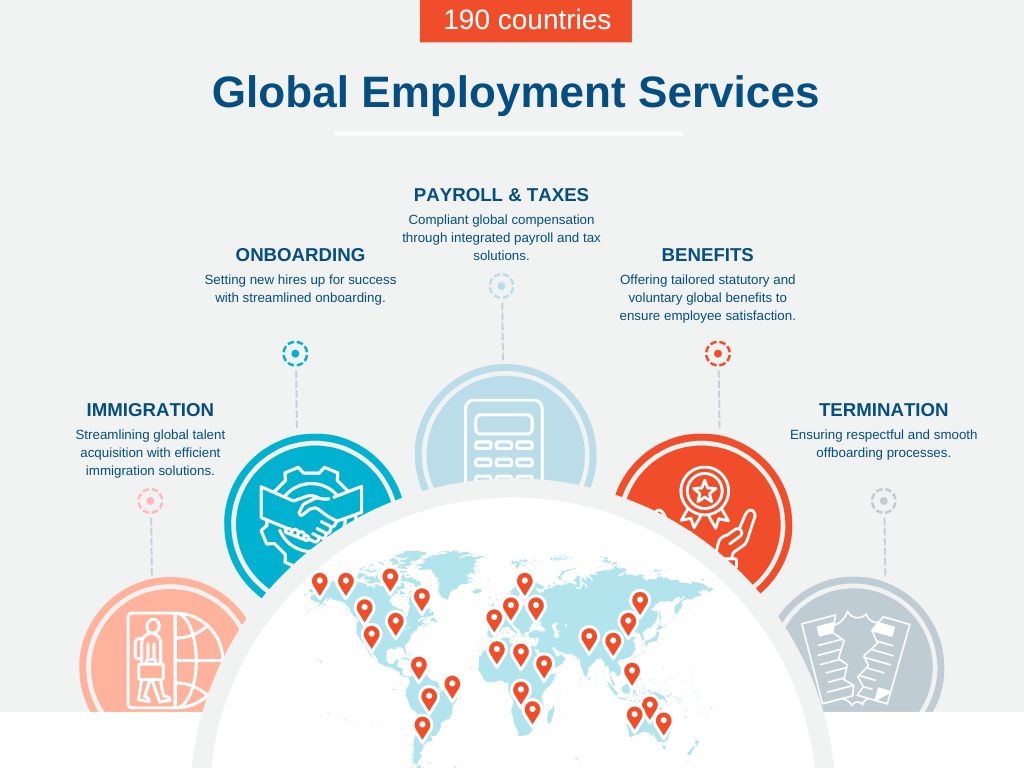
Global PEO Services Include

  1. Local tax compliance
  2. Payroll and tax administration
  3. Legal and regulatory requirements
  4. Insurance and other mandatory and voluntary benefits provision
  5. Workers comp and safety compliance

A global PEO has access to technologies and resources that may not be available to smaller enterprises. Also, they have global expertise that companies that only operate in their home country lack. They can offer your global employees better benefits and incentives, ensure accurate and timely payroll, onboarding, and termination, and provide professional global HR support. Partnering with a global PEO can give your company an advantage over your competitors when it comes to recruiting the world’s top talent.
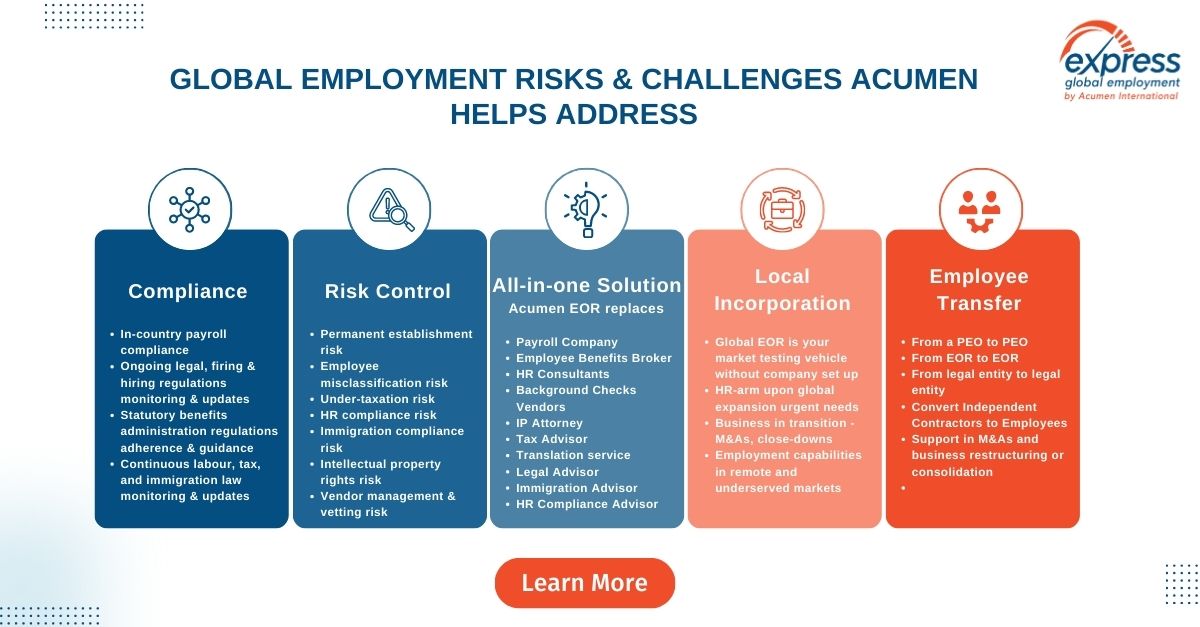
Acumen: Your Express Global PEO for Immediate Employment Needs

Today’s world is changing at a rapid pace, posing challenges never before experienced by global employers. To stay competitive, businesses need to be nimble and creative, finding unique solutions for new challenges that no company has had to face in the past.

Acumen International offers a flexible and reliable solution for your human resources needs:

  • Whether you’re going through a company acquisition and need to transfer the current workforce as a result of restructuring so that there are no breaks in work
  • Urgent in-country tax compliance threat
  • Starting your own company abroad but need a stopgap solution meanwhile and want the employees to work for you before incorporation is done
  • Cannot move the hire date and have a pressing talent gap to be filled in.

Request a tailored quote for your particular case today.

Contact Acumen today and let us take the stress out of global hiring even if you are pressed for time.