Send Email
Blog

Global Expansion Made Easy: Your Trusted EOR Partner

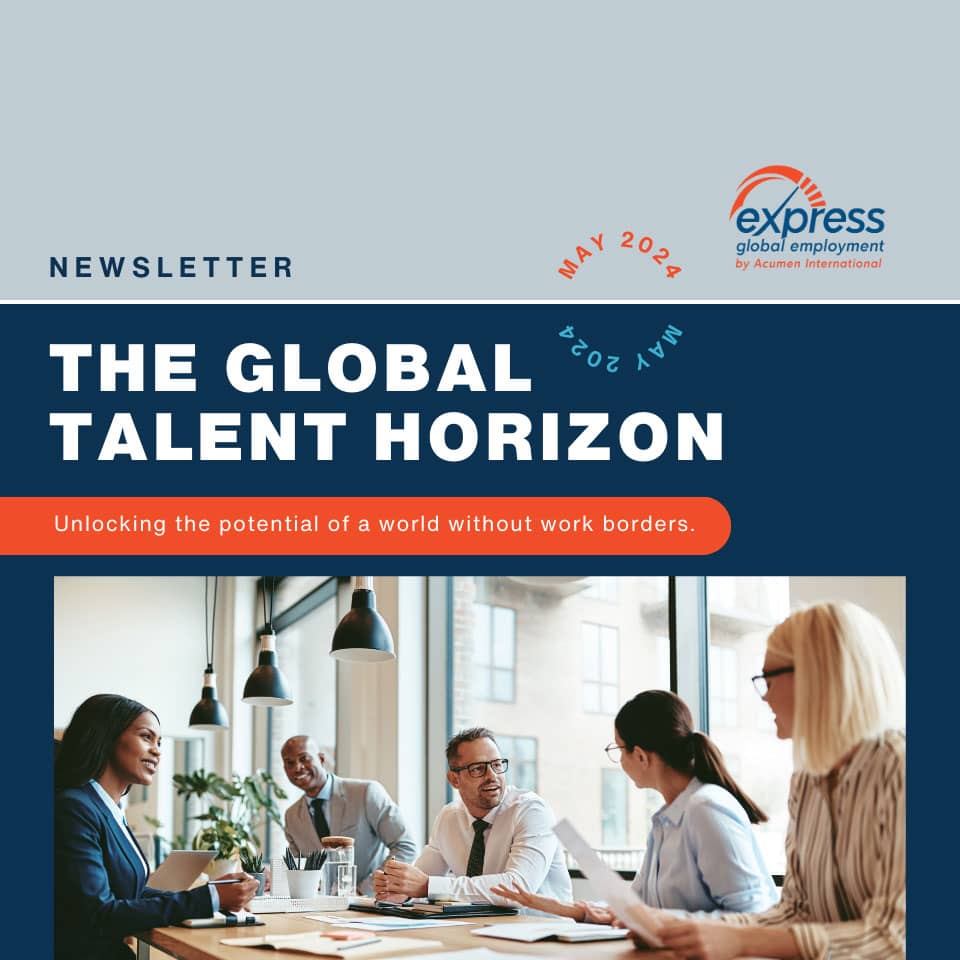
Welcome to the May edition of “The Global Talent Horizon.” This month, we explore how Acumen International alleviates the complexities of global business expansion. Our expertise in placing foreign talent, combined with superior customer service, innovative platforms, and cutting-edge technology, ensures comprehensive EOR solutions.  Discover how our commitment to excellence simplifies your journey into new… Read more Global Expansion Made Easy: Your Trusted EOR Partner

Welcome to the May edition of “The Global Talent Horizon.” This month, we explore how Acumen International alleviates the complexities of global business expansion. Our expertise in placing foreign talent, combined with superior customer service, innovative platforms, and cutting-edge technology, ensures comprehensive EOR solutions. 

Discover how our commitment to excellence simplifies your journey into new markets, positioning Acumen as your trusted ally in fostering global growth through expertly managed, stress-free international talent acquisition.

Navigating International Expansion in 2024: Technology and Strategy Insights

A recent Forbes article highlights key trends for businesses strategising their international operations in 2024. At Acumen International, we align with these insights by providing comprehensive EOR solutions that simplify your global hiring efforts. 

Key insights include;

  • capitalising on green and digital transformation policies, 
  • leveraging flexible talent hubs and 
  • engaging with innovation ecosystems. 

Our strategic foresight ensures your expansion is both current and forward-thinking.

📖 Read the full Forbes article here >>

Debunking Global Expansion Myths: True Expertise Unlocked

Expanding internationally can be fraught with myths that can deter companies. Acumen International dispels these myths, offering clarity and expert support to ensure your global expansion is successful and stress-free. 

Quick market entry is always possible.

  • Reality: Visa and immigration processes vary widely and can delay plans. Acumen ensures you navigate these waters with expert precision, planning for realistic timelines.

It’s too complex and risky.

  • Reality: With Acumen’s expert EOR solutions, we handle the complexities of compliance, payroll, and local regulations, ensuring a smooth transition into new markets.

You must incorporate locally to operate.

  • Reality: With Acumen’s EOR services, start operating in new markets without immediate incorporation, testing the waters before making large commitments.

International hiring is necessary for global growth.

  • Reality: Bring your trusted team along! Acumen supports your expat visa and immigration needs, keeping your core team intact.

EORs only handle administrative tasks.

  • Reality: Acumen provides comprehensive end-to-end solutions far beyond mere paperwork processing. We help you with everything from strategic planning to full operational deployment.

With Acumen’s expert Global EOR solutions, we handle the complexities of compliance, payroll, and local regulations, allowing you to focus on strategic growth.

🌎 Explore how we simplify global expansion >>

Small Countries, Big Impact: Discover Hidden Gems for Remote Talent

Small nations often pack a significant punch in the global talent pool. Acumen International highlights exceptional opportunities for hiring remote talent in lesser-known yet advantageous countries. These countries offer favourable tax regimes and high quality of life, making them attractive for remote workers.


Welcome to the Team: Mike Flowers, Leading US Operations

Acumen International welcomes @Mike Flowers as the Head of US Operations. With 87% of U.S. companies agreeing that international expansion is crucial for long-term growth, Mike’s leadership ensures that our US clients benefit from strategic insights and global experience. His expertise enriches our robust offering, allowing US businesses to navigate new markets confidently.

Read more about why Mike believes Acumen are the perfect choice for US customers expanding globally 

Legislation: What’s New in Global HR Legislation

Stay informed with the latest developments in global HR legislation to ensure your business remains compliant and ahead of the curve.

EU AI Act: Regulating Artificial Intelligence

The EU Council has approved the AI Act, the world’s first major law regulating artificial intelligence. This law sets comprehensive rules surrounding AI technology and applies a risk-based approach, prohibiting applications deemed “unacceptable” and imposing stringent requirements on high-risk systems.

  • Employer Impact: This has major implications for any entity developing, using, or reselling AI in the EU, particularly for U.S. tech firms. 
  • Employer Actions: Ensure compliance with the new regulations, focusing on transparency, risk management, and cybersecurity. Acumen’s EOR services can help navigate these changes effectively.

👉Learn more about the EU AI Act >>

Singapore Tightens Rules for Hiring Foreign Professionals

Starting next year, Singapore will raise the salary criteria for foreign professionals applying for employment passes. The new minimum salary will be S$5,600, with higher thresholds for the financial sector. This move aims to ensure high-quality employment pass holders and maintain a level playing field for locals.

  • Employer Impact: Stricter hiring criteria may limit the pool of eligible foreign professionals. 
  • Employer Actions: Review hiring strategies and salary structures to comply with the new requirements. Acumen can help manage these changes and streamline the hiring process in Singapore.

👉Learn more about Singapore’s new hiring regulations >>

EU Platform Work Directive: Protecting Platform Workers

The EU Parliament has adopted the Platform Work Directive, which aims to improve the working conditions of platform workers and regulate the use of algorithms in the workplace. The directive introduces a presumption of employment, ensuring the correct classification of workers and protecting against unfair algorithmic decisions.

  • Employer Impact: The directive requires the reclassification of platform workers and adherence to new rules on algorithmic management and data protection. 
  • Employer Actions: Implement changes to comply with the directive, ensuring human oversight in decision-making processes and robust data protection measures. Acumen’s Contractor Management services can assist in navigating these regulatory changes.

👉Learn more about the EU Platform Work Directive >>

Summary and Close

Acumen International reaffirms its commitment to valuing human interaction and innovation as we explore avenues for seamless global expansion. Our expertise ensures your business can expand internationally with peace of mind and reassurance. Experience the difference a well-managed, people-powered approach can make to your international expansion ambitions.

✉️ Speak to an Advisor to Expand Your Business Internationally >>

Thank you for joining us this month. Here’s to a future where global expansion is seamless and successful with Acumen International by your side.


Blog

How to Hire Top Global Talent Fast

Hiring top global talent is not easy under any circumstances, but when the heat is on to fill vacancies ASAP, it is easy to go into crisis mode. Operating under duress often leads to costly mistakes that can snowball down the road, putting your business at risk, harming your reputation, and creating unnecessary drama. When… Read more How to Hire Top Global Talent Fast

Hire Top Global Talent Fast

Hiring top global talent is not easy under any circumstances, but when the heat is on to fill vacancies ASAP, it is easy to go into crisis mode. Operating under duress often leads to costly mistakes that can snowball down the road, putting your business at risk, harming your reputation, and creating unnecessary drama.

When faced with urgent hiring needs, especially when hiring globally, it is important to keep a cool head and not compromise your standards. Quality global talent is out there, you simply need creative solutions to find it. A global PEO can help.

Top 4 Reasons to Hire Top Global Talent Urgently

Every business owner or manager will eventually confront a situation where key personnel needs to be augmented or replaced, or where unforeseen circumstances create immediate hiring needs. Some common urgent hiring scenarios include the following.

1. Mergers or acquisitions

Mergers or acquisitions where corporate reshuffling leaves critical gaps in key positions displace key employees, or demands relocation. You may lose some of your most seasoned top talents if they are unwilling to relocate. Or if some of the candidates want to be hired directly by your company while you are terminating your business entity because of the takeover. Either way, you may need to transfer your workforce among departments or even to another entity, and allocate them to the active projects, which can directly impact your company’s bottom line.

2. Urgent global talent onboarding

Urgent global talent onboarding on multiple fronts, where new technologies, new departments, or new products and services require skilled professionals for implementation. Finding qualified candidates with specific skills and enticing them to work for you can be difficult. However, timely onboarding can become crucial in the war for top global minds if you don’t want to lose a valuable candidate to competition.

3. Local compliance threats

Local compliance threats, where international contractors must be rapidly converted to full-time employees to avoid litigation and tax issues related to independent contractor/employee misclassification. Political unrest, economic downturns, or regime changes can make compliance a volatile landscape.

4. Sudden critical growth

Sudden critical growth, where your new company receives more orders than it can handle to keep up with explosive demand for your goods or services. While this is generally a good thing, the urgent need for staffing can be a nightmare.

In such situations, your first impulse may be to scoop up the first warm bodies whose CVs reflect the requisite qualifications. But when it comes to onboarding new hires, hasty decisions often lead to long-term regrets.

What Are the Key Challenges of Hiring Top Global Talent Urgently?

When you have critical positions to fill in multiple countries, the challenge looms even larger. There are numerous potential obstacles to overcome and countless nuances that vary from one country to the next, each requiring a unique approach.

Some common challenges faced by recruiters on an international scale include:

Finding qualified candidates

It is not uncommon for businesses to face a “feast or famine” situation. When you’re not hiring, applicants are beating down your door, but when you desperately need to fill a vacancy, there are no qualified applicants to be found.

Beating competitors’ offers

In many cases, if you have urgent staffing needs, there is a good chance your business rivals are vying aggressively for the same pool of candidates.

Beating competitors’ offers

In many cases, if you have urgent staffing needs, there is a good chance your business rivals are vying aggressively for the same pool of candidates.

Impossible timelines for hiring

Higher-ups often want a position filled yesterday, but international hiring is a long game. There can be scads of red tape that pump the brakes on your hiring machine, delaying the onboarding of essential employees.

A general shortage of skilled candidates

The explosive growth in technology has left companies scrambling to fill high-tech positions in a field where the number of vacant positions exceeds the number of skilled candidates.

Under-informed recruiters

It is not unusual for certain positions to be outside the scope of recruiters’ knowledge. This can pose problems when candidates ask specific or technical questions about the position that recruiters are not equipped to handle.

Employee retention challenges

Chances are your prime candidate pool will be Millennials, born between 1980 and 2000. They have a lot to offer, being tech-savvy, flexible, and forward-thinking. But they are less likely to stay at a single job for decades, and more likely to be lured away within two to three years of hiring. This means that your urgent hiring woes are not likely to go away anytime soon.

If you want to succeed and thrive in the international market, you need the very best talent you can find.

Solutions for Hiring Top Global Talent 

Hiring in a hurry is not the optimal scenario, but there are solutions available to accelerate the recruiting and employment process. One of the smartest moves you can make is to align yourself with a global professional employer organization (PEO).

A global PEO can offer HR support for legal onboarding and payrolling selected candidates and can help you recruit international talent if you haven’t found them yourselves. The advantage of working with a global PEO company is that they know how to deftly navigate the often choppy waters of international hiring from one country to the next. A global PEO can expedite foreign employee onboarding procedures including recruiting and arranging local payroll for the desired candidate, so you can fill critical key positions in the least amount of time.

Global PEO Services Include

  1. Local tax compliance
  2. Payroll and tax administration
  3. Legal and regulatory requirements
  4. Insurance and other mandatory and voluntary benefits provision
  5. Workers comp and safety compliance

A global PEO has access to technologies and resources that may not be available to smaller enterprises. Also, they have global expertise that companies that only operate in their home country lack. They can offer your global employees better benefits and incentives, ensure accurate and timely payroll, onboarding, and termination, and provide professional global HR support. Partnering with a global PEO can give your company an advantage over your competitors when it comes to recruiting the world’s top talent.

Acumen: Your Express Global PEO for Immediate Employment Needs

Today’s world is changing at a rapid pace, posing challenges never before experienced by global employers. To stay competitive, businesses need to be nimble and creative, finding unique solutions for new challenges that no company has had to face in the past.

Acumen International offers a flexible and reliable solution for your human resources needs:

  • Whether you’re going through a company acquisition and need to transfer the current workforce as a result of restructuring so that there are no breaks in work
  • Urgent in-country tax compliance threat
  • Starting your own company abroad but need a stopgap solution meanwhile and want the employees to work for you before incorporation is done
  • Cannot move the hire date and have a pressing talent gap to be filled in.

Request a tailored quote for your particular case today.

Contact Acumen today and let us take the stress out of global hiring even if you are pressed for time.

Blog

How to Avoid Risks of Terminating Overseas Employees

Expanding your business globally is a huge undertaking with infinite moving parts. Hiring, onboarding, and compensating a global workforce is a complex process, and terminating employees can be even more challenging. Every country has its own laws governing procedures for firing or laying off employees locally, and failure to comply can result in harsh penalties… Read more How to Avoid Risks of Terminating Overseas Employees

Expanding your business globally is a huge undertaking with infinite moving parts. Hiring, onboarding, and compensating a global workforce is a complex process, and terminating employees can be even more challenging. Every country has its own laws governing procedures for firing or laying off employees locally, and failure to comply can result in harsh penalties for your company.

To further complicate things, the global pandemic has impacted the way companies conduct business, both at home and abroad. Regulations have been imposed on both employers and workers that restrict and redefine employer-employee relations. In many cases, new laws introduced by global governments favor employees over employers, to protect them from unfair termination and overly restrictive policy changes.

As a Global Employer of Record service provider, Acumen International assumes responsibility for all stages of engaging international employees on your company’s behalf, from onboarding to dismissal. Our solution is designed to help you avoid legal troubles associated with employee termination around the world, saving you time and money, and preserving your company’s global image.

Following are some facts about employee termination in some of the world’s leading economies.

Employment Termination in the United Kingdom

The UK’s Coronavirus Job Retention Scheme (CJRS) was announced in March 2020 as a furlough program designed to subsidize the wages of 9.6 million UK employees, amounting to nearly a third of the UK’s workforce. The subsidies covered 80 percent of workers’ monthly wages and employment costs, capped at 2,500 Euros per month per worker. As furloughed employees, workers were guaranteed to retain their jobs at the end of the furlough period.

Initially intended to last from March-October 2020, the Scheme has since undergone multiple modifications and extensions, with government contributions being reduced to 70% in July 2021 and dropping to 60% in August, with employers contributing 10% and 20% respectively. The Scheme finally reached its terminus on September 30, 2021, preserving its after-effect.

Since then, the UK government has released a COVID-19 plan for the fall and winter that includes a work-from-home policy, along with mandates for wearing face coverings and proof of compliance with vaccine mandates.

Employment Termination in Canada

In March 2020, Canada’s federal government passed the Employment Standards Amendment Act to provide job-protected leave for employees impacted by COVID-19. The law is meant to prevent employers from terminating their employees for reasons related to COVID-19, such as employee quarantine or caregiving for a family member with the virus.

In general, a Canadian employer cannot force an employee to get a vaccine unless a law states otherwise. For example, first responders and law enforcement are required to be vaccinated. An employer may terminate an employee if they refuse to get vaccinated without a valid reason protected under the Human Rights Code.

Employment Termination in China

Despite being the country hit first and hardest by the pandemic, China implemented an effective strategy to stabilize its economy as much as possible. Before the pandemic, China already had strict termination laws in place. These laws became even more stringent, requiring employers to seek permission from legal authorities to submit a termination letter to an employee. In addition, employers in China are required to give 30 days notice of termination or alternatively, to provide one month’s salary prior to letting the employee go.

Employment Termination in Australia

In Australia, workplace laws are established to ensure that employees are lawfully and fairly terminated. They outline what compensation employees are entitled to upon termination, and provide guidelines for termination due to redundancy. Laws for terminating employment are regulated by the Fair Work Ombudsman and the Fair Work Commission.

Unfair Dismissal

  • a worker is dismissed
  • the dismissal was harsh, unjust, or unreasonable
  • the dismissal was not due to redundancy
  • a small business dismissed the employee without adhering to the Small Business Fair Dismissal Code.

Every year, approximately 15,000 unfair dismissal cases are filed in Australia. Any terminated employee can file a case against you, provided they:

  • are covered by an award or employment agreement
  • earn less than $158,500 per year
  • apply within 21 days of the dismissal

Once filed, it is up to the Fair Work Commission to determine whether the employee’s termination was justified and lawful.

Australian employees impacted by the coronavirus have additional protections under a special workplace health and safety law to provide for sickness, quarantine, and lockdowns.

The law addresses the following:

  • Extended periods of sick leave
  • Protections in the workplace
  • Protection from workplace discrimination
  • Unfair dismissal

The onus of proof of fair and lawful termination falls on the shoulders of the employer, and an accusation can result in costly legal and court fees, even if the case is ruled in the employer’s favor.

Tips on Terminating Overseas Employees

Terminating a foreign employee doesn’t have to be a nightmare. You can take several steps to ensure everything goes smoothly — and legally — when you end the employment relationship. If you’re an employer with employees working abroad, here are some practical tips on avoiding the risks of terminating these workers.

  1. Understand the laws in your employee’s country.
  2. Use an experienced international employment law attorney to help you navigate these laws and any other challenges that might arise during the termination process.
  3. Retain an employment law expert who can help you navigate the unique challenges of termination in a foreign jurisdiction.
  4. Understand how the termination will affect your company’s reputation, ability to recruit top talent, and ability to do business in that country going forward (for instance, if you must rehire your former employee).

How Acumen’s Global PEO Solution Can Help Avoid Termination Risks

International laws regulating employer-employee relations vary significantly from country to country, and even more so with additional pandemic-imposed restrictions in place. An unpredictable pandemic can bring about rapid changes affecting businesses and workers.

Hiring and terminating employees in multiple countries can be challenging, even in a relatively stable business landscape. In more turbulent times, the difficulties are magnified as labor laws evolve to keep pace with current events.

In today’s world, events caused by the pandemic can disrupt your business operations to the extent that you need to lay off or dismiss a large portion of your workforce, exposing your company to accusations of wrongful termination. Employee termination can result in fines and penalties amounting to thousands of dollars if found unlawful or unfair.

Acumen’s Global Employer of Record solution can help to protect your company from compliance violations when downsizing your global workforce. As the legal employer for your overseas personnel, Acumen can help smooth the process of terminating your workforce – locals and ex-pats – without the risk of penalties.

As your global PEO partner, Acumen can onboard, compensate, and terminate your employees on your behalf, ensuring that your company is fully compliant with local labor laws. As part of our service, we provide our clients with expert advice and assistance when it becomes necessary to terminate an employee.

As global employment experts, our team stays abreast of changing laws and mandates in 190 countries worldwide to ensure that our clients always remain legally compliant with local labor laws and regulations.

Benefits of Acumen’s Global Employer of Record Solution

  • All-stage processing and handling of your global HR needs.
  • Accurate information about employee records and severance package requirements.
  • Up-to-date information about regulatory changes in countries where you do business.
  • Assistance with termination procedures and appropriate documentation.
  • Reduced risk of fines and penalties when downsizing your workforce.
  • Around-the-clock assistance, regardless of time zone.

For cost-effective assistance in weathering the global pandemic and other challenges that force you to downsize your global workforce, contact Acumen’s team of global employment experts today. We are available around the clock to help you navigate today’s ever-changing international business regulations and remain compliant in the countries where you do business.

Blog

Employee Leasing on Global Markets

Employee leasing – how to become a super seller on global markets The decision about how to enter an overseas market can have a significant influence on the results the company achieves. When a company has made a decision to enter a foreign market, there are a variety of market entry modes that have to… Read more Employee Leasing on Global Markets

Employee leasing on global markets

Employee leasing – how to become a super seller on global markets

The decision about how to enter an overseas market can have a significant influence on the results the company achieves. When a company has made a decision to enter a foreign market, there are a variety of market entry modes that have to be considered carefully.

There are four main mechanisms of new markets entry:

  • Licensing or Franchising
  • Joint Venture
  • Direct Investment
  • Direct Exporting

Franchising or Licensing

Franchising gives businesses an opportunity to grow very fast however requiring plenty of resources. This mode is rather costly as it requires a lot of training, frequent travel abroad, preparation of materials often in different languages etc. The entrepreneur who chooses this way of market entry is supposed to be a self-starter and have a high level of self-organization.

Licensing is less risky, but it allows for a lesser amount of control. According to a licensing agreement, the company grants the rights to use its product or service to another firm. This market entry strategy works best if the party that buys a license has a relatively large market share in the target market or markets.

Joint Ventures

Joint ventures are a particular form of partnership that results in setting up a third independently managed company. A third company is created when two companies agree to work together in a particular geographic or product market. There are five main goals joint ventures aim to achieve: market entry, risk and/or reward sharing, technology sharing and joint product development, and compliance with government regulations. Such partnership’s advantages are account base increase, access to the best knowledge leading to company intellectual capital enhancement, awareness of the local business environment, and knowledge of local languages. This strategy allows an opportunity to combine valuable assets and the two companies’ best features and increase operational efficiency.

The trick here is finding the right partner. I will discuss choosing the right people to represent your business in more detail below.

Direct Investment

Direct Investment involves direct ownership of facilities in the target country or countries. This can be achieved by either acquiring an existing entity or establishing a new enterprise. This strategy is certainly the most costly and riskiest of all, as it involves the transfer of resources, including capital, technology, and personnel. However, some companies can’t but choose this strategy and undertake these costs due to government regulations, transportation costs, and the possibility of accessing technology or specific skills.

Direct exporting

Direct exporting means marketing and selling directly the products produced in one market into the chosen foreign markets. Exporting is one of the most traditional methods of entering new markets. It does not require any investment in foreign production facilities as goods are supposed to be distributed from the country of production to the target country. Exporting is generally based on coordination between four main players:

  • Exporter
  • Importer
  • Transport provider
  • Local government

Many companies hire agents and/or distributors to represent their products in the chosen markets. As they become the face of your company, agents and distributors have to be chosen carefully, the same way you would hire your key staff.

We have elaborated our unique employee leasing solution to meet this need for qualified sales personnel responsible for global sales. Its main goal is to assist export companies with new market entry and make exporting to a number of chosen markets fast and easy.

How our employee leasing solution works

  • You select Sales Representatives from the pool of the best local sales personnel in any country you wish to enter or expand your sales to
  • They become your own sales personnel under your full control and supervision and are employed locally by us on your behalf
  • We act as a Professional Employer for your remote personnel and provide full local business support such as cars, offices, and business expenses.
  • You get a fully compliant, single-point-of-contact employment solution for your remote personnel anywhere in the world
  • They represent only your product category and attract buyers to your product or service, thus serving as your remote hands in each desired country. You set sales targets and control your salesforce to meet them. They allocate all their time to selling your products and developing your business contrary unlike independent sales reps, who generally represent the whole range and balance between what the buyers would most want to buy.

With our solution, you enjoy all the pluses of working with independent sales agents – unique expertise your in-house personnel may not have, access to their account base, etc. – yet managing and controlling them as if they were your company employees. You also get a unique opportunity to start sales in any number of chosen countries.
Our company acts as an Employer of Record for your agents, freeing you from having to open your own legal entity/ ies in each chosen country and letting you reap the benefits of exporting to our region with minimum costs and no employment risks.

Our employee leasing solution is for

  • Small and medium businesses striving for international success
  • Ambitious SME owners with a burning desire to conquer the world with limited resources
  • Companies which utilised their local market potential and are willing to boost their income by going global

International Payroll | Employment Outsourcing

Blog

Brexit Guide: How to Minimize the Risks with a Global PEO

There is no doubt that the UK’s withdrawal from the European Union has upset the apple cart of international businesses. Brexit has brought about numerous changes on both sides of the English Channel, and businesses are scrambling to keep up. In particular, EU and EEA companies that are looking to expand, employ or retain employees… Read more Brexit Guide: How to Minimize the Risks with a Global PEO

There is no doubt that the UK’s withdrawal from the European Union has upset the apple cart of international businesses. Brexit has brought about numerous changes on both sides of the English Channel, and businesses are scrambling to keep up. In particular, EU and EEA companies that are looking to expand, employ or retain employees in the UK will have to make some key adjustments.

Our Brexit Guide for Employers will bring you up to speed with the most important changes that need your immediate attention, and offer some solutions for making a smooth transition to the new rules of business engagement in the UK post-Brexit.

Business Challenges in Post-Brexit UK for Global Employers

On December 24, 2020, the EU and UK reached a trade agreement that outlines and details the terms of doing business between the two entities. On the European side, EU and EEA global businesses will be impacted in multiple areas:

New Travel Restrictions

Business personnel traveling between EU and EEA countries and the United Kingdom will now need a current government-issued visa to enter the UK and remain in-country.

Deadline for EEA and Swiss Nationals to Register for UK Immigration

EEA citizens and Swiss nationals who lived in the UK prior to December 31, 2020, now have until June 30, 2021, to register for immigration status if they wish to remain in the UK under the EU Settlement Scheme. To fully qualify for immigration, they must reside continuously in the UK for five years, after which they must submit an additional application. Failure to meet the June 30 deadline will result in expulsion from the UK.

Employers are now required to conduct right-to-work checks

As of June 30, 2021, businesses employing EEA or Swiss nationals will be required to run right-to-work (RTW) checks on those employees. In the past, simply viewing the EEA/Swiss employee’s passport or national ID was sufficient to establish RTW, but citizens of those countries are not issued hard documents that satisfy RTW requirements. Now, beginning July 1, 2021, employers will have to use the online RTW website provided by the UK government to verify EEA/Swiss right-to-work status. RTW verification is a complex multi-step process that puts the onus of RTW on the employer. Failure to comply can result in civil and/or criminal penalties for the employer.

New requirements for EU and EEA business registration and entity formation in the UK

Under the new trade agreement guidelines, certain EU entities will no longer be allowed to register in the UK, including Societas Europaea (SEs) – the European equivalent of an LLC – and European Economic Interest Groups (EEGs). In addition, EEA companies that were previously registered in the UK will now be treated like all other overseas companies and will be required to report additional information to the UK’s Companies House.

New regulations impacting the relocation and immigration of personnel

EU nationals living inside the UK face as yet unknown challenges concerning their employment status and contractual agreements, with the possibility of deportation. Employee misclassification can become a thorny subject for businesses, with no clear answers and potentially harsh consequences.

A new provision on workers’ rights

Both EU and UK business entities are required to implement similar rules concerning workers’ rights, such as those implemented in the Netherlands.

New provisions regarding social security

Under the new regulations, employers’ social security contributions for employees will be paid to the employees’ home state, in accordance with local requirements. For companies employing workers from multiple countries, compliance will likely pose an HR challenge. In some cases, employers may have to register with local authorities in the employee’s home country and make arrangements there for local payroll and social security contributions.

Considerations for EU and EEA Global Employers

In addition to complying with the many provisions of the new trade agreement, international companies employing workers in the EU, EEA and UK will have to sort out intricate details of new employment laws that affect the legal status of their workers, rules concerning the residency of employees’ family members, and the different rules applying to EU vs EEA workers. In addition, the agreement establishes a plethora of deadlines that must be met by businesses in a timely manner.

Needless to say, global businesses will be challenged to meet the requirements that apply to their permanent workforce and temporary contractors, or run compliance risks that can result in fines and penalties. But there is good news for EU and EEA businesses planning to operate in the UK and employ and retain their employees without undue headaches. Acumen International Global PEO solution offers an innovative approach to global hiring that paves the way for a smooth transition post-Brexit.

How a Global PEO Solution can Help EU Businesses Transition Post-Brexit

December 31, 2020 marked the end of Brexit’s implementation period, and the beginning of massive changes in how non-UK workers can continue to compliantly live and work in the UK.

EU Settlement Scheme

EEA/Swiss citizens and their family members already residing in the UK must apply for settled or pre-settled immigration status by June 30, 2021.

Frontier Workers

Individuals already working in the UK during the implementation period but living in the EEA will be granted frontier worker status, so long as their work is “genuine and effective,” and must return to their country of residence at least once every six months. After June 30 2021, frontier workers must present a digital confirmation of their status, which they must apply for prior to that date.

Immigration after the Implementation period

EEA and Swiss workers not eligible under the EU Settlement Scheme will have to apply for one of two types of work visas. The first is a skilled work visa. To qualify, the worker must have a minimum skill level of RFQ Level 3, and must meet the English language requirement. The second is an intra-company transfer visa for employees currently working for international employers at their branches in the UK.

Travel Restrictions

In addition to regulations governing residency and work permits, the UK will implement an electronic travel authorization (ETA) system where individuals entering the UK from the EEA will have to apply online and pay a fee to gain entry to the UK.

To some, the UK’s exit from the EU on the heels of a global pandemic seems like an untimely move that only makes things more complicated for the global business community. But others see Brexit as the perfect opportunity to remodel their businesses to align with new trends toward remote work, telecommuting and technological innovation.

Acumen Global PEO offers the perfect solution for companies caught in the crosshairs of Brexit, allowing you to:

  • Continue your global business projects without interruption or loss of talent.
  • Scale your business and outpace your competitors by leveraging our innovative PEO solution.
  • Compliantly recruit, employ, and compensate the world’s best global talent.
  • Meet compliance requirements for EU and EEA workers residing in the UK.
  • Meet the post-Brexit UK HR compliance demands of the trade agreement without fear of fines or penalties.

With Acumen’s Global PEO solution, you can confidently expand your global presence, knowing that your business interests in the UK will be protected post-Brexit and beyond.

Acumen International – Your Global PEO Provider

Whether you need global employment solutions for hiring and compensating your selected global workforce in the UK or an ex-pat hiring solution to onboard citizens from your home country, Acumen International Global PEO can help.

As an experienced and recognized leader in the global employment industry, Acumen has the tools and connections to make your post-Brexit transition go smoothly, so you can focus on your business. Acumen’s global infrastructure extends to 190 countries, giving you endless opportunities to make a global footprint, anywhere in the world.

Our solution can help you to rapidly expand into a new country since you will not have to wait until your business entity is legally established there before you begin hiring employees. For more information on the cost of hiring in the UK, visit our website to get Acumen’s Express quote now.

Blog

Acumen’s Global PEO to Adjust to Global HR Trends & Changes 2020 – Annual Report

It would be hard to find a human alive who mourns the passing of 2020. No question that the year’s events in 2020 have upended almost every aspect of modern life, and global HR trends are no exception. Global businesses were affected in multiple ways by the events of 2020. Luckily, Acumen International knows how… Read more Acumen’s Global PEO to Adjust to Global HR Trends & Changes 2020 – Annual Report

It would be hard to find a human alive who mourns the passing of 2020. No question that the year’s events in 2020 have upended almost every aspect of modern life, and global HR trends are no exception. Global businesses were affected in multiple ways by the events of 2020. Luckily, Acumen International knows how to roll with the punches, and we have kept pace with the many changes occurring across the globe, to mitigate the impact on our international business partners. In this Annual Report article we present changes in top global HR trends 2020 “accompanied” by Acumen’s solutions provided and implemented and supported by our Case Studies! Enjoy… Table of Contents Global HR Changes 2020 + Our Solutions

  1. Changes in the Workplace
  2. Challenges for Hiring and Retention of Top Talent
  3. Worker Misclassification
  4. Employees Stranded Abroad
  5. Technology’s Impact on HR

Summary Acumen’s Solutions → Global Payroll Awards 2020 Recognition


Global HR Changes 2020 + Our Solutions

1. Changes in the Workplace

The COVID-19 pandemic became a major factor to result in the greatest global HR changes that reformatted many companies’ workplaces in 2020. We can name Remote work one of them. It turns to be a scenario that has been playing out within every country as the number of coronavirus cases swells and more employers commit to the social-distancing practices that health officials say will help hold back the pandemic spread. Working remotely, once a perk for trusted employees, became the new norm and officially – a demand by the Law for office workers in 2020 because of COVID-19 both on domestic and the global scales. Work from home practices in their turn resulted in changes in the system of paying employer taxes and mandatory contributions. Large international companies and corporations have been forced to reinvent ways to attract and retain key international talent as well as keeping an eye on the latest trends in compliant global hiring. Apart from the world’s biggest companies possessing the status of “International”, many SMEs (small and mid-size businesses) were classified as “non-essential,” taking massive losses or being forced out of business. Yet savvy business owners took advantage of the situation to innovate, moving their operations online and expanding their reach to international markets.

Acumen International Solution Provided

Many of the mentioned companies, who became our new clients this year, had been previously unaware of Acumen’s International PEO solution, and how it could help them resolve their global HR challenges. Now more than ever, these global businesses implement and enjoy the benefits offered by Acumen’s Global PEO aka Global EOR (Employer of Record) solution. We walked our clientele through the many benefits of the solutions provided and demonstrated we are there to help in 190 countries. Our in-country team of experts continually monitors local labor laws and HR-related regulations updates in every of 190 countries of our coverage, so we helped our clients’ companies always remain legally compliant within the countries they entered in 2020. Our clients entered the year of 2021 being aware and assured that with our help they can fast and easy do both:

  • hire a local expert in their (client’s) home country,
  • onboard an expatriate employee in any country of the world.

2. Challenges for Hiring and Retention of Top Talent

Attracting and retaining key employees posed new challenges for companies, as remote work eliminated geographic constraints and made hiring more competitive. With a quickly changing global landscape, Acumen’s Global PEO solution can help your business reshape its remote workforce retention policies and practices, to help you lure and retain the biggest fish in the international talent pool. Due to the pandemic 2020, immigration policies have changed and a number of restrictions have been introduced. All of this introduced extra difficulties for companies that wanted to bring the talent to the countries where they are based or renew visas and work permits for their existing workforce…

Acumen International Solution Provided

We helped a number of our clients (who had been unaware of the Global PEO solution priorly) not only to onboard their selected talent, but also – legally retain their remote worker in the country. We helped to either hire a local citizen or bring an expat into a country, paying them a salary so that they could continue to work for the client company. Some countries use complex methodologies to calculate employee payroll, that consist of minute details as well as specific nuances to be carefully adhered to. One of these countries is – Norway, where we had an unprecedented case to resolve this year. The goal was to grant the employee a compensation package in Norway that was equitable to the one they enjoyed in the United States… To get into the details of our solution – See our Norwegian Case Study.

3. Worker Misclassification

Classification of workers, both domestically and globally, posed new legal challenges, as companies leveraged the growing gig economy. The year 2020 was marked by numerous costly worker misclassification cases, including lawsuits against rideshare companies and food delivery services. And more suits are still there to come!.. Correct classification of workers both domestically and globally is becoming more complex, with ever-changing in-country rules and regulations, at the same time remaining crucial for employer companies! The focus problem to be aware of here is – to employ compliantly!

Acumen International Solution Provided

Company’s Global PEO solution has helped this year a number of businesses – our clients – avoid the risks of Contractors vs. Employees misclassification while retaining top talent and protecting their employer brand. A range of companies operating in Africa, Asia, and/or the Middle East would expand their operations to Europe. One of such companies wished to turn their Global Access Sales Director they have already had in France from an independent contractor to their employee in order to be compliant and get more commitment from the worker. We helped our client to break into the French market and keep moving, keeping the talented sales director long-term. At the same time we helped to avoid risks of misclassification that could result in costly lawsuits. To get into the details of our solution – See our French Case Study.

4. Employees Stranded Abroad

Many international employees were stranded abroad by COVID-19, and companies faced new challenges to keep their global talent pool legally employed. In one instance, a US citizen employed by a global healthcare entity was stranded in Taiwan while visiting his family.

Acumen International Solution Provided

The usual timeframe to apply for and get a work visa in Taiwan is normally 3 to 4 weeks. Our client needed to expedite the legal process, so that the employee could start working as soon as possible. Acumen International stepped in with its Express Global Employment solution: we immediately got all the needed employment documents ready, and – the very moment the employee got his visa – we employed him, thus enabling him to start his work. But we didn’t stop there… Read our Taiwan Case Study.

5. Technology’s Impact on HR

Changes and innovations in technology have upended the HR industry, bringing about new HR trends in global employment. The biggest “changes” of 2020 resuted in implementing COVID-19 employee tracking, tracing and assessment tools. The main focus of these tools now was – to enable our clients to communicate with their global staff, set the needed tasks, and track performance. Technologies for transferring money internationally also became even more important. Acumen is light years ahead of the competition, having developed during this year and is now getting prepared to present the HR world with two innovative self-service tools:

  • 💡 Global Payroll Calculator – an online SaaS only tool that helps clients instantly estimate total payroll costs and taxes in 190 countries;
  • 💡 Global HR Assistant (GHRA) – a global knowledge base with continually updated in-country information for 190 countries. It provides our client companies with valuable info to make informed decisions on global employment.

Summary

As a global employment innovator and a Global PEO service provider, Acumen International was able to leverage its global expertise and infrastructure to help companies adapt to changing global HR trends, grow and expand in 2020. Our 2020 “and a Little More” achievements include:

  • Scaling up of our NGO client sector.
  • Attracting new businesses in the Healthcare IT Solutions and media industries.
  • Establishing projects in 17 new countries:

1. Algeria
2. Bahamas
3. Benin
4. Bermuda
5. Bolivia
6. Cyprus
7. El Salvador
8. Fiji
9. Finland
10. Germany
11. Kyrgyzstan
12. Malawi
13. Suriname
14. Switzerland
15. Taiwan
16. Tanzania
17. Uruguay

The events of 2020 have forced internationally operating businesses to rethink how they hire, compensate and retain talent around the globe, and many are looking to Acumen’s Global PEO and EOR solutions to overcome the challenges caused by an ever-changing global business landscape. Whether your business is already a player on the world stage, or you are ready to expand to global markets, get a free quote on the cost of employment estimate in any country we cover.

Acumen’s Solutions → Global Payroll Awards 2020 Recognition

“To be recognized as 2020’s Professional Employment Organization of the Year is a great honor for us. Acumen’s global team is dedicated to providing the highest quality service to our international clients, and we are honored to accept this Award.”

Nick Ganzha, Founder and CEO of Acumen International

The Global Payroll Awards is an annual type of event featuring sponsorship by the Global Payroll Association (GPA) aimed at recognizing excellence in the Global Payroll industry. In 2020 the Association received a record number of submissions, which more than doubled the number of submissions in 2019. This year Acumen International services were recognized to become the Winner of GPA 2020 awards!

Blog

Enterprise Guide for Choosing the Best Global PEO

Expanding your business globally is an exciting step for growth and brand recognition. However, putting down roots in a foreign country can be fraught with challenges, ranging from cultural and legal obstacles. With global business expansion on the rise, the global employment service industry is experiencing a boom in demand. Partnering with an international PEO… Read more Enterprise Guide for Choosing the Best Global PEO

Expanding your business globally is an exciting step for growth and brand recognition. However, putting down roots in a foreign country can be fraught with challenges, ranging from cultural and legal obstacles. With global business expansion on the rise, the global employment service industry is experiencing a boom in demand. Partnering with an international PEO (Professional Employer Organization) can be a great asset for establishing your overseas business venture with minimal friction.

A global PEO helps recruit and hire local employees and place expats while meeting compliance requirements of local laws and regulations. In addition, an experienced global PEO can be an invaluable ally for various other issues. But not all PEOs are created equal. Services provided by international PEO companies can differ greatly from one provider to the next.

International PEO Basics

An international PEO is a global employment company that helps businesses meet their international employment needs with minimal stress and friction. A global PEO service provider paves the way for businesses to get established in foreign countries while minimizing the risk of compliance penalties and fines for violating local employment regulations.

Partnering with a global PEO company can save your business time and money by helping you navigate the social and cultural nuances of global employment that vary from one country to the next. A global PEO provider can speed up the visa application process, cut through bureaucratic red tape, and smooth over the speed bumps associated with benefits and compensation.

What to Look for In a Global PEO

When shopping for a global PEO, there are a number of things to consider:

  • Each company’s market experience
  • Which countries they cover
  • Their in-country expertise
  • The industries they serve
  • Which positions are onboarded
  • Whether their solution covers both locals and expats
  • Whether they provide immigration support
  • If they can meet urgent employment needs
  • If they offer additional benefits.

You should also enquire about limits on the number of project employees, since some PEOs will not take on smaller projects.

Questions to Ask Before Partnering with a Global PEO

Before your company commits to a particular global PEO, you should ask the following questions:

  • What issues are you struggling with that a global partner could resolve? Make a list and see if the PEO’s solutions align with your needs.
  • What credentials can the potential partner provide to back up their claims of expertise?
  • What type and scope of experience does the team who will handle your project possess?
  • Are there any standalone SaaS products or tools to help simplify your decision-making?

Carefully researching each global PEO company before committing to a partnership can save you time, money and headaches down the road.

The Differences Between PEO Companies

There are essentially three types of PEOs: Human Resource Outsourcing Organization (HRO), Classic PEO, and Global PEO. See how they differ by comparison:

HRO Classic PEO Global PEO
Not a co-employer Functions as a co-employer Functions as a legal employer on the client’s behalf
Does not assume liability Assumes liability alongside a factual employer Assumes full liability
Handles multiple HR services Handles HR, payroll and taxes, mostly in the USA Handles HR, payroll and taxes internationally; provides global employee benefits and additional services beyond HR
Can administer benefits and organize insurance Can negotiate insurance and benefits with vendors Can administer and organize insurance, benefits and additional services beyond HR

While all global PEO companies exist to help international businesses expand their markets, reinforce their talent pipelines, and grow their range of services, their business practices differ widely. Also, the needs of businesses vary, depending on the size of your company, the size and duration of your project, and the number of employees involved. Choosing the right global PEO is essential for your global business success.

Acumen International Global PEO Services

Acumen International is the world’s fastest-growing global PEO company for many reasons. Here are just a few of the features that set Acumen apart:

  • 20 years of experience in HR
  • 9 years of expertise in global expansion and compliance
  • Offers an Express Global Employment solution for expedited 72-hour employee onboarding
  • Offers services in over 190 international locations
  • With its Global Payroll Calculator (GPC) it provides self-service tools for global expansion and talent acquisition. Both tools help your business access expert in-country hiring and firing information and quickly calculate employer burden, empowering you to make informed business decisions.
  • Has an in-country team of experts to collect data and make updates on changing labour laws and regulations
  • Acumen’s unique blended business model features a physical presence of legal entities in six countries, including the UK, Estonia, Ukraine and Georgia, and leverages in-country partners (ICPs) in locations without legal entities.
  • Offers direct support to clients from Acumen’s client managers
  • Provides local worker support through local partners and coordinates support between workers and their factual employers.
  • Acumen’s business model provides deep expertise for in-country market leaders, with flexible pricing based on the number of project employees.

Selecting the right global PEO for your company’s needs is a critical step in global expansion. Changing providers in mid-project can be costly and disruptive to your team’s workflow. Acumen International offers customized PEO solutions designed to meet the needs of every client.

Understanding the differences between International PEOs can help you choose the best PEO to fulfill your business needs. It is important to carefully consider your short-term and long-term business goals to make a well-informed decision. Contact the team at Acumen International today and see how our solutions can help your business grow.

Contact us today or Request a Quote here.

Blog

Navigating Risks In Cross-Border Employment

Dealing with the rigors of the international marketplace means being able to adapt to different trends, as well as keep a steady stream of talent so you can compete. In order to handle this issue, you also need to be ready to hire talent from different areas, as well as deploy them over the course… Read more Navigating Risks In Cross-Border Employment

Dealing with the rigors of the international marketplace means being able to adapt to different trends, as well as keep a steady stream of talent so you can compete. In order to handle this issue, you also need to be ready to hire talent from different areas, as well as deploy them over the course of international expansion. However, working across different countries when hiring talent or utilizing existing members of your teams comes with inherent risks. Here’s how to tackle them.

Benefits of Cross-Border Hiring

As a start, it’s essential that we talk about some of the benefits of cross-border hiring. After all, it’s difficult to discuss risk without reward. Here are some of the key benefits for putting together cross-border ventures:

  • The ability to increase revenue by expanding operations and your audience.
  • Diversifying the portfolio for your clients. For example, if one region had economic issues, profits from other areas could make it easier to weather the market shift.
  • Upscaling products. Having a larger international market makes it easier for you to spread your offerings to different areas. In addition, you have a larger talent pool to work from if you need to ramp up operations to take advantage of a surge in business.

So, with this in mind, say that you’re looking to break into a particular area. One key thing to do is find a strategy for your market entry. A few of the options include:

  • Direct export
  • Licensing
  • Franchising
  • Partnering
  • Joint Ventures
  • Buying an existing company

Each of these comes with its own set of pros and cons. For example, moving into an existing company means that you have an existing infrastructure, but also existing expectations you need to adhere to.

As a side note, it’s essential when planning a market entry strategy, that you pay proper attention to HR. Whether your focus is diversification, concentration, or going international, you need to power your plans with talent. A refined global HR method, using services like Professional Employer Organization or a Global Employer of Record (GEOR) is key here.

Cross-Border Employment Pressure Points

With that covered, we can begin to talk about some of the risks of cross-border operations.

Compliance: Compliance is a far-reaching category, but certain areas are more likely to give your company trouble. Tax risks are one key area of discussion. For example, you need to make sure that you are properly paying your tax responsibilities for each country you do business in, while keeping your business structure in mind. In addition, if you’re transferring current employees to work as expatriates, you need to be mindful of immigration law.

Employee misclassifications: Many people perceive independent contractors as an easy way to fill global teams. However, opting for this route, and giving the wrong classification, can end up causing problems like financial penalties and the early termination of projects.

Employee retention: This is a concern for any business, but can be especially troublesome for cross-border operations. Benefits and other expectations may be different from one country to the other.

Culture barriers: This is mainly an issue when employing expats. It may be difficult to work with local professionals or partners at first. Discrimination may even become an issue.

Time issues: If there is a large time zone difference between the country and your base of operations, it may impact the ability of your teams to contact each other or deliver projects properly.

Systemic risk: Economic developments in the country you’re doing business in may impact your operations. These include market problems in the local economy or even political unrest.

Legal risks: In some cases, a legal change may occur in your country of business that has an instant impact on your business. This can include the law being applied in a way you wouldn’t expect, or international sanctions on the entire country.

The Art Of Managing Global Assignment Risks

With all these potential pitfalls, it’s important to make sure that you know exactly how to manage issues when it comes to cross-border employment. Generally, this orbits around two main points. The first is making sure that you’re confident on how to maintain the processes of hiring and assigning international talent. This means making sure that you’re able to find clarity and transparency, potentially across multiple countries.

The second stage of this is understanding that you won’t be able to manage all of this alone. Even the most diligent companies and HR departments may not be cognizant of the different regulations and aspects of employment law for each company in which they do business. Considering how these can change or be extremely complex, it’s best to have reliable business partners in this area.

If you’re interested in finding professional support when it comes to your cross-border employment and secondment, your ideal first option is working with Acumen International. When it comes to helping your company grow, we offer a variety of key benefits. These include:

  • Global coverage, with support in over 190 countries.
  • The ability to help with employment compliance in each country we serve, no matter the specific regulations.
  • Complete confidence that your employees will be classified properly, and employee benefits repayment will be handled correctly.
  • 24/7 support in case you have any issues.
  • Flexibility in service, as well as a clear termination procedure that still leaves you in control.

Acumen International is your ideal partner when it comes to all of these different methods. We look forward to working with you for all your cross-border hiring needs.

Reach out to us today for more information.

Blog

Benefits of PEO For International Expansion

International expansion has a wide variety of benefits for just about any company, from being able to reach out to new customers to insulating themselves from market issues in their original country. However, like any business proposition, there’s going to be an element of risk. International expansion going wrong has damaged or even sank some… Read more Benefits of PEO For International Expansion

International expansion has a wide variety of benefits for just about any company, from being able to reach out to new customers to insulating themselves from market issues in their original country. However, like any business proposition, there’s going to be an element of risk. International expansion going wrong has damaged or even sank some companies, and it’s largely due to some of the following reasons:

  • Misreading the new audience
  • Neglecting your original client base
  • Failing to follow regulations in your new market

The final issue can be particularly damaging due to not only dealing with fines but the fallout that comes with having broken tax or hiring laws abroad. A PEO solution is one of your best options to avoid this problem.

What Is A Global PEO Solution?

At the core, a global PEO (a Professional Employer Organization) is a company designed to serve as an outsourcing firm for companies looking to do business abroad. What this essentially entails is that rather than hiring individuals directly and dispersing them to international locations, the PEO will take care of a lot of these elements. These can range from:

  • Insurance/benefits
  • Payroll
  • Hiring
  • Retirement
  • Regulatory compliance
  • Training/development

Note, the PEO will still follow the instructions of the company that enlists them, and ultimately, those that use the PEO will have final say over decisions like employee termination. A global PEO solution simply serves as an intermediary that acts locally on the client’s behalf. This solution is widely used by international companies to onboard and payroll a remote workforce – highly skilled talent or local sales managers.

How is this the case? In order to do business in another country, most international regulations require you to either incorporate or establish a legal entity. These processes can be long, expensive, and in some cases, difficult to obtain. By using a PEO service, you can bypass this step while still remaining compliant with local laws and regulations.

PEO solutions are generally used by companies that have already decided to expand internationally through a local team, or perhaps a local team headed by an expat worker. Hand-in-hand with this is figuring out a way to deploy these team members, as well as how to properly arrange/manage them.

Risks And Concerns Of Hiring A Remote Workforce

As mentioned earlier, any business decision comes with risk, and the same applies to a remote workforce. Some potential risks include:

  • Misclassifying full-time workers as independent contractors
  • Failing to adhere to labor laws in terms of benefits/tax responsibility
  • IP accidentally being attributed to a single worker versus your company
  • Trade secrets being spread by your international team

With a lot of these issues, your ignorance of law serves as a little excuse. It’s essential for you to have a means to regulate the employment relationship, even if they are in a different country from you. This is why a full global HR infrastructure needs to be in place before you start hiring. In essence, a PEO employment service is insulated against a lot of the problems with a workforce. Using this business model not only keeps you from problems like misclassification but also avoids you losing a client base by having such mistakes/penalties going public. In addition, it allows companies to start back-bone operations in a new market with a small headcount and ‘test’ the market before incorporating in the country.

What You Get With A Global PEO Service

So, with this in mind, what exactly are some of the benefits that you get in terms of using a global PEO service? The most obvious one, as we covered before, is the fact that it mitigates a lot of the existing risks with a remote workforce. Having a service as a partner that specializes in tackling international compliance and hiring regulations means less stress and work for you. Along with this, being able to quickly adapt to different regulations makes it far more feasible to expand to multiple markets at once. This applies whether you’re looking to move to multiple countries in a single region or across several regions.

There are other benefits that shouldn’t be ignored, either. For example, using a PEO service helps you upscale your product line at a quicker rate, since you don’t have to go through as much red tape. In turn, this lets you add more clients to your portfolio, which supports the bottom line. Along with this, being able to develop quickly internationally and avoid any penalties or sanctions helps preserve the international image of your business.

When looking for the ideal global PEO program to take advantage of all these benefits, you’d be hard-pressed to find a better match than Acumen International. Our services can support your international business expansion in over 190 major global markets. We’re ready to help you develop your workforce and image in the new markets.

Reach out to us today for more information.

Blog

Workforce Mobility – the world of opportunities

More and more companies are seeing the value in expanding their business internationally, whether they are planning to enter new markets, expand their market share, or diversify their customer base. In order to do this, companies need to be able to recruit international talent and to relocate some of the team members to foreign countries.… Read more Workforce Mobility – the world of opportunities

More and more companies are seeing the value in expanding their business internationally, whether they are planning to enter new markets, expand their market share, or diversify their customer base. In order to do this, companies need to be able to recruit international talent and to relocate some of the team members to foreign countries. By doing this, companies can get a strong foothold in the new markets or tap into unique skills, regardless of where they are based. For this reason, the notion of workforce mobility is becoming more and more important.

Workforce Mobility Trends

First, let’s talk about some of the key trends that are driving global mobility across the board. One thing that’s making the prospect more attractive is the idea of developing the employee experience. For example, say you are a company planning for some major international expansion soon and have an employee quickly rising onto a management track. It would just make proper sense in this situation to try and invest in business travel for them to create a more well-rounded prospect.

Many companies are dealing with a skilled talent shortage, especially in certain markets and niches. Hiring on skills versus geography is a great way to get around this, but you also need to have the means to deploy international talent when it is needed.

Finally, having an international workforce inherently benefits your international expansion. From globalizing your methods to helping develop your networking, being able to lean on the expertise of your international workers is great for helping you make headway in an environment, where the customer base and business norms may be different.

Elements Of Global Talent Mobility

So, if you find that corporate mobility is for you, what are some of the ways that you can go about doing it? There are three main methods up for discussion, and sometimes, a combination of these is the best option.

Foreign employment: Sometimes, you want to work from the outside in and augment your in-house team with a pool of contingent workers in the target country you’re looking to do business in. Just make sure you onboard them in full compliance with employment legislation of the host country.

International assignment or secondment: Another option here is taking employees from within your company and assigning them elsewhere for a limited period of time Such employees are seconded employees. They continue to contribute to the home country for social security while working for the employer company overseas.

Expats sent overseas – By using your existing team and deploying them as expat workers, you can have the exact talent you want leading your new branch or company overseas. Just note that this can take a long time and a lot of expenses to manage.

International expansion to new markets: In some cases, you may want to take a more formal approach, like setting up a new branch, to get into a new market. This allows you to build the organizational structure to get a proper presence.

Best Practices For Corporate Transfer and Relocation

So, with all these elements kept in mind, what are some of the best practices that companies can put in place for managing their corporate relocation?

First of all, it’s essential to have contingency plans on top of contingency plans when it comes to addressing common relocation concerns. Here are a few of the common examples that tend to arise.

  • Immigration complexity: Every country has its own unique immigration regulations, and oftentimes, they can be in flux. As a result, you need to make sure you are fully aware of the laws on the books, but also how future laws may be trending to build your team.
  • Uncertainty: As mentioned before, especially in recent years, immigration and immigration policy have been a hot-button issue in many countries. You want to make sure your business is ready to adapt accordingly.
  • Visa delays: Many companies building international teams will want to have a few members of their core teams sent over in order to both teach others and ensure a universal standard. Visa delays can end up negatively impacting the timeline if not accounted for.
  • Demographic challenges: In some cases, it may be difficult to find prospects in the right demographics that you want for a certain position in a certain country.

Immigration compliance hangs over all of these points as a greater issue. Failing to comply with a country’s immigration regulations not only means potential sanctions and risk of visa rejection but a severe hindrance of you doing business in a given country in the future.

Finally, it’s essential for companies serious about workforce mobility solutions to have a partner in place to help facilitate the process. As our other examples show, there are a lot of bureaucratic and logistical roadblocks to relocating your top talent across international settings. Looking into countries that help with relocation is a good way to ensure you’re staying in compliance and minimizing the risks of some of the most common concerns.

If you’re looking for a global mobility consultant to further your goals, using a work permits for expats program, like what Acumen International offers, is the perfect match. Our global mobility consultants can provide work permit and immigration support for over 190 countries. Be able to smoothly move around talent to further your international expansion with our support.

Blog

How To Engage A Global Infrastructure With Talent Strategy

Those in the manufacturing industries are familiar with the basic principles of a successful supply chain. This is essentially managing connections with multiple suppliers to make sure you have all the raw materials you need to create a successful product. While the materials may be different, the basic concept is becoming more and more versatile… Read more How To Engage A Global Infrastructure With Talent Strategy

Those in the manufacturing industries are familiar with the basic principles of a successful supply chain. This is essentially managing connections with multiple suppliers to make sure you have all the raw materials you need to create a successful product. While the materials may be different, the basic concept is becoming more and more versatile across the board. In a world where global business is the norm, a new paradigm is coming into place when it comes to managing your international workforce. As it turns out, these supply chain principles work well when adapted for talent.

How Optimizing A Contingent Workforce Became Essential

To see an example of the need for talent strategy optimization, we should look at the major IBM layoffs in the early 2000s. IBM had long built its niche not necessarily in bleeding-edge tech, but being able to provide solutions more efficiently and quickly than its competitors. As the company began to expand its operations globally around this time, issues in the “talent supply chain” became more and more apparent.

To make this a bit clearer, the talent pool at that time generally consisted of three main sources: contractors, full-time employees, and applicants. The issue here was that hiring and managing these three main sources of talent was mainly done independently. As a result, there would be a lot of redundant hires or talent basically waiting for assignments. For a company that had the market advantage of efficiency, this was not acceptable and eventually resulted in massive layoffs as operations were consolidated.

How do businesses today avoid history repeating itself? Now, it’s the advent of a contingent workforce, a more unified, flexible system of talent that allows different professionals to swap from project to project within a company. You can still use the same three differing sources, but there’s a lot less separation, leading to a true talent ecosystem versus smaller teams with tunnel vision. Being able to manage talent in this way was a key part of growing the “world of work” as we know it.

In perspective, competing with startups and other emerging contenders for attracting dynamic young workforce, major established companies are now putting forward an environment of collaborating and partnering with talent. “Open-source talent” is a term that’s often used, and it’s not far off from the truth.

Managing A Talent Supply Chain

So, with this said, how does connecting to a global pool of talent for contingent workers help your company? There are a few key benefits to talk about. For example, being able to take on projects for multiple companies rather than being locked into a single role is a great benefit for talent growth and development. Having multiple tasks to take on helps expand their knowledge, which ultimately lets them be a better asset for the companies they work with. In addition, a pool of better-educated, versatile talent is good for the entire industry.

There are also practical benefits as well. For example, rather than having multiple sets of full-time employees locked in, the ability to take on contingent workers as needed makes it a lot easier to budget for individual projects, as well as universal needs. Finally, it’s more practical to manage multiple workers across different countries this way. By using a talent pool in multiple markets, it can be easier than spreading domestic workers too thin by relocating them. However, to do this compliantly, you may need Global PEO services.

Global PEO and Talent Supply Chain Solutions

It’s important to note that PEO isn’t the only approach to the contingent workforce employment. While looking at this path, you may find businesses that use outsourcing agencies, the self-employed or other tactics. However, when it comes to building an international image, you want to focus on the best practices. This is where PEO stands above. For example, it’s far easier to establish confidentiality and business connections with your talent using PEO. In addition, Global PEO services are naturally designed to be more agile and adaptable to meet client needs.

Because an effective talent strategy has become more and more of a necessary practice for businesses, any sort of support in this area is key for success. However, as businesses expand internationally into new markets, managing these regulations becomes even more difficult.

For instance, opening your own entity in each new market to handle foreign integration is a slow and bloated way to tackle this issue, which is where PEO (professional employment services) from a managed service provider like Acumen International comes in.

Global PEO services come with a unique feature called dedicated management that allows companies to manage a global workforce deployment all through one single contract. This applies to a single key piece of talent or multiple teams across multiple countries. In addition, we also provide key benefits like medical insurance, social contribution, payroll, and bonuses, which are essential for drawing and retaining your top talent. Be ready to tackle the new world of work today with Acumen International, the global employment provider.

Reach out to us today for more information.

Blog

Is USMCA Good To Start Business In Mexico

As the business world shifts and evolves, smart executives and founders are thinking of ways to both drive up profits and minimize expenses. International expansion has been a gateway to both. Entering new markets allows you to use a different labor market to your benefit, while also expanding your product or service to a new… Read more Is USMCA Good To Start Business In Mexico

As the business world shifts and evolves, smart executives and founders are thinking of ways to both drive up profits and minimize expenses. International expansion has been a gateway to both. Entering new markets allows you to use a different labor market to your benefit, while also expanding your product or service to a new audience. Mexico, in particular, has become a new hub in terms of North American business. However, it’s important to understand the pros and cons, as well as the recent USMCA (United States – Mexico – Canada Agreement), to take advantage of these opportunities.

Pros and Cons Of Opening A Business In Mexico

As a start, if you’re interested in self-mastering a business strategy in Mexico, you want to build around the major benefits. They run as follows:
Geolocation: Mexico is located in proximity to both the United States/Canada as well as Central America. As a result, it’s easy to reach both of these markets with Mexico as a central hub. Of course, if you have ambitions to work in other areas besides, this may be more of a con.
Labor Market: Labor is inherently cheaper in Mexico than in other countries, and this is one of it’s largest draws as a market. In addition, as the currency and economic conditions improve, things will only get better.
Social Development: This government branch is specifically designed to help build up impoverished and rural areas of Mexico, creating a possible opportunity.
However, like any country, there are particular cons you need to consider if you want to start a business in Mexico. Here are some of the major hurdles:
Creating a Legal Entity: Compliance is essential when it comes to hiring international employees. Many companies try to make this easier by establishing a legal entity in Mexico. However, one needs to follow Mexico’s specific rules and understand that this can be a time-consuming process.
Bureaucracy: Complicating this is navigating another country’s bureaucratic processes. Various regulations and delays may cause you to miss your window of opportunity to expand.
Uncertainty: One of Mexico’s largest trade partners, the US, is in a period of uncertainty in terms of relations. However, as we will explain in a moment, the trade environment may become clearer soon.


Understanding a USMCA Comparison

One major factor that everyone needs to consider when it comes to doing business in Mexico is the USMCA. Known as T-MEC in Mexico, this is a free trade agreement designed to supersede NAFTA and is signed, but not ratified, at the time of this writing. However, many political figures are confident that this will reach a positive conclusion, so adapting to USMCA may be more of a when, as opposed to an if.

The goal of the current administration is to try and modernize NAFTA with this new agreement, and there are indeed some opportunities for people looking to do business in Mexico. Here are some of the key elements to consider.

Digital Products: New provisions of the agreement allow data to be transferred cross-border, and cutting down limits on where data can be stored and processed. The terms of copyright have also been extended from 50 to 70 years.
Import/Export: Automobiles must have up to 75% manufactured in either the US, Mexico, or Canada to avoid tariffs. This may impact what type of industries want to do business in Mexico, based on what they specialize in. Thus, the agreement will help small businesses access the markets of potential trading partners, creating a stakeholder platform that provides entrepreneurs the chance to offer regular feedback on improving USMCA and market access for small firms. Along with this, USMCA eliminates a “local presence” requirement for cross-border service providers. This creates a massive lowering of costs. With this rule in place, small businesses no longer need a foreign office to do business.
Employment: 40% to 45% of all automobile parts need to be made by workers who earn at least $16 an hour by 2023. Mexico recently passed tougher labor laws to protect workers. While you can still reap the benefits of cheaper labor in Mexico, this makes compliance more important. The agreement, if enforced, would strengthen labor standards and rights, especially those related to collective bargaining in Mexico. This will help support better wages and labor conditions across the board.

Improving Your Organization Via Global PEO Best Practices

As alluded to before, even with USMCA potentially opening up a sea of business opportunities, the conventional methods of opening up a business in Mexico are far from flawed. Hiring on your own staff to lead these new teams requires lots of bureaucratic red tape to navigate, which could throw off your planned expansion timeline. The same applies to opening your own entity to engage more control. With this said, there is a way to go about opening your own business in Mexico without a legal entity.

This is using solutions like Acumen International’s Global PEO system. Our team will handle complex aspects like onboarding and payroll, whereas you still remain in control of your employees, all while not having to worry about compliance issues. If you want to promote your brand without needing a local presence, we can help make that happen. If you do want to fully set up in Mexico, our solutions allow you to take advantage of workplace diversity and be able to recruit the top talent.

It’s important to remember that a total of 80% of business respondents believe that their talent acquisition is more about total value creation for the company than achieving cost savings. This means that it’s essential that you think of the top quality options when it comes to starting a business in Mexico without incorporation. The USMCA differences that we have profiled, show new opportunities in this area, but also new regulations you need to remain compliant too.

At Acumen International, our services, like Global PEO, designed to help you navigate this balance. Foreigners can open a business in Mexico, building up their team the way they want while being confident that they are in compliance with all regulations. On top of this, it’s done at a fraction of the speed of foreign incorporation. There is barely a better way to enhance value creation for your company than that.

Reach out to us today for more information.

Blog

Hiring employees in foreign countries Benchmark

Employment without borders is rather a necessity than a preconditioned option. In terms of economic relationship, “global mobility” appears as a dawn of the upcoming technological revolution. In the days of post-industrialization, companies of all sizes and niches are seeing the benefits of expanding internationally. The global transformation of the world economy is inevitable, ergo,… Read more Hiring employees in foreign countries Benchmark

Employment without borders is rather a necessity than a preconditioned option. In terms of economic relationship, “global mobility” appears as a dawn of the upcoming technological revolution.

In the days of post-industrialization, companies of all sizes and niches are seeing the benefits of expanding internationally. The global transformation of the world economy is inevitable, ergo, multinational corporations are the major consumers of these changes. Mainly driven by the cross-border movement of goods, services, and labor, “global mobility” arises as the looming globalization force.

Starting from the late 1970s, international labor pool constantly evolving to interconnected workforce network, changing the way modern employment is perceived. In this light, the Social Security administration becomes crucial for proper relationship development between business representatives, trade unions, and governments.

People matters much like business

It comes without saying that consolidation of global networking requires a proper regulation, mainly provided by centralized legal authority. One of the organizations, responsible for adherence to social obligations is the International Labor Organization (ILO). In many cases, ILO appears as a pledge and a final resort for labor rights. Human trafficking and modern slavery, same as child labor become an issue in developing countries, that is why international corporations endorse ILO as a global workforce regulator.

Perhaps, one of the most high-profile labor related cases is a case against multinational corporation Coca Cola, initiated by the International Labor Rights Fund and the International Steel Union on behalf of a Colombian trade union in the beginning of 2000s. The authorities sued the beverage manufacturer for murder, torture and kidnap of Colombian trade union members, who tried to protect the civil rights of the bottle plant staff, opposing subcontracting of thousands of workers apparently engaged by Coca Cola in order to reduce labor costs.

As we see from the above example, not just understanding of international core labor standards but compliance and implementation of Social Security Standards are crucial for establishing an effective, standardized, and ethic driven networking.

Hiring employees in foreign countries is exercised under common standards and regulations

From New York to Tokyo, from London to Johannesburg, multinational corporations around the globe continuously exercise the immense amount of business operations. Taking into account the fact that all of these transactions require appropriate regulation and maintenance, millions of participants all over the world take care of global network functionality. Every day, new contenders become a part of this web.

Regardless of the country or region of the designated market, the primary responsibility is always related to ethical and compliant performance. Putting a strategy into action requires professional assistance, including the incorporation of a talented workforce; therefore, businesses need to understand the ongoing procedures that include:

  • Legal fees and government registration fees payout;
  • Establishing inhouse bank accounts (must be completed in person);
  • Preservation accounting records locally in the market;
  • Designating a country manager, paid in the country;
  • Breaking down entity/terminate the operations under corporate law;
  • Sourcing and continuously managing multiple vendors for booking and HR operations.

In addition, companies establishing their presence abroad should adhere to a certain ethical context:

  • Freedom of association;
  • Right to organize/collective bargaining;
  • Restrictions on child labor;
  • Restrictions on forced labor;
  • Restrictions on discrimination;
  • Equal remuneration.

Innovation-driven approach is a key to access

Considering the possible risks and hurdles related to hiring employees in foreign countries, it is quite reasonable for companies to handover this due diligence to professional employment organizations (PEO). Global PEOs are advanced employers of record, who commit 100% compliant ethical, financial, and operational performance regardless of the destination point. Addressing a Global Employer of Record is a right way for multinationals to adhere to international labor standards, provide their services, sell goods, and keep the global networking system functioning smoothly and flawlessly.

Social Security Administration reflects the humane and mutually beneficial relationship despite the role of participants. Moreover, the relevant adherence to social standards leads to succession and appears as a leverage point of global integration. On the other hand, neglect of basic moral principles and core labor standards denotes failure to take advantage of that great opportunity.

Reach out to us today for more information.

Blog

International Expansion Through A Global HR Strategy

We live in a time where the world is more connected than ever in terms of business. International expansion is proving not just to be a potential option, but a key facet in businesses developing their audience, reach, and workforce. However, there is a right and a wrong way to take advantage of this trend.… Read more International Expansion Through A Global HR Strategy

We live in a time where the world is more connected than ever in terms of business. International expansion is proving not just to be a potential option, but a key facet in businesses developing their audience, reach, and workforce.

However, there is a right and a wrong way to take advantage of this trend. Plotting to expand internationally without a true HR strategy is not only expensive, but opens up your company to legal risk due to non-compliance. So, with this in mind, here are some of the key elements of consideration for your international HR management strategy.

Why You Need A Global HR Strategy

Ultimately, when it comes to expansion, you have two main purposes in mind:

  • Broadening the scope of business operations in terms of groups served
  • Broadening the amount of services your company offers

Expanding internationally strikes both of these points. Not only are you opening your company up to a whole new audience, but you’re also needing to take the country’s needs into account. For example, a telecommunications company based in the United States, trying to branch into Nigeria, is going to need a very different approach due to the different infrastructures there. However, success here means they have two huge audiences to profit from.

However, international expansion is about staffing strategy as well as planning. For example, in order to facilitate that Nigerian expansion, the American company would want:

  • Employees who are able to communicate in local languages to facilitate partnerships.
  • Employees who are familiar with the local telecommunications structure.
  • Employees who know the American strategy and work mode to ensure this new project maintains the original standards.

This often requires a combination of expat and international hiring to manage. Your HR management strategy for globalization can take three major forms, which are as follows.

Expansion Through Diversification: This basically entails when a business expands via changing what they offer. Using our telecommunications example, the American company that focuses on landlines may make a stronger push into mobile to appeal to the Nigerian market. By taking this step, they are better insulated against economic downturns.

Diversification can take two forms, concentric and conglomerate. Concentric is expanding into areas similar to or adjacent to the current area of business, while conglomerate is going into new areas.

Expansion Through Concentration: This covers when a business doubles down on some of their existing strategy, rather than implementing a new product or service. For example, bringing existing telecommunications services to a new country, in and of itself, fits this description. However, introducing a new product into your existing market fits as well. The benefit here is that there’s less of a learning curve, but shifts in your niche can affect your business more drastically.

International Marketing: When it comes to developing international marketing, you have a variety of different options you can go with. These range from direct/indirect exports to global web businesses to joint ventures with local companies in the field of choice. However, all of these share one major hurdle for your human resources team.

Refining Your International HR Strategy

Whether you want to build a global web empire or set up an office in a new country, each country you’re looking at has its own set of rules regarding hiring. These hurdles for hiring the team members you want can slow your international expansion plans. There is one way to compliantly tackle the issue, though: a Global Employer of Record (GEOR) solution.

Global Employer of Record programs as the heart of your expansion strategy offer two key benefits:

  • The ability to hire qualified talent to help fit your new market, meaning you always have the best workforce behind your expansion.
  • Ease of use when it comes to the hiring process, including risk mitigation and compliance with any local regulations.

But how do you make this work in your business?

Implementing a GEOR Solution For Your Global Human Resources Strategy

Creating an HR strategy for global expansion is important not just for compliance, but also for helping to expand the sales reach and overall effectiveness of your company. However, to increase the return on investment for your efforts, you need advanced HR strategy solutions, like a Global Employer of Record program.

If you find yourself in the market for these human resources services, Acumen International is a standout option. We offer an express advantage to all of your international hiring needs. Whether your plans include hiring only a few temporary employees or a large expat workforce, we make it easy to work inside the hiring laws where you live, facilitating smoother international expansion. We also provide speed, helping you to onboard employees within 72 hours.

Reach out to us today for more information.

Blog

5 Developed Markets Perfect For Increasing Your Sales Growth

One of the major factors that all companies should have in mind, even if they are doing well, is ways to increase their sales. From expensive training to tech integration, many companies have dozens of different practices they use to try and raise their sales, however, many are missing out on international expansion as an… Read more 5 Developed Markets Perfect For Increasing Your Sales Growth

One of the major factors that all companies should have in mind, even if they are doing well, is ways to increase their sales. From expensive training to tech integration, many companies have dozens of different practices they use to try and raise their sales, however, many are missing out on international expansion as an opportunity. Not only is it more feasible than ever, but the benefits are quite clear. Examples include:

  • Exposing your product to a new audience.
  • Handling the ebb and flow of business success.
  • Being able to implement something that is no longer exclusive to big businesses.

However, what are some of the best potential options to choose from? Here’s what’s worth considering.

The Most Attractive International Markets For Expansion

Depending on your industry of choice, there may be dozens of different countries out there that can pose a potential opportunity. In addition, there are some countries that were formerly havens for international expansion, that may no longer be as appealing. The U.K in the wake of Brexit is a perfect example.

With that in mind, here are 5 countries that are currently looking like the strongest options when it comes to international expansion, specifically with sales growth in mind.

#1. Germany

The uncertainty that Brexit is causing in the U.K’s business world has set Germany as the EU’s new economic stronghold. The German government also understands the amount of international interest that will soon be coming to their borders, and has begun making sizable changes to their immigration laws. The goal here is to make it easier for foreign companies to establish themselves and onboard teams of their choosing. Over 2.7 million foreign employees are doing business in Germany, and that number is only set to grow as the country becomes more and more prominent. Cities like Berlin and Frankfurt are set to become hubs of international commerce for the region.

However, there are some pain points we should talk about when trying to establish a German branch of operations. For one thing, those same laws that we were mentioning mainly target German-speaking vocational workers, as opposed to white-collar international workers. The primary alternative, setting up a German entity, is also time-consuming. In addition, if you’re an English-speaking country looking to relocate past the U.K., you have to deal with a language barrier to start.

#2. The Netherlands

The Netherlands is also a country that is set to expand in growth in the wake of Brexit, and one of the main reasons why is that while Dutch is the native language, over 90% of Dutch people in the Netherlands speak English. In addition to easy integration and a strong economy, the Netherlands also has some unique tax benefits when it comes to people who are interested in expanding. Some key examples include housing benefits and tax deductions for spouses.

When it comes to the process of establishing a business, the Netherlands is relatively efficient compared to some other countries on that list, but relatively efficient isn’t the same thing as easy. For example, while foreign enterprises only require a residence permit, you still do need to go through other steps, like getting a Citizen Service Number from your local city hall. The main issue with starting a business in the Netherlands is that you have to take a few of these smaller steps, which can be easy to miss and potentially put your business at legal risk.

#3. Canada

Changing economic situations and regulations in the U.S. may make it not an appealing place to expand into at the moment, but Canada poses a great alternative for businesses wanting to reach that lucrative North American market. In fact, in many international rankings, Canada actually beats out its neighbor to the south in terms of places to do business. Factors like trade freedom, investor protection, and lower corporate tax rates are often cited.

However, the major barrier to doing business in Canada is the fact that rules for hiring and firing expat employees often change by individual province, though there are a set of national labor laws as well. This can pose a major headache if you plan on expanding to multiple areas across the country at the same time. Examples like Target’s failed Canadian expansion show while the area is rife with opportunity, it doesn’t mean that this is automatically guaranteed to succeed. In addition, if you plan on doing business in the French-speaking area of Quebec, you may encounter a language barrier both while establishing an entity or just doing day-to-day business.

#4. Ireland

Ireland has a lot going for in terms of international expansion to increase sales. For one thing, major corporations have been flocking to its shores for years to take advantage of the generous corporate tax rate, 12.5 percent to be exact. Compared to other major countries in the E.U., this is quite low. In addition, Ireland boasts one of the youngest average populations in the E.U., meaning it may be a great place to expand if that is your target audience. Notably, with labor costs in Ireland expected to grow, it makes it that much more appealing to look for expat hires.

However, while many people instantly see the tax rate and think that Ireland is a perfect place to do business, there are fundamental differences. For example, in the U.S., indefinite employment contracts are a common thing, but they are against the laws in Ireland. Companies looking to do business here need to fundamentally understand the different regulations or use a solution that lets them outsource that work.

#5. Japan

For many businesspeople, Japan is seen as the “gateway” into the greater Asian market, and a naturally strong place to do business. From a sales perspective, Japan has one of the largest consumer markets in the world, serving as a potentially lucrative hub, while having more of an established business infrastructure than a lot of the other major countries that may still be developing. In addition, when it comes to forging local partnerships, the reputation of the Japanese workforce as being highly-educated and dedicated is near-legendary.

However, despite the appeal, Japan has perhaps the least amount of foreign investment considering its industrial development. Why is this the case? It all boils down to the fact that Japan is also a notoriously bureaucratic country. On top of typical processes for things like establishing residency or creating a new entity, there are also a wide network of offices and procedures for things that many U.K. or U.S.-based companies may not even think about needing to have approved. In addition, despite being well-educated, most Japanese professionals do not speak English.

Handling the Pros and Cons of Expanding

Every country has a different approach when it comes to doing business, but there are a few things that universally apply.

  • All countries have laws when it comes to international expansion and hiring that you absolutely must follow.
  • Setting up a new entity in the country of choice is a way to circumvent this issue, but is also prohibitively expensive and sometimes complex.

As a result, it’s important for businesses to have a way to emphasize the benefits while mitigating the cons of international expansion. One key way to do this is by using a Global Employer of Record (GEOR) service. When you work with a GEOR service, they become the registered legal employer for the worker, essential outsourcing the logistical work of local hiring and payroll compliance. However, you still control all the day-to-day aspects of the employee’s job.

In terms of a Global Employer of Record solution, Acumen International is the ideal option, whether you are looking for a bridge option while establishing an entity in a new country or a permanent option to support your international expansion. With the ability to onboard expat employees within 72 hours, we can help you quickly and efficiently set up your team in these exciting new business markets.

Reach out to us today for more information.

Blog

EU Countries To Do Business In Post-Brexit

Brexit has created an environment of uncertainty when it comes to companies that have their European operations based in the UK. A recent extension of the deadline has given UK leaders extra time to decide how to approach the split, but this is of little comfort for many international businesses. The UK’s combination of a… Read more EU Countries To Do Business In Post-Brexit

Brexit has created an environment of uncertainty when it comes to companies that have their European operations based in the UK. A recent extension of the deadline has given UK leaders extra time to decide how to approach the split, but this is of little comfort for many international businesses. The UK’s combination of a common language and favourable environment made it a common starting point for many international businesses, but now, there’s a question of what can fill that void, especially in a no-deal scenario.

There are a few EU countries that stand out as the strongest candidate.

The Ideal Countries of Choice

Germany: With the UK potentially going off on its own, Germany is now poised to be the economic center of the EU. Roughly 20,000-30,000 new jobs are poised to be brought to Frankfurt and other major German cities, meaning there will be many positions to fill. On top of this, Germany is currently making major changes to its immigration laws to make it easier for foreign countries to set up shop and bring on their own expat employees. The fact that Germany has an unemployment rate of below 5%, one of the lowest in the EU, makes expat hiring even more attractive.This puts Germany at the top of the list when it comes to UK alternatives for post-Brexit business. However, easier doesn’t mean ideal. The new laws are designed more for German speakers with vocational skills. This means that other companies will want to either set up a German entity or use a GEOR solution. In addition, English speaking companies will need to navigate a language barrier to start.

The Netherlands: As mentioned before, one of the biggest reasons that the UK was so popular with American companies is the lack of a language barrier. The Netherlands is similar to Germany in that it is centrally located in Europe (making for a good central base for EU operations), and has a strong economy. However, one major difference is that the language barrier is minimal. Over 90% of Dutch people in the Netherlands speak English, which makes onboarding and general operations far easier. In addition, there are even tax incentives for some skilled international workers. However, you will need a residence and work permit, which can take time your business doesn’t have when it comes to expat hires.

For example, you need to have a Citizen Service Number for tax and employment purposes in order to work. This is something you get at city hall upon entering the country, but can be an annoying logistical step if you need your expat workers to get started right away.

France: France is a viable option to do business in, compared to other EU countries, but it’s not as easy to onboard expatriate employees as it is in Germany, nor do you enjoy the lack of language barrier that you see in the Netherlands. In addition, as far as setting up an entity in the EU goes, France is one of the more difficult countries to get things off the ground in. The main reasoning for this is there is a lot of bureaucracy involved in terms of creating an entity. While France has implemented a “talent passport” program to try and speed things up, qualifications are very specific.

Expanding Your Operations To Other EU Countries

Brexit means that a variety of EU companies and companies with EU operations are beginning to consider relocation now, rather than waiting to see how things pan out. Whether you plan on doing business in Germany, the Netherlands, France or another part of the EU, there’s always going to be some sort of compliance hurdle that you need to overcome.

Larger companies may set up an entity in the EU to navigate this, but for many other businesses, this isn’t feasible in terms of their time or resources.

The alternative here is using a Global Employer of Record (GEOR). This combines speed and efficiency to allow companies to bring on the employees they want in the EU and elsewhere, without having to set up their own entity. To accomplish this, the GEOR becomes as the registered legal employer for the worker.

In terms of a Global Employer of Record solution, Acumen International is the strongest option available. Whether you are looking for a long-term solution to keep your expat hires in compliance with in-country laws, or just looking for an interim solution while establishing an entity in the country of your choice, we have you covered.

To give you an idea of the efficiency, we can help you onboard your expats fast as 72 hours after the initial request. This puts less risk on your company, and makes it possible to tackle emergency projects faster.

In addition, if you’re still in the planning stage when it comes to global operations, we offer handy online tools like our Global Payroll Calculator to see what type of expenses you may need to account for. See how your company can be proactive with Brexit, rather than reacting to an uncertain situation.

Reach out to us today for more information.

Blog

New Tasks And Opportunities For Companies Post-Brexit

Recent news shows that while the extension to figure out a Brexit deal may be welcomed by some, this isn’t the case for the business world. The UK’s services sector has seen a slump, and the ongoing uncertainty on what exact form Brexit will take is largely to blame. However, in business, it pays to… Read more New Tasks And Opportunities For Companies Post-Brexit

Recent news shows that while the extension to figure out a Brexit deal may be welcomed by some, this isn’t the case for the business world. The UK’s services sector has seen a slump, and the ongoing uncertainty on what exact form Brexit will take is largely to blame. However, in business, it pays to be proactive. Here are some of the things that business with UK operations can do in the wake of a looming Brexit.

How to React

How exactly companies choose to react to Brexit is largely based on their relationship with the UK. Here are examples of some of the main categories of professionals and what they need to focus on.

EU Nationals working in the UK: This will largely depend on whether we see a “Deal” or “No Deal” Brexit. In the event of a “No Deal,” which seems more likely, given recent events, residents before Exit Day will have the right to work, but must be settled or pre-settled by December of 2020. For those who arrive after Exit Day, they will have a temporary right to work. A “Deal” will result in a flat right to work until December 2020, and these people need to be settled or pre-settled by June 2021.

Businesses in the EU: Many businesses in the EU need to adapt for the sudden loss that they will experience when Brexit occurs. For example, statistics show that Brexit is going to cost Germany 10 billion euros per year. Brexit could mean losing customers/clients, so businesses need to have a backup plan now. In addition, for UK businesses, British entities have been allowed in the UK up to this point. That may change now.

US Businesses: The UK made for a great entry point into the EU due to common languages and similar regulatory systems. However, with Brexit taking this off the table, American businesses may need to think about an alternative country, or whether business in the EU makes sense at all.

There are a few common steps that all companies should take with Brexit on the horizon as well. Some of these include:

  • Prioritizing staff to move and secure immigration status for
  • Looking at mobility provisions in current staff contracts
  • Preparing for a temporary service gap
  • Looking for changes in immigration law across the EU

Moving Operations

For various reasons, one of the most difficult tasks that may accompany Brexit for a lot of businesses is the decision to be proactive and leave the UK altogether. Statistics show that one out of eight German firms is planning to leave the UK, with Brexit as a primary reason.

However, for some companies, the decisions may not be as easy. There’s the potential risk of a language barrier, as well as the compliance barriers that make it long and difficult to hire expats across the EU. Some companies get around this by setting up an entity, but for companies trying to relocate post-Brexit, this isn’t a time-efficient option.

The ideal alternative in this regard is using a Global Employer of Record (GEOR) to facilitate your relocation or reorganization. No matter what EU country you decide to move operations to, you can skip a lot of the bureaucracy and move all your top employees to your new location. To make this happen, the GEOR serves as the registered legal employer for the worker. This means that they take on the responsibility of

  • Immigration requirements/compliance
  • Payroll
  • Maintaining foreign employment, in any country

However, your company maintains control in the most essential areas, including:

  • Compensation
  • Performance
  • Assigned Duties
  • Termination

In the wake of Brexit, many companies are scrambling to find a more stable place to do business. A Global Employer of Record solution is the best way to accomplish this, and Acumen International is the best GEOR on the market. Whether you want to relocate as a bridge option while you continue to plan, or have permanent plans to establish roots in Germany, the Netherlands, or other countries, we can help. Don’t let visa/immigration processes hinder the scaling of your business.

Since Brexit developments are happening day by day, we know speed is important. Because of this, we make it possible to onboard expats in the EU as fast as 72 hours after submitting your initial request. This means:

  • Lower employment risk
  • Quicker speed for projects
  • An emergency employment option-in any country
Blog

How the least used field in your CRM can grow your sales

So what is the field in your CRM which is almost never used or even does not exist in some CRMs? It’s your customer “native language” field. If you don’t have this field – add it immediately. If you have the field but don’t have the data – have your sales force collect it. If… Read more How the least used field in your CRM can grow your sales

So what is the field in your CRM which is almost never used or even does not exist in some CRMs?

It’s your customer “native language” field.

  • If you don’t have this field – add it immediately.
  • If you have the field but don’t have the data – have your sales force collect it.
  • If you are already collecting that data – use it to your full advantage.

Sort your customers and prospects by the “native language” field and put a sales manager with the same native language in charge of them. If you don’t have this language in your company and you see a significant group of customers and prospects in your CRM – hire a sales manager with that native language.

If you want to expand to some global markets or work there already – hire a person in-house, or have a light footprint used by many multinationals nowadays. It’s when you hire a local person to work with your clients in that country, but you don’t open your own legal entity.

Use that strategy to make a one on one connection with your customers, and see your sales grow.


Foreign Employees Benefits and Compensatione | Express Global Employment

Blog

Employers who fear diversity fail in today’s global marketplace

If you fear diversity, you will fail in today’s global marketplace. Nick Ganzha, the Founder and CEO of Acumen International, talks about three main reasons why you do fear diversity: 1. You do not understand foreign mentality and culture, and it’s human nature to fear what you don’t understand, what you feel is foreign to… Read more Employers who fear diversity fail in today’s global marketplace

If you fear diversity, you will fail in today’s global marketplace.

Nick Ganzha, the Founder and CEO of Acumen International, talks about three main reasons why you do fear diversity:

1. You do not understand foreign mentality and culture, and it’s human nature to fear what you don’t understand, what you feel is foreign to you.

2. You do not know how you can manage and control the unknown since diversity is an unknown field for you.

3. You believe that diversity can ruin your company’s culture.

If you do business globally, then diversity is vital for you to succeed.

Why? Learn more from the video.

At Acumen International we help employers like you become successful in global markets by attracting and retaining global talent in more than 190 countries.

Blog

How International PEO Solution Can Help In Providing Vital Infrastructure To Foreign Employees

Expanding your business globally requires allocation of more resources and infrastructure. Working with diverse teams that are more innovative on the ground is smarter than relying on a homogenous team that is less productive. When your organization expands into foreign markets to boost productivity and increase sales, you will be compelled to hire and manage… Read more How International PEO Solution Can Help In Providing Vital Infrastructure To Foreign Employees

Expanding your business globally requires allocation of more resources and infrastructure. Working with diverse teams that are more innovative on the ground is smarter than relying on a homogenous team that is less productive. When your organization expands into foreign markets to boost productivity and increase sales, you will be compelled to hire and manage new employees who will be based in those markets.

The first step towards empowering your teams in foreign markets in an effective manner is to ensure the team is provided with everything they need. Employees in foreign markets need vital infrastructure and resources to run the business smoothly. Providing your employees with necessary infrastructure and sharing information is a rewarding management practice that will encourage them to take the initiative and be proactive in improving their performance.

According to their business goals companies may hire different types of global workforces: sales reps, IT talent and technical support specialists, each of them requiring a sufficient infrastructure to support their activities.

Imagine this: You need to rent an office for your sales team in a foreign market, provide them with laptops and cell phones, and organize car lease. The area sales managers whose job requires travelling to neighboring countries to grow sales in those markets will definitely incur additional business expenses you’ll need to handle. Another example: you have dispersed global IT teams in different countries which you also need to provide with housing, computers, special software, cell phones, reliable communication gadgets/systems, performance assessment tools and what not.

Moreover, to lure and retain top global IT talent, tech companies provide employees with the best possible benefits. For instance, Twitter provides three free meals per day and on-site acupuncture services. Facebook provides all inclusive food and beverages at the office, as well as on-site services for banking, dry cleaning, bike repair, hair care, gaming zones and leisure rooms. While not an in-office perk, one of the most popular benefits at Evernote is the twice-a-month house cleaning service employees have access to, while Pinterest provides employees with happy hours, game nights and watching movies.

Developing the skills of your employees; giving them the right resources, motivation, authority, growth opportunities; and encouraging them to be accountable for their actions will unearth their potentials and improve competencies.

If you’re looking for a seamless solution to provide infrastructure to your global employees, reach out to Acumen International today to learn how our solution can assist you expand quickly and smoothly.

Acumen International is an International PEO solution provider that supplies employees in foreign markets with the necessary infrastructure to enable them to perform their respective duties optimally. With us you can enjoy all the benefits that we provide on particular markets. We can actually employ the person, compensate him, administer all his business expenses and provide him with a substantial infrastructure.

Reach out to us today to learn more.

Top Reasons for Converting INDEPENDENT SALES REPS into FULL-TIME EMPLOYEES

Blog

Helping US employers with H-1B visa compliance

US immigration policy and reform have been high on the agenda for Donald Trump since he became President. Every visa category is currently under review, whether publicly or privately, but the U.S. work visa undoubtedly making the headlines is the H-1B visa. Since signing the ‘Buy American, Hire American’ executive order in April, 2017, there’s… Read more Helping US employers with H-1B visa compliance

US immigration policy and reform have been high on the agenda for Donald Trump since he became President. Every visa category is currently under review, whether publicly or privately, but the U.S. work visa undoubtedly making the headlines is the H-1B visa.

Since signing the ‘Buy American, Hire American’ executive order in April, 2017, there’s been mass upheaval across the business community. Many U.S. companies have been forced to scramble to meet compliance criteria and deal with likely skills shortages as a result of Trump’s ever tightening U.S. visa restrictions.

How has this affected U.S. employers?

Let’s put it this way, many human resources departments have been extremely busy in recent months!

Right now, the recruitment landscape looks very different for U.S. employers. What the future holds is everyone’s guess. The question is, how do employers who rely heavily on H-1B visa holders prepare themselves for what is to come?

Acumen International sheds some light on where you stand and what you can do to safeguard your business amid an imminent H-1B visa lockdown and likely skills shortages.

The H-1B visa story so far

Following the signing of the ‘Buy American, Hire American’ executive order, the U.S. Department of Homeland Security (DHS), United States Citizenship and Immigration Services (USCIS) and other US government agencies, have been under strict instructions to ensure that H-1B visas are only granted to highly skilled or highly paid individuals.

This follows years of alleged abuse of the H-1B visa system, mainly by foreign tech companies, who are accused of hiring foreign workers on lower salaries for IT roles, at the expense of American workers. Stories of American workers being forced to train their replacements, before being fired, were widely documented by the media.

It’s clear that the broader goal of the ‘Buy American, Hire American’ executive order is to boost wages and employment rates for U.S. workers via rigorous enforcement and the administering of U.S. immigration laws, to eliminate abuse of the H-1B visa system.

Unfortunately, this has left many US employers in a really tight spot, and the road ahead is only set to get bumpier.

How are things looking for US employers right now?

A report recently released by Talent Tech Labs (TTL) states that 80% of large employers are very concerned that a shortage of H-1B work visas will make talent acquisition even more difficult.

Under the current system, 85,000 H-1B visas are issued each year, 20,000 of which are reserved for applicants with a master’s degree. The problem is, many are caught up in a lengthy ‘lottery’ process that can last 18 months or more.

How are US employers trying to combat skills shortages?

Unsurprisingly, many large US organisations are finding it easier to shift operations to other countries where they can hire the right talent at the right price and much quicker. However, not every company has this luxury, and for those employers trying to wait out the US visa system, they have to have their talent pipeline packed well ahead of the process.

Unfortunately, this leads to a wider problem. The cost of recruiting is escalating, while the time it takes to process foreign personnel is adding to lost productivity. Meanwhile, amid the chaos, employers are getting themselves into a mess with H-1B visa compliance.

The risks of H-1B non-compliance

U.S. employers are expected to vet every candidate thoroughly. They need to be able to prove that each candidate is someone who can safely come into the U.S. to work, plus they must be highly qualified for each job. While this can help reduce visa delays, many organisations do not have the resources in place to ensure they meet compliance criteria.

Failure to comply with H-1B regulations will result in an audit and most likely an investigation. These usually occur as a result of a current or former employee filing a complaint against an employer.

Compliance criteria for an H-1B visa is a minefield. Unfortunately, it’s no surprise that many US employers fail to comply with H-1B visa requirements. Ultimately, this can lead to problems for employers, with audits and investigations that can result in companies being hit with hefty financial penalties.

The truth is, US employers require expert assistance to meet H-1B visa regulations and to secure the right staff for the future of their business. That’s where Acumen International comes in…

How Acumen International can help with H-1B compliance

As a Global Employer of Record service company, we offer a fully compliant employment solution for both locals and expats that is active in 190+ countries. We can assist you with the H-1B process to employ foreigners on your behalf in the USA with 100% compliance. However, we will be able to apply for a visa in April 2018 at the soonest. With an overall process taking from 6 to 18 months, the earliest date your employees hired through us can start working for you is October 2018, when they’ve received a visa. This is without saying that H-1B visa is a random selection process, sometimes referred to as an H-1B lottery caused by the USCIS getting several times as many petitions as the actual cap subject number of about 85,000 numbers (65,000 regular quota + 20,000 Masters quota). This would mean there is no guarantee your applicants will ultimately get a visa.

Given the above complexities of H-1B visas, another option for companies is to expand their horizons into global talent banks. Our Global Employer of Record solution allows you to employ foreign workforce (local citizens) locally in literally any country of the world instead of relocating them to the USA. With the US H-1B visa process becoming more challenging, Acumen serves to acquire, engage, and maintain a talented international workforce on your behalf, allowing you to access a pool of global talent, select the best skills fully aligning with your project needs and at the same time take advantage of the overseas wages. With our solution, you no longer need to wait for months to have your employees work for you. On the contrary, you can instantly engage your workforce so you can plan and take up more projects, leading to higher customer satisfaction and more profits for your company.

By outsourcing employment of your global workforce to Acumen International, you get a unique opportunity to attract and engage top global talent taking advantage of lower wages overseas and enjoying freedom from establishing local business entities. By choosing to employ your foreign workforce instead of hiring them through any other mode, you can reduce compliance risks and liabilities, on the one hand, and retain the key people, on the other hand.

As your single business partner in over 180+ countries, we ensure that you get unlimited access to a pool of global talent, and have them employed through a single service agreement with our company.

All of these benefits will help to ensure that your company does not fall foul of H-1B visa compliance rules and crippling skills shortages.

To learn more about how Acumen International can help you, call +1 (813) 336-1605, now or send us the details of your hiring need.