A Solution To Hire Independent Contractors Globally An Agent of Record, also known as an Independent Contractor Solution, enables companies that are hiring the global workforce to gain a strategic advantage in the freelance market while reaping the benefits of global talent pools. The shifting dynamics in the global workforce challenge global employers to leverage… Read more What is an Agent of Record
A Solution To Hire Independent Contractors Globally
An Agent of Record, also known as an Independent Contractor Solution, enables companies that are hiring the global workforce to gain a strategic advantage in the freelance market while reaping the benefits of global talent pools.
The shifting dynamics in the global workforce challenge global employers to leverage various opportunities available with hybrid teams. Using an Agent of Record Solution (AOR), global employers can engage global talent resources for short-term projects or as part of a strategy to explore new markets or potential permanent hires. This gives organizations the freedom to take on more projects requiring specific qualifications, providing cost savings and flexibility in global talent acquisition.
At Acumen International, we are champions of the opportunities available with hybrid teams and can support you with our global employment solutions, regardless of the complexity.
How An Independent Contractor Solution Can Empower Your Business
Compliance Assurance: Effortlessly navigate global talent pools, select independents you want to work with and easily onboard and pay global contractors in international or local currencies.
Cost Efficiency: Realise savings by avoiding the costs of the direct hire and minimise financial output at the start of a project. Easily transition freelancers into full-time employees with Acumen International’s support.
Flexibility & Scalability: Meet market demands by hiring independent contractors globally for short-term or exceptional projects like trial runs, per diem work, or shift tasks, all without long-term commitments.
Expert Support: Benefit from the expertise of a dedicated Acumen’s manager who will facilitate communication and oversee project completion, ensuring your intellectual property is safe and protected, and quality standards are met.
Contract-to-Employee Pathway: With over two decades of experience, we specialise in transitioning contractors to full-time employment offering a smooth transition for your expanding team. Rely on us to guide you through various in-country legislative nuances and procedures related with contractor to full-time employee transfers, which our team knows and can assist with.
Independent Contractor Solution vs. Umbrella Company
Unlike traditional umbrella companies that only act as intermediaries to arrange payouts, an Independent Contractor Solution provides a full spectrum of services to enable employers to legally deploy and pay their global workers internationally without legal risks to the company and risk to the intellectual products that you develop.
From ensuring global tax compliance to offering a complete service with global HR strategy support, we go beyond contractual management to deliver a comprehensive and compliant solution tailored to your global hiring needs. We will allocate a dedicated manager to your projects to help you manage worker communication in various time zones and ensure invoice approvals and payouts are run smoothly.
At Acumen International, we understand the shifting dynamics of the global workforce and are champions of the opportunities available with hybrid teams. Leverage our international employment solutions and talent acquisition expertise for agile, global workforce integration.
There is no question that technology has fueled a global gig economy that enables freelancers and small business contractors to engage with enterprises of all sizes. While some businesses benefit from as-needed services from independent contractors and sales representatives, there are some downsides for both companies and contractors. Many businesses gravitate to traditional employer-employee relationships.… Read more Salaried Employees vs. Independent Sales Reps: Which Is Better?
There is no question that technology has fueled a global gig economy that enables freelancers and small business contractors to engage with enterprises of all sizes. While some businesses benefit from as-needed services from independent contractors and sales representatives, there are some downsides for both companies and contractors. Many businesses gravitate to traditional employer-employee relationships.
Full-time Employee vs. Independent Contractor
While salaried employees and independent contractors perform similar tasks for businesses, several distinct differences define their relationship to and interactions with the employer.
Please mind the ✅ – Benefits and ❌ – Risks connected with both* :
Salaried Employees
Independent Contractors
Working Relationship
✅ Long-term formal employment: Long-term engagement with defined job roles. An employee is hired to perform a specific ongoing role in a company and is given a job description that clearly defines the scope and nature of their work.
Temporary per-project employment: Short-term engagement. While some contractors work for the same company for years on end, their position in the company is fundamentally temporary. The employer is not legally bound to engage the contractor for a defined period of time beyond that agreed upon contractually. Tasks are often fragmented and short-term.
Taxes and contributions
✅ Employers are responsible for withholding a defined percentage of employee wages for federal and state taxes and for Medicare, Social Security, Worker’s Compensation, medical insurance, and other withholdings. They must issue IRS form W-2 to employees by the end of January of the previous year.
❌ Independent contractors are responsible for their own taxes, medical insurance, and other contributions. They must submit IRS form 1099-MISC with their tax returns detailing their year’s earnings and pay self-employment taxes directly to the government.
Control vs. Autonomy
✅ Employer control. An employer retains a high level of control over their salaried employees. They set tasks, monitor time, and oversee work completion. Time-tracking software may be used to ensure productivity. The employer defines decision-making and time management.
Personal autonomy. Contractors typically have less oversight than salaried employees and have more control over their time. While the employer may request specific tasks or projects to be completed, they have less control over how the contractor accomplishes the required work. Retain greater autonomy for time management and decision-making.
Intellectual Property Ownership
✅ Employer retains full IP rights for employee innovations: Employees who develop innovative solutions or work on creative projects cede ownership of their intellectual products to the employer.
❌ Contractor retains IP rights for innovations unless otherwise stipulated: Contractors rarely participate in a company’s production or creative endeavors. If a contractor is inspired while working for a company, they retain ownership of any innovations or creative works that arise as a result.
Commitment
✅ Employee engagement. Employers expect salaried employees to commit fully to the business without conflicts of interest or divided loyalties. Employees may be prohibited from moonlighting with other companies.
❌ Limited commitment. While many contractors develop long-term relationships with the companies they serve, they are free to engage with other companies. They are not obligated to remain loyal to a single entity. A contractor is not a strategic member of a company’s team and makes minimal contributions to its long-term growth.
✅ Team mentality. Employees are expected to share and model the company’s values and commit to its mission. Key professionals become emissaries for the company in the public domain.
Compensation
✅ Long-term compensation. In exchange for their loyalty and commitment to the company, employees are compensated with salaries, insurance benefits, retirement packages, opportunities for professional development, and other perks that make it beneficial to remain with the company long-term.
❌ Short-term compensation. Contractors are typically paid per project and do not enjoy the perks and benefits of full-time salaried employees. They are responsible for their own taxes, insurance, retirement funds, and professional growth.
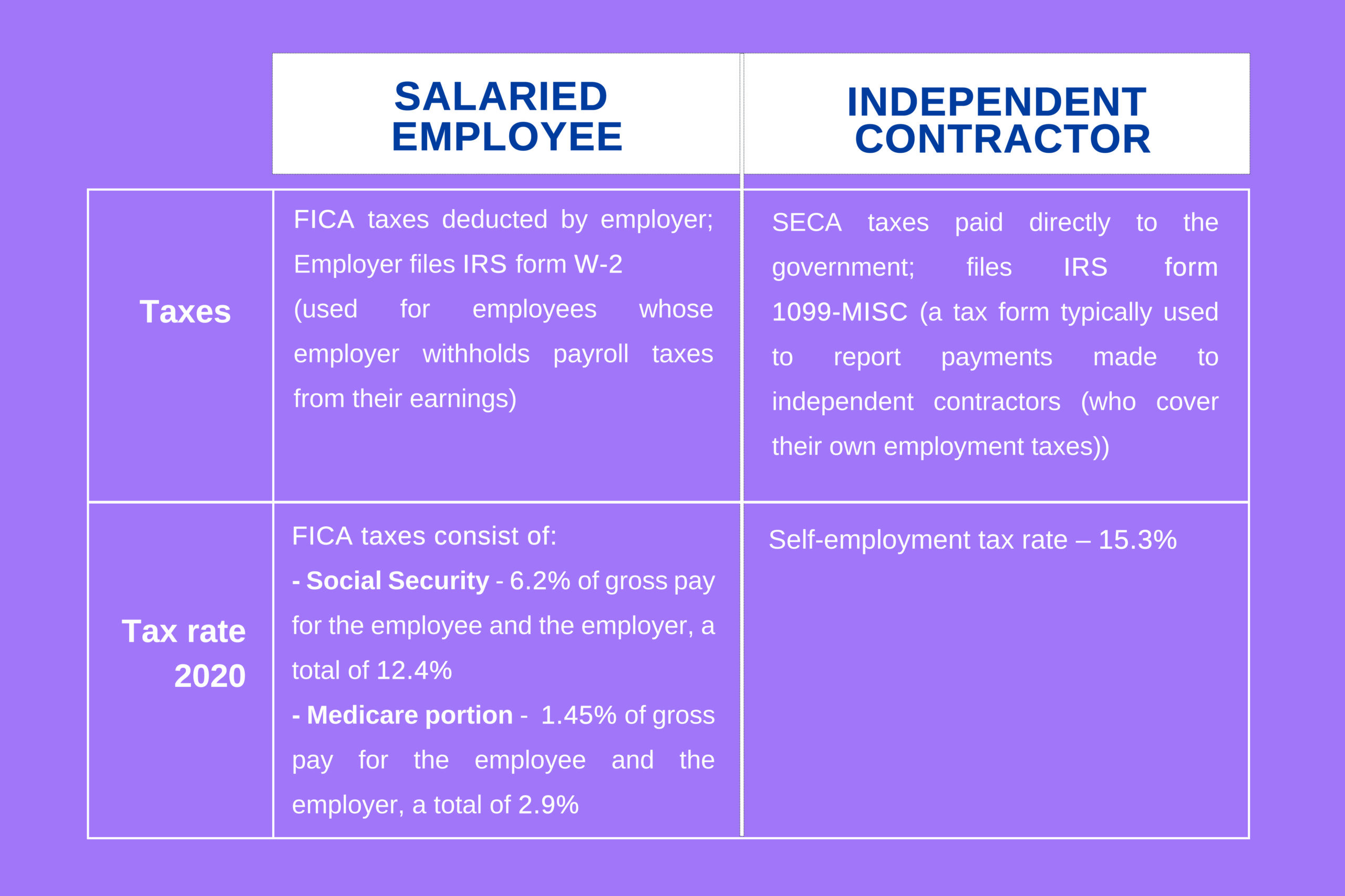
An employee or a salaried worker pays Federal Insurance Contributions Act (FICA) taxes just like their employer in equal parts.
The contractor, also called a commission-based worker is responsible for paying self-employment (SECA) taxes.
Check the below infographics for greater visibility:
Risks of Hiring Contractors Over Employees
For many businesses expanding overseas, it may seem sensible to start with local independents in the interest of saving money on taxes, benefits and the cost of establishing a legal entity. However, working with foreign independent contractors has multiple inherent risks.
Compliance Risk
Working in foreign nations can present pitfalls that you didn’t see coming. When you employ foreign workers, you must be certain that you fully comply with national and local laws and regulations regarding taxes and employment guidelines. Failure to meet compliance requirements can put you in a legal bind that can be costly and time-consuming.
Financial Risk
Employing foreign independent contractors gives you minimal control over their behavior or activities and how they represent your brand. They may even work for your competitors and promote whichever products bring the highest commission, losing you money in the long run.
Business Risk
Contractors are temporary employees with limited loyalty to any single entity except their own. Your competition can easily poach high performers, and low performers can harm your brand’s image. High turnover can result in loss of leads and customers and have a destabilizing effect on workforce morale.
Full-time Employee vs. Independent Contractor
✅ – Benefits and ❌ – Risks* :
Salaried employees
Independent contractors
Risks
✅ Minimal compliance and business risks. No misclassification risks
❌ May pose high-penalty risks due to misclassification
While using an independent commission-based sales force may be less expensive in the short run, a dedicated sales team that works exclusively for your brand will save you money in the long run. Moreover, the complexities and challenges are magnified if you take on contractors for projects in multiple countries.
Get the Best of Both Worlds with a Global Employer of Record
A Global Employer of Record (EOR) can provide the ideal solution to your overseas staffing problems. A Global Employer of Record (EOR) is a third party that acts on your company’s behalf to onboard and payroll your chosen foreign talent without establishing a foreign entity for your business.
Partnering with a Global Employer of Record (EOR) can benefit your business in multiple ways:
Increase the loyalty of your foreign salesforce without having to set up your own legal entity abroad. Delegate employee management to a Global Employer of Record (EOR) to handle the entire scope of employee hiring, retention, replacement, and compensation.
Build strong brand equity via a globally distributed workforce that represents your company proudly and builds customer relationships across the globe. Retain ownership of your client base after salespeople leave your company.
Protect your company’s security, IP rights, and client database from unscrupulous contractors without loyalty to your brand.
Build a hybrid salesforce that is 100% dedicated to your products and brand. Combining the expertise of independent agents or contractors with the loyalty of salaried employees creates a win-win situation that gives you the best of both worlds while mitigating your compliance, financial and business risks.
A Global Employer of Record (EOR) is less expensive than in-country incorporation, allowing you to exit unlucrative markets easily. You can start with a small team or even one person in multiple countries and go global now without waiting for your business to grow.
Global Employment Solutions at Your Fingertips
Working with a Global Employer of Record (EOR) partner can benefit businesses as they expand into new markets. A Global EOR partner is an entity that takes on the legal responsibility of employing workers in a foreign country on behalf of the business. The Global EOR partner is responsible for all employment-related matters, including payroll, taxes, benefits, and compliance with local labor laws and regulations.
Here are some of the benefits of working with a Global EOR partner:
Benefit
Description
Compliance with local laws
Global EOR partners ensure compliance with local laws and regulations, reducing the risk of legal disputes and fines
Access to top global talent
Global EOR partners have local knowledge and expertise, making it easier for businesses to find and hire the right talent
Faster time to market
Global EOR partners can handle all employment-related matters, reducing the time and resources needed to expand into new markets
Lower costs
Global EOR partners can help businesses save money by reducing the need for businesses to hire additional staff or set up local entities
Reduced risk
Global EOR partners ensure compliance with local laws and regulations, reducing the risk of legal disputes and fines
Compliance with Local Laws and Regulations across 190 Jurisdictions
One of the most significant benefits of working with a Global EOR partner is that they ensure compliance with local laws and regulations. This is especially important in countries with complex and ever-changing labor laws. Global EOR partners have the expertise and resources to navigate the legal landscape, ensuring businesses comply with all local laws and regulations.
Access to Top Global Talent
Working with a Global EOR partner provides businesses access to top global talent. Global EOR partners have local knowledge and expertise, making it easier for businesses to find and hire the right talent. They have established networks of local candidates, which can be especially valuable in markets with tight talent pools.
By working with a Global EOR partner, businesses can expand their talent pool and find the best candidates for their positions. This can help businesses achieve global expansion goals and compete more effectively in the global marketplace.
Faster Time to Market
Working with a Global EOR partner can also help businesses reduce the time and resources needed to expand into new markets. Global EOR partners can handle all employment-related matters, such as payroll, benefits, and compliance, allowing businesses to focus on their core operations.
This can result in faster time to market, as businesses can quickly establish a presence in new markets without having to set up local entities or hire additional staff. This can be particularly beneficial for businesses that must enter new markets quickly to take advantage of market opportunities or stay ahead of competitors.
Lower Costs
Expanding into new markets can be costly, especially if businesses need to hire additional staff or set up local entities. Working with a Global EOR partner can help businesses save money by reducing the need for additional staff or local entities.
Global EOR partners handle all employment-related matters, including payroll, benefits, and compliance, which can significantly reduce the cost of expanding into new markets. This can be particularly valuable for businesses that are expanding into multiple markets simultaneously, as it can help them save time and resources.
Reduced Risk
Expanding into new markets can be risky, particularly if businesses are unfamiliar with local laws and regulations. Working with a Global EOR partner can help businesses reduce the risk of legal disputes and fines by ensuring compliance with local laws and regulations.
Global EOR partners have the expertise and resources to navigate the legal landscape, ensuring businesses comply with all local laws and regulations. This can help businesses avoid costly legal disputes and fines, which can significantly impact their bottom line.
In summary, working with a Global EOR partner can benefit businesses as they expand into new markets. By ensuring compliance with local laws and regulations, providing access to top global talent, reducing time to market, lowering costs, and reducing risk, Global EOR partners can help businesses achieve their global expansion goals and compete more effectively in the global marketplace.
Hiring a Global Sales Team vs. Hiring Independent Sales Reps and Self-Employed Agents in Foreign Countries Hiring a Global Sales or IT Team in Foreign Countries: What You Need to Know Need Some Tips on Compliantly Firing a Foreign Sales Rep? Top Benefits of Full-Time Employee vs. Independent Sales Rep Global PEO and EOR Solution… Read more Hiring International Sales and IT Teams in Foreign Countries
Expanding operations into foreign markets is an excellent way to generate revenue by tapping into different monetary resources. In such a case, hiring local salespeople to represent your company in its target market is the best idea.
Successful global expansion is rooted in the efforts of a talented, remote sales force that help you break into the local market, communicate more efficiently with your clients, and consequentially generate maximum revenue.
Hiring a Global Sales Team vs. Hiring Independent Sales Reps and Self-Employed Agents in Foreign Countries
The Difference between International Salesforce Types
Foreign Independent Sales Reps
Direct In-House Sales Forces
Cheapest and free of legal hassles. High risk of employee misclassification with costly penalties for that.
Expensive and only companies with large budgets can afford it. Setting up the company’s legal entity in a foreign country is required.
Reduced team spirit, less engagement with the product, independence of sales reps that will be less likely to work as a team and be productive in the long-term.
High team spirit, product engagement, and high productivity by retaining the best team members long-term.
Hiring a Global Sales or IT Team in Foreign Countries: What You Need to Know
Depending on the needs of your business, you may want to hire an IT team to streamline your software development project or a bunch of salespeople to represent your company in the foreign market, which requires you to keep the following considerations in mind.
How a PEO Can Help Mitigate HR Compliance Risks and Exposures when Hiring International Teams
Activities for your global sales force or IT teams can differ based on your overall strategy, the product your company offers, the specific geography you’re trying to target, and how much involvement you want from your international sales staff. Many employment solutions can only help with a single issue, such as paying salaries to your global sales or IT teams. However, these solutions often do not assist you with the scope of activities specific to these teams. This can be a problem if you need help managing all aspects of your team’s activities.
These include paid travel, car allowances, and mobile phone provisions. In some cases, families may even be relocated to another country if an employee is sent abroad for business development.
Once you have engaged remote salespeople or IT teams and software developers in a legally correct manner to mitigate compliance risks and exposures, it is just as important to decide how you will stop cooperation with them. Whether due to changes in your company or theirs, it is essential to have a plan to end the relationship to protect yourself from any legal issues that could arise.
Need Some Tips on Compliantly Firing a Foreign Sales Rep?
As an employer company, it is often necessary to ‘divorce’ yourself from a salesperson or IT developer whose services are no longer needed. However, it is also essential to protect yourself from any unexpected resignations from your IT team or other staff members. Unexpected resignations can often lead to substantial financial losses for many companies.
As your business grows, you’ll need to evaluate which type of salesforce or IT team members will be the best fit at different stages. Self-employed foreign reps or IT developers can be a good option during the startup phase. However, if you’re looking to serve strategic partners, you’ll likely need fully committed international sales or IT professionals.
There are several reasons why an employer may not be able to fire an employee legally. These include immigration status, retaliation, or refusal of lie detector testing. It is essential to be aware of these before taking any action.
If you have an employee leaving your company, pay them all outstanding wages for work done. This includes any final payments, no matter how poor the quality of the work may have been. If the employee is required to sign any nondisclosure agreements, make sure they do so before leaving.
Top Benefits of Full-Time Employee vs. Independent Sales Rep
Global PEO and EOR Solution for Hiring International Sales and IT Teams
A neutral body that takes over the whole scope of foreign-sales-teams activities on your behalf, regardless of the number of salespeople and countries where you want to hire them, can be the best way to go. Companies of this kind are primarily known as Global Professional Employer Organizations (PEOs). Companies of this type are very broad in character and scope.
Global PEO company is your single partner with international experience and standardized employment reporting procedures.
Acumen International is a Global Professional Employer Organization and Global Employer of Record. Its global network is set up in different countries with established jurisdictions in all matters about HR, taxes, accounting, payrolls, compliance, labor, and employment. It provides an excellent solution that is equally compliant across 190 countries.
At Acumen International, we take on all the legal, financial, and contractual responsibilities for employers and foreign workers. This way, employers only have to sign a single service agreement, and employees only have to sign an employment agreement. We make the whole process simpler and more accessible for everyone involved.
Third-party Global Employment Solutions: Be as Agile as Possible with a Global PEO and EOR Partner
Before thinking about hiring employees, you’ll need to set up your business entity and jump through all the associated hoops. This can include paying taxes, setting up a compliant payroll system, and sometimes applying for a social security number from the tax authorities. These additional steps can take anywhere from a few weeks to several months.
As your business expands globally, it is important to be agile to make the best decisions for your company. Markets and consumer demand are constantly changing, so it is vital to be as flexible as possible. The more agile you are, the easier it will be to make the right choices for your business.
Outsourcing can be an excellent way for organizations to save money and increase efficiency. By carefully selecting which global employment functions to outsource and working with a trusted partner, businesses can reap the benefits of outsourcing without putting themselves at risk. Outsourced standard functions include payroll, benefits, and absence management, but the decision of which functions to outsource should be made case-by-case. With careful planning and execution, outsourcing can help your organization run more smoothly and save money in the long run.
When expanding your business into new countries, there are many benefits to using a global PEO (Professional Employment Organization) or EOR (Employer of Record). A Global PEO and EOR Partners can handle all the immigration, hiring, payroll, tax, and HR compliance for you, freeing up your time to focus on other aspects of running your business. And if you ever need to leave the country, you can do so without being tied down by any long-term commitments.
Benefits of Building an International Sales Team or IT Team with a Global PEO Partner
Quickly and Easily Enter International Markets with PEO: No Entity Setup Needed
Starting a business is costly, whether you use a PEO or set up your legal entity. However, working with a PEO can save you money compared to the latter option. With a PEO, you benefit from their years of experience and knowledge of best practices, which can help reduce costs. In contrast, setting up your legal entity takes up valuable resources and staff time, not to mention the added cost of complying with various regulations. Therefore, working with a PEO is the way to go if you’re looking to cut costs and streamline your operations.
There are many benefits to using a global EOR (Employer of Record) or PEO, including cost savings in entity setup fees. By partnering with an experienced and reputable company, you can leverage existing legal entities in other countries, which can help you save money and time.
When considering the benefits of using a global employer of record, companies can expect to save money when entering or exiting international markets and hire top talent quickly. Additionally, this method allows companies to draft and maintain compliant employment contracts, manage all payroll and tax withholdings, and ensure a quick entry or exit from international markets.
Quick Time to Market and Ability to Hire Top Talent Faster
Global expansion is a complex and time-consuming process with many potential pitfalls. A professional employer organization (PEO) can help you navigate the process and establish a presence in your chosen country quickly and efficiently. By tapping into the global talent pool, you can expand your reach into new markets with a sales force or IT developers that speak the local language and understands the nuances of doing business in that country.
A PEO can help you establish a presence in your chosen country quickly and effectively. Setting up a legal entity can be lengthy, sometimes taking up to 12 months. This can lead to delays and setbacks in your global expansion plans.
This is where a professional employer organization (PEO) can be extremely helpful. Compared to the time and effort required to set up a legal entity, using a PEO is much quicker and easier. This can be crucial when maintaining momentum during your expansion and avoiding the loss of potential candidates, clients, or other opportunities.
Full HR Compliance and Streamlined Employment Processes
No question starting up a legal entity takes significant time and effort. Not to mention, there are always added costs associated with compliance and other red tape issues. However, using a PEO can help alleviate many of these concerns.
A PEO can help ensure HR compliance during your business expansion. On the other hand, setting up a legal entity exposes you to compliance risks that could impede your ability to reach your target market. Countries have different employment laws, which can change suddenly and without warning. This leaves your team scrambling to catch up and adapt business practices, a process that can lead to non-compliance. A PEO, however, has extensive knowledge of employment regulations around the world and can advise on a variety of employment legislation, including:
Compliant employment contracts
PTO (sick pay, holiday pays, etc.)
Parental leaves
Holiday entitlement
Hiring and firing practices (termination, notice period, etc.)
Global PEO Can Protect You from Sales Rep Employment Risks
An employment agreement usually includes a 2-week notice period, which can help companies avoid sudden resignations of employees that might lead to decreases in sales and, subsequently, profit loss.
Many companies have expanded internationally and have found that using a global PEO solution is very beneficial. This is because it allows them to get employees who are fully committed to the company and similar to the sales teams they already have in-house. In addition, it allows them to keep these employees for an extended period, which protects the company from any employment risks. Acumen International is a legal employer and therefore takes on all employment risks. This can save the company a lot of money that would otherwise be spent on setting up expensive business entities overseas.
Global PEO Is a Cost-Effective Global Employment Solution
Compared with traditional direct sales force hiring on own entities, employment using the Global PEO solution is much cheaper, flexible, and risk-free for the employer.
An international workforce that you employ using our Global PEO solution is a kind of hybrid of independent and direct salesforce. Here are the advantages of Sales Rep employees:
Hired compliantly
Dedicated and fully engaged with company product
As the parent company’s employees, they are obliged to fulfill global strategy and advocate the brand, not simply make sales and earn a commission like in case with independent sales reps
Lower expansion cost
Flexibility, lean approach: companies can enter more markets, test the markets before they decide to get established there, and quickly withdraw from unattractive countries.
A substantial benefit of long-term staff is that it gives your company the ability to build strong brand equity and make the company and your product recognizable in the foreign market. With short-term sales reps, you risk losing everything if the person decides to leave. In the long run, strong brand equity allows you to reduce overhead costs so that you invest less in the promotion of your products in the foreign market over time while enjoying the same sales volumes and revenues.
Global Payroll Made Easy and Affordable
One of the most challenging aspects of business management is keeping up with payroll. Maintaining an accurate and up-to-date payroll is vital for any business, large or small. But for businesses with sales or IT employees in multiple countries, keeping track of different payroll laws and regulations can be daunting. This can be even more difficult when you have employees in different countries, each with its unique payroll laws.
When managing payroll for international employees, businesses must be mindful of each country’s different tax, payroll, and employment laws. This can be daunting and time-consuming, with stiff penalties for non-compliance. Acumen International payroll services can help you navigate international payroll and employment laws and take care of all the details, so you can focus on running your business.
Global Employment Cost Assessment
In today’s business world, it’s more important than ever to be mindful of costs when expanding your company internationally. Hiring talent in different countries can be expensive, so you must know each country’s compliance, tax, labor, and immigration requirements. One way to save money when hiring employees or independent contractors is to choose the most cost-effective and business-friendly country. This can help you reduce expenses by up to 50%.
Different countries have different labor laws and benefits, so it’s essential to do your research before making a decision. So why not take advantage of our Global Payroll Calculator — the advanced country-by-country employment cost comparison tool? With just a few clicks, you can compare the payroll costs, benefits, employer and employee taxes, and mandatory benefits for 190 countries. The Global Payroll Calculator can make it much easier to find cost-effective locations for your next global expansion move.
The tool considers local taxes, payroll regulations, benefits, compliance requirements, and other labor-related factors that can impact an employer’s budget. By tracking developments in 190 countries worldwide, the research team behind the calculator strives to keep the data up-to-date so businesses can make informed decisions about expanding their operations internationally.
Get Ready To Conquer The World: How A PEO Can Help You Dominate Any Industry
There are many benefits to using a PEO, including saving on compliance risks and time-consuming set-up processes associated with setting up a new legal entity. PEOs are also cost-effective and quick, making them a great option for businesses looking to start the market quickly and efficiently.
If you’re looking to hire and expand on a global scale, you need a partner that can manage payroll, HR, work visas, and employee benefits compliantly and smoothly. Acumen International is that partner. We have the expertise and experience to navigate the complex international employment laws and visa requirements so you can focus on exploring new business markets. Let us help you realize your global expansion goals.
Technology has made it easier for domestic companies to engage in global trade and engage talent internationally. However, onboarding, payrolling and managing foreign workers is a complex international employment challenge for many businesses. Navigating the changing in-country laws and regulations, often in a foreign language, may be outside the skillset of your company’s HR department.… Read more 3 Global Talent Hiring Models: Which is Right for Your Company?
Technology has made it easier for domestic companies to engage in global trade and engage talent internationally. However, onboarding, payrolling and managing foreign workers is a complex international employment challenge for many businesses.
Navigating the changing in-country laws and regulations, often in a foreign language, may be outside the skillset of your company’s HR department. Not to mention recruiting, onboarding, and compensating a global workforce in ways that are compliant with local labour law regulations.
Thankfully, solutions are designed especially for companies like yours who want to expand abroad. The key is choosing the right one.
What to Consider Before Choosing the Global Hiring Model that Fits Your Company Best
The complexities of legally engaging workforce in foreign countries pose major stumbling blocks for many companies, especially SMEs. However, the misconceptions shouldn’t keep your business from international expansion or hiring. In order for you to choose the method of hiring and rewarding your international workers, you need to answer the following questions:
How are we going to do international money transfer? Is the security of our company’s funds addressed properly? To compensate workers internationally, you cannot simply transfer money to global workers as you may be exposing yourself to compliance risks in many cases. Many companies use platforms like Upwork to hire and pay freelancers for works completed. However, that mostly works for one-time projects that are not key to your business. If you plan to engage a highly skilled foreign talent long-term for them to fulfil some key business tasks for your company, you must enter into a contract with the independent workers or with a third-party agency that would pay your global workers on your behalf. This kind of agency is usually in charge of secure money transfers from the client to their workers, regardless of where in the world they pay workers for you.
Can I use payroll outsourcing to pay my foreign talent overseas? Payroll outsourcing is not as simple as it may seem, since you need to have a registered entity in the host country or countries, and act as a legal employer for your global employees. That means your company carries all global employment risks. A global PEO (professional employer organization) is an alternative solution that can employ workers on your behalf, eliminating the need for you to open your own entity and therefore taking employment risks of a legal employer while providing a workable solution.
How do I remain compliant with the local laws and regulations if I am not aware of the legislative norms? Violating local laws and regulations when engaging and rewarding global talent can lead to fines and penalties, or even prison in some countries. Some companies may be banned from working with independent contractors and be forced to hire only full-time employees if they are found guilty of misclassifying global workers they are engaging. Choose the solutions that ensure 100% compliance to protect yourself from compliance risks
3 Key Options to Pay Workers Internationally
Even the best HR professionals often have no idea of how to hire and fire a global workforce, and it is often a learn-as-you-go proposition. Most businesses who need to hire global talent use one of three approaches:
Foreign Independent Sales Agent
EGE Solution = Fully Committed Sales Rep
Own Foreign Subsidiary
Dedication and commitment
Fast Market Entry
No Employment Risk
Cost Effectiveness
Rely on independent contractors and freelancers to fulfil overseas business demands. The remote global workforce is growing by leaps and bounds, and finding experienced freelancers with the qualifications you need is becoming increasingly easy. However, locating, recruiting, communicating with and compensating workers internationally can be time-consuming, and it can get a bit messy if you have to keep track of multiple freelancers at once. Moreover, language barriers may make communication with global talent difficult, not to mention independent contractor/employee misclassification risks as the legal boundaries are often blurred between both.
Directly hire international professionals on your own. While this may seem like the most direct and least complicated option, it is not as easy as it seems. Before you hire global talent in your target market, you will need to do some market research and establish your company as a foreign entity in the country where you intend to do business. This can involve months of bureaucratic red tape. In addition, you will need to consider taxation and the overhead costs. When your overseas project comes to an end, you will need to hire lawyers to liquidate your international business entity. This way is the most expensive too.
Hire a global PEO solution/service provider to officially employ and payroll your global workforce, regardless of where they are based. A global PEO provider can become a company’s best international friend and business partner, helping you to overcome the challenges of international employment so you can concentrate on growing your business. A global PEO provider can help companies of all sizes get established in foreign markets in the following ways:
Attract and acquire global talent, and officially employ them on your behalf. Partnering with a global PEO reduces the risk of your acquired talent defecting to your competition for a better offer. A global PEO lets you tap into a global talent pool to meet local talent shortages, saving you money while you build your company’s brand.
Expand into different markets at a measured pace. You can start small and hire incrementally as your business grows, reducing your initial costs as you build larger revenues. A global PEO reduces your business setup time by eliminating the need to establish or liquidate your own local entity
Provide local client support, helping you navigate local labor laws and regulations to smooth the way for increased revenues from your international project.
Benefits of a Global Employer of Record
A huge plus of partnering with a global PEO is that you don’t have to invest funds in opening your own entity in multiple target markets and yet get established in the target market or markets. You can reduce the costs of market research and eliminate the need to hire a legal team to liquidate your entity, should you decide to leave a certain country. It is enough to simply terminate the employment agreement with the employee that you hired in that country. In addition, a global PEO will safeguard your company’s international flow of funds and protect your intellectual property rights.
Despite lucrative opportunities abroad, SMEs with a limited budget or small staff often think they are not ready to expand globally. For such companies, a global PEO can provide an interim solution while you test the waters of foreign markets prior to establishing a permanent foreign entity. Working with a global PEO offers a safe, affordable international solution for some SMEs that have tight budgets and seek to save the initial overhead cost while hiring international workforce to meet their global business needs. Moreover, a global PEO can stand in the gap to keep things running smoothly during any kind of restructuring, such as a merger or takeover.
As a flexible hybrid solution, a global PEO lets you tap into the global workforce pool to distribute different workloads, shift work, project work and commission-based payments. A global PEO ensures your company remains fully compliant with local laws and regulations, saving you the headache of figuring it out on your own.
Some companies that have worked with us several years so far have chosen to employ and payroll their global workforce through a global PEO solution as an alternative to a direct hire through their own entities.
Acumen International, Your Global PEO Partner
Engaging an international workforce to scale your business is a big decision, riddled with countless unknowns. Acumen international has been providing global PEO services to companies like yours for over 20 years, and we have experience and capacity to support clients in 190 countries. Our Express Global Employment solution takes the guesswork out of hiring and compensating workers internationally, both local nationals and expats including work permit and visa support. Contact Acumen today and explore your options for taking your business abroad.
In autumn of 2019, the California AB-5 (Assembly Bill 5) law was passed, and it came into effect on January 1st, 2020. For companies based in California or doing business in California, this set off a cascade of changes regarding worker status and the steps companies have had to make to avoid misclassification.
In addition, there’s the chance that this law may be a precursor to other legislation on the subject down the line. However, at the same time that companies have begun to adapt to this law, there’s also another universal business change: adapting to the COVID-19 pandemic. As a result, any companies dealing with global hiring/HR managers should be watching how these two trends intertwine.
The Details on AB-5
Another law that was designed to have a similar impact to AB-5 was IR-35 in the U.K. While the coronavirus resulted in a delay of this implementation (originally April of 2020), it was primarily concerned with the UK employers’ staying compliant when hiring independent contractors, and making sure that workers classification is handled appropriately for income taxes. AB-5 has some similar focuses, but let’s take a closer look at the main details of the law.
AB-5 requires workers to be classified as proper employees unless they can prove they fall into three specific categories:
A worker free from control/direction of the hirer related to work performance, both under contract and in fact.
A worker doing jobs outside of the hiring entity’s normal business.
A worker engaged in an independently established business/trade that’s the same as those involved in performed work.
If all three of these criteria aren’t met, the worker is classified as an employee, giving them full rights including employee benefits, employee protections, and other applicable items. Other states, like New Jersey and Massachusetts, also have their version of these laws on the books.
The first companies to see major consequences from this were app-based ones like Uber and Lyft, which hired independent contractors as the body of their workforce. These were some of the first companies to have trouble with the bill, as paying for all these benefits per the new law made their models go from cost-effective to troublesome. Depending on which side of the debate you are on, the ability to have off-payroll working rules was either a benefit or a major issue.
Many people who were truly independent contractors were worried they would lose all of their clients due to them no longer being able to afford them. This was a major reason why the bill had so many opponents at its inception, and still does today.
This is a smaller part of a greater debate that’s going on globally with regard to worker reclassification. This essentially entails the idea of treating contract workers as full-on employees. The main argument here is that it opens up the possibility for basic benefits, such as minimum wage and unemployment insurance. This bill and the ripple changes for employment law and labor codes have reshaped the “gig economy,” and have a lot of companies rethinking how they bring on professional support.
How Does Coronavirus Factor In?
In many ways, the coronavirus has created a sea of changes across the world of employment. You see businesses struggling with lack of clients, the shifts to a remote workforce, but in California, the debate over AB-5 has boiled hotter, with new arguments on both sides. Advocates for the law say that it’s important now more than ever that all workers have the ability to get healthcare coverage, sick leave, and other protections in a pandemic climate. Opposition for the law notes that the U.S. is already headed towards a recession, possibly a historic one, and there’s no reason for additional red tape taking valuable workers off the table.
With all this said, if businesses had to only consider compliant measures before in the past, today, it’s absolutely necessary. Different governments are providing temporary protections for gig workers, but that’s still a band-aid solution for the greater question of worker classification. When the dust settles from this pandemic, employers will ultimately be responsible for classifying workers correctly to avoid potential fines or lawsuits.
While AB5 may just be relevant to California in the U.S., it could serve as a bellwether for greater employment classification changes around the world. It’s always best for global companies with staff in several countries and multi-site projects to be ahead of the curve. This is where an international PEO and payroll solution company comes in, such as Acumen International. We take the time to learn about rapidly-changing in-country labor laws and regulations so you don’t have to keep track.
Always know that you’ll have HR and legal compliance with our help. No need to add on extra concerns while the business world grapples with the coronavirus.
April of 2020 is going to mark a major change in UK in-country labor laws and regulations, with the expansion of IR35 laws. For many companies, this is going to mark a major shift in the way that they use independent contractors. That means it will be more important than ever to make sure that… Read more IR35 And What UK Employers Hiring Independent Contractors Should Know
April of 2020 is going to mark a major change in UK in-country labor laws and regulations, with the expansion of IR35 laws. For many companies, this is going to mark a major shift in the way that they use independent contractors. That means it will be more important than ever to make sure that your company is adequately prepared if you plan on doing business in the UK now or in the future. Here’s a closer look at what these laws entail and how your company needs to react.
What Are The IR35 Laws?
Technically, IR35 has been around for quite some time. In its original form, it was designed to keep companies from engaging in “disguised employment.” This essentially refers to the practice of a company having a worker registered as an independent contractor, but essentially doing all the same tasks an employee would. By taking this route, they can save on income taxes, but are skirting the rules.
IR35 enabled Her Majesty’s Revenue and Customs (the UK tax authority) to collect an additional payment under these circumstances. For example, if a contractor was working through an intermediary, such as a limited company, and would be an employee of their client if not for said intermediary, IR35 would apply.
Curious if this applies to your employees? Here are a few signs that your employee may be more of an independent contractor:
Doing their service billing a personal services company (PSC)
Creating their own business, then paying themselves a salary
Getting income classified as dividends. These are exempt from contributions to National Insurance.
Paying a lower amount than 45% in income taxes on earnings
To give you an idea of the last point, full-time employees would be paying taxes/NICs up to 45% and 12%, respectively. Basically, this means more income for the employee, but less tax money for the country (IR35 does not apply to the self-employed). By 2017, reforms to IR35 resulted in an additional £550 million brought in through income tax and NICs, and many workers across the country needed to reclassify.
The government regulators considered this a major success and is now extending from public sector employees to private-sector employers. The 2020 update is likely the reason that you’ve seen a lot of 2020 updates lately regarding IR35. The major change is extending the provisions set in 2017 to
to independent contractors, recruitment agencies, and medium/large companies in the private sector.
Note that approximately 1.5 million small private businesses are exempt from this set of updates. Here are the criteria to define those:
Employing less than 50 people
Annual turnover of less than £10.2 million
Balance sheet must have a maximum total of £5.1 million
Preparing Your Company For IR35
So, let’s say that you don’t fall into any of the above categories. How can your company prepare? The first step you can take is using the HMRC tool called CEST to classify your workers and figure out if they apply as independent contractors. If you are honest, you should get an accurate answer, though there may be some exceptions. If you disagree with the answer, be sure to see a tax specialist for guidance. If a worker disagrees with your statement, you have 45 days to respond. Make sure you have a dispute resolution policy, as there may be many examples of conflict here.
These aren’t the only steps that you should take to protect your business. Some of the other items your company should focus on include:
Planning for any related costs
Revisiting worker status for those employed through outside contracts or PSCs
Seeing if IR35 provisions will alter contracts after 2020
Talking to current contractors about relevant changes
Establishing a plan for any future working relationships that may be impacted by IR35
Perhaps the most important thing is figuring out what to do with your off-payroll employees now and in the future. A key step to take here is making sure you have a different onboarding method to ensure they aren’t taking part in employment practices they are not entitled to. If you plan on partnering with PSCs or similar businesses, you also need to make sure they have systems on the books that will guarantee compliance. Be sure that you are mindful of other off-payroll working rules as well.
For example, the PSC can pay the worker outright. This is managed through their payroll without deducting any more tax. As an alternative, they can receive payments as dividends. On the other hand, HMRC has confirmed that they will not normally seek tax from earlier years if the treatment has changed.
Overall, despite these facts, using a global PEO solution is the best way to ensure you stay in HR and legal compliance with all employees or independent contractors across multiple countries, not just the UK. IR35 law is only one example of the various ways that we can expect employment laws to evolve in the future.
Acumen with its hyper-local expertise in labor codes of over 190 different countries is your ideal way to stay compliant without the need to learn multi-country legal terms and requirements. In addition, our global EOR service frees you from the need to open a separate business entity to operate internationally.
The gig economy has changed the way a lot of companies do business. Even for the most established professionals, working with independent contractors has been seen as a method to help cut down on costs and potential legal liabilities. However, this method opens up a new liability of its own, namely, worker misclassification. Not correctly… Read more What Makes Independent Contractor Compliance Essential
The gig economy has changed the way a lot of companies do business. Even for the most established professionals, working with independent contractors has been seen as a method to help cut down on costs and potential legal liabilities. However, this method opens up a new liability of its own, namely, worker misclassification. Not correctly identifying worker status leaves a major compliance risk, and potential loss of intellectual property. Here’s what you need to know.
Independent Contractors Vs. Employees: The Landscape
The main reason that workers’ status is so important is that you have government agencies at the federal, state, and local levels looking for things to make sure the appropriate taxes are collected. This is especially important for international businesses, as tax agencies will audit them to make sure all taxes are covered, and that independent contractors aren’t crossing over into employee’s duties. If not, fines will be imposed.
If you’re looking to go abroad and avoid employee misclassification risks, solutions like Acumen’s Independent Contractor Compliance (ICC) or a Global Employer of Record service are key so you can follow classification/tax regulations both in your base country and where you are doing business internationally. In essence, global businesses hiring globally dispersed teams have twice the classification risk.
One of the major differences between the two categories is that an independent contractor and employee are entitled to different items, like healthcare, benefits, time off, etc. As workers in the gig economy are beginning to lobby for more and more employee status, the risk grows. Not only do non-compliant companies find themselves at risk for fines, but there’s also a brand hit and potential criminal charges. In many cases, contractors may lead the charge, reporting to the government if they feel misclassified.
One final note here is that because of the rise of the gig economy, employees and contractors are becoming more blurred. This means that, technically, you may not misclassify someone, but still end up getting fined because the demarcation isn’t as clear.
Avoiding Employee Misclassification Risks Through A Global PEO Solution
So, you want to go global, but also protect your company. A global PEO solution is the ideal step to take here. In essence, by working with a PEO company, you are hiring full-time employees, but a third party helps you with regard to the responsibilities you have, like payroll, global corporate tax, legal and HR matters, employee benefits provision, for example. Yes, this costs more upfront than working with an independent contractor. However, this is not just a cost—but an investment in your security and freedom from financial and other losses.
In general, investing in your employees when managing globally distributed teams is a good trait to follow. Not only does moving from independent contractors to full-time employees give your team more trust in you, it also avoids the constant turnover that happens in a lot of work environments. It’s also best for the long-term. You don’t have to worry about penalties for noncompliance, or paying more down the line to convert your contractors to full-time employees later if needed. In addition, being on your team formally means you don’t have to worry about employees taking IP with them if they leave. In addition, employee loyalty grows as they feel as part of your global team.
When you choose Acumen as your global PEO provider, you’re getting more than a partner to help you avoid workers misclassification. We combine PEO with a variety of other services, like an online payroll calculator to help you find the cost of employing a specialist (both local and expat) in 190 countries.
The gig economy isn’t new and is here to stay. In which case we’ll continue to observe a substantial evolution of the way companies do business. That’s especially relevant for those doing business globally. Above all, the projects’ implementation requires human resources. Here’s where hiring comes in to play. The key task is to see… Read more A contingent workforce in the GIG Economy: How global employment is shifting
The gig economy isn’t new and is here to stay. In which case we’ll continue to observe a substantial evolution of the way companies do business. That’s especially relevant for those doing business globally. Above all, the projects’ implementation requires human resources. Here’s where hiring comes in to play. The key task is to see the hiring process as a negotiation, with a view to form a partnership, as the article originally published at Vervoe states. Technically, that partnership is between a business and an employee. But in reality, it is a partnership between human beings who need to work together and achieve common goals.
In global hiring, the rise of a contingent workforce signals the above evolution, marking a challenging shift for both employees and employers. If highly-skilled workers seek flexible employment, an alternative to the traditional full-time to maintain their independence, then companies in their turn, are apt to make the most of that talent to meet their business needs. The challenge for businesses seeking the top-notch skills that contingent labor can provide is to pay those workers properly and compliantly. As an employer, you can engage your global workers in different ways. Which, in its turn, determines the worker-organization relationships and therefore the following worker classifications:
Employees: These are staff employed directly by the company they are working for.
Independent contractors: These workers stand on their own. They provide services and are paid on completion. They are not employed by any company. At the end of their work they provide an invoice for payment.
Contingent workers: As such, they are not employees of the firm they are working for, and the business owner has no responsibility to provide continuous work on a permanent basis.
These workers are hired to complete specific tasks under a statement of work (SOW) provision. Generally, it could reduce the cost and strain required to manage more employees, in the form of benefits administration, training/development, etc. Contingent workers are responsible for their own taxes as they work for themselves — not the company. However, using a contingent employment model on a permanent basis can bring lots of trouble for you as an employer: the most significant risks of using contingent workers lie in the legal consequences of misclassifying them. You’ll face significant liability under tax law, wage and hourly regulations, and other employment laws if a court or administrative agency determines that your contingent workers were actually employees. The company can be hit with fines and penalties on top of having to pay the taxes owed to that employee. Another issue is confidentiality. An employer that uses contingent workers has no guarantee that they won’t move on to a competitor. That’s particularly true when workers possess specialized skills and expertise that limit the number of companies for which they can work. The no benefits issue lies in the fact that contingent workers receive no benefits compared to their directly hired colleagues, and it may be tricky to retain this talent, paying him/her only the salary. Some contingent workers even feel as “second-class citizens” compared to regular employees or as if they aren’t a part of the team.
It’s critical for you to understand the differences between these types of relationships, as confusing them causes a growing number of lawsuits. The relationship of the workers to your company is a key concern to federal and state governments, in particular the agencies responsible for collecting payroll taxes. That’s why the worker’s employment status is crucial for both a company and a worker. The contingent or gig workers tend to be classed as ‘dependent contractors’ making them more connected to the company engaging them. But again, it’s up to the HR departments of the companies hiring globally to take that into account when developing their strategies.
Hiring a global workforce always takes time and effort. Need to quickly and compliantly onboard your international talent? For that we have designed our solid Global Employer of Record solution. We at Acumen International help you handle all of the above challenges with 100% legal compliance, thus giving you a superpower to attract and retain the best-of-breed global talent.
We are currently at the peak of information technology; it has never been easier to communicate on a global scale as it is today. Globalization is the only way to expand into new markets. Many businesses are spreading their influence into foreign markets to grow their brand and increase sales. However, setting up an international… Read more How to Avoid Troubles while going global in the Era of Globalization
We are currently at the peak of information technology; it has never been easier to communicate on a global scale as it is today. Globalization is the only way to expand into new markets. Many businesses are spreading their influence into foreign markets to grow their brand and increase sales.
However, setting up an international labor force is the biggest challenge when it comes to expanding into foreign countries. It can be rather cumbersome and time-consuming. If you are looking to hire human resources overseas, here are some of the hoops you will have to jump through:
Work permit
An employee must have a work permit to work abroad or for a foreign company. Its acquisition may take months in some regions. Different countries have different and often stringent work permit requirements. Most of these processes involve legal compliance, proof, and qualification certification. Some governments make it considerably difficult to bring in foreign workers to get their citizens employed instead. Others are opposed to specific foreign investors as they can be believed to pose unfair competition to local businesses.
Visa
After securing a work permit, an employee needs a visa to travel to a foreign country. The granting of a visa may depend on several factors that neither the employer nor the employee controls. Diplomatic relations, political climate, and other social factors may hinder one from being granted a visa or at the least require fulfilling several demands. In addition, a visa is only issued for a limited period, after which it must be renewed.
Foreign Labor Laws
Different countries have different labor laws. These laws dictate the employee-employer relationship, employee rights, and other work-related social and wellbeing requirements. Specific labor laws may force an employer to reevaluate the entire human resource structure. In some countries, labor laws are complicated and detailed, to avoid the hefty fines and penalties imposed on lawbreakers, most employers opt for a legal consultant specialized in labor law to handle such matters.
Three Engagement Models of Global Employment
As an employer onboarding and tasking employees in foreign countries, you are responsible for handling all the legal matters involving permits, visas, and labor laws. On top of that, you are also responsible for the employees’ wellbeing – housing, transport, ideal work environment, and the like. To ease the burden, international employers opt for one of three conventional services to assist in global employment.
1. Independent Contractor
You can hire the services of independent workers in foreign markets on a contract agreement rather than on a more tedious employment basis. Independent contractors are flexible and can tune their efforts quickly to promote your services and products in a market they are already familiar with. Business often hires contractors for sale purposes in an affiliate arrangement.
The problem with contractors is that they are not representative of the company or brand. Chances are, a single contractor may be working for several companies simultaneously. Time and resources must be divided among the various clients, including competitors. Besides, a contractor is not under the direct control of the employer.
2. Local Staffing Agency
Local staffing agencies work in the foreign country, source, vet, and hire local employees on your behalf. They take care of all the staffing within the local country’s legal framework, eliminating the need for legal consultation. They also serve on contract as an intermediary between the employer and employee.
Local staffing seems like an ideal solution for global employment. The problem is these agencies are localized in their host countries. If you are looking to employ workers in multiple countries, you’ll have to deal with several agencies in all the different countries. There are also some significant risks while working with local employment agencies.
You are not in control of the hiring process. The agency does the sourcing and vetting of qualified employees. You may have an unproductive labor force if the vetting process is not thorough.
The contact with the agency is agreed upon within the agency’s host country’s legislation. This means you’ll still need some familiarity with the contract’s foreign law.
You will still need to set up a payment platform for foreign workers. Usually, this is done by international funds transfer services and banks. Some countries are open to international funds transfers, others need persuasion, and currency exchange fees are included.
3. Establishing a Legal Entity
To grasp foreign law, you might find yourself hiring a legal entity to guide you through the legal framework of hiring employees in a foreign country. A local legal team with vast experience in labor laws in different countries is ideal for smoothening the hiring process since they know all the hurdles to jump. A legal entity also saves you time filling out legal paperwork and speeds up hiring.
Legal counsel and assistance are not cheap. Hiring international employees is lengthy, and retaining a legal entity for an extended period may be very expensive. A legal entity will only cover matters regarding the law; you will still need to put in much time and effort to resolve other hiring affairs.
Global Employer of Record by Acumen International
An international workforce in a foreign market is an invaluable brand promotion and representation resource. However, the conventional hiring of foreign ambassadors is no longer effective; they present new problems requiring more resources. Innovations in international hiring services come from Global Employer of Record.
A Global Employer of Record (GEOR) is responsible for hiring and retaining a foreign workforce on your behalf. The company rendering such services covers hiring and employee upkeep, including payroll, amenities, and legal compliance for locals and ex-pats. GEOR eliminates the need for expensive infrastructure and additional human resources in legal counsel and agencies to hire and maintain employees in foreign countries.
The global Employer of Record contract is within the legal jurisdiction of your local country, which stays in favor of its citizens. GEO also reduces your exposure to misclassification risks.
At Acumen International, we provide a risk-free, fast, and reliable global employment solution. We are a Global Employer of Record, serving in over 180 countries and growing. We employ foreign workers on your behalf and take responsibility for their welfare. Our goal is to make it easy for businesses to expand to overseas markets by providing hassle-free, 100% compliant international employment services.
Call us for a free no-obligation consultation on our service to onboard your foreign workers.
Before we get into the cases where a company may prefer employees to contractors and vice versa, let’s first clarify; who is an employee, and who is a contractor. At some level, the two may appear to be similar since a company can opt for either an employee or a contractor to perform the same… Read more Employees VS independent contractors: what is the best fit for your business goals?
Before we get into the cases where a company may prefer employees to contractors and vice versa, let’s first clarify; who is an employee, and who is a contractor. At some level, the two may appear to be similar since a company can opt for either an employee or a contractor to perform the same duties; however, the two are entirely different entities from certain perspectives.
Key Differences Between Employees and Contractors
Here are some of the critical factors that set apart employees and contractors.
An employee is a long-term worker hired on either a full-time or a part-time basis and is answerable to the employer company. A contractor (also known as an independent contractor) is a self-employed laborer hired by a company on a contract basis to complete a specified task or series of tasks, usually within a given period.
Several enforceable employment and labor laws cover employees, both federal and state. Labor and employment laws do not cover an independent contractor. By law, employees have a right to certain benefits that should be provided by the employer such as insurance, housing, commute, and welfare depending on the state and job. Contractors have no right to any benefits.
An employee earns hourly, daily or monthly rates paid in wages or salaries. And reports all money paid for taxation in a W-2 form after every tax year. A contractor can be paid in periodic rates, at the beginning of the contract, or after completion and fulfillment of allocated task or contract. The contractor is at liberty to dictate payment schedules to the employer or is open to a mutual agreement with the employer regarding the same. A contractor reports earnings beyond 600 dollars on form 1099 every end of the calendar year.
An employee must adhere to a rigid work schedule stipulated by the employer in the job description. While a contractor, unless indicated in the contract statement, does not need to work on an employer’s schedule. The contractor only needs to focus on completion of the assigned task within the specified period. Employees are directly under the control of their employer; though, within legal reason. Employees must follow company rules and uphold its image. A contractor cannot be controlled by the employer and has little or no investment in the employer’s company image, mission or other jobs.
Both employee and contractor can be hired depending on merit and they both contribute to the company’s labor force. Depending on the company’s business needs in some instances it is better to hire contractors and in others the more permanent employees.
When to Hire Contractors?
The whole idea of contract workers is based around the premise that it is wasteful in both resources and time to hire employees for short-term or temporal one-off tasks. Short-term assignments are those that only take a short period to complete and mostly come around only once. Hiring short-term employees means setting up the entire infrastructure to accommodate fully entitled employees for only a short time.
This may work in local market. However, things may differ if you are hiring independent contractors overseas. Regardless of the duration of an assignment, penalties for employee misclassification are huge in some countries. This is without mentioning expatriate personnel that needs to be involved in short-term overseas projects. A foreigner needs to be officially employed in the host country so he is eligible to work there.
The choice between an employee and a contractor should be based on different factors when you are hiring locally and abroad.
These are mostly simple tasks requiring little or no supervision. An excellent contractor will have good work ethics and require little if any supervisor.
Contractors specialized in professional tasks requiring expertise, such as IT consultancy and security, come in handy in performing them on a contract arrangement. This saves on employee training and learning time.
Another case when hiring contractors may be advisable is work outside the central focus of business. Tasks that are not related to the primary objective or company mission emerge. Such duties are best assigned to hired contractors rather than employees.
When to Hire Employees
Employees are a more permanent solution to a company’s labor needs. Despite being more demanding than contractors, they are more reliable and easier to monitor and supervise. They also grow alongside the company and are deeply invested in its success, giving them an incentive to be productive.
Top Reasons for Converting FREELANCERS into FULL-TIME EMPLOYEES
Employees are mostly hired for performing:
Long-term tasks
Long-term tasks are the primary reason why there is a need for employees. Long-term tasks involve the core operations of a company or business. Tasks such as marketing, service, sales and production management are invaluable business operations. For such jobs, what is needed is a consistent and reliable workforce for everyday availability, which can only be achieved by hiring employees on a more permanent basis. Hiring contractors, in the long run, can prove to be expensive and have inconsistent results for lengthy tasks.
Talent retention, reinforcing companies’ talent pipelines
If a company has a long-term project and has a highly-skilled candidate, as a rule, it is willing to retain him. Employee status is more suitable than Contractor in this case. The company can provide an employee with all the benefits and equipment to motivate him, build a long-term relationship. Moreover, after the project termination the company has an official right to move the talent/an employee to another project within the company.
Work requiring close supervision and administrative collaboration
Crucial company operations require a close administrative handle. Such tasks need workers who can work closely with their superiors. Employees can easily be monitored closely, and their progress can be observed at regular intervals.
Recursive tasks
If a company has repetitive tasks that are separated by reasonable intervals, it may be economical to hire employees who will perform consistently every time.
The bottom line is, there are tasks only suitable for employees and others for contractors. In modern business models, it is increasingly becoming difficult to distinguish between the two. Most companies inevitably have to work with both contractors and employees; with contractors continually taking over workforces, in most cases easing access to valuable professional labor.
Remember in the States; the IRS considers every worker an employee unless they can be proven to be a contractor.
It is critical for an employer to correctly determine whether the individuals providing services are employees or independent contractors.
How You Avoid Misclassification Risks With Acumen International
Contractors are relatively less cumbersome and cheaper to hire compared to employees. Contractors have less social and resource demands. However, not all tasks can be assigned to contractors. It’s important for businesses to adapt to the rising trend of increasing contract workers in the labor force. Results from a recent study show that over 40% of the workforce in America is likely to be self-employed independent contractors by 2020.
Just because one employment model works great in one country does not mean that it will work in the next. The idea of having an independent sales rep is often an unknown concept in most countries. Especially the countries with strong pro-employee labor laws. Let’s take the example of Belgium. Imagine that you plan to… Read more The dangers of working with independent sales reps in Belgium
Just because one employment model works great in one country does not mean that it will work in the next. The idea of having an independent sales rep is often an unknown concept in most countries. Especially the countries with strong pro-employee labor laws.
Let’s take the example of Belgium. Imagine that you plan to hire someone and you thing it will be easier to have the candidate working as a self-employed sales agent. Working with a sales agent seems a lot less complicated compared to employment, where you must figure out all the peculiarities of Belgium labor laws. But here’s the catch: you are likely to run into the trap of employee misclassification (‘schijnzelfstandige’).
This might work both ways. Either the employee goes directly to the labor authorities to report employee misclassification or the labor authorities investigate the relation themselves. If the labor authorities determine that it is a case of employee misclassification then the employer must pay social security taxes (+/- 35%) and employee contributions (13,07%).
In addition, one should pay interest on the total amount (7%) and on top of that there is a fine of 10%. We are not talking about the contributions of one month. The claims of the labor authorities can extend to three years (seven years in case of fraud). Additionally, there will be the additional costs of criminal prosecution and administrative fines.
There is a strong incentive for the ‘employee’ to report employee misclassification, especially when the relation with the ‘employer’ goes sour. An ‘ex-employee’ can claim benefits such as severance payments, holidays accrual and a 13th month over the duration of the contract. The ‘employee’ can also claim a refund of all the contributions made during the period of ‘self-employment’.
There are four tips to prevent employee misclassification in Belgium
The consequences of an employee misclassification ruling in Belgium are severe. However, there are certain ways to prevent this.
# Specify the nature of the work
Most Belgium industries start with the notion that parties are free to describe their own work relation. If one agrees to be self-employed then this will be the basic principle, unless it is proven that there is a case of employee misclassification. So always state in the title of the contract that it entails cooperation on a self-employed basis.
# Don’t specify the labor conditions
Specifying the assignments given to the self-employed contractor is a no go. Do not give the impression that this is an employer-employee relation. Try to avoid making agreements on the number of hours worked and the amount of vacation that is allowed in a year. The less you work with a fixed compensation, the better.
# Exclusivity
Do not mention in your contract that the contractor is not allowed to work for competitors. It is possible to have a non-compete clause but this will raise alarm bells at labor authorities. If you do decide to have a non-compete clause make sure it is limited in time, territory and activity.
# Use an Employer of Record Organization in Belgium
The above-mentioned measures can make it less likely to be charged with employee misclassification. However, if you want to cover the risk completely, then it is possible to use the services of an Employer of Record Organization in Belgium. Acumen International offers fully compliant global employment solutions in more than 190+ countries. Our Global Employer of Record solutions have helped manufacturing companies start selling their products in the global marketplace without having to worry about compliance issues, in particular permanent employee / sales rep misclassification. Manufacturers are now free to focus on the ways to increase sales and get higher revenues.
Preventing full-time employee / independent sales reps (manufacturer’s agents) misclassification is important in any country. This is especially true for Germany since the German labor laws have some of the strictest punishments when the courts decide that you willfully neglected the law. The claims for backdated social security contributions can go back as far as… Read more 4 essential tips to prevent employee / independent sales reps misclassification in Germany
Preventing full-time employee / independent sales reps (manufacturer’s agents) misclassification is important in any country. This is especially true for Germany since the German labor laws have some of the strictest punishments when the courts decide that you willfully neglected the law. The claims for backdated social security contributions can go back as far as 30 years. If found guilty, the employer could also face criminal charges for tax evasion, which results in high fines and/or a prison term.
Unfortunately, the definition for employee misclassification (scheinselbständigkeit) is not very clear. There are however certain criteria you can take into consideration when trying to prevent full-time employee / independent sales reps (manufacturer’s agents) misclassification.
So here are 4 essential tips to prevent employee / independent sales rep misclassification for your German sales reps.
#1. Have an external party check the nature of the working relationship between your company and the sales rep
The golden tip is to have an external party check whether there is a case of full-time employee / independent sales rep misclassification or not. This will not prevent employee / independent sales rep misclassification cases.
Either the German labor laws or the relationship between your company and the independent sales rep could change. However, having the relationship verified by an external party will make it less likely that you will be charged with willful neglect. This is important because when found guilty you must ‘only’ pay social security contributions for a maximum of four years.
#2. Make sure the independent sales rep has multiple sources of income
If the sales rep receives approximately 80% of his income from one customer, then this will be a red light for labor authorities. As noted above, the relationship between the sales rep and the employer can change over time.
Keeping away from the 80% figure over a long period is essential to prevent full-time employee / independent sales rep misclassification.
#3. Don’t act as the employer
When working through independent manufacturer’s agents, don’t make the sales rep comply with a certain number of working hours. Don’t give too detailed instructions about how the work should be executed. Don’t let the sales agent work on your property. Don’t make the independent sales reps write detailed periodic reports about their activities. Don’t make investment in office supplies for your independent sales agents. Don’t prevent the sales rep from operating under his own tradename, etc.
#4. Use an Employer of Record solution
The above-mentioned measures can make it less likely to be charged with misclassification of employees as independent sales reps. However, if you want to eliminate the risk completely, then the best option will be to to use the services of an Employer of Record Organization in Germany.
Acumen International offers fully compliant global employment solutions in more than 190+ countries. Our Global Employer of Record solutions have already helped hundreds of manufacturing companies eliminate employee / sales rep misclassification (implying an obligation to pay backdated contributions and penalties when found guilty) as well as other legal, financial and business risks related to working through independent sales reps. Among them valuable customer base loss, recruitment costs required to replace the reps when they decide to leave, etc. Manufacturers are now free to focus on the ways to get higher revenues, while selling their product in the global marketplace in a fully compliant manner, irrespective of the number of foreign markets they operate in.
While many argue that it is better to work with independent contractors rather than employees owing to its flexibility and possibly low cost effective, there are a lot more to be considered before you can finally decide on whether you still want to work as or hire an independent contractor or as an employee. Hiring… Read more Contractor management: the precedence of hiring employees over independent IT contractors
While many argue that it is better to work with independent contractors rather than employees owing to its flexibility and possibly low cost effective, there are a lot more to be considered before you can finally decide on whether you still want to work as or hire an independent contractor or as an employee.
Hiring an employee can lead to additional responsibilities and overhead, no doubt about it, but these responsibilities and costs can easily be offset by the productivity and returns that are brought about by a dedicated employee. An employer who prefers to work with an independent contractor has a higher chance of meeting with the disappointment of them (contractor) having to leave in the middle of a very important project and leaving the employer with the expenses of new recruitment/replacement. Other high risks about working with contractors are non-guarantee of compliancy from the contractor’s end or the fear of losing your customer base to contractors who might neither be loyal nor dedicated to you. Except for an occasion where a lot of projects are involved, working as an independent contractor can be more expensive than being employed, and this is mainly because all the expenses, including the tax deductions are borne by the contractor.
Our contractor management services are designed in such a way that all the challenges of being or using a contractor will be taken care of. In consequence of these contract management solutions, you will be able to calmly employ great talents who as a result of their satisfaction will remain motivated and loyal to you and consequently improve your productivity, increase your profitability and competitiveness.
Through our contractor management solutions, Acumen International will scale down the many hassles of hiring your deserved workforce, keeping them engaged and motivated, will take up the challenges of payrolling, local tax payments and reporting, onboarding, offboarding and most importantly, complying to the local authorities all along. Also, you will enjoy extra benefits such as car leasing, office / showroom rental, equipment (notebook, mobile, etc.), secretarial services, business expenses, medical insurance, immigrants and expats employment.