Send Email
Blog

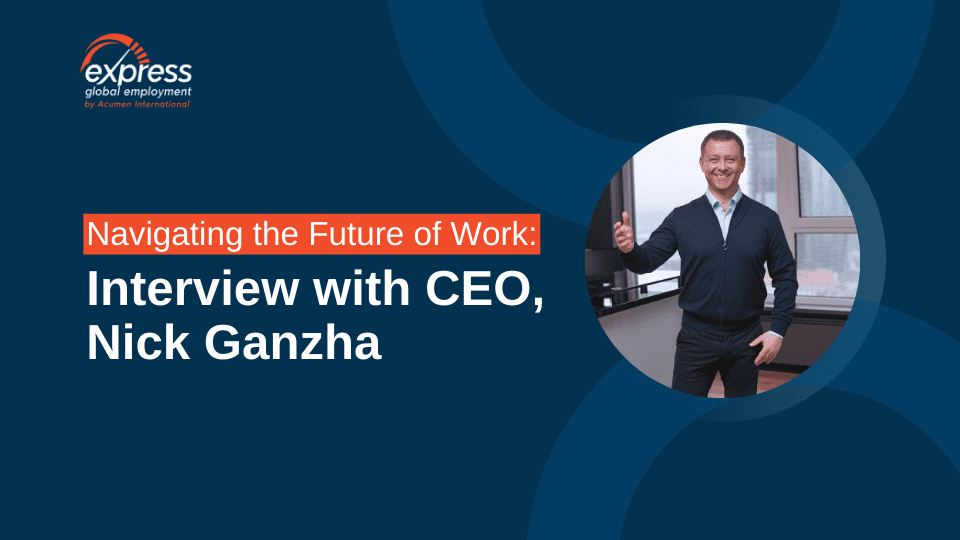
Navigating Change: An Interview with Acumen International’s CEO, Nick Ganzha

In a revealing conversation, Nick Ganzha, CEO of Acumen International, shares insights into the company’s innovative approach to global employment and technology. He delves into Acumen’s strategic vision, its response to the challenges of remote work, and the trends shaping the future of the global workforce. Q: Can you outline the main objectives of the… Read more Navigating Change: An Interview with Acumen International’s CEO, Nick Ganzha

10 views 0 Comments

In a revealing conversation, Nick Ganzha, CEO of Acumen International, shares insights into the company’s innovative approach to global employment and technology. He delves into Acumen’s strategic vision, its response to the challenges of remote work, and the trends shaping the future of the global workforce.

Q: Can you outline the main objectives of the recent leadership meet-up in Cyprus?

A: Our primary goal was to introduce Acumen’s shift towards humanised technology, defining our objectives and roadmap. We are a human focused business supported by technology where we can tailor our solutions to the specific client needs and provide them with the solutions no platform can provide.

It was also a moment to reunite our team, celebrate our long-awaited reunion, welcome new members, and reflect on our remote working experiences. We also outlined actionable steps to improve our overall Employer of Record Services based on our comprehensive experience in the Global EOR market.

Q: After such an unprecedented few years, how did it feel to meet up with the team again?

A: Meeting with the team again stirred a complex blend of emotions. It felt as though everything had changed yet remained the same. The team’s unwavering dedication and level of engagement were palpable, but there was an underlying need to realign these qualities with our new strategic goals and the evolving market demands. 

To evolve the concept of unity, it was more than just unveiling a new strategy and roadmap. It involves engaging with and listening to our global team’s feedback and their perceptions of market needs. This approach has proved immensely effective in transforming our team into passionate advocates and active participants in implementing our ideas, particularly our shift towards a technology orientation. We discussed how each individual and department could actively contribute to fostering a digital-first culture. This initiative aims to develop an organisation that is not only adaptive and digitally fluent but also deeply human-centric, ensuring that every voice is heard and valued.

This reunion was a poignant reminder of the resilience, adaptability, and collective spirit of our team. It reinforced the importance of embracing change, fostering open communication, and uniting behind a shared vision. As we look to the future, it’s clear that our journey towards integrating technology and human-centricity is not just about responding to immediate challenges but shaping the future of global employment in a way that is inclusive, innovative, and aligned with the evolving needs of the workforce and the market.

Q: What have you learned from the transition to a global remote workforce, and how will this shape your services moving forward?

A: The shift to a global remote workforce highlighted the value and staying power of such a model. The geopolitical challenges, especially the Russian war against Ukraine, tested our resilience and adaptability. 

The transition has been illuminating on multiple fronts. Here are the key learnings and how they will influence our future direction:

  • Global Remote Workforce Viability:
    • The shift affirmed the sustainability and benefits of a global remote workforce, emphasising that this trend will persist.
    • Leveraging opportunities across countries, we recognised the immense value and potential of tapping into a global talent pool.
  • Rethinking the People Business:
    • The concept of (Global) PEO was re-evaluated, transforming into a leverage to retain the key dispersed personnel. 
    • We faced an unprecedented Ukrainian talent exodus and responded by providing solutions for employing and re-employing talent globally, becoming the #1 go-to partner for Ukrainian businesses and a primary international employment provider.
  • CSR and Personal Responsibility:
    • My commitment to corporate social responsibility intensified, leading to significant participation in CSR initiatives supporting Ukraine.
    • This personal responsibility transformed into a broader commitment, rallying our employees around these causes.
  • Testing Our Own Solutions:
    • Amid the war, we were able  to test our EOR solutions first-hand, employing our staff through our services in various locations. This experience broadened our Global EOR expertise, proving the effectiveness of our services under extreme conditions.
  • Going Global as a Survival Strategy:
    • The necessity of going global, once a choice, has now become a survival strategy for businesses.
    • This realisation underpins our strategy moving forward, emphasising our role in guiding businesses through arising upheavals and global employment complexities
  • Future Direction:
    • Our experiences will inform our product and service development, offering insights to our global clientele on navigating global employment challenges.
    • We aim to share our journey and solutions, ensuring businesses don’t have to navigate these challenges alone—Acumen is there to guide them.

Our approach going forward is to harness these learnings, continuing to innovate and adapt in a way that supports our clients and their employees around the world.

Q: Can you share insights or trends from the meet-up that will influence the global employment landscape?

A: The global employment landscape is on the cusp of significant transformation, with several key trends emerging from our discussions:

  • Evolution of Professional Employer Organisations (PEOs): PEOs are transitioning from providing purely operational support to playing strategic roles within businesses. The 3Sixty Insights Global Executive Advisory Council highlights this focusing on the shift from tactical work in human capital management to strategic approach. This is about a (Global) PEO/EOR that has the expertise to help businesses approach their HCM strategically. It evokes a broader concept of a PEO not only taking care of operational HR for employers and mitigating risk, but also capable of transforming their entire strategic vision, decision-making and execution on their organisational strategy wherever it intersects with the company’s people.
  • Flexible and Hybrid Workforces: The tenure of full-time employees is reducing, with the average being one to two years, whereas sought-after consultants are extending, signalling a trend towards more flexible, hybrid work models. This adaptability in the workforce is driving changes, making flexibility a critical component of modern work environments.
  • Trust as a Core Value: Trust is becoming a central element of organisational success, not just in client relationships but also internally. The 2024 Global Talent Trends study by Mercer emphasises this, noting that fostering a climate of trust through fair pay, equity, and inclusion is top of mind for leaders in 2024 and beyond. This trend indicates a broader shift towards more transparent, equitable, and inclusive workplace cultures.
  • Technological Integration and Human-Centricity: The integration of technology and AI in the workplace is advancing rapidly, with a significant impact on productivity and employee engagement. A LinkedIn poll by The HR World suggests that “8 in 10 use AI to assist their work,” highlighting the growing reliance on technology to support various work processes. However, the emphasis remains on driving human-centric productivity, ensuring that technological advancements enhance rather than replace the human element.
  • Addressing Global Workforce Well-being: The well-being and mental health of the globally distributed workforce are gaining prominence. Organisations are increasingly focusing on creating supportive environments that cater to the diverse needs of their employees, recognising the importance of mental health in achieving overall productivity and satisfaction.

These trends suggest a future where businesses must be agile, embracing new operational models and technologies while maintaining a strong focus on trust, inclusivity, and the well-being of their workforce. Here at [Acumen International], we’re poised to support businesses through these changes, offering strategic insights and solutions tailored to the evolving global employment landscape.

Q: How does Acumen plan to adapt its strategies in response to these trends?

A: As we navigate the complexities of the global employment landscape, we are focused on adapting our strategies to address both current trends and the underlying challenges of the labour market. Our approach encompasses several key dimensions:

  • Embracing Technology with a Human Focus: Recognising the integral role of technology in today’s work environments, we are committed to developing technological solutions that not only meet our client’s needs but also enhance and support human efforts. Our aim is to ensure that technology serves humanity, reinforcing the value of human input rather than diminishing it. This perspective is crucial in addressing challenges presented by economic cycles, company growth, and the changes that accompany mergers and acquisitions.
  • Addressing Labour Market Imbalances: The International Labour Organization (ILO) has highlighted the structural imbalances in the world’s labour market, a view supported by insights from the Geopolitical Futures article on “Employment Returns to Pre-Pandemic Levels.” Global employment may have bounced back to pre-pandemic figures, yet the persistence of labour market imbalances, slowing productivity growth and the increasing number of workers in extreme poverty underline the structural issues facing the global workforce. In response, Acumen is focusing on strategies that not only bridge these imbalances but also anticipate and mitigate the impacts on both workers and organisations.
  • Navigating Economic and Geopolitical Uncertainties: The current geopolitical landscape, marked by conflicts and trade tensions, contributes to the uncertainty affecting the global labour market. These factors, coupled with aggressive actions by central banks and the deceleration of global economic growth, underscore the need for resilient and adaptable employment strategies. We are poised to guide businesses through these uncertainties, offering solutions that foster stability and loyalty among workers and organisations alike.
  • Tackling Productivity and Skill Shortages: Despite the return to pre-pandemic employment levels, concerns about labour and skills shortages persist. The exit of a significant segment of youth from the labour market and the challenges of reintegration highlight the need for innovative employment solutions. We can help our clients identify and fill these skill gaps, leveraging our [global employment solutions] to address labour shortages and enhance productivity.
  • Future Proofing Against Economic Slowdowns: With the global economy expected to slow further, the resilience of the labour market is more critical than ever. Acumen’s [global employment services] are designed not only to weather these slowdowns but also to emerge stronger, with a focus on sustainable growth.

By focusing on technology integration with a human-centric approach, we aim to maintain and strengthen the loyalty and resilience of workers and organisations worldwide.

Q: Finally, how does Acumen envision its role in shaping the future of [global employment] and supporting businesses through these changes?

A: Acumen International is strategically positioned to lead and shape the future of [global employment] by addressing and anticipating the evolving needs of the [global workforce] and the businesses that rely on it. Our approach is multifaceted, focusing on several key areas:

  • Redefining Global Mobility Programs: We are committed to transforming global mobility programs from reactive to proactive strategies. This involves streamlining and simplifying immigration processes and making talent attraction, acquisition, management, and retention more efficient. The goal is to turn these programs into strategic advantages for businesses, enabling them to be more agile.
  • Emphasising Skill-Based Hiring: Echoing the sentiment from a Forbes article on “The Freelance Revolution In 2024,” we recognise the growing importance of freelancers and the shift towards a more flexible workforce. This aligns with our belief in hiring based on skills, not geography, allowing businesses to tap into a global talent pool and adapt to market needs with a blend of permanent and temporary workers.
  • Addressing Employment Shifts and Contractor Convergence: As noted in one of our latest posts about freelance revolution and hybrid workforces, the opportunities hybrid teams open up for global employers  are becoming increasingly significant. This shift, driven by evolving legal regulations and changing workforce expectations, necessitates enhanced compliance and flexibility in talent management strategies. Our EOR and Contractor Solutions are designed to provide businesses with the flexibility and growth at all stages needed to thrive in the current economic climate.
  • Leveraging Technology for Efficiency: With the development of our industry-leading technology solutions, leveraging AI and tapping into expert networks, we offer solutions that enhance efficiency and help businesses become more competitive and attractive as employers.

Our goal is to provide and hone our solutions and product portfolio, allowing businesses to access a global talent pool and offer compelling employee value propositions, making them the best companies to work for in an ever-evolving global market.

This conversation with Nick Ganzha highlights Acumen International’s proactive approach to global employment challenges and its commitment to innovation and human-centric solutions. As the world of work continues to evolve, Acumen’s strategies and insights offer valuable guidance for businesses navigating the complexities of the global workforce.

Compensating independent contractors globally is easy now
Blog

What is an Agent of Record

A Solution To Hire Independent Contractors Globally An Agent of Record, also known as an Independent Contractor Solution, enables companies that are hiring the global workforce to gain a strategic advantage in the freelance market while reaping the benefits of global talent pools. The shifting dynamics in the global workforce challenge global employers to leverage… Read more What is an Agent of Record

A Solution To Hire Independent Contractors Globally

An Agent of Record, also known as an Independent Contractor Solution, enables companies that are hiring the global workforce to gain a strategic advantage in the freelance market while reaping the benefits of global talent pools.

The shifting dynamics in the global workforce challenge global employers to leverage various opportunities available with hybrid teams. Using an Agent of Record Solution (AOR), global employers can engage global talent resources for short-term projects or as part of a strategy to explore new markets or potential permanent hires. This gives organizations the freedom to take on more projects requiring specific qualifications, providing cost savings and flexibility in global talent acquisition.

At Acumen International, we are champions of the opportunities available with hybrid teams and can support you with our global employment solutions, regardless of the complexity.

How An Independent Contractor Solution Can Empower Your Business

  • Compliance Assurance: Effortlessly navigate global talent pools, select independents you want to work with and easily onboard and pay global contractors in international or local currencies.
  • Cost Efficiency: Realise savings by avoiding the costs of the direct hire and minimise financial output at the start of a project. Easily transition freelancers into full-time employees with Acumen International’s support.
  • Flexibility & Scalability: Meet market demands by hiring independent contractors globally for short-term or exceptional projects like trial runs, per diem work, or shift tasks, all without long-term commitments.
  • Expert Support: Benefit from the expertise of a dedicated Acumen’s manager who will facilitate communication and oversee project completion, ensuring your intellectual property is safe and protected, and quality standards are met.
  • Contract-to-Employee Pathway: With over two decades of experience, we specialise in transitioning contractors to full-time employment offering a smooth transition for your expanding team. Rely on us to guide you through various in-country legislative nuances and procedures related with contractor to full-time employee transfers, which our team knows and can assist with.

Independent Contractor Solution vs. Umbrella Company

Unlike traditional umbrella companies that only act as intermediaries to arrange payouts, an Independent Contractor Solution provides a full spectrum of services to enable employers to legally deploy and pay their global workers internationally without legal risks to the company and risk to the intellectual products that you develop.

From ensuring global tax compliance to offering a complete service with global HR strategy support, we go beyond contractual management to deliver a comprehensive and compliant solution tailored to your global hiring needs. We will allocate a dedicated manager to your projects to help you manage worker communication in various time zones and ensure invoice approvals and payouts are run smoothly. 

At Acumen International, we understand the shifting dynamics of the global workforce and are champions of the opportunities available with hybrid teams. Leverage our international employment solutions and talent acquisition expertise for agile, global workforce integration.

With our Contractor Management Solution, global talent acquisition is made easy, allowing your business to thrive in an ever-changing economic landscape. Check out our services or request a quote.

Blog

How to Avoid Permanent Establishment Risk

Globalization has resulted in national economies and markets becoming intertwined. Due to a surge in economic integration in recent years, it has become evident that current international tax regulations, established over one hundred years ago, are no longer adequate.  This lack of adaptation to modernity allows for BEPS (base erosion and profit shifting), which undermines… Read more How to Avoid Permanent Establishment Risk

10 views 0 Comments

Globalization has resulted in national economies and markets becoming intertwined. Due to a surge in economic integration in recent years, it has become evident that current international tax regulations, established over one hundred years ago, are no longer adequate. 

This lack of adaptation to modernity allows for BEPS (base erosion and profit shifting), which undermines trust in taxation systems and creates inequalities as profits are not taxed accurately. Tax policymakers and governments must act quickly to address this problem and restore confidence in their tax systems. They can do this by ensuring taxes are collected in the locations where value is generated.

Currently, regulations are the primary method used to define whether or not a company is engaged in PE activity. Tax treaties may also specify what constitutes a Permanent Establishment (PE). In addition, some countries tax laws may specify what activities constitute a permanent establishment (PE) for their jurisdiction.

What Is a Permanent Establishment?

Harmonization of tax laws has led to many countries adopting the Organisation for Economic Co-operation and Development Model Tax Convention, which puts certain restrictions on when businesses will be considered permanent establishments (PEs) in another country. In brief, an organization will have a permanent establishment (PE) if any of the following applies:

1. The business has a physical presence in a foreign country.

2. The business is regularly present through employees or agents.

3. A sale is made from a fixed place of business.

4. The business is engaged in continuous and systematic activities in the foreign country.

Understanding the Concept of Permanent Establishment

Permanent Establishment (PE) is a concept in international taxation that refers to a fixed place of business through which an enterprise carries out its business activities. A PE can be a branch, office, factory, warehouse, or any other fixed place of business where the enterprise carries out its business activities, either wholly or partially.

When an enterprise operates through a (Permanent Establishment) PE in a country other than its home country, it may become subject to the tax laws of that country. This means that the income generated by a PE is potentially taxable in the country where the business is located and in the country where the business is incorporated.

Only income attributable to local activity should be subject to local tax, which can be determined through a profit attribution exercise. However, consideration must also be given to whether there is an applicable double tax treaty between the two countries.

Generating Taxable Income

For example, suppose you have a sales force that calls on customers in a foreign country on behalf of your organization. In that case, that presence is considered a Permanent Establishment, and you must pay tax for the income your salespeople generate.

If an enterprise is found to have a PE in a foreign country, it may be subject to tax on the profits earned in that country, as well as penalties and interest for failing to comply with the tax laws of that country.

To avoid permanent establishment risk, enterprises must carefully assess their business activities in foreign countries and ensure that they do not create a fixed place of business or exceed the allowable time limit for employee presence in that country.

They should also seek professional advice to understand the tax laws of foreign countries where they operate.

Get Express Quote

Permanent Establishment Management Control

Permanent Establishment (PE) Management Control refers to the extent to which the enterprise maintains direct control over the business operations in a foreign country.

If an enterprise wants to maintain direct control over everything from accounting procedures to staff management, it may choose to establish a foreign legal entity. This option allows the enterprise greater control over its operations in the foreign country, including hiring and managing employees, implementing its accounting procedures, and maintaining its banking relationships.

However, establishing a foreign legal entity can be costly and time-consuming. In addition, it requires the enterprise to comply with the legal and regulatory requirements of the foreign country, which may differ significantly from those of the home country.

Alternatively, an enterprise may outsource some operations, except for managing assets and collecting profits. This option allows businesses to focus on their core competencies while outsourcing non-core activities to specialised service providers.

Permanent Establishment Risk: Addressing the Concerns

Permanent Establishment (PE) requires the most due diligence in tax risk management.

You may think you can conduct business overseas without registering a legal entity, but you would be wrong. You might need to register your business even if you only send an employee on a temporary assignment or establish a small promotional office. Failing to do so can result in severe consequences.

Different countries have different tax laws, and a multinational company must consider all of these when conducting business. The tax authorities of a particular country can determine which elements of the company’s economic activity take place in a particular country and how much profit is attributable to them.

This process can be complex, but ensuring the company complies with all applicable laws is essential.

25 Questions to Help You Assess Permanent Establishment Risk

Here are some additional questions that can help assess and avoid Permanent Establishment (PE) Risk:

1. Have you identified all the business activities that your company will perform in the target country?

2. Will your company have a fixed place of business in the target country, such as an office, warehouse, or factory?

3. Will your employees or contractors spend significant time in the target country?

4. Will your company have the authority to sign contracts or make decisions for your clients or customers in the host country?

5. Will your company have the authority to negotiate or conclude contracts for your clients or customers in the target country?

6. Will your company have the authority to bind your clients or customers in the target country?

7. Will your company be able to manage or supervise employees or contractors in the target country?

8. Will your company have the authority to provide after-sales services or technical support in the target country?

9. Will your company be able to receive payments or handle financial transactions in the target country?

10. Will your company have the authority to conduct research and development activities in the target country?

11. Will your company have the authority to control the use or disposal of assets in the target country?

12. Will your company have the authority to make decisions on pricing, marketing, or distribution of goods or services in the target country?

13. Will your company have the authority to manage or oversee the supply chain in the target country?

14. Will your company have the authority to perform any other significant business functions in the target country?

15. Have you reviewed the tax laws and regulations of the target country to understand the criteria for determining whether a PE exists?

16. Have you reviewed the tax treaty between your home country and the target country to understand the provisions related to PE?

17. Have you considered the potential impact of transfer pricing regulations on your operations in the target country?

18. Have you assessed the potential penalties and fines for non-compliance with tax laws and regulations in the target country?

19. Have you considered the potential reputational risks associated with being deemed to have a PE in the target country?

20. Have you established a risk management plan to address PE risk, including strategies for minimizing risk, monitoring compliance, and managing potential disputes with tax authorities?

21. Are your employees in the target country extensively involved in sales or contract negotiations? They don’t need the power to sign contracts to qualify as being involved in contract negotiations.

22. Do your employees’ job titles or descriptions pertain to revenue generation? 

23. Do your employees receive compensation related to sales, such as commissions or bonuses, for meeting sales targets?

24. Do they receive compensation based on sales, such as commissions or bonuses for their sales performance?

25. Have you reviewed the contractual agreements between your company and your clients or customers in the target country to understand the scope of your authority and obligations and whether they could create a PE?

Get Express Quote

Attributable Activity Test to Determine Permanent Establishment

Let’s explore how to avoid permanent establishment risk using Global Employer of Record services. Unlike the standard “permanent establishment” definition, which focuses on whether an entity is carrying on business through a fixed place of business, the definition of permanent establishment for income tax purposes is broader. There are two main tests for determining if an organization has a PE.

The Attributable Activity Test is one of the criteria used to determine whether a foreign company has a Permanent Establishment (PE) in a host country for tax purposes. This test determines whether the activities performed by the foreign company in the host country are sufficient to create a PE, even if there is no physical presence or fixed place of business in the host country.

The Attributable Activity Test focuses on the activities “attributable” to the foreign company in the host country. These activities are those that are carried out on behalf of the foreign company by its employees, agents, or other representatives in the host country.

To determine whether the foreign company has a PE under the Attributable Activity Test, the tax authorities will typically consider the following factors:

  1. Whether the activities performed by the foreign company in the host country are “core” activities that are essential to the company’s business.
  2. Whether the activities are performed for a “sufficient” period, there is no fixed rule for what constitutes a “sufficient” period. Still, it generally means that the activities must be ongoing and regular rather than occasional or sporadic.
  3. Whether the activities are performed with a “sufficient” degree of authority, the foreign company’s employees, agents, or other representatives must have the power to make decisions on behalf of the company that affect its business operations in the host country.
  4. Whether the activities are performed with a “sufficient” degree of continuity. To establish a significant connection between the foreign company and the host country, the activities must be performed over a long period.

Activities that Can Create a Permanent Establishment under the Attributable Activity Test

  • Negotiating contracts or concluding sales agreements on behalf of the foreign company.
  • Providing technical assistance or after-sales support services to customers in the host country.
  • Performing marketing or advertising activities directed at customers in the host country.
  • Conducting research and development activities related to the company’s business operations in the host country.
  • Providing management or supervisory services to local employees or agents of the foreign company.
  • Providing training or education services to customers or employees in the host country.

It is important to note that the Attributable Activity Test is only one of several criteria tax authorities may use to determine whether a foreign company has a PE in a host country. Other factors that may be considered include the existence of a fixed place of business, the level of control and management exercised by the foreign company over its operations in the host country, and the nature and extent of the company’s activities in the host country.

5 Ways Minimize PE Risks with a Global Employer of Record

As a business owner, you may feel overwhelmed by the tax implications of expanding your business overseas. However, new ideas exist to reduce complexity and ease the burden on busy entrepreneurs.

Using a Global Employer of Record (EOR) can be an effective way for multinational employers to prevent or address Permanent Establishment (PE) risks. This third-party global employment solution enables compliance with local employment and tax laws while avoiding the establishment of a legal entity and taxable presence in the country.

1. No Establishment of a Foreign Legal Entity

The Global EOR model enables multinational employers to engage workers in different countries without establishing a legal entity. This helps to reduce the risk of creating a taxable presence in the country and triggering a PE.

2. Compliance with Local Employment Laws

The Global Employer of Record (EOR) handles employment’s legal and administrative aspects, including compliance with local labour laws and regulations. This ensures that the client company is not inadvertently creating a PE through non-compliance with local employment laws.

3. Tax Compliance

The Global Employer of Record (EOR) can also handle tax compliance, including payroll taxes and social security contributions. This ensures the company is not creating a PE through non-compliance with local tax laws.

4. Permanent Establishment Risk Mitigation

Using a Global Employer of Record (EOR), talent engagement model can help multinational employers mitigate the risk of a PE by ensuring that all legal and tax obligations are met. This helps to minimize the potential negative impact on the company’s reputation, financial statements, and regulatory compliance.

5. Flexibility of Global Moves

The Global Employer of Record (EOR) model allows multinational employers to engage workers flexibly in different countries. This helps minimize the risk of creating a PE by permanently establishing a business presence in the country.

Sample Employment Tax Calculation

How to Pro-actively Address Challenges of Permanent Establishment Risk

The challenge of Permanent Establishment (PE) risk can be addressed through a combination of preventive and corrective measures. Below are some suggestions to resolve the fundamental challenges of PE risk:

  1. Conduct a comprehensive risk assessment: This involves reviewing business operations and transactions to identify potential PE risks. It is important to consider the different types of taxes that could be affected, including corporate income tax, indirect tax (VAT/GST), and payroll taxes. The risk assessment should also consider the potential impact on the company’s reputation, financial statements, and regulatory compliance.
  2. Develop and implement a PE risk management strategy: The strategy should be tailored to the company’s specific operations and risks. This may involve implementing policies and procedures to ensure compliance with tax laws and regulations, including appropriate VAT registrations and payroll reporting. The strategy should also include ongoing monitoring of changes in tax laws and regulations and changes in the company’s business operations.
  3. Maintain accurate and complete records: Good record-keeping is essential to demonstrate compliance with tax laws and regulations. This includes maintaining records of all transactions, contracts, and agreements relating to the company’s operations in each jurisdiction.
  4. Engage in open and transparent communication with tax authorities: It is important to establish good relationships with tax authorities and be transparent about the company’s operations and tax position. This can help prevent misunderstandings and reduce the risk of audits and penalties.
  5. Seek professional advice: Given the complexity of tax laws and labour regulations, it may be beneficial to seek professional advice from tax and global employment experts. This can help ensure that the company complies with all applicable tax laws and regulations and can help to identify potential risks and opportunities for optimization.

Companies expanding globally by taking a proactive approach to Permanent (PE) risk management can minimize the potential negative impact on their reputation, financial performance, and compliance obligations.

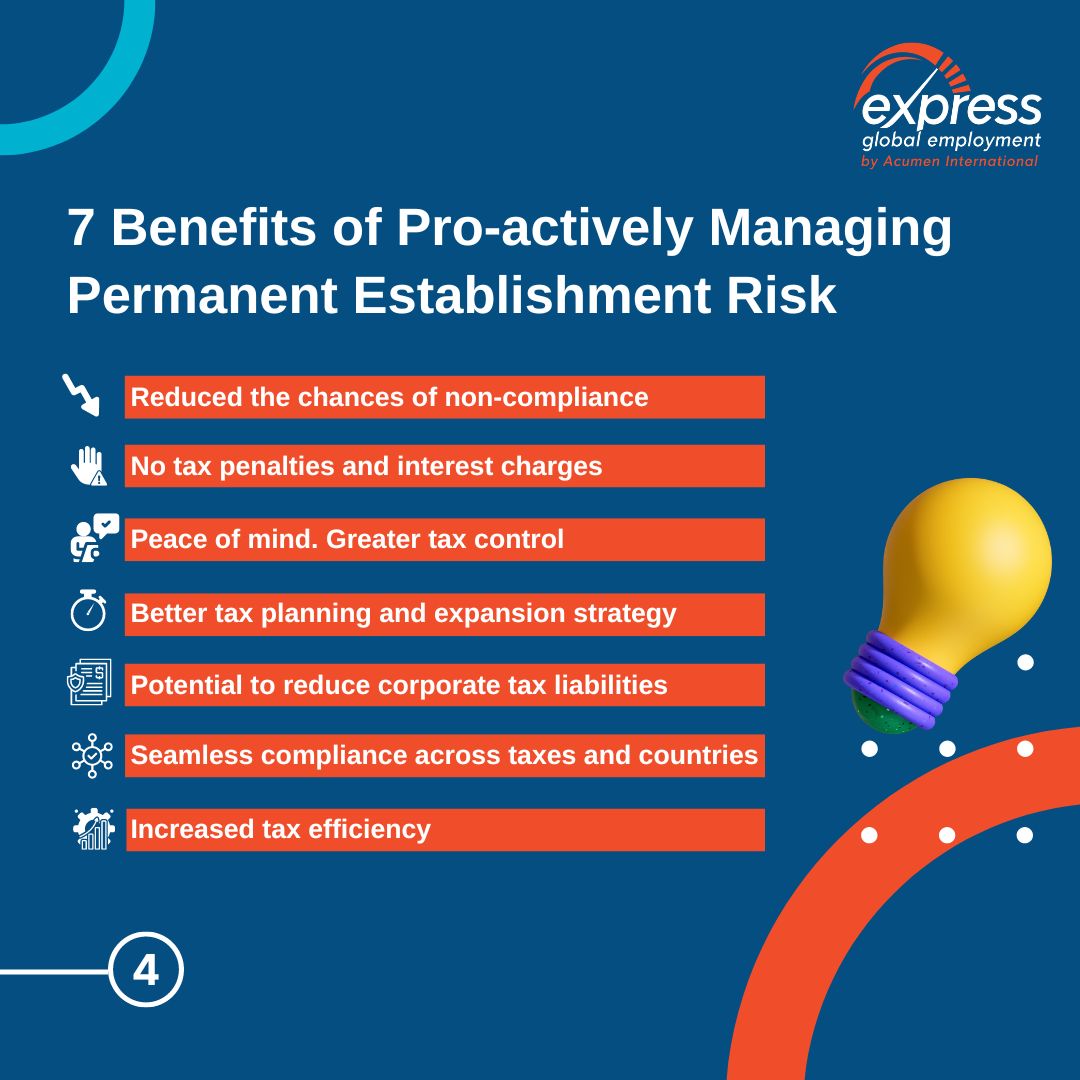
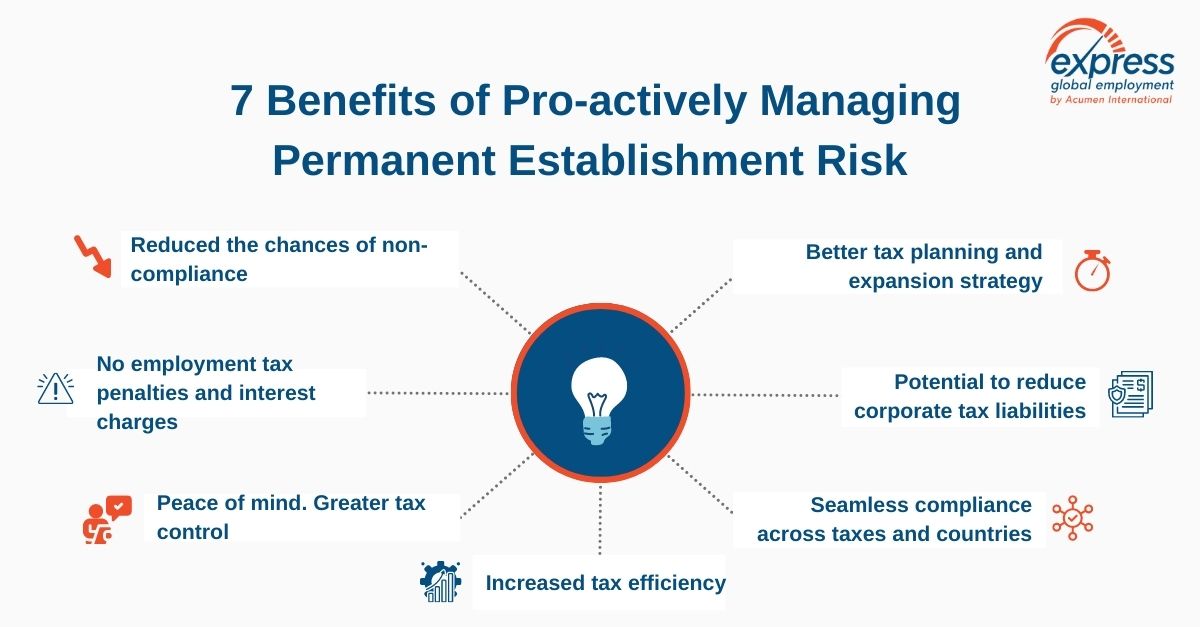
Benefits of Pro-active Permanent Establishment Risk Management

Concluding Thoughts on How to Avoid Permanent Establishment Risk

Managing Permanent Establishment (PE) risk is a smart business move for organizations with international operations. By proactively managing PE risk, companies can promote tax compliance, expand globally tax-compliantly, and avoid penalties and interest charges from tax authorities.

This approach provides a greater sense of security on a challenging issue and helps to prevent unnecessary taxation and interest payments due to mistakes or lack of awareness.

By controlling Permanent Establishment risk, companies can minimise potential negative impacts on their reputation, financial performance, and regulatory compliance while maximizing the benefits of their global operations.

Get Express Quote

Blog

How We Maintain a Truly Customer-Focused EOR Business

In the ever-evolving landscape of Global Employment services, the trend has sharply turned towards technology-driven solutions. However, the rise of investment-backed SaaS companies offering ‘self-serve’ global EOR models, while impressive in their technological reach, often overlooks the critical element of customer service. This disconnect poses a high risk, particularly when navigating the intricacies of legally… Read more How We Maintain a Truly Customer-Focused EOR Business

9 views 0 Comments

In the ever-evolving landscape of Global Employment services, the trend has sharply turned towards technology-driven solutions. However, the rise of investment-backed SaaS companies offering ‘self-serve’ global EOR models, while impressive in their technological reach, often overlooks the critical element of customer service. This disconnect poses a high risk, particularly when navigating the intricacies of legally compliant onboarding of global workers and HR issues—a realm where personalized guidance is not just valuable but necessary.

Acumen International bucks this trend. Our journey for the last 23 years as a bootstrap business, growing organically and successfully, has been grounded in our unwavering commitment to our customers. We have matched the competition in technological capabilities, yet where we truly excel is in supporting and fronting this technology with people, both the client and the employee that we employ for the client. Our approach ensures that every interaction is not just a transaction but a partnership towards achieving global employment services success.

The Virtue of Bootstrapping

Bootstrapping in the business world represents a commitment to growth driven by customer revenue rather than external funding. This approach emphasizes sustainable development, allowing companies like ours to remain agile and responsive to customer needs. By prioritizing our client’s needs over fund-raising ambition, we ensure that every innovation and service enhancement aligns with our global clientele’s real-world applications and burning needs.

In the Forbes article “A Founder’s Perspective On Bootstrapping Over Raising Venture Capital” (April 2023), Eddie Lou, co-founder of CodaPet and OneGoal, and an active angel investor, shares his journey. He emphasizes the freedom and focus bootstrapping has allowed in prioritizing customer needs. “Bootstrapping… allows entrepreneurs to maintain complete control over their business decisions without having to answer to outside investors who may have a different agenda. By keeping their equity and decision-making power intact, founders have the freedom to chart their own course and pursue their vision on their own terms.”

Prioritising Customers in the SaaS Journey

The future of HR tech and SaaS leans towards a customer-first approach. Industry experts argue the importance of keeping customers at the forefront of business strategy, suggesting that the true value of SaaS solutions lies in their ability to solve specific customer problems effectively. This philosophy not only enhances the customer experience but also fosters loyalty and long-term relationships, ensuring that businesses remain competitive and is sustainable in a rapidly evolving market.

Frank V. Cespedes and Jacco van der Kooij discuss the importance of keeping customers at the core of business strategies in the Harvard Business Review article, “The Rebirth of Software as a Service” (April 2023). They argue that a customer-led model enhances long-term growth and sustainability, “Some SaaS firms correctly refer to their service groups as Customer Success (CS) teams, because they are vital in closing a sale, onboarding customers, business reviews that track on-going product impact, and the expansion phases of the customer lifecycle.”

The Centrality of Customer Needs in Global Employment

Keeping customer needs at the core of business operations is essential for success. According to industry leaders, understanding and addressing the unique challenges faced by clients is the cornerstone of a truly customer-led buying experience. By offering tailored solutions and support, companies can create a more personalized and effective buying journey, enhancing customer satisfaction and fostering a culture of trust and reliability

In an article published by G2 entitled “Why Customer-Led Buying Is the Way Forward for SaaS” (October 2023) Mads Fosselius emphasizes the significance of a customer-led buying experience, allowing customers to interact with the product on their terms. “Ensuring that the customer’s needs are always kept as the core focus is the primary goal of the customer-led buying approach, and it does this by handling a balance of sales-led and product-led strategies. When successful, it allows brands to foster a sustainable model for long-term growth.”

In embracing these insights, Acumen International has solidified its position as a leader in delivering Employer of Record solutions. In year 2024, we plan to launch the HR platform and tools that will help us balance cutting-edge technology with unmatched personalized support. Our dedication to understanding and addressing the unique needs of our clients, informed by direct feedback and engagement, shape our technology roadmap and operational strategies. This ensures we not only meet but exceed the expectations set by our clients, reinforcing our commitment to their success.

As we look towards the future, we remain steadfast in our belief that technology, no matter how advanced, should enhance rather than replace the human touch. Our focus on developing our business with our customer’s priorities at the forefront, not those of our investors, distinguishes us in the market and underpins our success in maintaining a truly customer-focused global EOR business.