Send Email
Blog

Global Payroll Management: a Look into 25 Emerging Trends

In the rapidly evolving landscape of global payroll management, the nexus between technology, user needs, and regulatory shifts is driving revolutionary changes. Today’s organisations are focused on ensuring accuracy and compliance in their payroll processes, enhancing user experiences, and meeting the diverse demands of a global workforce. This article encapsulates 25 emerging trends shaping the… Read more Global Payroll Management: a Look into 25 Emerging Trends

7 views 0 Comments

In the rapidly evolving landscape of global payroll management, the nexus between technology, user needs, and regulatory shifts is driving revolutionary changes. Today’s organisations are focused on ensuring accuracy and compliance in their payroll processes, enhancing user experiences, and meeting the diverse demands of a global workforce.

This article encapsulates 25 emerging trends shaping the contemporary world of payroll management. From harnessing the power of cloud technologies and AI to adapting to the rise of the gig economy, these trends provide a comprehensive glimpse into the future of payroll. Let’s delve deeper into each trend to understand its significance and the value it brings to modern businesses.

Navigating a Global and Diverse Work Landscape

The era of globalisation has ushered in a new set of challenges and opportunities for businesses, especially when it comes to managing payroll across multiple jurisdictions. Global employers are not merely grappling with numbers—they’re crafting strategies that address regional disparities, workforce diversities, and ever-evolving regulatory environments.

1. Globalisation of Payroll

  • Insight: A globally integrated payroll system is not just a matter of convenience—it’s a linchpin for cohesive business operations and informed strategic decisions. A singular view can highlight disparities, identify cost-saving opportunities, and foster organisational alignment.
  • Actionable Strategy: Embrace a global payroll platform that provides centralised reporting. Yet ensure that it remains agile enough to address local regulatory shifts. Integrate real-time analytics to monitor cross-border transactions and facilitate instant financial decision-making actively.

2. Customisation

  • Insight: Payroll isn’t one-size-fits-all. Regional nuances, from holidays to union rules, can significantly affect payroll. Understanding these distinctions is crucial to ensure compliance and employee satisfaction.
  • Actionable Strategy: Regularly collaborate with regional teams and third-party local experts. This knowledge sharing will ensure payroll systems are appropriately customised and infuse global strategies with regional insights.

3. Gig Economy Adaptation

  • Insight: The gig economy is rewriting the rules of employment and compensation. It’s not just about processing payments differently—it’s about understanding how non-traditional employment impacts benefits, talent retention, and legal liabilities.
  • Actionable Strategy: Establish clear protocols for freelance and contract-based engagements. Develop a comprehensive understanding of how gig workers fit into your global workforce strategy and what their inclusion means for financial forecasting.

4. Centralisation

  • Insight: While centralising payroll operations can offer better control, balancing this against the need for regional expertise is crucial. Centralised processes disregarding regional nuances can lead to compliance oversights and financial missteps.
  • Actionable Strategy: Implement an integrated model where regional expertise centres complement central oversight. This approach combines the efficiency of centralisation with the nuanced understanding of decentralisation.

The Digital Revolution in Payroll

As the digital age continues its relentless march forward, no business operation remains untouched, and payroll is no exception. Technological advancements are not just about automating routine tasks; they are fundamentally altering how companies think about and manage their payroll operations. For businesses looking to thrive, understanding these shifts is not just beneficial—it’s imperative.

5. Cloud-Based Systems

  • Insight: Shifting from traditional on-premises systems to cloud-based platforms isn’t merely a trend—it’s a necessary evolution. The cloud offers unparalleled scalability, flexibility, and security, facilitating seamless operations irrespective of a company’s size or geographic spread.
  • Actionable Strategy: Prioritise transitioning to a cloud-first approach for payroll. Its flexibility regarding access, backups, and updates makes it a worthy investment for future-proofing payroll operations.

6. AI and Machine Learning

  • Insight: AI and ML are much more than buzzwords. They’re tools that can predict payroll anomalies, optimise salary distributions, and even forecast hiring needs based on financial data.
  • Actionable Strategy: Integrate AI-driven analytics into your payroll processes. Leveraging predictive analytics can proactively address potential issues, ensuring smoother payroll cycles and more informed financial decisions.

7. Real-Time Analytics

  • Insight: In an age where data drives decisions, having access to real-time payroll analytics is invaluable. It empowers HR and finance teams to make informed, timely decisions directly impacting the company’s bottom line.
  • Actionable Strategy: Equip your payroll systems with robust analytics tools. Review this data regularly to identify trends, efficiencies, and areas for improvement.

8. Mobile Accessibility

  • Insight: The modern workforce is mobile-first. Ensuring payroll information and functionalities are accessible on mobile devices is not a luxury—it’s an expectation.
  • Actionable Strategy: Opt for payroll solutions that offer comprehensive mobile applications. This enhances user experience and ensures consistent access, irrespective of location.

9. Integrated Systems

  • Insight: Siloed operations are a relic of the past. Integrated systems that combine HR, finance, and even CRM functionalities can streamline operations, improve data accuracy, and enhance inter-departmental collaboration.
  • Actionable Strategy: Work towards systems integration. Ensuring that different tools speak to each other reduces redundancies and paves the way for a holistic view of company operations.

10. SaaS Payroll Solutions

  • Insight: The shift to Software as a Service (SaaS) isn’t just about cost-effectiveness. It ensures payroll systems are always updated, compliant, and scalable based on ever-changing business needs.
  • Actionable Strategy: Consider transitioning to a SaaS model for payroll. The regular updates, built-in compliance checks, and scalability make it a strategic choice for modern businesses.

11. Use of APIs

  • Insight: In an interconnected digital ecosystem, APIs are the bridges that connect different software solutions, enabling them to work together harmoniously.
  • Actionable Strategy: When selecting payroll software, prioritise solutions that offer robust API integrations. This ensures that your payroll system can easily connect with other business tools, enhancing overall efficiency.

12. Blockchain Technology

  • Insight: Beyond cryptocurrency, blockchain’s transparent and immutable nature has vast potential in payroll—particularly in fraud prevention and ensuring transactional transparency across borders.
  • Actionable Strategy: Stay updated on emerging blockchain-based payroll solutions. While this field is nascent, early adoption could offer a competitive edge regarding security and transparency.

Employee-Centric Payroll Innovations

The employee experience is undergoing a radical transformation. Today’s workforce seeks compensation, empowerment, flexibility, and tools to contribute to their well-being. Innovative payroll solutions are emerging that place employees at the centre, recognising that a satisfied and empowered workforce can greatly contribute to business success.

13. Self-Service Portals

  • Insight: Gone are the days when employees would wait for HR to address their payroll queries. Today’s workforce seeks autonomy in managing payroll details, from checking payslips to updating tax information.
  • Actionable Strategy: Implement comprehensive self-service portals that offer a blend of autonomy and security. Regular feedback loops can help refine the portal’s features based on employee preferences.

14. Enhanced User Experience

  • Insight: User experience in payroll systems is no longer a back-end concern. A system that’s intuitive, responsive, and easy to navigate can significantly boost employee satisfaction and reduce the need for frequent support.
  • Actionable Strategy: Prioritise UX design in your payroll solutions. Regular usability testing and gathering employee feedback can ensure the system remains both functional and user-friendly.

15. On-Demand Pay

  • Insight: With instant transfers and digital wallets, the modern financial ecosystem has ushered in an era where waiting for a monthly paycheck seems archaic. Employees increasingly prefer accessing their earnings as and when they need them.
  • Actionable Strategy: Explore partnerships with platforms that offer on-demand pay facilities. While ensuring financial feasibility, such initiatives can greatly enhance the company’s value proposition to its workforce.

16. Continuous Payroll

  • Insight: Traditional payroll cycles are giving way to real-time payment structures. This shift caters to immediate financial needs and aligns with the gig economy’s payment models.
  • Actionable Strategy: Investigate the feasibility of real-time payment structures. If a complete shift seems challenging, consider hybrid models that offer both traditional and real-time payment options.

17. Employee Financial Wellness

  • Insight: Financial wellness goes beyond just earning a paycheck. Tools that aid employees in budgeting, savings, and investments contribute to their overall well-being, leading to increased productivity and loyalty.
  • Actionable Strategy: Integrate financial wellness tools and educational resources into your payroll systems. Collaborate with financial experts to conduct regular workshops and offer personalised financial guidance.

Efficiency and Accuracy Enhancements

In the complex world of payroll management, efficiency and accuracy are paramount. With businesses expanding globally and compliance norms becoming more stringent, the margin for error is shrinking. The solution? Technological innovations that prioritise both efficiency and precision.

18. Automation of Routine Tasks

  • Insight: Manual processes in payroll are not only time-consuming but are susceptible to human errors. Automation ensures consistency, speeds up processes, and reduces the potential for inaccuracies.
  • Actionable Strategy: Identify repetitive and time-intensive tasks within the payroll process. Implement automation tools, ensuring that they’re configured to align with company policies and local compliance requirements.

19. Predictive Analytics

  • Insight: Payroll isn’t just about disbursing salaries; it’s also about forecasting financial liabilities, budgeting, and future planning. Based on current and historical data, predictive analytics provides a window into future trends.
  • Actionable Strategy: Embed predictive analytics capabilities into your payroll system. Regularly review its forecasts, adjusting for external economic or industry-specific variables to ensure financial preparedness.

20. Advanced Reporting

  • Insight: As businesses grow, so does the complexity of their payroll data. Advanced reporting tools simplify and transform this data into actionable insights, helping businesses make strategic decisions.
  • Actionable Strategy: Opt for payroll solutions offering various reporting features. Ensure teams are trained to interpret these reports, translating data into actionable business strategies.

21. Payroll Fraud Detection

  • Insight: Payroll fraud, be it from internal or external sources, can have significant financial and reputational repercussions. Modern payroll systems have sophisticated tools to detect and prevent fraudulent activities.
  • Actionable Strategy: Incorporate AI-driven fraud detection tools into your payroll systems. Regular audits and real-time monitoring can act as robust deterrents against potential fraud.

Compliance and Payroll Security

In the age of digitisation and globalisation, the payroll landscape is undergoing significant shifts, not just in terms of technology but also in its responsibility towards data integrity, legal mandates, and environmental stewardship.

23. Data Security

  • Insight: As payroll systems become increasingly digital, they also become prime targets for cyber threats. Safeguarding sensitive employee data is not only a best practice but a foundational trust factor between employers and employees.
  • Actionable Strategy: Employ multi-layered security approaches like encryption, two-factor authentication, and regular security audits. Stay updated with global cybersecurity best practices and ensure they are integrated into the payroll system.

23. Regulatory Compliance

  • Insight: As businesses expand across borders, they face complex regulations that change frequently and vary by region. Non-compliance can result in financial penalties and damage to reputation.
  • Actionable Strategy: Invest in payroll solutions designed to adapt to varying regulations. Conduct regular training sessions to keep the HR and payroll teams abreast of international and local compliance requirements.

24. Outsourcing Payroll

  • Insight: The complexity of modern payroll and the demands for accuracy and compliance have led many companies to rely on external experts who specialise in these areas.
  • Actionable Strategy: If considering outsourcing, perform thorough due diligence to select a provider that aligns with your company’s needs, values, and operational footprint.

25. Sustainable Payroll

  • Insight: The global call for sustainability is resonating within the payroll sector. Eco-friendly practices reflect corporate responsibility and can result in operational cost savings.
  • Actionable Strategy: Promote paperless payroll processes, utilize energy-efficient infrastructure, and support digital methods of communication and documentation.

Looking Beyond Today: The Future of Global Payroll

For global employers navigating the intricate web of payroll management, the current trends and innovations represent just the beginning. The fusion of technology, employee expectations, and regulatory dynamics is reshaping the fabric of payroll processes. But what lies ahead?

The next wave of payroll transformation will likely be characterised by even deeper artificial intelligence integrations, pushing the boundaries of predictive analytics and personalised employee experiences. Global employers should anticipate the rise of more universal compliance standards, especially as businesses continue to transcend traditional geographical boundaries. This may streamline multi-country operations, offering a more unified approach to global payroll management.

Additionally, the definition of ’employee’ might evolve, given the rise of gig economies, remote work, and unconventional work structures. Payroll systems must be agile and accommodate diverse employment models, from full-time contracts to micro-tasks.

Furthermore, as sustainability influences corporate strategies, eco-conscious payroll practices may become a standard expectation, not just an added advantage. This would be driven by environmental imperatives and a new generation of employees prioritising eco-responsibility.

For global employers, the message is clear: Embrace the present innovations, but always keep an eye on the horizon. The world of payroll is not static; it’s dynamic and ever-evolving and holds promise for those willing to adapt, innovate, and lead.

Simplify Your M&A Operations with a Global Employer of Record
Blog

Simplify Your Mergers and Acquisitions Operations with a Global Employer of Record

HR’s Role in Smooth Mergers and Acquisitions Transitions The success of mergers and acquisitions (M&A) depends on speed, but HR teams are often left in the dark until the last minute. This can make it challenging for HR teams to adapt and prepare for the changes that come with the deal. As a result, the… Read more Simplify Your Mergers and Acquisitions Operations with a Global Employer of Record

7 views 0 Comments

HR’s Role in Smooth Mergers and Acquisitions Transitions

The success of mergers and acquisitions (M&A) depends on speed, but HR teams are often left in the dark until the last minute. This can make it challenging for HR teams to adapt and prepare for the changes that come with the deal. As a result, the HR team must work quickly and efficiently across multiple locations to ensure a seamless transition and prevent any negative impact on the deal.

In addition to the time constraints, HR must also navigate the complex legal and compliance requirements of multiple markets where they may have limited knowledge. They must also quickly integrate new systems and processes, often with a limited runway.

Furthermore, HR is tasked with supporting and training a new workforce with different cultural norms and expectations. Failure to adequately engage the new workforce can lead to low morale, decreased productivity, and increased turnover rates.

To succeed in Mergers and Acquisitions M&A deals, HR leaders must be able to manage the challenges of a fast-moving, complex environment while still delivering results. However, it is important to consider the risks and challenges that may arise if HR operations are not effectively managed across multiple jurisdictions. 

Global Employer of Record companies can maximize success during times of change, such as mergers and acquisitions, business restructuring, or close-downs.

Inadequate HR management during a merger or acquisition for global employers can result in various challenges, such as non-compliance issues, difficulties in managing employees, risks of litigation, inconsistent HR operations, and limited access to top talent in different regions.

This article will discuss the benefits of working with a Global Employer of Record service during times of change and how a Global EOR can mitigate these risks and ensure effective HR operations across multiple jurisdictions.

During Mergers and Acquisitions,  business restructuring, or close-downs, a Global EOR can help ensure a smooth transition for employees, provide clear communication and handle any issues that may arise.

Navigating HR Challenges during Mergers and Acquisitions

Labour, Tax, and Immigration Compliance Issues

Compliance issues are one of the main risks of not having comprehensive HR management across locations. Each country has its own labour, tax, and immigration laws and regulations pertaining to employment, and failing to comply with these laws can lead to costly fines and legal disputes. International Employers could face difficulties staying up to date with the intricate and constantly evolving laws in different jurisdictions without the assistance of a global EOR.

Employee Management during Mergers and Acquisitions (M&A) Operations

M&A and other business transitioning processes can create significant challenges for employers with employees in multiple jurisdictions. From global payroll and benefits to employer and employee taxes, there are numerous aspects of global HR operations to consider.

Managing employees across multiple jurisdictions can be complex and challenging, particularly regarding global payroll, benefits, employer and employee taxes, and other aspects of global HR operations. Without the guidance and expertise of the Global Employer of Record, international employers may struggle to manage employees effectively, which can lead to high turnover rates and low employee morale.

Risk of Litigation: Don’t Let Poor HR Management Ruin Your Mergers and Acquisitions Deal

Neglecting HR management during M&A can lead to several problems, including non-compliance with local laws, disengaged employees, and the departure of valuable personnel. Poor HR management can increase employers’ litigation risk, particularly if employees feel their rights have been violated. This can include issues such as wrongful termination and more. These consequences can harm the reputations of both the acquiring and acquired companies, ultimately putting the deal’s success at risk.

Moreover, many countries have mandatory benefits requirements, such as health insurance, pensions, and paid time off. Employers may struggle to navigate these requirements without proper guidance, resulting in legal disputes and unhappy employees across jurisdictions.

Working with a Global EOR with expertise in managing global HR compliance and benefits can mitigate these risks by ensuring employers comply with in-country regulations and avoid costly legal issues.

Lack of Consistency

Employers operating in multiple jurisdictions may struggle to maintain a standardized approach to HR operations if they lack consistent HR management. This can cause confusion and frustration among employees and lead to potential legal issues if employment practices vary across regions.

Inconsistent HR practices and policies can create significant challenges for companies undergoing an M&A deal, potentially leading to reputation damage and legal issues.

However, by partnering with a Global EOR, employers can ensure a standardized and compliant approach to HR management, mitigating these risks and increasing the likelihood of a successful M&A deal.

Limited Talent Pool

During M&A or other business transitioning, international employers will likely face challenges in attracting and retaining top talent in different regions. This challenge becomes more pronounced in countries where skilled workers are scarce or where talent competition is fierce.

Engaging with a Global EOR can assist employers in retaining and attracting top talent by providing competitive compensation and benefits packages and fostering a supportive and positive work environment.

Get Express Quote

Benefits of Partnering with a Global Employer of Record to Support Mergers and Acquisitions (M&A) Operations

If your business is undergoing any transition, such as a merger or acquisition (M&A) or a shutdown, it’s crucial to understand the benefits of teaming up with a Global Employer of Record (EOR) service. A Global EOR can help ensure a smooth transition by providing valuable support and solutions. Here are several ways that a Global EOR can prove advantageous during times of change.

Employee Transfer and Management

In the case of an M&A, a Global EOR can help transfer employees from one company to another. This includes ensuring a smooth transition for employees, providing clear communication, and handling any issues that may arise. In addition, a Global EOR can also manage employees during business close-downs, including handling severance payments and termination procedures following all in-country labour and tax laws.

Compliance with Local Laws and Regulations

During M&A or business close-downs, significant legal and compliance issues may be considered. Firstly, a Global EOR can help international employers navigate the complex and rapidly evolving landscape of global employment laws and regulations. This can be particularly challenging for employers operating in multiple jurisdictions, as they must comply with the different legal requirements and cultural norms of each country in which they operate.

A Global EOR can help ensure compliance with local labour and tax laws and regulations, including compliant employment contracts, tax filings, and benefits administration. By working with a Global EOR, businesses can avoid legal issues and fines that may arise if compliance issues are not handled correctly.

The deep global employment expertise of the Global EOR and their in-country best practices can help international employers remain compliant with all applicable laws and regulations, reducing the risk of costly legal disputes or regulatory penalties.

Minimising Risk and Cost during Business Transitions with Global EOR Solutions

A Global Employer of Record can help minimise the risk of legal issues and associated costs during business transitions by providing expert guidance on compliance issues across multiple jurisdictions. They can ensure that all employment contracts, benefits, and tax obligations comply with local laws and regulations, reducing the risk of fines and penalties. 

In M&A situations, a Global EOR can conduct due diligence to identify and address compliance issues and provide ongoing support to ensure a smooth transition.

Maximizing Business Agility with a Global EOR’s Flexible Talent Engagement Model

A Global Employer of Record can offer various global employment solutions to help businesses navigate through M&A or business close-downs. With a flexible global talent engagement model, businesses can scale up or down quickly to meet new demands while minimizing the risk of financial penalties associated with non-compliance. This is achieved through the Global EOR’s expertise in managing compliance issues and navigating the complexities of HR operations across multiple jurisdictions.  By partnering with a Global EOR, businesses can benefit from streamlined HR processes, including payroll, benefits administration, and employee onboarding and offboarding.

How Acumen International Can Facilitate M&A Operations

As a leading global EOR, Acumen International has the expertise and experience to help businesses navigate the complexities of M&A operations. With our extensive network of local partners and their in-depth knowledge of local laws and regulations, we can ensure a smooth and seamless transition during times of change, such as M&A or business restructuring. This can help minimize disruptions to operations and maintain productivity while also ensuring compliance with local laws and regulations.

Partnering with Acumen International can also help businesses save time and resources by streamlining HR processes and minimizing administrative burdens. Our comprehensive global employment solutions, including payroll management, employee benefits, and HR compliance, can help businesses focus on core activities and strategic initiatives rather than being bogged down by administrative tasks.

Sample Employment Tax Calculation

Blog

Navigating New Horizons: Interview with Abid Hamid, NED at Acumen International

In this candid conversation, we dive into the transformative journey of Acumen International, exploring the nuances of adapting to a hybrid workforce model and the strategic moves that set the company apart in the global employment solution arena. Abid Hamid, Non-Executive Director at Acumen, shares his first-hand insights with a blend of professional acumen and… Read more Navigating New Horizons: Interview with Abid Hamid, NED at Acumen International

10 views 0 Comments

In this candid conversation, we dive into the transformative journey of Acumen International, exploring the nuances of adapting to a hybrid workforce model and the strategic moves that set the company apart in the global employment solution arena. Abid Hamid, Non-Executive Director at Acumen, shares his first-hand insights with a blend of professional acumen and personal flair.

Q: Can you share a brief overview of the global meet-up in Cyprus and how it symbolised a new chapter for Acumen International?

A: Cyprus was an opportunity for our dispersed team, scattered by the war in Ukraine, to come together. It was a rare chance for face-to-face connections that we’ve been missing, making it more than just a corporate meet-up. It marked a new chapter of resilience and unity.

Q: What were the key challenges and triumphs experienced by Acumen in relocating the team and adapting to remote work over the past two years?

A: No one has a continuity plan for war breaking out. But we adapted to it incredibly well. Anyone who wanted to move could do so. We ended up scattered across the globe. And yet, the business didn’t just survive; it thrived. That’s a testament to our resilience. Despite everything, we supported our clients without missing a beat, showing the true strength of our business fabric.

Q: What crucial learnings from Acumen’s remote work adaptation can you pass on to businesses currently exploring or optimising remote workforce models?

A: After AI, remote work is probably the most talked about item at board meetings across the world, but the problem when expanding internationally, is how to retain a culture. With Acumen’s Global Payroll Calculator (GPC), the world becomes your talent pool. Imagine you’re a US company needing web developers. With the GPC, you input your budget, and you can compare five different countries instantly. It’s like having the world at your fingertips, offering you the best talent, regardless of geography.

I think the only problem we have, is that while you can hire anyone from anywhere, maintaining company culture becomes the new challenge. Ensuring that someone joining from halfway across the world feels as connected and invested as someone in your local office is critical.

The advent of remote work has levelled the playing field regarding cultural differences. Entering a new market, such as opening an office in India or Malaysia, for instance, brings its own set of challenges and learnings. But remote work has, in many ways, made understanding and bridging these cultural gaps easier. The key lies in not just leveraging tools like the GPC for global hiring but in deeply investing in the cultural integration of your global workforce. 

Q: Following Acumen’s launch of the Contractor Solution to support the global trend of hybrid workforces, how do you envision companies effectively leveraging a mix of freelance and full-time talent?

A: The future is hybrid, no doubt. With Acumen’s Contractor Solution, we’re essentially giving expanding businesses a new toolkit. Whether you need someone for six months or a permanent team member, we’re providing global employment solutions for all options. Our expertise in knowing the legalities and nuances of 190 markets can help our clients make informed choices. Many countries, especially around Europe, have strict rules when it comes to contracting, so it’s important that our clients understand this and can see all the best options available. 

We’re not just offering services; we’re enabling decision-making with a comprehensive understanding. It’s about flexibility, but also about compliance and making the right decision for your needs.

Q: With the evolving nature of work, what strategies do you recommend for businesses to remain agile and competitive in leveraging global talent?

A: Talent is what makes a company grow. Today, you’re not limited to your local talent pool; you’ve got access to talent across the whole world. But diving into global hiring is not just about finding cheaper alternatives; it’s about finding the best fit for your needs. The right partner can demystify the process, ensuring compliance, quality, and cost-effectiveness. It’s about broadening your horizons and making choices that align with your strategic vision.

Acumen can step in to de-risk the global hiring process. We offer tools and insights that simplify complex decisions, like choosing between hiring locally or venturing into new markets like Chile or Bulgaria. Our job is to remove the intimidation factor from global hiring, ensuring compliance with regulations, transparency, and quality every step of the way.

Q: What advice would you give leaders managing the transition to a hybrid or fully remote workforce model?

A: Dive deep and understand what you’re getting into. Don’t shy away from seeking help. The shift to remote or hybrid models is laden with nuances—from legal and tax implications to cultural integration. It’s about understanding the playing field and making informed decisions. Markets like South Africa offer highly skilled, English-speaking specialists available in the same time zone at a lesser cost than someone in the UK. Find a specialist like Acumen who can talk you through it and find a solution that works for you. And remember, cost isn’t the sole factor; it’s the value that matters.  

Q: How does Acumen plan to support businesses in navigating the shift towards more flexible, hybrid workforce models in the coming years?

A: At Acumen International, our approach goes beyond offering mere global employment services; we offer full consultation solutions. With over two decades under our belt, we are committed to education, risk management, and strategic advice. Throughout this, we have navigated the complexities of global employment, enabling us to offer unmatched insights and practical advice.

This vast amount of knowledge we have, allows us to guide businesses with confidence, backed by real-world proof points of our expertise. Whether it’s explaining the intricacies of compliance across different jurisdictions or tailoring workforce solutions that fit a company’s unique needs when entering a new market..

When you engage with Acumen, you’re not just leveraging our services; you’re tapping into a rich history of expertise and a proven track record. 

Reach out to us if you need assistance

Blog

Legal Entity Setup Overseas: Is It Really What You’re Looking For?

A subsidiary, a representative office, or any other term you want to use, describes the foreign arm of a multinational company that does business in said country. Technically, a given company could have as many legal entities as it has in countries it does business in, one in the Philippines, one in the UAE, and… Read more Legal Entity Setup Overseas: Is It Really What You’re Looking For?

13 views 0 Comments

A subsidiary, a representative office, or any other term you want to use, describes the foreign arm of a multinational company that does business in said country. Technically, a given company could have as many legal entities as it has in countries it does business in, one in the Philippines, one in the UAE, and one in Spain, for example.

One thing that is going to have a significant ripple effect on your foreign branch is what structure you decide to take. Whether you go into incorporation or create a stand-alone subsidiary impacts your tax liability, business capabilities, and more. Here’s a look at all the major entities that can employ staff and what sets them apart:

Selecting the Ideal Overseas Legal Entity Set Up Option

When your company leadership decides to expand into a new country, one of the first things you’re likely to hear is how important it is for you to start a new legal entity in that country. Short-term employee trips may be satisfactory for exploratory visits, but a formal legal entity is needed for significant business relationships. So, with this in mind, here’s a closer look at what it takes to set up a foreign business entity and when you should look into employment without establishment in a country of your choice.

Establish Entry and Exit Strategies Beforehand

The business world is always moving forward. To stay ahead of the competition, it is essential to grow quickly and make decisions without hesitation. This can sometimes lead to businesses expanding without a well-thought-out plan, but taking advantage of opportunities as they arise is often necessary.

Different businesses have different strategies for entering and exiting countries. However, ad-hoc strategies are more likely to lead to miscommunication and problems. Businesses must have a fully realized strategy before entering or exiting countries. By doing more planning and preparation, the process will be more straightforward.

If your business can rapidly enter and exit markets, it will be much easier to be agile and responsive to fluctuations in demand. This flexibility reduces the chances of disruptive bottlenecks and helps ensure continued growth.

Get Express Quote

Understanding the Concept of Permanent Establishment

There is no one-size-fits-all when choosing the suitable business model for your company. It depends on your business activities, budget, employment plans, time constraints, and risk tolerance.

When organizations consider expanding their operations internationally, they must decide whether to establish a legal entity in-country. If your organization has determined the time is right for global expansion, and you’ve decided the location(s) targeted, you will need to consider establishing a legal entity in-country. Deciding whether to set up a legal entity in the host country and, if so, what type of entity to set up will be critical to protecting your organization’s bottom line and reputation.

What Is a Permanent Establishment?

A permanent establishment (PE) is a fixed place of business that can be a branch office or an independent office to conduct business activities and generate profits in a foreign country. The PE is subject to tax on its income derived from within the host country, even though it may be part of an integrated enterprise with operations outside the host country. The PE can also be taxed on its income from outside the host country if it has obtained substantial benefits from being present in the host country and carrying out business activities there.

Permanent Establishment Management Control

The critical question is whether your organization wants to control its business operations in that country or prefers to outsource all aspects except managing assets and collecting profits. 

A foreign legal entity might be best suited if you want to maintain direct control over everything from accounting procedures to staff management. However, an alternative setup option may be right for you if you want to outsource some aspects of your operations other than managing assets and collecting profits.

Some countries require you to have a percentage of local ownership to do business. This makes the LLC an appealing option. As a limited liability company, shareholder exposure is limited based on the investment.

Permanent Establishment Timeframe

Establishing a legal entity is a critical first step. Depending on the country, the type of legal entity selected, and other factors, this process can take anywhere from two weeks to six months. Some countries allow businesses to establish an entity without having a physical office space or local bank account – these are typically the faster options.

Before you embark on any foreign venture, ask yourself the following questions.

20 Questions to Ask Before Choosing a Foreign Legal Entity Set Up

  1. What activities do you see your company performing in the host country, now and in the future?
  2. How many employees or contractors will you engage in the host country?
  3. What will the partners’ level of involvement be in the host country?
  4. What are your long-term plans for operating in the host country? Do you plan to expand your business there?
  5. Would you like to buy or lease office space in the host country?
  6. What is your timeframe for operating in the host country?
  7. What revenue model do you plan to use?
  8. Are marketing and PR any significant advantages to operating as a local company?
  9. What potential tax implications will your company have if it expands into the host country? 
  10. Could any taxes be levied on specific industries or types of investment? 
  11. Would there be any unusual withholding taxes on fund transfers or sales of goods?
  12. What initial capital and governance requirements must be met to establish a new business in a foreign country?
  13. What is the ideal number of shareholders to distribute ownership among?
  14.  Who will act as a local director?
  15. What level of freedom will local management have?
  16. Do your employees in the host country have a designated workspace from which they will operate? This could be their home office or other formal business accommodation. 
  17. Are your employees in the country extensively involved in sales or contract negotiations? They don’t need the power to sign contracts to qualify as being involved in contract negotiations.
  18. Do your employees’ job titles or descriptions pertain to revenue generation? 
  19. Do your employees receive compensation related to sales, such as commissions or bonuses for meeting sales targets?
  20. Do they receive compensation based on sales, such as commissions or bonuses for their sales performance?

Get Express Quote

3 Options for Multi-location International Employment

Businesses establishing a global presence face the challenge of managing and scaling an employee base with no common borders or language. To successfully expand abroad, companies have several options for enabling hiring in international markets. 

There are six key things to consider when choosing an employment method for your company’s global expansion:

  1. Budget and time frame
  2. Tax implications
  3. Compliance
  4. Employment liability
  5. IP protection
  6. Asset acquisition.

The most commonly used foreign market entry modes are the following: 

  1. Overseas Permanent Establishment (a representative office, a branch, a subsidiary, and other foreign legal entity types )
  2. Selecting independent contractors to handle tasks remotely.
  3. Work with a global EOR (Employer of Record) and GEO (Global Professional Employer Organisation) Partner. 

The legal entity available to you will differ depending on the country, but there are generally three most common Permanent Establishment options

  1. a representative office;
  2. a branch;
  3. a subsidiary.

Representative Office

What is a Representative Office?

If you’re looking to establish a presence in a new country with little to no revenue generation, a Representative Office (RO) may be the way to go. A Representative Office is the most limited of all options on this list, generally designed to allow a company to do marketing and other non-transactional practices.

Representative Offices are relatively quick and easy to set up. Your staff can be involved in brand promotion, customer service, or distributor support—but not direct sales or contract negotiations. Due to these limitations, an RO may not be the best option if you’re looking to grow your business rapidly in a new market.

When Open a Representative Office?

If your organization is considering establishing a Representative Office, some circumstances might make it a worthwhile investment. For example, if you need to conduct market research or attend trade shows to gauge potential interest in your product or service in a new territory or if you have customers or distributors who would benefit from regular in-person communication and support. Another reason you might need a Representative Office is to oversee local or regional brand promotion.

Branch

What Is a Branch?

A branch office is a company’s division that operates in a different geographical area from the parent company. This allows the business to serve a specific market or region more effectively. For example, a company headquartered in New York may have an office in Tokyo to serve the Japanese market or an office in Munich to serve the German market.

When Open a Branch?

Opening a branch office in another country can have profound implications for your company. First and foremost, you will not be protected from any legal obligations arising from the branch’s activities. Secondly, any profits generated by the branch will be subject to host-country taxes. Before deciding to open a foreign branch, be sure to research the host country’s tax laws and transfer pricing arrangements.

A branch office keeps many of the benefits of a subsidiary and is generally easier to register or capitalize. The trade-off here is that the laws of some countries mean you can only do marketing and sales work from a branch office.

Branch offices can have some disadvantages, but there are also situations where registering one may be the right decision for your organization. You should consider establishing a branch office if the following circumstances apply:

  1. You will be involved in many activities in your host country beyond marketing. These activities are essential for sales and transactions but do not directly or indirectly generate revenue. Therefore, you need staff on the ground to carry out these essential tasks.
  2. After careful consideration, you have concluded that the host country’s tax laws will protect the parent company from liability and have little impact on your overall profitability.
  3. You have an excellent opportunity to move quickly and capture a market before the competition. You don’t want to spend time establishing a subsidiary entity type, so take advantage of this chance now.
  4. You don’t plan to stay in the host country for very long.

Subsidiary

What Is a Subsidiary?

A subsidiary company is a separate legal entity from its parent company. A parent company usually establishes a subsidiary to conduct business in the host country. The main advantage of having a subsidiary is that it provides a layer of protection for the parent company from any liabilities arising from the subsidiary’s activities.

While setting up a subsidiary can be time-consuming and require significant financial investment, the advantages often far outweigh the challenges and costs. Subsidiaries can help limit the parent company’s tax exposure by shielding profits from taxes in the host country, which can provide excellent stability and security for the business.

A subsidiary is the most formal structure possible, which brings some key benefits, like having 100% foreign ownership. The trade-off is that it is also the most expensive and challenging to set up. Note that some countries require capitalization for any subsidiaries.

When Open a Subsidiary?

Businesses should consider establishing a subsidiary when the following circumstances exist:

  1. Your plans involve staying in the host country for an extended period.
  2. You have big plans for your business in the host country, and you’re confident that the profits will be high enough to justify setting up a subsidiary there.
  3. Registering your company locally will improve its image and bolster its marketing and sales efforts. This move will help communicate to your customers that you are invested in the community and increase confidence in your brand.
  4. If a company decides to open a branch office or another type of non-subsidiary entity in another country, that company will be required to pay taxes on its earnings in that country according to the tax laws of the host country.

 Foreign Entity Set-up Expenses

  • Incorporation fees
  • Statutory fund
  • Filings
  • Legal services
  • Consultancy fees.

Get Express Quote

Advantages and Disadvantages of Each Legal Entity Type

Entity Type Advantages Disadvantages
Representative Office
  • No in-country Corporate Tax
  • Less regulatory oversight
  • Short set-up time
  • Cannot perform core business activities, sell, or transact business
  • Grey-area activities, such as marketing and service activities, may trigger the permanent establishment
Branch
  • Can engage in the core business, sales, and transactional activities
  • No share in the capital is required in most jurisdictions
  • Greater flexibility to enter or exit markets
  • Relatively short set-up time across most of the jurisdictions
  • Subjects parent company to legal obligations arising from branch activities
  • Can expose parent company profits to host-country taxes
  • Set-up and administration costs can be as expensive as a local subsidiary
Subsidiary
  • Can engage in the core, sales, and transactional activities 
  • Limits tax and legal liability of host-country activities
  • The entity can be marketed as a part of the local community
  • Set-up can be a lengthy process, with multiple government registrations
  • May require statutory capital investment
  • May require local directors 
  • Subject to host-country regulatory oversight

Pros and Cons of Setting Up a Business Entity

One topic that isn’t discussed as much as it should be is whether setting up a business entity can help or hinder expansion plans. Here are some examples of positives and negatives in this regard.

Pros of Setting Up a Business Entity

Compliance 

This is probably the apparent advantage. You can’t legally hire and manage employees unless you have some form of legal entity. There are alternatives that are arguably better suited for many companies, though. We will discuss those later.

Flexibility

Depending on your setup format, your company will have much more versatility in business actions in the new country. If you are willing to make the investment to set up a full subsidiary, you have an entirely separate legal entity to work with.

Cons of Setting Up a Business Entity

Outright Restrictions

In some countries, like Saudi Arabia, there are limits on who can open a business in certain industries. For example, if you wanted to get into oil there, you would need to partner with a local. Naturally, finding a business partner you want to work with takes time.

Bureaucracy

Setting up a foreign branch or representative office still requires you to fill out various forms and communicate with different government agencies in your country of choice. Language and cultural barriers can make these complicated and slow things down even more.

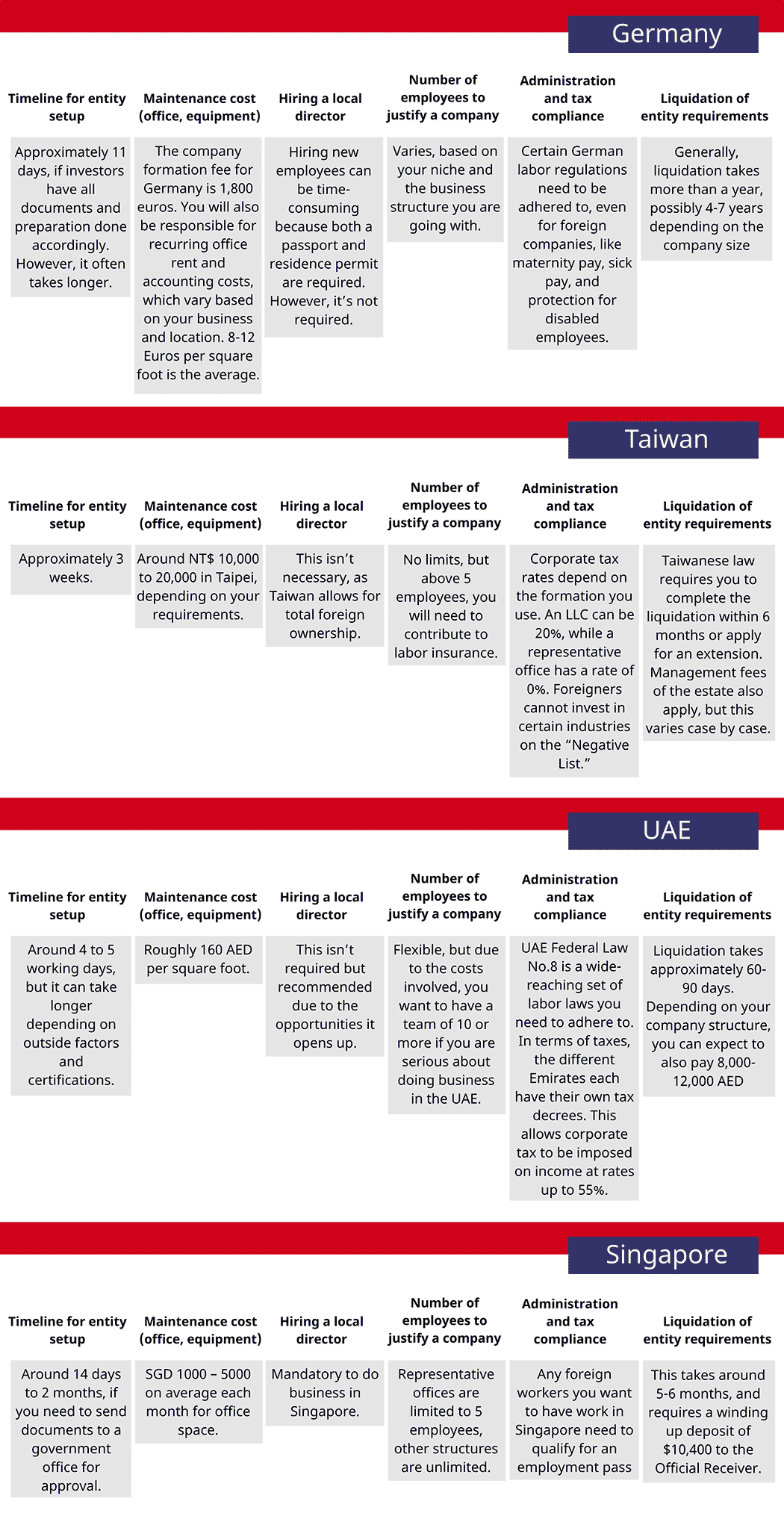
Different Entry Requirements & Costs for Opening a Company in Several Countries
Permanent Establishment Risk: Addressing the Concerns

You may think you can conduct business overseas without registering a legal entity, but you would be wrong. You might need to register your business even if you only send an employee on a temporary assignment or establish a small promotional office. Failing to do so can result in severe consequences.

Different countries have different tax laws, and a multinational company must consider all of these when conducting business. The tax authorities of a particular country can determine which elements of the company’s economic activity take place in that country and how much profit is attributable to them. This process can be complex, but ensuring that the company complies with all applicable laws is essential.

Flying Under the Radar of Local Tax Authorities

An organisation’s sustained physical presence in a country can trigger a taxable presence, or a “permanent establishment” (PE), in that country. This may occur if the organization generates revenue directly from activities in that country or if the organization’s activities contribute to the revenue of a group entity in that country.

As an organization operating overseas, it is crucial to be cautious of triggering a Permanent Establishment (PE) under local laws, as this can expose your company to unexpected tax liabilities, fines, and reputational damage. Failure to properly register a Permanent Establishment can have severe consequences for your business, so it is essential to understand the requirements of each country in which you operate.

Although the Organisation of Economic Co-operation and Development’s (OECD) base erosion and profit shifting (BEPS) project has had many far-reaching outcomes, one of the most significant is the modification of the definition of a permanent establishment. This change has important implications for businesses operating in multiple jurisdictions, as it may affect their tax liability.

The OECD is using Action 7 of BEPS to tackle common tax-avoidance strategies used by multinational corporations to avoid paying taxes in the countries where they do business. The organization is trying to stop companies from sidestepping local tax authorities by establishing related distributors rather than agencies or commissionaires.

Triggering Permanent Establishment Risk

A business is taxed based on the geographic location of its income-earning activities. To ensure Fair Taxation of the Digital Economy, on 21 March 2018, the European Commission proposed new rules to ensure that digital business activities are taxed in a fair and growth-friendly way in the EU. The penalties for noncompliance are steep (20% penalty on top of the 3% tax, plus fines).

As businesses look to expand into new markets, they must be aware of their tax liability in each country with a customer base. They must also be aware of the compliance obligations in each country where they sell their products. Suppose you are selling digitally and don’t already have this in-house expertise or don’t work with a global PEO & EOR partner. In that case, you need to start thinking about addressing this challenge immediately.

As it turns out, the trigger of a taxable presence in another country is not just an abstract challenge but a real non-compliance risk. Business in another country can come with hidden risks –  like inadvertently triggering a taxable presence. 

Acumen International has experience dealing with this problem – we were approached by a client who had unwittingly violated PE laws abroad. Two of the company’s employees were placed in one of the EU countries, working from home. However, since they weren’t generating much revenue directly in that country, the company decided to do their payroll registration instead of registering a complete corporate legal entity.

One year later, the local state tax authorities came knocking to say that an employee’s job title containing the word “sales” meant the company should have registered in-country as a business, resulting in higher employer payroll taxes. Ultimately, the company owed over €20,000 in back taxes and fines.

Non-compliance with local PE requirements can have dire consequences for businesses. The company took steps to mitigate the damages, but the message is still pretty clear: adhere to the requirements or face serious repercussions.

Get Express Quote

When Can a Legal Entity Setup Be Justified?

A company set up in a foreign country can be justified as one with an international headcount of over 20 employees. If you’re dealing with a smaller headcount, a global PEO solution will be able to satisfy your needs cost-effectively.

A company setup is closely connected with ongoing expenses that must be considered during decision-making. A business’s cost to invest borders on $20K for legal company setup, with an additional $40 thousand annually spent for maintenance. The process will take three to four months, and this time must also be allocated.

A global PEO tackles this pain point by cutting you as much as 60% of expenditures while still providing you with the desired result: presence in a new country and active operations.

Third-party Global Employment Solutions: Be as Agile and Super Protected with a Global PEO and EOR Partner

Before hiring global talent, you must set up your business entity and jump through all the associated hoops. This can include paying taxes, setting up a compliant payroll system, and sometimes applying for a social security number from the tax authorities. These additional steps can take anywhere from a few weeks to several months.

Many companies see the decision to set up subsidiary companies as a critical function of doing business abroad. However, as we’ve pointed out, there are pros and cons to this approach.

However, due to a lack of industry knowledge, many assume that building a legal entity abroad is the only way to expand while staying in industry compliance. Not necessarily.

Rather than go through the bureaucratic process, you can use a global Employer of Record solutions provider like Acumen International. We can help you in over 190 different countries. By taking the burden off your hands, we serve as an alternative, agile approach that supports modern global employment needs.

Global PEO and EOR — Alternative Options To Setting Up A Legal Entity Overseas

As your business expands globally, it is essential to be agile to make the best decisions for your company. Markets and consumer demand constantly change, so being as flexible as possible is vital. The more agile you are, the easier it will be to make the right choices for your business.

Outsourcing can be an excellent way for organizations to save money and increase efficiency. By carefully selecting which global employment functions to outsource and working with a trusted partner, businesses can reap the benefits of outsourcing without putting themselves at risk. Outsourced standard functions include payroll, benefits, and absence management, but deciding which functions to outsource should be made case-by-case. With careful planning and execution, outsourcing can help your organization run more smoothly and save money in the long run.

When expanding your business into new countries, there are many benefits to using a global PEO (Professional Employment Organization) or EOR (Employer of Record). A Global PEO and EOR Partners can handle all the immigration, hiring, payroll, tax, and HR compliance for you, freeing up your time to focus on other aspects of running your business. And if you ever need to leave the country, you can do so without being tied down by any long-term commitments.

The main benefit of using a global PEO versus a new entity for your business setup abroad is a lack of administrative cost and burden. Your global PEO provider will handle the complex logistics of staying compliant and managing your international employees without a legal entity. However, you ultimately have the final say on what gets done. Also, by going this alternative way, you still get the most considerable benefit that setting up a foreign entity could give you – expanding your presence in a new and lucrative market.

18 Burdens a Global PEO Can Relieve for Your In-House HR Department

  1. Global expansion complexity 
  2. Global payroll administration
  3. Employee benefits administration
  4. Immigration support and continuous immigration compliance
  5. Drafting compliant employment contracts to adhere to local labor and tax regulations in 190 countries
  6. Lengthy onboarding 
  7. Complex and risky offboarding
  8. Background checks
  9. Workforce compensation administration
  10. Ongoing compliance monitoring and guidance
  11. Guidance on best practices of voluntary benefits provisioning
  12. Immigration and relocation support for your ex-pat workforce, such as visa sponsorship and securing work permits
  13. Lack of institutional knowledge.
  14. IP right protection
  15. Lack of local and international legal support
  16. Convert local contractors into full-time employees
  17. Business Transitions: acquisitions, mergers, close-downs
  18. The need to deal with multiple global employment service providers.

Difference between an EOR and a PEO. Global Employment Risk Mitigation Strategy

Both PEOs and EORs work differently. However, an EOR is a company that takes on the legal risks of employing your workers, including finance, legal & compliance, and safety risks, saving you from any potential problems down the line. This means that all of the responsibilities that come with being an employer are shifted to them — from tax reporting to handling any injuries or issues on the job. You’ll have none of these hassles but will take responsibility for managing your employees’ tasks and performance.

ATTRIBUTE PEO EOR
Employment Model Co-employer Sole Employer
Permanent Establishment Factor Can only work with clients who have a registered in-country (state) entity Facilitates foreign expansion without setting up an entity
Key Services Global employment, payroll, benefits, immigration (visa, work permits), mobility Global employment, payroll, benefits, immigration (visa, work permits), mobility
Responsibilities Responsible for the entire array of HR functions Responsible for a portion of HR functions
Tax Administration Depending on local tax regulations may require taxes to be filed under the client’s taxpayer ID Files taxes under own Taxpayer ID Number
Payroll Funding Requires advanced payments from the client Provides payroll funding
Local Entity Establishment Required Optional
Local Entity Ownership Does not own the entities. Instead, a global PEO partners with a local or global third-party provider. A PEO  does not allow you to hire in other countries where you do not have a local entity. 100 % owns legal entities in the country of service. Allows to hire a workforce in other countries without setting up a business entity
Liability Shares responsibilities and liabilities EOR assumes all responsibilities and liabilities. It hires employees in the new country under its local business entity and takes on all of the legal risks.
Legal Advice Optional 100% compliance required
Global Labour & HR Compliance Optional 100% compliance required
Insurance May require the client to provide their own insurance. Provides general liability (GL) and workers’ compensation (WC) insurance coverage.
Benefits Provides higher quality  employee benefits at competitive prices Provides higher quality employee benefits at competitive prices
Employment Agreement The client must draft and sign the employment agreement with an employee. Drafts and signs the employment agreement directly.
Pricing Structure
  • Fixed monthly fee per employee
  • Percentage of payroll plus applicable taxes
  • Fixed monthly fee per employee
  • Percentage of payroll plus applicable taxes

Global Employment Services: How a Global PEO and EOR can Help You in Business Transition 

Acumen International PEO offers a unique blend of experience and service suite, providing global employment opportunities that are genuinely global-ready. If your company is transitioning, such as going through an acquisition or merger, or experiencing a company liquidation, Acumen International can find a legal and compliant solution to hire your employees—anywhere in the world! Many companies struggle with handling the employees being left behind during these times of transition. It’s common for employees to feel insecure about their future employment prospects, particularly when they have been forced out of their positions.

This can also be problematic for companies, who will likely have open positions that need filling but still have lingering contracts to fulfill. In both cases, having a resource like Acumen International PEO can ensure that the company’s business continues without being negatively affected by the change. When you’re working with Acumen International, we take care of all the paperwork and legal obligations so that you can focus on completing your transition plans. We also handle everything from payroll to benefits and even complete payroll tax administration for all our employees worldwide. This gives employers peace of mind that all their international obligations are fulfilled while allowing them to focus on their transition plans. 

A reduction in the workplace can be a scary time for employees. Global PEO can provide outplacement services to help reduce the risk and ensure that downsized employees have some assistance while searching for a new employer.

Legally Compliant, Cost Effective & Hassle-Free Mode of Market Entry

Acumen International is a global employment (PEO and EOR) company that provides services to expanding businesses. Acumen understands how employers can benefit from outsourcing their human resources management and the challenges an employer faces during this period of change. Acumen can help minimise these risks by offering businesses compliant and secure global employment services.

Acumen International’s global PEO and EOR services can help you by providing faster access to qualified talent in your industry. Our PEO and EOR services can help you get a presence in 190 countries quickly and easily without worrying about compliance with labour and tax regulations.

Are you an employer looking to hire looking for qualified talent in your industry but don’t want to go through the hassle of setting up a foreign legal entity? If so, you may need to partner with a global Employer of Record (EOR).

8 Scenarios When You Might Need a Global PEO and EOR Partner

  1. You have hired an employee but are unhappy with your current employment service provider. 
  2. You’ve decided to hire an independent contractor instead of a full-time employee, but you’re unsure if you comply with local laws and regulations.
  3. You are currently looking to improve the quality of your employment services.
  4. You can no longer afford to maintain a whole legal operation via your entity in the target country.
  5. You have a temporary project or one that doesn’t require you to open a legal entity in the target country.
  6. You need to hire a foreign workforce for your new project.
  7. To expand your business, you will need a mix of local and foreign employees. Those who are familiar with the local market will be able to help reduce the learning curve.
  8. International employers’ biggest challenge is supporting their organization’s employees when their business restructures or reorganizes. A global Employer of Record can support your business upon mergers, acquisitions or close-downs. When you manage the employee relations aspects during any business transitions (M&As or close-downs), you want to ensure that the process is seamless and 100% compliant.

Get Express Quote
Blog

A human-centered approach in global employment

In an era where technology continues to shape the landscape of global business, the need for a human touch remains paramount. Acumen International stands at the forefront of this intersection, championing a human-centred approach to global employment solutions. At the helm of these efforts is Maria Savva, Global Operations Director, whose insights and leadership have… Read more A human-centered approach in global employment

7 views 0 Comments

In an era where technology continues to shape the landscape of global business, the need for a human touch remains paramount. Acumen International stands at the forefront of this intersection, championing a human-centred approach to global employment solutions.

At the helm of these efforts is Maria Savva, Global Operations Director, whose insights and leadership have been pivotal in steering Acumen’s course towards enhancing client experience through technology.

Q: Could you share your perspective on the recent global meet-up in Cyprus and how it’s influencing Acumen’s direction, particularly in blending human interactions with technology?

A: The Cyprus meet-up was nothing short of amazing. For many of us, it was the first time we met in person, which brought an invaluable dimension to our teamwork and problem-solving abilities. The CEO’s presentation gave us insight into Acumen’s evolution as a global employment organisation across 190 countries and solidified our vision for the future. This experience united us, building trust and a strong team spirit. It was a crucial step in our journey, especially as we aim to further humanise technology in our operations.

Q: As the Global Operations Director overseeing customer-facing teams, how do your interactions with clients inform and shape Acumen’s technology roadmap?

A: Our approach is rooted in active listening. By engaging directly with our clients, we grasp their expectations and explore how we can exceed them. This interaction is the cornerstone of how we evolve our technology. Feedback varies; while some clients prefer regular updates through calls, others may not wish to dedicate as much time. Regardless of the method, we prioritise understanding their needs, which informs our technological advancements and innovations, like the Global Payroll Calculator. This tool is a reflection of our commitment to not just meeting but exceeding client expectations with our global employment services.

Q: Which of Acumen’s products are you excited about, and why?

A: I’m particularly proud of our Global Payroll Calculator and Navigator. These tools provide specific, country-level legal insights, which are instrumental in making informed decisions when expanding your team internationally. What sets us apart is our holistic approach. We offer a unique combination of human interaction, customised solutions, knowledge, and technological tools, which is something our competitors often lack. This blend ensures that our clients can always reach a real person with their queries, whether they’re about legislation, compliance, or budget concerns, setting us apart as a leading global employment company.

Q: How does the feedback loop with clients help refine Acumen’s services and technological solutions?

A: Our dialogue with clients provides critical insights that help us tailor and refine our technology. For example, integrating data input features specifically requested by our clients’ finance teams allows us to offer bespoke services that significantly enhance their operational efficiency. This ongoing feedback is vital for continuous improvement and innovation in our offerings, cementing our status as a premier employer of record services provider.

Q: What strategies do you employ to ensure Acumen’s team exceeds client expectations through technology and personalised service?

A: Our primary strategy is to be available, transparent,  accountable, and easy to engage with. We foster a culture of mutual learning between our team and clients, which enhances our service delivery. We emphasise on hiring skilled and empathetic individuals who care deeply about clients and our team and understand the significance of their work, which is central to our ethos. This approach not only meets but often exceeds client expectations, underlining our role as a comprehensive Global Employer of Record (EOR).

Q: How important is it for the Acumen team to deeply understand the intricacies involved with global employment?

A: The human experience is indispensable in our line of work. Clients appreciate the ability to speak to a human who not only understands their issue but can also empathise and offer solutions. This level of responsiveness and empathy cannot be replicated by technology alone. It’s the human touch that often makes the difference, providing reassurance and clarity in complex situations, especially in the realm of global employment outsourcing.

Q: Acumen’s long history and global reach give it a competitive edge. Could you discuss the key services you’re particularly proud of?

A: Our extensive experience, covering over 20 years and operations across 190 markets, gives us a profound understanding of global employment intricacies. As one of the first companies in this space, we established a robust framework early on. This foundation, enriched by decades of experience, has only added value to our offerings over the years. We’re able to provide comprehensive services, including Employer of Record and all-encompassing immigration solutions. 

I’m particularly proud of our ability to help our clients deal with complex circumstances, showcasing our adeptness at navigating intricate regulatory landscapes. Our long-standing position and accumulated expertise in the market enable us to deliver unparalleled service and support to our clients, affirming our commitment to excellence and innovation in the global employment sector.

Q: Finally, what achievements under your leadership have made you most proud?

A: First of all, I’m proud of our team. I have an amazing team that supports our company on all levels, including clients, partners, colleagues, and management. Our client-centric approach, combined with our technological tools, has not only sped up processes but also deepened our team’s understanding and increased efficiency, making Acumen a formidable player in the tech and global employment sectors.

Blog

How To Convert Independent Contractors into Employees

The root cause of employee misclassification is often a mix of financial motivations, regulatory complexity, the desire for flexibility, and sometimes a lack of awareness or deliberate avoidance of legal obligations. Addressing these underlying causes requires a clear understanding of employment laws, a commitment to compliance, and, often, a willingness to invest in the proper… Read more How To Convert Independent Contractors into Employees

20 views 0 Comments

The root cause of employee misclassification is often a mix of financial motivations, regulatory complexity, the desire for flexibility, and sometimes a lack of awareness or deliberate avoidance of legal obligations. Addressing these underlying causes requires a clear understanding of employment laws, a commitment to compliance, and, often, a willingness to invest in the proper classification of workers to avoid the long-term risks and costs associated with misclassification.

In this article, we address a significant shift in today’s work environment: the transition of workers from contractor roles to full-time employment. Its aim is to provide organisations with practical advice and strategies for managing this transition effectively, ensuring legal compliance and operational efficiency.

Neglecting the significance of tax compliance can lead to various risks for a business. Not only does it carry the possibility of legal repercussions, but it can also harm a company’s reputation and disrupt its operations. Moreover, compliance plays a crucial role in shaping economies and societal norms. However, achieving compliance is becoming progressively challenging in today’s complex regulatory landscape.

The shift from contractors to full-time employees is increasingly significant in a rapidly transforming global workforce. This shift marks a strategic pivot for businesses worldwide, driven by evolving regulations, changing workforce expectations, and the need for enhanced compliance.

Let’s delve into the crucial trends shaping this transition, offering essential insights for organisations navigating this change:

  1. Increasing Regulatory Complexity: Globally, countries are experiencing more intricate compliance requirements. This complexity, varying significantly from region to region, makes ensuring compliance increasingly challenging and necessitates robust governance frameworks.
  2. Varied Legal Interpretations and Lack of Clarity: Differences in legal interpretations and insufficient clarity in employment and tax laws can create compliance issues worldwide. This includes varying definitions and standards in labour laws, tax regulations, and employment benefits.
  3. Intensified Audits and Regulatory Scrutiny: Increased regulatory scrutiny, technological advancements, and compliance with changing labour laws drive a global trend towards more rigorous audits. These audits often extend beyond basic legislation adherence to include standards like equity, diversity, and inclusion.
  4. Evolution of Employee Compensation Structures: Globally, companies are rethinking compensation structures to meet evolving talent expectations and align with business goals. This shift has led to a greater focus from tax authorities on how compensation is structured and reported.
  5. Rise in Workforce Mobility: Increased global mobility, including remote work, short-term international assignments, and virtual engagements, presents operational challenges in managing employment tax compliance and payroll obligations.
  6. Enhanced Focus on Corporate Tax Risk Management: Tax regulators worldwide focus more on corporate tax risk management and governance, indicating a potential shift towards more stringent workforce tax issues in the future.
  7. Need for Adaptive, Tax-effective Governance Frameworks: Organisations must understand their current compliance status and develop governance strategies that align with their business goals and risk appetite. This includes regularly updating tax policies, training teams, and implementing efficient tax technology and controls.
  8. Anticipation of Tax Reforms and Legislative Changes: Many countries are likely to experience reforms in workforce taxation, particularly concerning classifications of employees versus contractors and the tax implications of various types of employee compensation.
  9. Growing Concern for Employee Rights and Protections: There’s an increasing global focus on improving protections for workers, including independent contractors and contingent workers, which affects how businesses classify and manage different types of workers.

Transitioning Disguised Employees across Jurisdictions

Imagine a Hypothetical Scenario

You’re an employer juggling the complexity of a multinational workforce, and a hidden concern lurks beneath the surface—disguised employees. This raises critical questions: Why resort to this strategy, and how daunting is the path to compliance? Let’s delve into the motivations, triggers for change, and intricate landscape awaiting a transition project.

Why Contractors as Disguised Employees? (Motives)

  1. Cost Savings: Avoiding employer taxes and benefits for disguised employees can translate to significant short-term financial gains.
  2. Flexibility: Contractors offer freedom from rigid employment structures and easier termination than formal employees.
  3. Specialised Skills: Securing specific skills through contractors bypasses lengthy recruitment processes for temporary needs.
  4. Tax Optimisation: Companies with a global presence can gain a strategic advantage by utilising contractors across multiple jurisdictions with lower tax rates.

Triggers for Transitioning

  1. Legal and Regulatory Risks: Increased scrutiny of disguised employees can expose companies to heavy penalties and reputational damage.
  2. Employee Dissatisfaction: Disparity in benefits and rights between contractor and employee classifications can lead to resentment and legal challenges.
  3. Talent Management Issues: Difficulty attracting, managing, and retaining top talent under contractor arrangements can hamper long-term growth.
  4. Operational Inefficiencies: Lack of standardised processes and integration for disguised employees can create administrative burdens.
  5. Lack of in-house resources to manage global talent and ensure legal compliance.
  6. Company restructuring.

Transitioning to Compliance: What to Prepare for

  1. Cost Impact and Unplanned Extra Cost: Increased payroll costs due to employee withholding taxes, employer social security contributions, and statutory benefits (varying across jurisdictions).
  2. Termination Management: Navigating notice periods, severance payments, and potential legal claims during employment transition (also differing by country) and getting consent to the transfer as per legal requirements (depending on the country)
  3. Project Framework: Develop a comprehensive plan with cost estimations, legal considerations, communication strategies, and timelines for each jurisdiction involved.
  4. General red tape may affect the overall project timelines.

A Roadmap for a Successful Contractor-into-Employee Transition

Navigating this transition is not a mere checkbox exercise but a strategic move towards a stable, sustainable, and ethical workforce. By understanding the motivations, triggers, and consequences, you can chart a course towards compliance, mitigating risks while reaping the benefits of a truly engaged and empowered global workforce.

Avoiding Potential Threats

  1. Under-taxation: Ensure accurate classification and tax payments to avoid penalties and reputational damage.
  2. Worker Misclassification: Mitigate employee misclassification risk by ensuring contractors meet genuine self-employment criteria.
  3. Permanent Establishment Risk: Manage cross-border operations to avoid permanent establishment risk and unintended tax liabilities in foreign jurisdictions.
  4. Potential Penalties: Proactively address compliance issues to avoid financial repercussions and legal disputes.
  5. Damaged Reputation: Maintain ethical practices and transparency to safeguard brand image.

Achieving Sustainable Goals

  1. Business Security: Foster legal and operational stability by adhering to employment regulations.
  2. Sustainability: Build a long-term, secure workforce through fair practices and talent development.
  3. Talent Retention: Attract and retain top talent by offering competitive benefits and opportunities.
  4. Fair Pay: Pay employees equitably, regardless of classification, to improve morale and productivity.
  5. Scalability.

Growing businesses must compare and contrast key global employment variables across different countries when transitioning from contractors to full-time employees. By examining Payroll and Tax Implications, Statutory Benefits and Contributions, and Termination Conditions, specifically in Germany, Poland, France, the Philippines, and Argentina, we can gain valuable insights into how these variables differ and their consequent impact on an organisation’s financial planning and overall strategy.

This comparative analysis is not just about understanding individual costs; it’s about viewing these variables through a broader lens to appreciate their cumulative effect on the bottom line and strategic operations.

The data provided in these tables is essential for businesses operating across borders. They compare key employment factors in different countries, helping companies to navigate the financial liabilities and legal obligations in diverse markets. With this comprehensive overview, employers can better anticipate the challenges and opportunities of global expansion, ensuring a balanced approach to workforce management that aligns with both financial realities and long-term goals.

Payroll and Tax Implications Comparison

CountryEmployer Burden (%)Employee Tax Rate (%)Source
GermanyApprox. 20-21.5%Approx. 14-45%BMF – Federal Ministry of Finance
PolandApprox. 17-18% (excl. 2.25% ZUS)Approx. 17-32%ZUS – Social Insurance Institution
FranceApprox. 28-31%Approx. 15-45%URSSAF – General Social Security Office
PhilippinesApprox. 13.5-16%Approx. 0-35%BIR – Bureau of Internal Revenue
ArgentinaApprox. 34-39%Approx. 5-35%AFIP – Federal Administration of Public Revenue

Statutory Benefits and Contributions Comparison

CountryHealthcarePension ContributionsOther Benefits
GermanyMandatoryMandatoryUnemployment, Long-term care insurance
PolandMandatoryMandatoryDisability, Sickness
FranceMandatoryMandatoryFamily, Housing, Social security
PhilippinesMandatoryMandatoryDisability, Death, and Pension Benefits
ArgentinaMandatoryMandatoryFamily Allowances, Unemployment Insurance

Termination Conditions Comparison

CountryNotice PeriodSeverance PaymentSource
Germany4 weeks to 7 monthsUp to half a month’s salary per year of serviceBMF – Federal Ministry of Finance
Poland2 weeks to 3 monthsSeverance based on tenure and reason for terminationZUS – Social Insurance Institution
France1 month to 2 monthsLegal minimum of one-fifth month’s salary per year of serviceURSSAF – General Social Security Office
Philippines30 daysOne month’s salary or half a month per year of service, whichever is higherBIR – Bureau of Internal Revenue
Argentina15 days to 2 monthsOne month’s salary per year of serviceAFIP – Federal Administration of Public Revenue

Action Plan for Transitioning Contractors to Full-Time Employees across Multiple Countries

Step 1: Audit of Current Employment Landscape

  • Gather Data: Collect comprehensive data on all contractors currently engaged in different countries, including their roles, positions, and contract terms.
  • Assess Compliance Risks: Evaluate the current contractor arrangements for compliance risks, particularly on misclassification issues.
  • Identify Key Transition Candidates: Based on the audit, identify contractors who should be transitioned to full-time roles to mitigate risks or align with strategic goals.

Step 2: Transitioning Process – Estimating Costs

  • Develop Cost Models Use Table:
    • Global Salary and Tax Implications to estimate changes in payroll costs.
    • Calculate potential employer burden and employee tax rates for each jurisdiction.
  • Benefits and Contributions Analysis:
    • Assess additional costs for statutory benefits using Table: Statutory Benefits and Contributions.
  • Termination and Severance Assessment:
    • Evaluate potential costs for terminations or severance using Table: Termination Conditions.
  • Total Cost Estimation:
    • Compile the data to provide a comprehensive cost estimation for the transition.

Step 3: Weighing Choices – Financial and Legal Planning for C-Suite

  • Compare Contractor vs. Full-Time Costs: Analyse the financial impact of transitioning contractors to full-time employees versus maintaining current arrangements.
  • Legal Compliance Check: Ensure the transition plan adheres to each country’s local employment laws and tax regulations.
  • Strategic Alignment: The transition plan should be aligned with the company’s broader strategic goals, such as talent retention or market expansion.

Step 4: Implementation Plan

  • Draft Transition Agreements: Prepare legal documents for transitioning identified contractors to full-time roles.
  • Communicate with Stakeholders: Communicate the transition plan to all relevant parties, including contractors, management, and HR teams.
  • Set Up Payroll and Benefits: Align with HR and payroll teams to integrate new full-time employees into existing systems.

Step 5: Ongoing Compliance and Management

  • Regular Audits: Conduct regular audits to ensure compliance with employment and tax laws.
  • Adjustments and Optimisation: Continuously review and optimise the employment structure in response to changes in laws, business needs, and workforce dynamics.

Step 6: Review and Feedback

  • Gather Feedback: Collect feedback from newly transitioned employees and management to assess the effectiveness of the transition.
  • Evaluate Impact: Assess the impact of the transition on business operations, compliance, and employee engagement.
  • Plan for Future Transitions: Use learnings to refine the process for future transitions.

Global Payroll Calculator – Your Precision Tool for Global Employment Cost Analysis

The Global Payroll Calculator (GPC) offers a sophisticated solution for instantly calculating employment costs across 190 countries, streamlining your global hiring strategy and ensuring cost-effective decisions.

Key Features & Benefits

  • Instant Cost Calculations: Quickly determine total employment costs, factoring in real-time tax rates and benefits for local and foreign talent in 190 countries.
  • Precision & Clarity: Achieve precise payroll calculations with detailed breakdowns of all payroll variables, ensuring transparency and preventing unexpected employment costs.
  • Cross-Country Comparisons: Utilise GPC’s capability to perform instant comparisons between countries, helping you identify the most advantageous locations for hiring.

Core Capabilities

  • Total Employment Cost Analysis
    • Monthly and yearly costs.
    • Gross-to-net and net-to-gross calculations.
    • Detailed breakdowns, including employer liability and employee taxes.
  • Full Tax Breakdown
    • Comprehensive coverage of social contributions, personal income tax, and automated tax caps.
    • Employer and employee tax splits with allowances and holiday entitlements.
  • Built-in Compliance
    • Ongoing validation against trusted government sources across 190 countries.
    • Updates in real-time to reflect the latest tax and labour laws.

Advantages of Global Payroll Calculator for Employers 

  • Manage complex global payroll budgets effectively.
  • Identify tax-friendly, cost-effective global talent hotspots.
  • Ensure compliance with international regulations to avoid legal issues.

Unique Solutions for Global Expansion Challenges

  • Express Global Employment Support: Backed by 20+ years of Acumen International’s expertise, the Global Payroll Calculator is integrated with our global EOR solutions to support your international workforce management.
  • Robust Methodology: Standardises diverse data into a unified format, enhancing decision-making clarity across multiple jurisdictions.

With Global Payroll Calculator, you gain a powerful tool designed to optimise your global employment strategies and ensure that your international operations are cost-effective and compliant.

Closing Words

Transitioning contractors to full-time employees requires careful strategic planning and compliance with evolving regulations. The insights offered here serve as a guide for businesses looking to navigate this transition smoothly. If you need further help transferring contractors into full-time employees, contact Acumen International.

For more information, visit Acumen International.

Blog

Global Employment Newsletter. March 2024. Blending Tech Innovation with Personalised Support

Contents Introduction Welcome to our March newsletter, where we’re exploring a theme close to our heart and critical to our mission: Humanised Technology. As the digital age propels us forward, Acumen International stands at the crossroads of innovation and personalised service, championing a service model that marries cutting-edge technology with the invaluable element of human… Read more Global Employment Newsletter. March 2024. Blending Tech Innovation with Personalised Support

10 views 0 Comments

Contents

  • Introduction
  • What is Humanised Technology?
  • How we maintain a truly customer-focused EOR business.
  • Interview with the CEO Nick Ghanzha, Navigating the Future of Work.
  • Spotlight on Portugal: A Hidden Gem for Tech Talent. 
  • What’s New in Global HR Legislation.
  • Summary & Close

Introduction

Welcome to our March newsletter, where we’re exploring a theme close to our heart and critical to our mission: Humanised Technology. As the digital age propels us forward, Acumen International stands at the crossroads of innovation and personalised service, championing a service model that marries cutting-edge technology with the invaluable element of human touch.

This month, we’re busy developing groundbreaking technology innovations designed to improve efficiency and ensure our clients feel supported, understood, and valued at every step. 

Join us in discovering how technology and human focus converge at Acumen for a truly unparalleled service experience.


What is Humanised Technology?

Following our global meet-up in Cyprus, we’re thrilled to share how our technology roadmap is shaping the future of global employment services. Humanised Technology at Acumen means blending our technological advancements with deep human insight and expertise. Our focus remains steadfast: to enhance, not replace, the human element in our services.

Maria Savva , our Global Operations Director, puts it best: 

“We offer companies the chance to reach out to employees globally with a personal touch that understands the needs of our clients deeply. We pride ourselves on exceeding expectations through our commitment to excellence and personalised care.”

Read on to dive deeper into this exciting topic. 


Insight: Maintaining a Customer-Focused EOR Business

In a world veering towards impersonal tech-driven solutions, Acumen International stands out by maintaining a truly customer-focused approach. Our unwavering commitment to our customers has defined our 23-year journey as a client-first focused business. We match technological capabilities with unparalleled support, ensuring our interactions foster solid partnerships throughout clients’ global employment journeys.

In our blog on How We Maintain a Truly Customer-Focused EOR Business, we highlight key insights that underscore our dedication:

  • The Virtue of Organic Growth: Our growth is driven by customer revenue, emphasising sustainable development and agility. This approach ensures that our innovations meet the real-world needs of our clients, aligning with our commitment to prioritise customer satisfaction. Our CEO, Nick Ganzha, states, “We are a human-focused business supported by technology where we can tailor our solutions to the specific client needs and provide them with the solutions no platform can provide.”
  • Prioritising Customers in the SaaS Journey: The evolving HR tech landscape underscores the importance of a customer-first strategy. Our solutions are designed to effectively address specific customer challenges, fostering loyalty and ensuring sustainable competitive advantage.
  • The Centrality of Customer Needs: Understanding and addressing client challenges is pivotal. Our tailored solutions and support are aimed at enhancing the customer buying experience, fostering a culture of trust and reliability.

As we forge into 2024, we are poised to launch new innovative tools that perfectly balance advanced technology with our unmatched personalised support. 

📖 Read the full blog here >>> Read More


Interview: Navigating the Future of Work with Nick Ganzha, CEO

In an enlightening discussion, Nick Ganzha , CEO of Acumen International, shares the company’s strategic vision and innovative approaches in the realm of global employment. 

Here are the condensed highlights of our conversation:

  • Cyprus Leadership Meet-Up: The primary objective was to embrace Acumen’s shift towards humanised technology, focusing on tailoring solutions to specific client needs. It served as a reunion to celebrate achievements, welcome new members, and outline actionable steps to improve Employer of Record Services.
  • Global Remote Workforce Transition: Here, Nick highlights the viability of remote work, emphasising the need for strategic human capital management and the importance of corporate social responsibility, especially in response to global crises.
  • Future Employment Trends:
  • The evolution of PEOs/EORs towards providing strategic business support.
  • The shift towards flexible, hybrid work models and the central role of trust within organisations.
  • The critical integration of technology to support human-centric productivity.
  • Adapting Strategies:
  • Emphasising technology that supports human efforts and addressing global workforce challenges.
  • Navigating economic uncertainties with resilient global employment strategies and tackling skill shortages.
  • Vision for Global Employment:
  • Transforming global mobility programs and emphasising skill-based hiring.
  • Adapting to employment shifts with flexible, compliant strategies.
  • Leveraging technology to enhance business competitiveness.

🎤 Read the full interview with Nick Ganzha >>> Read now


Spotlight on Portugal: A Hidden Gem for Tech Talent 

Portugal is emerging as a prime destination for tech talent, blending cost efficiency with a vibrant culture and exceptional work-life balance. Here’s why Portugal stands out in the global tech landscape, and how Acumen’s Solutions are perfectly poised to support your hiring needs:

Why Portugal is Your Next Tech Talent Hub:

  • Cost Benefits for Employers: Save on taxes and incorporation costs, maximising your budget to attract top-tier talent without excessive overheads.
  • Work-Life Harmony: Portugal’s culture fosters productivity and creativity thanks to its enviable lifestyle and work-life balance.
  • Local Talent Commitment: With 50% of IT professionals preferring to stay in Portugal, employers have access to a pool of dedicated local talent.
  • Competitive Salaries in a Lower Cost Environment: The average salary for tech professionals (46K EUR) in Portugal goes further due to the lower cost of living, enhancing your return on investment.

Portugal not only offers a strategic advantage with its burgeoning tech talent pool but, combined with Acumen’s comprehensive Global EOR and Contractor Solutions, makes scaling your team or launching new projects more effective and efficient than ever.

🇵🇹 Learn more about Portugal >>> Discover now


Legislation: What’s New in Global HR Legislation

Stay informed with the latest developments in global HR legislation to ensure your business remains compliant and ahead of the curve.

🇦🇺 Australia Introduces ‘Right to Disconnect’

Australia is set to empower its workforce with a ‘right to disconnect’ law, aiming to protect employees from working unpaid overtime and ensuring they are not obligated to be online outside working hours. This move is part of a broader effort to enhance work-life balance and is expected to come with fines for non-complying employers.

  • Employer Impact: Encourages healthy work-life boundaries, potentially increasing employee satisfaction and retention.
  • Employer Actions: Review and adjust work policies to comply with the new legislation, ensuring respectful communication practices outside of standard working hours.

🇦🇺 Read more about Australia’s right to disconnect.

🇸🇰 Slovakia Streamlines Employment for Third-Country Nationals

The Slovak government is easing the process for employing third-country nationals (TCNs) in the transportation and industry sectors, increasing the total number of employment visas issued. This initiative is designed to address labour shortages by facilitating the recruitment of foreign talent.

  • Employer Impact: Expanded talent pool and simplified hiring process for employers in critical sectors.
  • Employer Action: Consider leveraging this new policy via Acumen’s PEO Service to support hiring Expats in Slovakia

🇸🇰 Discover the details of Slovakia’s employment process streamlining.

Hungary’s Immigration Law Overhaul

Hungary’s new immigration law, effective March 1, introduces 24 types of residence permits, including eight dedicated to employment. It also tightens conditions for TCNs and eliminates the flexible “residence permit for other purposes.”

  • Employer Impact: More defined pathways for hiring international talent but with increased regulatory complexity.
  • Employer Actions: Assess the new categories to identify applicable permits for future hires and adjust recruitment strategies accordingly. Acumen can support with work permits and immigration support

🇭🇺 Read about changes in Hungary’s immigration law.


Summary & Close

As we embrace the synergy of technology and personalised support, Acumen International reaffirms its dedication to empowering clients while ensuring they feel valued and supported. This month, we invite you to discover the difference that humanised technology can make in your global employment journey.

Stay updated with the latest from Acumen International.

Thank you for being with us this month. Here’s to pioneering a future where technology enhances human connection, making global employment more efficient and human.