Welcome to the May edition of “The Global Talent Horizon.” This month, we explore how Acumen International alleviates the complexities of global business expansion. Our expertise in placing foreign talent, combined with superior customer service, innovative platforms, and cutting-edge technology, ensures comprehensive EOR solutions. Discover how our commitment to excellence simplifies your journey into new… Read more Global Expansion Made Easy: Your Trusted EOR Partner
Welcome to the May edition of “The Global Talent Horizon.” This month, we explore how Acumen International alleviates the complexities of global business expansion. Our expertise in placing foreign talent, combined with superior customer service, innovative platforms, and cutting-edge technology, ensures comprehensive EOR solutions.
Discover how our commitment to excellence simplifies your journey into new markets, positioning Acumen as your trusted ally in fostering global growth through expertly managed, stress-free international talent acquisition.
Navigating International Expansion in 2024: Technology and Strategy Insights
A recent Forbes article highlights key trends for businesses strategising their international operations in 2024. At Acumen International, we align with these insights by providing comprehensive EOR solutions that simplify your global hiring efforts.
Key insights include;
capitalising on green and digital transformation policies,
leveraging flexible talent hubs and
engaging with innovation ecosystems.
Our strategic foresight ensures your expansion is both current and forward-thinking.
Debunking Global Expansion Myths: True Expertise Unlocked
Expanding internationally can be fraught with myths that can deter companies. Acumen International dispels these myths, offering clarity and expert support to ensure your global expansion is successful and stress-free.
Quick market entry is always possible.
Reality: Visa and immigration processes vary widely and can delay plans. Acumen ensures you navigate these waters with expert precision, planning for realistic timelines.
It’s too complex and risky.
Reality: With Acumen’s expert EOR solutions, we handle the complexities of compliance, payroll, and local regulations, ensuring a smooth transition into new markets.
You must incorporate locally to operate.
Reality: With Acumen’s EOR services, start operating in new markets without immediate incorporation, testing the waters before making large commitments.
International hiring is necessary for global growth.
Reality: Bring your trusted team along! Acumen supports your expat visa and immigration needs, keeping your core team intact.
EORs only handle administrative tasks.
Reality: Acumen provides comprehensive end-to-end solutions far beyond mere paperwork processing. We help you with everything from strategic planning to full operational deployment.
With Acumen’s expert Global EOR solutions, we handle the complexities of compliance, payroll, and local regulations, allowing you to focus on strategic growth.
Small Countries, Big Impact: Discover Hidden Gems for Remote Talent
Small nations often pack a significant punch in the global talent pool. Acumen International highlights exceptional opportunities for hiring remote talent in lesser-known yet advantageous countries. These countries offer favourable tax regimes and high quality of life, making them attractive for remote workers.
Discover Andorra: Remote Talent Paradise is ideal for businesses valuing privacy and innovation. Learn more about Andorra >>
Luxembourg: Small Country, Big Talent A hub of multilingual professionals perfect for international businesses. Learn more about Luxembourg >>
Liechtenstein: Strategic Talent Acquisition Benefit from high-skilled remote talent in a central European location. Learn more about Liechtenstein >>
Welcome to the Team: Mike Flowers, Leading US Operations
Acumen International welcomes @Mike Flowers as the Head of US Operations. With 87% of U.S. companies agreeing that international expansion is crucial for long-term growth, Mike’s leadership ensures that our US clients benefit from strategic insights and global experience. His expertise enriches our robust offering, allowing US businesses to navigate new markets confidently.
Stay informed with the latest developments in global HR legislation to ensure your business remains compliant and ahead of the curve.
EU AI Act: Regulating Artificial Intelligence
The EU Council has approved the AI Act, the world’s first major law regulating artificial intelligence. This law sets comprehensive rules surrounding AI technology and applies a risk-based approach, prohibiting applications deemed “unacceptable” and imposing stringent requirements on high-risk systems.
Employer Impact: This has major implications for any entity developing, using, or reselling AI in the EU, particularly for U.S. tech firms.
Employer Actions: Ensure compliance with the new regulations, focusing on transparency, risk management, and cybersecurity. Acumen’s EOR services can help navigate these changes effectively.
Singapore Tightens Rules for Hiring Foreign Professionals
Starting next year, Singapore will raise the salary criteria for foreign professionals applying for employment passes. The new minimum salary will be S$5,600, with higher thresholds for the financial sector. This move aims to ensure high-quality employment pass holders and maintain a level playing field for locals.
Employer Impact: Stricter hiring criteria may limit the pool of eligible foreign professionals.
Employer Actions: Review hiring strategies and salary structures to comply with the new requirements. Acumen can help manage these changes and streamline the hiring process in Singapore.
EU Platform Work Directive: Protecting Platform Workers
The EU Parliament has adopted the Platform Work Directive, which aims to improve the working conditions of platform workers and regulate the use of algorithms in the workplace. The directive introduces a presumption of employment, ensuring the correct classification of workers and protecting against unfair algorithmic decisions.
Employer Impact: The directive requires the reclassification of platform workers and adherence to new rules on algorithmic management and data protection.
Employer Actions: Implement changes to comply with the directive, ensuring human oversight in decision-making processes and robust data protection measures. Acumen’s Contractor Management services can assist in navigating these regulatory changes.
Acumen International reaffirms its commitment to valuing human interaction and innovation as we explore avenues for seamless global expansion. Our expertise ensures your business can expand internationally with peace of mind and reassurance. Experience the difference a well-managed, people-powered approach can make to your international expansion ambitions.
As more companies look to international markets to expand their businesses, there has been an explosion of Global Employer of Record (EOR) companies, the vast majority of which are SaaS-based models. This surge reflects the evolving landscape of global business expansion and underscores the critical need for a marriage of technology and on-ground experience when… Read more Choosing the Right Global EOR Partner: Key Questions to Ask Before You Decide
As more companies look to international markets to expand their businesses, there has been an explosion of Global Employer of Record (EOR) companies, the vast majority of which are SaaS-based models. This surge reflects the evolving landscape of global business expansion and underscores the critical need for a marriage of technology and on-ground experience when selecting the perfect Global EOR partner.
For businesses navigating this complex landscape, choosing the right Global EOR partner can provide seamless integration of international employees, ensure compliance with local laws and optimise operational efficiencies. But with so many options available, how do you choose the best Global EOR company for your needs?
Essential questions to ask to help you make an informed decision
1. What experience does the EOR Prospect have in the market you are looking to enter?
Understanding the experience level of your Global EOR partner in the specific country where you plan to hire is critical. It is essential to know how well they understand the local labour laws, culture and business environment.
2. What on-the-ground experience does your Global EOR partner have in that country?
Understanding the on-the-ground experience of your Global EOR partner in the target country is essential. While EOR companies may not maintain their own local entities in every market, a robust network of seasoned, well-established partners is critical.
It’s crucial to verify that your EOR provider, like Acumen International, leverages a network of trusted and thoroughly vetted local partners with extensive regional experience and compliance knowledge. This ensures that service quality and legal compliance are uncompromised, maintaining high standards of operational excellence wherever you choose to expand.
3. Can they provide details of the staffing and operations of their local entity?
Ask about the structure and staffing of their local operations. Who manages their entity, and what experience and qualifications do these professionals have? Understanding who will handle your operations locally provides insights into the operational reliability and expertise of the Global EOR company. Having an effective EOR team on the ground will be especially important should any challenges occur moving forward.
4. What is their track record of hiring in your desired country?
Inquire about the EOR’s previous experience with companies hiring in the target country. Ask for specific examples, including how they addressed challenges and any pain points encountered during the process.
5. What are the steps to establish and dissolve a local entity in your target country?
6. What employment models does the Global Employer of Record partner offer?
Different business needs require different employment models. Whether it’s EOR, contracting, Professional Employer Organization (PEO), or Agent of Record (AOR) services, ensure the EOR can offer the solution that aligns perfectly with your business needs.
7. Do you require recruitment services?
If your global expansion plans include searching for and hiring local talent, check if your Global EOR partner provides recruitment services. This can significantly streamline the process of finding and hiring the right talent.
8. How does the Global EOR partner support the immigration and visa processes?
Finally, if your expansion involves relocating existing employees or hiring international talent, understanding the Global EOR’s capability to handle immigration support and visa processes is essential. Effective on-ground support in this area can save considerable time and reduce compliance risk.
Selecting a Global EOR partner is a strategic decision that requires thorough vetting. By asking these detailed questions, you can gauge whether an EOR provider can meet your specific international employment needs. Remember, the perfect EOR partner should offer a strong and intuitive technology platform but, more importantly, robust on-the-ground support and experience to ensure a smooth and compliant operation across borders.
According to a Wells Fargo survey (20 Dec 2023), “87 percent of U.S. companies agree that international business expansion is needed for long-term growth, with emerging markets providing the greatest opportunities. Acumen International is committed to helping US firms with their global expansion and has hired Mike Flowers as the Head of our US Operations. Mike brings… Read more Acumen International Welcomes Mike Flowers to Lead US Operations
According to a Wells Fargo survey (20 Dec 2023), “87 percent of U.S. companies agree that international business expansion is needed for long-term growth, with emerging markets providing the greatest opportunities.
Acumen International is committed to helping US firms with their global expansion and has hired Mike Flowers as the Head of our US Operations. Mike brings a wealth of expertise and a proven track record in Employer of Record Services, making him the perfect leader to spearhead our initiatives and build on Acumen International’s thirteen years of experience in the US market.
US Expertise with Global Reach
With Mike at the helm, Acumen International is uniquely positioned to offer US businesses the best of both worlds: deep local knowledge backed by extensive global employment experience. Mike’s leadership ensures that our US clients will benefit from strategic insights that only a global employment organisation with 23 years’ of experience can provide.
Why Should US Companies Choose Acumen International?
Global Experience, Local Insight: Mike’s expertise enriches our already robust offering, ensuring that our US clients can confidently draw on Acumen’s 23 years of experience to navigate new market development. Whether it’s understanding complex local regulations or managing cross-border teams.
Unparalleled Global Network: Acumen’s reach extends across most markets worldwide, including remote and challenging regions. This unparalleled network and knowledge open doors for our clients in virtually any location they choose to pursue, providing a strategic advantage in global market expansion.
Comprehensive Service Offering: Acumen’s breadth of services covers all aspects of global expansion. From recruitment and immigration support to international payroll and compliance, we handle the intricacies of international employment, allowing our clients to focus on their core business activities.
Flexible Approach to Employment Agreements
At Acumen International, we understand that one size does not fit all when it comes to global employment. We are committed to a flexible approach in crafting employment agreements, ensuring that each solution is bespoke , whilst ensuring all agreements are fully compliant with all laws and regulations.
👉We invite you to reach out to explore how Acumen International can help your business achieve its global aspirations. Contact us today to start your journey towards international success.
Worker misclassification is the practice of companies inappropriately classifying workers as independent contractors rather than employees to avoid costs and administrative burdens associated with the latter. Companies do this to save money on things like benefits, payroll taxes, and unemployment insurance. Worker misclassification refers to an employment situation in which either an employer or an… Read more How to Avoid Employee Misclassification Risk?
Worker misclassification is the practice of companies inappropriately classifying workers as independent contractors rather than employees to avoid costs and administrative burdens associated with the latter. Companies do this to save money on things like benefits, payroll taxes, and unemployment insurance.
Worker misclassification refers to an employment situation in which either an employer or an employee intentionally misrepresents the true nature of their working relationship.
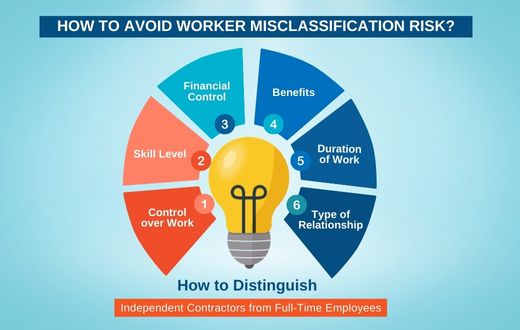
Independent Contractors vs Full-Time Employees: How to Distinguish between Them
The distinction between independent contractors and full-time employees is important because it affects issues such as tax obligations, benefits, and labor laws. Here are some factors that can help distinguish between the two:
1. Control over Work
Does the company have the right to direct how, when, and where the worker does his or her job?
If the worker is free from control and direction in carrying out the duties under the contract and in practice, then the worker is likely an independent contractor.
At the same time, full-time employees typically have more control and are subject to the direction and control of their employer.
2. Skill Level
How much training was required for a position? – The more training a company requires its employees to have, the less likely that company is going to hire an independent contractor.
The skill level of an independent contractor is often directly related to the type of work they do, in that there’s a certain expectation that they have a more specialized level of expertise than a full-time employee.
An independent contractor is hired with their specialized skills in mind, while a full-time employee is generally hired to perform a specific job function within your company.
3. Financial Control & Tax Obligations
Are the business aspects of a worker’s job controlled by an employer or are they in control of their own finances?
Tax obligations are one of the major differences between independent contractors and full-time employees. Independent contractors are responsible for paying their own taxes, while employers are required to withhold taxes from the pay of full-time employees.
4. Benefits
Full-time employees are often eligible for benefits such as health insurance, retirement plans, and paid time off,
When an employee is misclassified, that person may not have access to various benefits, such as health insurance and pension plans. Independent contractors are typically responsible for their own benefits and social security.
5. Duration of Work
Full-time employees are typically hired for a longer period of time, while independent contractors are often hired for specific projects or short-term work.
6. Type of Relationship
Is there a written contract or agreement that outlines what will be done and how much will be paid?
When you treat someone as an independent contractor, they are not part of your company’s payroll. Rather, they operate as freelancers paid for their services—no matter how many hours they log in an average week. Independent contractors are often hired for specific projects or jobs that will end at some point and are not an ongoing source of work. In general, if a person does other work besides what you bring them in for (such as taking additional jobs from other employers or working independently), she’s more likely to be considered an independent contractor than a full-time employee.
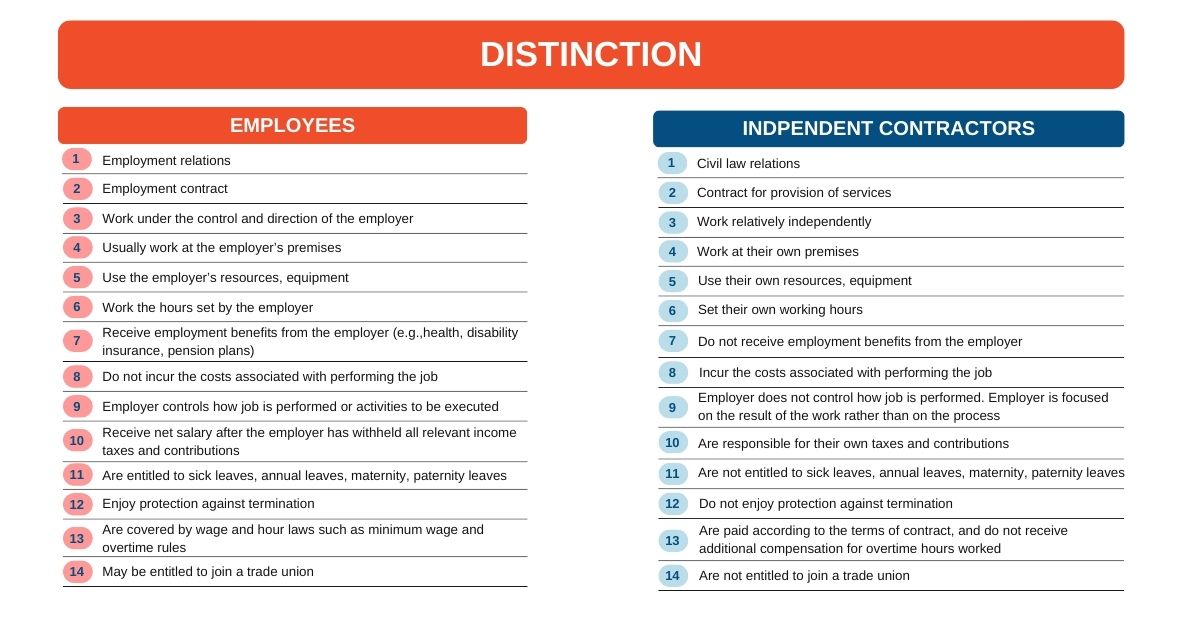
Visual Comparison of Independent Contractors and Employees: Understanding the Key Differences and Factors to Consider
The chart below represents a comparison between an independent contractor and an employee regarding various factors.
Several factors differentiate independent contractors from employees. These include factors such as tax responsibilities, control over work, flexibility, benefits, and job security. The chart highlights that while independent contractors have more flexibility and control over their work, they do not receive the same level of benefits and job or social security as employees.
11 Practical Steps for Properly Classifying Workers
Employers should carefully evaluate each of these factors when classifying their workers. It’s important to note that misclassifying workers can result in legal and financial consequences for the employer, including fines, back pay, and penalties.
or C-level executives of businesses operating internationally, it is crucial to be aware of the differences in worker classification and the potential implications on your business. With the increasing number of cross-border workers and remote work arrangements, navigating international labor laws and regulations can be challenging. Misclassifying workers as independent contractors or employees can result in costly legal and tax consequences, including fines, penalties, and back taxes owed.
To avoid these risks, it is recommended that C-level executives consult with legal and tax professionals who specialize in international labor law. These professionals can guide compliance requirements and help ensure your business adheres to local laws and regulations.
In addition, it is important to regularly review and update worker classifications as job responsibilities, reporting structures, and other factors may change over time. This can help mitigate risks and ensure that your business is operating in compliance with relevant laws and regulations.
Here are some practical steps that employers can take to ensure they are properly classifying their workers. By taking these steps, employers can ensure that they properly classify their workers and avoid potential legal and financial consequences.
Understand the difference between employees and independent contractors: The first step is to understand the legal and tax differences between employees and independent contractors. E
Review job descriptions and employment agreements to accurately reflect the worker’s status as independent contractors or employees.
Review the worker’s responsibilities, work schedule, and the level of control the employer has over their work.
Develop clear and consistent policies: Develop clear policies and guidelines for employee classification and apply them consistently across the organization. Ensure that all workers understand their classification and the expectations associated with their role.
Consult with legal or tax professionals to ensure local laws and regulations compliance.
Regularly review and update worker classifications as necessary, as job responsibilities and other factors may change over time.
Use a worker classification tool. Various worker classification tools are available, including the IRS’s “Independent Contractor or Employee” questionnaire. These tools can help determine whether a worker should be classified as an employee or an independent contractor.
Review contracts and agreements with independent contractors to ensure they are properly classified and their contracts reflect their status.
Provide training for managers and supervisors on worker classification and the importance of proper classification. This can help prevent misclassification from occurring in the first place.
Keep accurate records: Keep accurate records of all workers, including their classification, hours worked, and payments made. This will help you demonstrate compliance in the event of an audit or legal dispute.
Seek legal guidance. If you are unsure how to classify a worker, seek legal guidance from an experienced employment attorney. They can help you navigate the complex legal and regulatory landscape and minimize the risk of misclassification.
By following these tips and best practices, you can minimize the risk of worker misclassification and ensure that your organization is in compliance with all relevant laws and regulations.
What Are the Laws that Determine or Regulate Employee Misclassification?
If you use a temporary service to fill your staffing gaps, avoiding worker misclassification is critical. This means that you must ensure that you are properly classifying the workers you’ve hired and that you’re meeting all of your legal obligations with regard to payroll tax withholding, workers’ compensation insurance coverage, and other factors.
Worker classification laws and regulations vary across different countries, and it’s important for employers operating globally to be aware of the laws and regulations that apply to their particular jurisdiction. Here are some examples of laws and regulations related to worker classification in other countries:
Canada
In Canada, worker classification is determined by the Canada Revenue Agency (CRA). The CRA looks at factors such as control over the worker, ownership of tools and equipment, and the worker’s chance of profit or risk of loss. Misclassifying a worker can result in significant financial penalties in Canada.
United Kingdom
In the UK, worker classification is determined by employment law and tax law. The key factor in determining worker status is the employer’s level of control over the worker. Other factors include the degree of integration into the employer’s business, the worker’s ability to substitute someone else for doing the work, and the financial risk the worker bears. Misclassifying a worker can result in financial penalties and legal action.
Here are some links to relevant laws and regulations in the UK regarding worker classification:
Employment Rights Act 1996 sets out the legal definitions of UK employees, workers, and self-employed individuals. It also outlines the rights and protections afforded to each category of worker.
IR35 Legislation: This legislation applies to workers who provide services through an intermediary, such as a limited or personal service company. It is designed to prevent tax avoidance by workers who should be classified as employees for tax purposes.
The National Minimum Wage Regulations: These regulations set out the minimum wage rates employers must pay to workers in the UK based on their age and employment status.
The Working Time Regulations 1998: These regulations set out the maximum number of hours workers can work per week, rest breaks, and annual leave entitlements.
It’s worth noting that this list is not exhaustive, and other laws and regulations may be relevant to worker classification in specific industries or sectors.
Australia
In Australia, worker classification is determined by the Fair Work Act. The Act distinguishes between employees, independent contractors, and “sham” contractors who are classified as independent contractors but are actually employees. Misclassifying a worker can result in legal action and financial penalties.
Fair Work Act 2009 is Australia’s main legislation governing employment and workplace relations. It sets out the rights and responsibilities of employees and employers and distinguishes between employees and independent contractors.
Independent Contractors Act 2006: This act provides additional protections for independent contractors in Australia, including protections against unfair contracts and treatment.
Fair Work Ombudsman: The Fair Work Ombudsman is the government agency responsible for enforcing workplace laws in Australia. Their website provides information on worker rights and entitlements, including determining whether a worker is an employee or an independent contractor.
Australian Taxation Office: The Australian Taxation Office (ATO) administers tax and superannuation laws in Australia. Their website provides information on worker classification for tax purposes, including information on determining whether a worker is an employee or a contractor.
European Union
The European Union has established rules regarding worker classification and the protection of workers’ rights. The rules vary by country, but generally, worker classification is determined by factors such as the degree of control the employer has over the worker, the worker’s ability to substitute someone else for doing the work, and the level of financial risk the worker bears. Here are some links to relevant laws and regulations in the European Union regarding worker classification.
EU Labour Law. This website provides an overview of EU labour law and regulations, including information on worker classification and employment contracts.
Directive 2003/88/EC. This directive establishes minimum standards for working conditions in the EU, including maximum working hours, minimum rest periods, and annual leave entitlements.
Directive 2014/67/EU. This directive guides the enforcement of EU rules on the posting of workers, including rules on worker classification and the protection of workers’ rights.
European Labour Authority. The European Labour Authority is the EU agency responsible for promoting and enforcing EU labour laws and regulations. Their website provides information on worker rights and protections, including information on worker classification.
European Trade Union Confederation: The European Trade Union Confederation is the umbrella organization for trade unions in the EU. Their website provides information on worker rights and protections, including information on worker classification and the protection of workers’ rights.
Understanding Benefits and Risks of Hiring Independent Contractors and Full-time Employees
Hiring independent contractors or full-time employees across borders can have benefits and risks, which should be carefully considered before deciding. Here are some points to keep in mind.
Benefits of Hiring Independent Contractors
1. Access to a Global Talent Pool
Hiring independent contractors from other countries can provide access to a wider range of skills and expertise than may be available locally.
2. Cost Savings
Independent contractors may be willing to work for lower rates than local employees, which can help businesses save on labor costs.
3. Flexibility
Independent contractors can be hired project-by-project, allowing businesses to adapt to changing workloads or market conditions.
Risks of Hiring Independent Contractors
1. Legal and Regulatory Compliance
Hiring independent contractors across borders can be complex from a legal and regulatory perspective. Different countries may have different laws governing employment relationships and tax obligations.
2. Communication and Cultural Barriers
Working with independent contractors from different countries may require navigating language and cultural differences, creating communication challenges and misunderstandings.
3. Data Security
Sharing confidential information with independent contractors in other countries can pose security risks, as different countries may have different privacy and data protection laws.
Benefits of Hiring Full-time Employees
1. Long-term Commitment
Hiring full-time employees across borders can provide a more stable and long-term commitment to the business, which can help build relationships and foster loyalty.
2. Cultural Diversity
Having employees from different countries can bring diverse perspectives and ideas to the business, leading to innovation and creativity.
3. Stronger Communication
Having employees in different countries can facilitate stronger communication and collaboration across borders, which can help businesses operate more efficiently and effectively.
Risks of Hiring Full-time Employees
1. Legal and Tax Compliance
Hiring full-time employees overseas can be complex from a legal and regulatory perspective, as different countries may have different employment laws and tax obligations.
2. Administrative Burden
Hiring full-time employees internationally s can require significant administrative work, such as obtaining work visas and complying with local labor laws.
3. Cost
Hiring full-time employees across borders can be more expensive than hiring independent contractors, as businesses may need to provide additional benefits such as health insurance and retirement plans.
Overall, when considering whether to hire independent contractors or full-time employees when going global, businesses should carefully evaluate the benefits and risks in light of their specific needs and circumstances. Consulting with legal and tax experts can also help businesses navigate the complexities of international employment relationships.
What Are the Consequences and Liabilities of Misclassifying Employees?
Misclassifying employees as independent contractors can result in various consequences and liabilities for employers, including:
Back taxes: Employers may have to pay back taxes at the national, state, and local levels.
Back benefits: Employers may be responsible for providing backdated benefits to the employee, such as medical insurance, worker’s compensation, vacation pay, and sick leave.
Legal penalties: Employers may be subject to legal fines, including liquidated damages and attorney fees. In some cases, misclassification can lead to class action lawsuits.
Damage to reputation: In addition to financial and legal repercussions, employers risk damage to their reputation among peers and potential hires.
How Global Employer of Record Can Help Address Worker Misclassification Risk?
Global Employer of Record (EOR) service providers can help employers operating internationally address the risk of worker misclassification by providing expert guidance and support on compliance with local labor laws and regulations. Here are some ways that EOR service providers can help.
1. Compliance with Local Laws in 190 Countries
Global Employer of Record has expertise in local labor laws and regulations and can help employers ensure compliance with worker classification rules in different jurisdictions. They can guide whether a worker should be classified as an employee or an independent contractor. They can also assist with the necessary paperwork and documentation to ensure compliance.
2. Worker Misclassification Risk Management
Global EOR service providers can help employers manage the risks associated with worker misclassification by supporting tax compliance, workers’ compensation insurance, and other regulatory requirements. They can also help employers stay up-to-date with changes to labor laws and regulations in different countries.
3. Flexibility
A Global EOR can offer flexible employment solutions for international workers, such as short-term assignments, contract work, or permanent employment, depending on the needs of the employer and the worker. This flexibility can help employers manage their workforce more effectively while minimizing the risk of worker misclassification.
5. Administrative Support
A Global Employer of Record can handle administrative tasks related to employment, such as payroll processing, benefits administration, and compliance reporting. This can help employers focus on their core business activities while ensuring that their international workforce is managed effectively and compliantly.
Global EOR can help employers navigate the complex and ever-changing landscape of worker classification laws and regulations across different jurisdictions. By leveraging the expertise and support of a Global EOR, employers can reduce the risk of worker misclassification and ensure compliance with local labor laws and regulations.
Understanding worker classification and its implications is critical to managing a successful international business. By staying informed and seeking expert advice when needed, C-level executives can help protect their businesses and avoid costly legal and financial consequences.
By partnering with a Global EOR, businesses operating internationally can ensure compliance with local labor laws and regulations and avoid the risks associated with worker misclassification. A Global EOR can help with everything from onboarding and payroll management to tax compliance and HR support.
Benefits of the Global EOR Talent Engagement Model
Reduced risk of worker misclassification and associated legal and financial consequences.
Compliance with local labor laws and regulations, including tax compliance.
Access to global talent without the need for setting up a legal entity in foreign jurisdictions.
Improved flexibility and scalability for global talent engagement.
Overall, the Global EOR talent engagement model can help businesses minimize the risks associated with engaging global talent while providing a streamlined and compliant solution for managing a global workforce.