Send Email
Blog

Global Employment Tax and Compliance Newsletter. November 2024

As 2024 nears its end, we want to extend our gratitude to the readers who have followed this newsletter over the past two years. This November edition brings you essential updates on employment-related changes around the globe. From evolving employer obligations in the UK and Poland’s new tax scheme for entrepreneurs to bilateral social security… Read more Global Employment Tax and Compliance Newsletter. November 2024

As 2024 nears its end, we want to extend our gratitude to the readers who have followed this newsletter over the past two years.

This November edition brings you essential updates on employment-related changes around the globe. From evolving employer obligations in the UK and Poland’s new tax scheme for entrepreneurs to bilateral social security agreements and innovative visa programs, these developments reflect the shifting priorities shaping global employment.

As always, we aim to equip you with the insights to stay ahead and make informed decisions. Thank you for your continued readership and trust.

Let’s close 2024 prepared for the opportunities and challenges 2025 will bring.

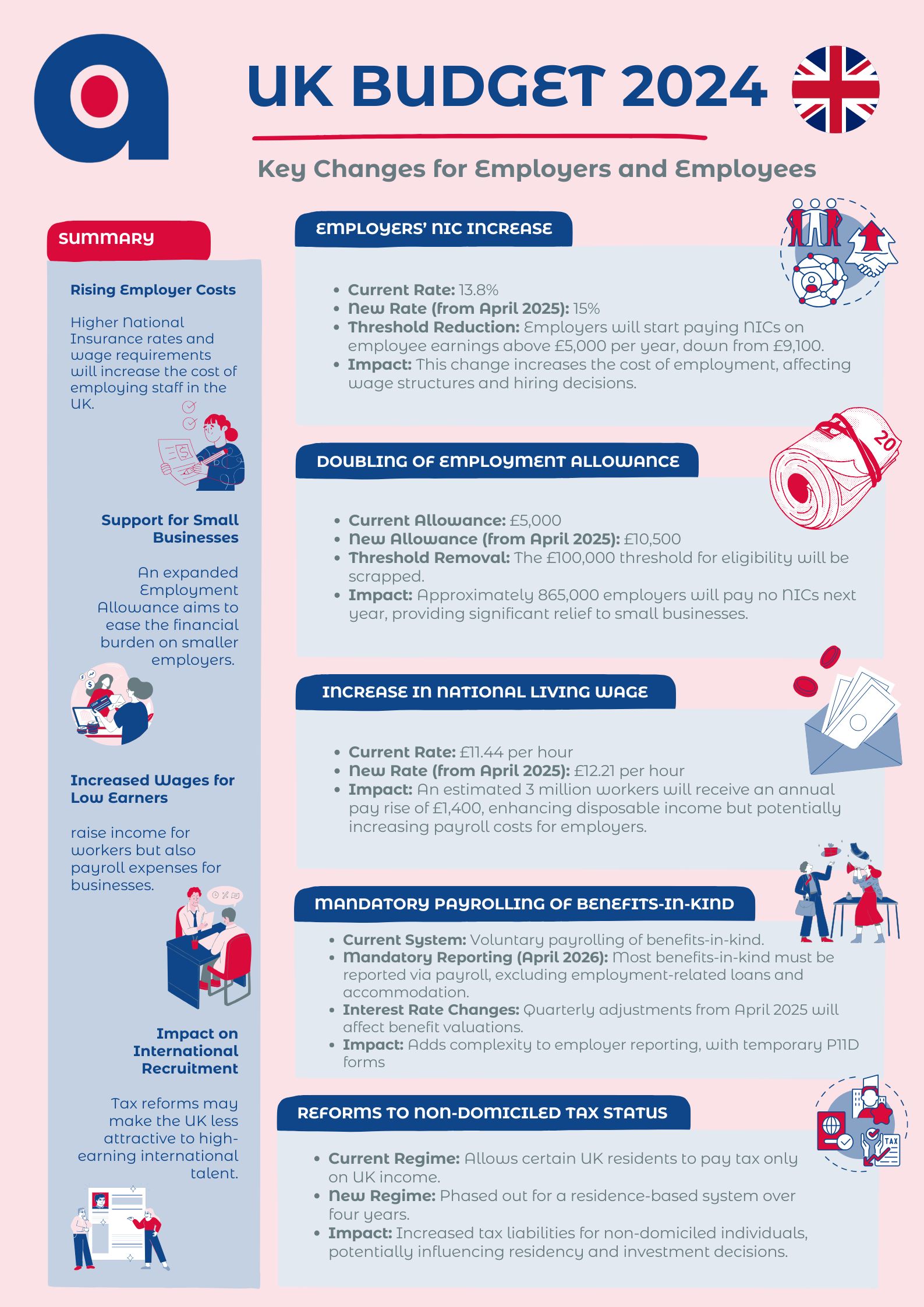
United Kingdom 🇬🇧: Budget 2024 Highlights for Employers and Employees

The UK Budget 2024 introduces key changes shaping employment and payroll strategies for the coming years.

These updates have implications for businesses of all sizes, from higher National Insurance Contributions to increased wages for low earners.

Employers should take note of:

  • Rising costs for staff compensation due to changes in NIC rates and the National Living Wage.
  • Relief measures for small businesses, including the doubling of the Employment Allowance.
  • There are new requirements in payroll reporting with the mandatory inclusion of benefits-in-kind starting in April 2026.
  • A phased-out non-domiciled tax regime that could affect international recruitment and investment decisions.

The infographic below provides a detailed breakdown of these updates and their implications.
Czech Republic 🇨🇿: Proposed Changes to Taxation of Employee Share and Stock Option Plans

A parliamentary proposal aims to amend the Income Tax Act, allowing employers to revert to pre-2024 rules for taxing employee share and stock option income. The amendment is expected to take effect from January 2025.

Key Updates

  • Tax Deferral Option: Employers may defer taxation by notifying the Czech tax authority within specific timeframes. If not deferred, income would be taxed at the time of acquisition or exercise, as before 2024.
  • Aligned Contributions: Czech social security and health insurance contributions will follow the same timing as the income tax.
  • Transitional Rules for 2024: Employers can retroactively apply tax deferral for 2024 if notification is submitted within two months of the amendment’s effective date.

Employer Actions

  • Decide whether to defer taxation for employee share and stock option plans.
  • Notify the Czech tax authority to opt for deferral.
  • Review tax and contribution liabilities for 2024 and ensure timely compliance with retroactive provisions.

Ireland 🇮🇪: PAYE Settlement Agreement Deadline and Enhanced Reporting Obligations

The deadline for PAYE Settlement Agreement (PSA) applications for the 2024 tax year is 31 December 2024. Employers should review their records to ensure taxable non-cash benefits are correctly identified and reported.

Key Updates

  • PSA Overview: The PSA allows employers to report and settle income tax, Universal Social Charge (USC), and Social Security (PRSI) on qualifying minor and irregular benefits outside the payroll system. Liabilities must be calculated on a grossed-up basis.
  • Deadlines: Approved PSA filings and payments are due by 23 January 2025. Missing this deadline will nullify the PSA arrangement, requiring employers to handle liabilities through the PAYE system, with potential penalties for late corrections.
  • Enhanced Employer Reporting (EER): From 1 January 2024, EER requires the submission of real-time informational returns for certain tax-free benefits. This provides Revenue with additional data and increases the likelihood of compliance checks on previously unreported benefits.

Employer Actions

  • Submit PSA applications by 31 December 2024 and ensure filings are made by 23 January 2025.
  • Review processes for identifying and reporting taxable benefits under PSA and EER obligations.
  • Implement mechanisms to assess the taxability of benefits and ensure compliance with EER requirements.

Timeline

PSA application deadline: 31 December 2024.
PSA filing and payment deadline: 23 January 2025.

Netherlands 🇳🇱: Updates on State Pension Age and Flexible Employee Contracts

1. State Pension Age Update

The state pension age in the Netherlands will increase to 67 years as of 1 January 2024, reflecting a gradual rise tied to life expectancy. Future adjustments will be announced at least five years in advance, providing certainty for employers and employees.

  • Impact Date: 1 January 2025 (no further increases planned for five years).
  • Employer Actions: To ensure compliance, employers should review employment contracts, especially for employees nearing the state pension age.

2. Legislative Proposal: More Security for Flexible Employees

The proposed “More Security for Flexible Employees Act” aims to replace on-call contracts with basic contracts, ensuring fixed minimum working hours. It also extends the break between consecutive fixed-term contracts from 6 months to 5 years, after which a new indefinite contract must be offered.

  • Impact Date: Not before 1 January 2026.
  • Employer Actions: Employers will need to transition from on-call contracts to basic contracts for non-student workers and maintain detailed records of employment terms for at least 5 years.
  • Key Considerations: Monitor legislative updates and prepare for significant administrative adjustments if the proposal is adopted.

Czech Republic 🇨🇿 and Brazil 🇧🇷: Bilateral Social Security Agreement Now in Force

As of 1 November 2024, the Czech Republic and Brazil have enacted a bilateral social security agreement.

The agreement simplifies compliance for cross-border workers and employers, eliminates double taxation of social contributions, and facilitates the claiming of pension benefits, promoting smoother mobility between the two nations.

The agreement applies to pension insurance but excludes health insurance, unemployment benefits, and social assistance.

Key Updates

  • Avoiding Dual Contributions: The agreement ensures individuals are only subject to social taxes in one country.
  • Equal Treatment: Workers are treated as nationals under the host country’s social security laws.
  • Totalisation of Periods: Social security periods accrued in both countries are combined for eligibility purposes.
  • Exportability of Benefits: Pension benefits, including old-age, disability, and survivors’ pensions, can be claimed across borders.
  • Coverage for Posted Workers: Employees on temporary assignments remain under their home country’s social security system for up to 36 months.

Employer Actions

  • Familiarise with the agreement’s terms to ensure compliance and prevent dual contributions for affected employees.
  • Advise employees about eligibility and benefits under the agreement, including totalisation provisions.
  • Coordinate with the Czech Social Security Administration or Brazil’s Instituto Nacional do Seguro Social for required documentation.

Austria 🇦🇹: New Rules for Teleworking Agreements Effective January 2025

Austria has expanded its teleworking regulations under the Employment Contract Law Amendment Act (AVRAG). These changes extend beyond home offices to other remote work environments, such as co-working spaces, libraries, or relatives’ homes.

Key Updates

  • Written Agreements Required: Employers must formalise teleworking arrangements in writing, mirroring existing home office requirements.
  • Locations Covered: The new rules clarify that remote work can take place in various settings, offering employees greater flexibility.
  • Compliance Deadline: Employers must ensure all teleworking agreements comply with the updated framework by 1 January 2025.

Employer Actions

  • Update policies and contracts to address the broader scope of teleworking environments.
  • Ensure teleworking agreements are properly documented and meet the new legal requirements.

Turkey 🇹🇷: New Tech Visa Program for Foreign Technology Professionals

Turkey has introduced a Tech Visa program to attract foreign technology professionals and entrepreneurs. The program aims to support the country’s technological growth by creating opportunities for innovative individuals to work and establish businesses in Turkey.

Key Updates

  • Eligibility: Open to foreign technology professionals and start-up entrepreneurs with expertise in the tech sector.
  • Application Process:
    1. Submit an initial visa application at a Turkish Consulate to receive a reference number.
    2. Complete the Ministry of Labour and Social Security application using the reference number.
    3. Upon approval, the Tech Visa is valid for up to three years.
  • Benefits:
    • Workers in R&D-focused companies are exempt from income tax, with the state covering half of their social security contributions, including universal healthcare.
    • A streamlined application process for tech professionals and their dependents.

Belgium 🇧🇪: New Minimum Salary Requirements for Non-EEA Employees in 2025

As of 1 January 2025, the Brussels, Walloon, and Flemish regions have updated their minimum salary thresholds for employing non-European Economic Area (EEA) nationals. Meeting these thresholds is mandatory for obtaining or renewing work permits or Single Permits.

Key Updates

  • Region-Specific Thresholds: Each region calculates the required salary differently. The Brussels region uses monthly gross salaries, while Flanders and Wallonia assess annual gross wages.
  • Categories Impacted: Specific thresholds apply to highly skilled workers, intra-corporate transferees (ICTs), management personnel, and EU Blue Card holders.
  • Age Consideration: Younger, highly skilled workers ( under 30 years) have lower requirements but must meet the standard thresholds when they turn 30.

Salary Thresholds for 2025

Employee CategoryBrussels (Monthly)Flanders (Annual)Wallonia (Annual)
Highly Skilled Employees€3,703€48,912€51,613
Highly Skilled (<30 Years)N/A€39,130€41,290
Management Personnel€6,647€78,259€86,110
ICT: Specialist€4,511€48,912€53,390
ICT: Trainee€2,611€48,912€33,370
ICT: Management€5,460€78,259€66,738
EU Blue Card€4,748€63,586€66,738

Consequences of Non-Compliance

  • Employers failing to meet salary thresholds risk penalties ranging from fines (€400 to €48,000 per infraction) to imprisonment in severe cases.
  • Employing a non-EEA national without meeting salary requirements may result in administrative and legal sanctions.

Employer Actions

  • Verify employee compensation aligns with the updated thresholds to maintain compliance.
  • Ensure that salary thresholds are met during initial hiring or permit renewal processes.
  • Consult immigration specialists to understand how regional rules may impact specific employment cases.

Poland 🇵🇱: New “Cash PIT Scheme” for Entrepreneurs Starting in 2025

On 30 October 2024, Poland enacted amendments to the Personal Income Tax Act, introducing a voluntary “cash PIT scheme” for small businesses and new entrepreneurs. This new approach simplifies tax administration and links income tax obligations to actual cash flow, offering greater flexibility for eligible taxpayers.

Key Updates

  • Eligibility: Available to businesses with revenue not exceeding PLN 1 million in the prior taxable year and to new entrepreneurs.
  • Tax Calculation:
    • Income tax is payable only after payment for goods or services is received.
    • Deductions for expenses are allowed only once payment is made for purchases.
    • Revenue must be recognised after two years, even if payment is still pending.
  • Administrative Requirements: Taxpayers must submit a written declaration to their tax office by 20 February of the taxable year or, for new businesses, by the 20th of the month following their start date.

Global Payroll Calculator – Your Precision Tool for Global Employment Cost Analysis
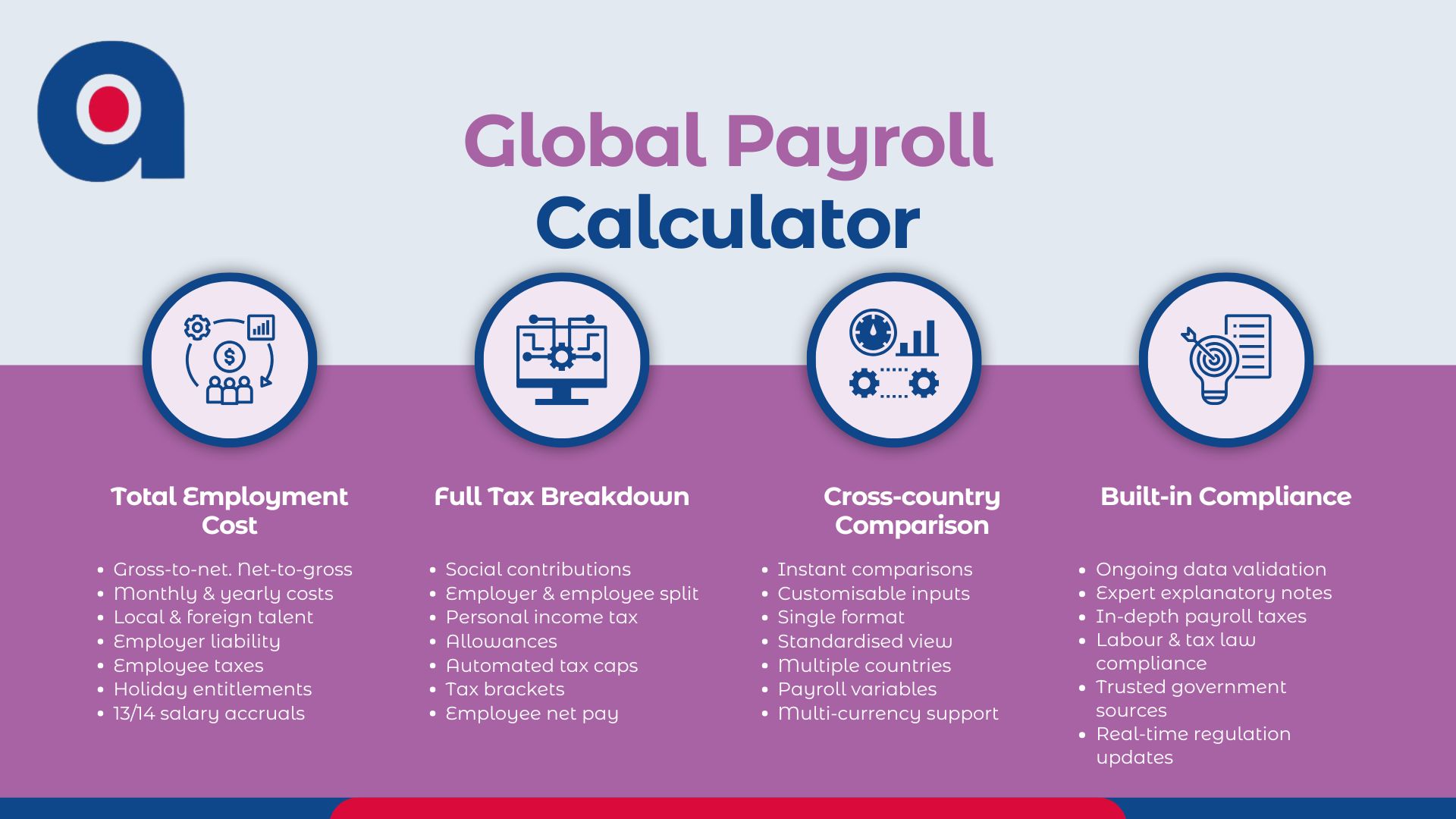
The Global Payroll Calculator (GPC) offers a solution for instantly calculating employment costs across 190 countries, streamlining your global hiring strategy and ensuring cost-effective decisions.

Key Features & Benefits for International Hiring

  • Instant Cost Calculations: Quickly determine total employment costs, factoring in real-time tax rates and benefits for local and foreign talent in 190 countries.
  • Precision & Clarity: Achieve precise payroll calculations with detailed breakdowns of all payroll variables, ensuring transparency and preventing unexpected costs.
  • Cross-Country Comparisons: Utilise GPC’s capability to perform instant comparisons between countries, helping you identify the most advantageous locations for hiring.

Core Capabilities of Global Payroll Calculator

  • Total Employment Cost Analysis
    • Monthly and yearly costs.
    • Gross-to-net and net-to-gross calculations.
    • Detailed breakdowns, including employer liability and employee taxes.
  • Full Tax Breakdown
    • Comprehensive coverage of social contributions, personal income tax, and automated tax caps.
    • Employer and employee tax splits with allowances and holiday entitlements.
  • Built-in HR Compliance
    • Ongoing validation against trusted government sources.
    • Updates in real-time to reflect the latest tax and labour laws.

The Global Shift to a Four-Day Workweek
The four-day workweek is moving beyond trials, with countries like Belgium, Japan, and Spain leading adoption efforts. While results show improved work-life balance and sustained productivity, challenges remain in sectors requiring continuous coverage across diverse cultural and legal frameworks.

Key insights

  • Global Examples: Iceland and the UK report reduced stress and improved retention after successful pilots, while Belgium and Japan implement flexible models.
  • Employer Considerations: Flexible schedules appeal to talent but may face resistance in industries like healthcare or manufacturing.
  • Opportunities: Companies adopting the four-day model can differentiate themselves in competitive labour markets while fostering better work-life balance.

This article explores the practical and cultural factors shaping this shift and offers insights for businesses considering its implementation.

How AI is Shaping the Future of Work
AI redefines global employment, creating roles like AI ethics officers while automating repetitive tasks. Businesses face challenges such as addressing bias, managing skills shortages, and adapting workflows.

The article highlights the need for ethical governance, effective reskilling programs, and a balance between AI capabilities and human expertise to remain competitive in an evolving workforce landscape.

The Hidden Dynamics of Employee Misclassification

Misclassifying workers is a growing risk for global employers, driven by cost-saving pressures, complex labour laws, and the demands for flexibility. This article examines why misclassification occurs and how businesses can avoid its pitfalls.

Key Insights

  • Common Drivers: Misclassification often stems from financial incentives, evolving contractor roles, and cross-border legal differences.
  • Industries at Risk: Technology, construction, healthcare, and gig economy sectors frequently rely on contractors, increasing their exposure to compliance risks.
  • Solutions: Businesses can mitigate risks by transitioning contractors into employees where necessary or ensuring compliant contractor management for short-term roles.

The Future of Global Employment: 15 Trends to Watch in 2025

Remote work is driving changes to tax policies, with updates in the UK, Germany, and the US creating new compliance challenges. APAC and LATAM are emerging as key regions for talent, while stricter contractor regulations globally are reshaping workforce strategies.

Tax Changes for Remote Work: Countries like the UK, Germany, and the US are adapting tax rules for remote workers, requiring companies to update compliance strategies.

New Talent Frontiers: APAC and LATAM are becoming promising regions for hiring. They offer skilled talent and competitive costs but require careful management of local laws.

Contractor Hiring Rules Tightening: Governments are introducing stricter regulations on gig workers, pushing companies to balance flexibility with compliance.

Custom Benefits Are Key: Personalised benefits, such as relocation support, are now crucial for attracting and retaining international talent.

Conclusion

This month’s developments showcase the dynamic nature of global employment and compliance, offering insights to help you stay ahead in 2025.

We’ll return next month with the December edition, providing the final updates of the year and reflecting on the themes shaping global employment strategies as we head into the new year.

Thank you for your continued readership!
Blog

Four-Day Workweek: Insights for Global Employers

The four-day workweek is no longer an experimental workplace trend. It has evolved into a serious consideration for governments, organisations, and workers worldwide. What began as isolated trials in countries like Iceland has now spread globally, with diverse approaches ranging from mandatory legislative changes to company-led initiatives. For multinational employers, this trend signals a potential… Read more Four-Day Workweek: Insights for Global Employers

The four-day workweek is no longer an experimental workplace trend. It has evolved into a serious consideration for governments, organisations, and workers worldwide. What began as isolated trials in countries like Iceland has now spread globally, with diverse approaches ranging from mandatory legislative changes to company-led initiatives.

For multinational employers, this trend signals a potential shift in how productivity, employee well-being, and work-life balance are prioritised in the modern labour market.

With countries such as Belgium, Japan, and Spain taking the lead, businesses operating across borders must navigate new employee expectations and the legal and cultural nuances associated with reduced working hours.

This article explores how the four-day workweek is being implemented globally, what employers need to know, and why this trend matters for companies competing in the international talent market.

Pioneering Countries: Leading the Global 4-Day Workweek Movement

Iceland

Iceland is widely regarded as a trailblazer in the four-day workweek movement. Between 2015 and 2019, the country conducted large-scale trials involving over 2,500 employees across public sector jobs such as social services, hospitals, and local government offices. These trials addressed two key challenges: high workplace stress and diminishing work-life balance.

The initiative was born from growing concerns about employee burnout and the need for more sustainable working conditions. By testing shorter workweeks while maintaining full pay, Iceland sought to evaluate whether such a model could balance productivity and employee well-being.

The results were striking:

  • Stress and Burnout: Participants reported significantly reduced stress levels and greater mental well-being.
  • Work-Life Balance: Employees found more time for personal interests and family, fostering overall satisfaction.
  • Productivity: Despite fewer working hours, productivity remained steady or improved, with teams adapting through prioritisation and better time management.

Following the trial’s success, 86% of Iceland’s workforce now has access to flexible or reduced-hour contracts, setting a precedent for other countries.

New Zealand

New Zealand’s role in the four-day workweek discussion began with bold moves by private companies. In 2018, Perpetual Guardian, a trust management company, conducted a well-publicised trial to test the impact of reducing working days while maintaining full pay.

The driving force behind this experiment was the company’s leadership, which wanted to combat rising stress levels, promote a healthier work-life balance, and boost productivity in a high-pressure industry. The trial provided clear evidence of its benefits:

  • Productivity: Despite working fewer hours, employees reported being just as productive, if not more, due to improved focus and efficiency during the reduced working week.
  • Employee Satisfaction: Workers reported greater satisfaction with their jobs and personal lives, leading to improved retention rates.

The success of Perpetual Guardian’s trial sparked interest across New Zealand, especially among businesses reliant on high employee engagement. Although not yet legislated nationally, New Zealand remains a reference point for company-led innovation in work structures.

Countries Adopting the Four-Day Workweek

Countries adopting the four-day workweek have taken bold steps toward formalising flexible schedules, demonstrating the viability of shorter workweeks through legislation or widespread adoption. Here’s how some key countries have made this shift.

Belgium

In November 2022, Belgium introduced legislation allowing full-time workers to request a four-day workweek. This move aimed to provide greater flexibility in work arrangements while maintaining employee salaries and benefits. Workers compress their 38-hour workweek into four 9.5-hour days, balancing shorter weeks and productivity.

Here’s a breakdown of its key aspects:

Adoption and Implementation

  • Employer Discretion: While employees can request a four-day schedule, employers have the right to approve or refuse the request. Any refusal must be accompanied by a written justification.
  • Trial Period: Approved requests are valid for six months, allowing employees and employers to assess the arrangement’s impact.

Current Adoption Rates

Despite initial enthusiasm, uptake of the four-day workweek remains limited. Contrary to earlier claims of a 56.5% adoption rate, a report from Acerta in October 2023 shows only 1.9% of employers have employees working a full-time four-day schedule.

Employer and Union Perspectives

  • Employer Concerns: Many businesses are hesitant, citing fears of organisational disruption and challenges in restructuring workloads.
  • Union Reservations: Labour unions have voiced concerns about the potential for increased daily workloads, which may lead to burnout or stress for employees.

While Belgium’s four-day workweek legislation introduces greater flexibility into the workplace, its adoption has been modest. Challenges around implementation, workload management, and employer acceptance highlight the need for more practical solutions and cultural shifts to make flexible work arrangements more accessible across industries.

United Kingdom

In 2022, the UK conducted one of the world’s most extensive four-day workweek trials. Over 70 companies from diverse industries, involving 3,300 employees, participated in the six-month pilot. The trial tested a model where employees worked reduced hours (typically 32 hours per week) without any pay reduction.

The results were overwhelmingly positive:

  • Productivity: Most businesses reported maintained or increased productivity levels.
  • Retention and Recruitment: Employees appreciated the improved work-life balance, which led to higher retention rates and greater appeal in attracting talent.
  • Permanent Adoption: More than 90% of participating companies decided to continue the four-day workweek after the trial.

This trial has positioned the UK as a leader in flexible work experimentation, setting an example for businesses worldwide.

Scotland

Following in Ireland’s footsteps, Scotland has rolled out its four-day workweek trials as part of a larger strategy to improve worker well-being and reduce burnout. The Scottish government has strongly supported these programs.

  • Trial Design: Employees work 80% of their usual hours while retaining 100% of their pay, with participating companies committing to maintaining productivity.
  • Focus on Quality of Life: The trial emphasises how shorter workweeks can enhance workers’ quality of life, particularly in high-stress sectors.
  • Public Sector Involvement: Discussions are underway to extend the trial to public sector roles, further demonstrating Scotland’s commitment to the concept.

Japan

Japan, long known for its gruelling work culture, is cautiously moving toward flexibility to address overwork and its societal consequences.

In 2019, Microsoft Japan launched the “Work-Life Choice Challenge,” a pilot program that tested a four-day workweek for a month. Employees worked four days while retaining full pay and enjoyed three consecutive days off each week.

The results were impressive: Microsoft reported a 40% increase in productivity, measured by sales per employee, compared to the previous year and a 25% reduction in days taken off.

The company limited meetings to 30 minutes to enhance efficiency and promoted online communication over face-to-face interactions. This initiative was particularly relevant in Japan, where long working hours have been linked to severe health issues, including karoshi (death by overwork). The success of this pilot highlighted the benefits of flexible work arrangements and encouraged Microsoft to consider further strategies to improve employee well-being and productivity.

The pilot’s outcomes were transformative:

  • Productivity Boost: Productivity increased by 40% due to fewer meetings and more focused work.
  • Energy Savings: The company also saw a 23% reduction in electricity use, aligning with sustainability goals.

While not yet legislated, Japan’s Ministry of Health, Labour, and Welfare has since encouraged companies to offer flexible schedules. The model has gained attention as a possible solution to the country’s chronic overwork culture.

Spain

Spain has taken significant legislative steps to trial a reduced workweek at the national level. In 2021, the Spanish government approved a two-year pilot program to implement a 32-hour workweek, primarily targeting small- and medium-sized companies in sectors such as manufacturing and technology.

The government allocated over €9.65 million to subsidise participating businesses to support this initiative, ensuring employees would not experience pay cuts despite the reduced hours.

The primary objectives of this program are to enhance work-life balance and demonstrate that shorter working hours can maintain or even boost productivity. This pilot represents one of the most substantial government-backed experiments promoting worker well-being while improving industrial efficiency.

United Arab Emirates (UAE)

In 2022, the UAE implemented a four-and-a-half-day workweek for public sector employees. This schedule runs from Monday to Friday noon, making the UAE the first country to align its working week more closely with Western economies.

  • Cultural Alignment: The policy was partly designed to align the UAE with international markets for smoother business operations.
  • Private Sector Influence: While the change is primarily in the public sector, private companies are increasingly adopting flexible models.

Portugal

Portugal is emerging as a key player in the four-day workweek movement, having launched pilot programs in 2023 with government funding. The government-backed initiative began in June 2023 and involves 41 private-sector organizations. 21 companies are starting a six-month trial of the four-day workweek while maintaining full pay for employees.

The primary aim of these trials is to evaluate the broader impacts on economic output and worker satisfaction. Participants voluntarily committed to reducing their working hours without financial compensation from the government, and they can opt out of the program at any time.

The program is being conducted in partnership with 4 Day Week Global, and researchers from Henley Business School and Birkbeck, University of London monitor its results.

Initial findings indicate positive outcomes, including reduced worker anxiety and fatigue and improved work-life balance. The initiative reflects Portugal’s commitment to modernising employment practices and enhancing employee well-being while assessing the potential for broader implementation across various sectors. 

Germany

Germany has taken a more cautious approach, with smaller-scale trials by individual companies and unions advocating for reduced hours.

  • Union Involvement: The German Trade Union Confederation (DGB) has called for shorter workweeks to balance work-life priorities and improve mental health.
  • Industry Focus: Trials have been most prominent in tech and creative industries, where flexible working hours are easier to implement.
  • Challenges: Resistance from employers in manufacturing and engineering sectors, where strict schedules are required, has slowed wider adoption.

Common Benefits of Four-Day Week

  • Enhanced Work-Life Balance: Workers report improved mental health and satisfaction.
  • Productivity Gains: Across industries, shorter workweeks often maintain or improve output.
  • Talent Retention: Flexible schedules attract top talent and reduce turnover.
  • Energy Efficiency: Countries like Japan have seen reduced operational costs, such as energy savings, from fewer workdays.

Business-Led Innovations in North America

While some countries legislate shorter workweeks, the movement in North America is primarily driven by individual businesses experimenting with and adopting four-day schedules. These private-sector initiatives showcase how flexibility and innovation can bring tangible benefits in productivity, employee satisfaction, and retention.

United States

In the U.S., a country known for its long working hours and “hustle culture,” the four-day workweek is gaining momentum as progressive companies experiment with alternative schedules. While no federal legislation mandates reduced workweeks, forward-thinking organisations are proving their viability.

Key examples include:

  • Kickstarter: The crowdfunding platform implemented a four-day workweek in 2021 as part of a year-long trial. Kickstarter aimed to reduce burnout and boost creativity by allowing employees more personal time. Following a successful trial, the company permanently adopted the model, citing no loss in productivity.
  • Buffer: The social media management platform has operated on a four-day schedule since 2020. Buffer’s leadership found that shorter weeks improved employee engagement and retention, with workers reporting greater focus during reduced hours.
  • Basecamp: This software company embraced a seasonal four-day workweek, offering employees flexible schedules during the summer months. This hybrid approach balances workload demands with opportunities for rest and rejuvenation.

These examples highlight how U.S. businesses lead the charge by prioritising employee well-being without sacrificing operational efficiency.

Challenges and Future Perspectives

  • While adoption grows, scalability remains a challenge, especially in industries like healthcare or retail, where customer-facing roles require continuous coverage.
  • However, rising demand from younger employees for flexibility and work-life balance could push more companies to follow suit, creating pressure for broader adoption in competitive labour markets.

Canada

In Canada, employers across public and private sectors increasingly adopt the four-day workweek.

Why Are Canadian Employers Adopting the Four-Day Workweek?

A York University report found that 73% of employers cited the pandemic as a key motivator for trialling a shorter workweek. Amid shifts in employee expectations, organisations are using this model to tackle the following issues:

  • Competing for Talent: Labour markets are becoming more competitive, and a four-day workweek is a differentiator that helps employers stand out, offering improved work-life balance.
  • Improving Workforce Satisfaction: As precarious gig work and contractual roles rise, a shorter, stable workweek helps organisations address burnout and improve engagement.

Conclusion: Is the Four-Day Workweek Right for Global Employers?

The four-day workweek is more than a trending idea — it reflects what employees increasingly value: flexibility, balance, and respect for their time. For multinational employers, adopting this model could mean attracting top talent, reducing burnout, and fostering a culture where people work smarter, not harder.

AI is changing the way we work. Automating repetitive tasks frees up time for people to focus on creativity, problem-solving, and innovation. This shift supports shorter workweeks, making them more practical and allowing employees to achieve more in less time.

But it’s not without challenges. Some industries, like healthcare or manufacturing, may find it harder to adapt, and operating across borders adds complexity. Labour laws, cultural expectations, and local business practices can vary widely, making one-size-fits-all solutions unrealistic.

The key is thoughtful implementation. Companies that adopt the four-day workweek with careful planning can achieve happier employees and steady productivity.

Blog

How AI is Shaping the Future of Work

AI is no longer a futuristic concept—it’s shaping jobs, workflows, and business strategies in real time. For businesses operating on a global scale, the challenge isn’t just keeping up with AI-driven changes; it’s staying ahead of them. Let’s move beyond broad predictions and focus on key trends already reshaping global employment—and what you, as a… Read more How AI is Shaping the Future of Work

AI is no longer a futuristic concept—it’s shaping jobs, workflows, and business strategies in real time. For businesses operating on a global scale, the challenge isn’t just keeping up with AI-driven changes; it’s staying ahead of them.

Let’s move beyond broad predictions and focus on key trends already reshaping global employment—and what you, as a business leader, need to do about them.

1. AI is Driving a New Era of Job Creation

AI is not only replacing jobs; it is creating entirely new roles. Sectors like healthcare, finance, and tech are witnessing a surge in demand for AI-related expertise.

Trends to Watch

  • Emerging Roles: Jobs such as AI ethics officers, generative AI specialists, and automation strategists are now in high demand.
  • Data Growth: With the exponential growth of data, roles in AI-driven analytics and data interpretation are expanding rapidly.
  • Global Talent Gap: Companies are experiencing a skills shortage, particularly in advanced AI technologies and ethical AI development.

Insight: Businesses that prioritise building talent pipelines for AI-related roles will stay competitive.

2. The Reality of Workforce Displacement

While AI creates opportunities, it also displaces roles that rely on repetitive or manual tasks. According to the World Economic Forum, 83 million jobs may be automated globally by 2028, with industries like manufacturing and logistics being the hardest hit.

Examples of Impact

  • Routine administrative jobs, such as data entry, are being replaced by AI-powered systems.
  • Automation in manufacturing reduces the demand for manual labour while creating new demands for system monitoring and maintenance roles.

Action Step: Create structured reskilling programs to help workers transition into new roles.

3. AI is Reshaping Workforce Skills

AI is fundamentally altering what it means to be employable. As automation handles routine tasks, human workers must shift focus to higher-order skills.

High-Demand Skills in an AI-Driven Economy

Key Insight: Companies investing in employee upskilling for AI collaboration are seeing a 34% increase in retention rates.

4. Generative AI: A Game-Changer for Productivity

Generative AI tools like ChatGPT, DALL-E, and Gemini are revolutionising workflows across industries.

Examples of Transformation

  • Marketing and Content Creation: Generative AI shortens timelines for campaigns and creates personalised content at scale.
  • Software Development: Codex automates code generation, accelerating product cycles.
  • Design: Tools like DALL-E are redefining graphic design by generating professional-grade visuals in minutes.

Future Outlook: Generative AI will likely become a standard in creative and analytical industries, requiring employees to adapt and collaborate with these tools.

5. Human-AI Collaboration is the Future

Rather than replacing humans, AI is enabling collaboration that amplifies productivity. Hybrid human-AI models are increasingly prevalent across industries.

Real-World Applications

  • Healthcare: AI-assisted diagnostics enable doctors to make faster, more accurate decisions.
  • Finance: AI-powered tools streamline investment analysis while humans focus on client engagement and strategic decisions.
  • Customer Service: Chatbots handle routine queries, freeing agents to resolve complex issues.

Insight for Leaders: Redesign workflows to blend human creativity with AI precision.

6. Ethics and Equity in AI Adoption

As AI adoption accelerates, ethical concerns cannot be ignored. Bias in AI algorithms, data privacy issues, and inequitable distribution of AI benefits remain significant challenges.

Key Challenges

  • Biased algorithms can perpetuate inequality if not appropriately managed.
  • Widening gaps between workers equipped for AI-driven roles and those left behind.

Action Point: Governments and organisations must collaborate on policies that promote fairness and inclusivity, including reskilling initiatives and ethical AI governance.

7. Trends in Sector-Specific AI Applications

AI is transforming industries at different paces, with healthcare and finance leading the charge.

Industry Snapshots

  • Healthcare: From diagnostics to personalised medicine, AI is enabling life-saving innovations.
  • Finance: Automation is replacing routine data tasks while creating roles in AI-powered financial consulting.
  • Manufacturing: Smart factories driven by AI are reducing downtime and improving production efficiency.

Insight: Businesses should evaluate how sector-specific AI trends can offer a competitive advantage.

8. Preparing for AI-Driven Workforce Transformation

Adapting to the AI revolution requires bold, forward-looking strategies.

Actionable Steps

  1. Build AI governance frameworks to ensure ethical and compliant usage.
  2. Invest in reskilling programs that prepare employees for AI-enhanced roles.
  3. Leverage predictive analytics to identify workforce needs and skill gaps.
  4. Adopt hybrid work models that seamlessly integrate human and AI collaboration.

Key Insight: Leaders who embrace a balanced approach to AI adoption will ensure long-term success for both their organisations and their employees.

Conclusion: Embrace the AI Revolution

AI is a transformative force reshaping global employment. Businesses that embrace AI proactively — by investing in reskilling, redefining workflows, and addressing ethical concerns — will be better equipped to thrive in this evolving landscape.

From enabling hybrid human-AI collaboration to driving productivity gains with generative AI, the opportunities are vast for companies ready to act. At the same time, the risks of inaction—job displacement, widening skill gaps, and ethical pitfalls—require deliberate, strategic planning.

Global employment is ultimately about people, and at Acumen International, we never lose sight of that. While Artificial Intelligence is reshaping global hiring and workforce management, what sets us apart is how we combine advanced technology with a personal, human approach.

At Acumen, seamless automation meets personalised care. We use AI to streamline processes and ensure compliance, but we also bring warmth, expertise, and adaptability to every client interaction.

Whether your goal is hiring in one country or 190+, we simplify the complexities of global employment so you can focus on growth — without losing the human connection that makes business thrive.

Let’s make global hiring effortless — and truly personal.

Blog

The Hidden Dynamics of Employee Misclassification

As businesses expand across borders and remote work becomes the norm, the challenge of accurately classifying workers intensifies. The line between independent contractors and full-time employees often blurs—not just due to ignorance or oversight but also because of strategic decisions shaped by business realities. Whether intentional or not, misclassification arises from the tension between the… Read more The Hidden Dynamics of Employee Misclassification

As businesses expand across borders and remote work becomes the norm, the challenge of accurately classifying workers intensifies. The line between independent contractors and full-time employees often blurs—not just due to ignorance or oversight but also because of strategic decisions shaped by business realities.

Whether intentional or not, misclassification arises from the tension between the need for flexibility and the demands of compliance.

In this article, we explore the business scenarios driving worker misclassification, the factors behind these decisions, and how global employers can mitigate risks.

By understanding the motivations and pressures businesses face, we aim to offer practical solutions: transitioning contractors into employees where needed or managing contractor payments compliantly when short-term or project-based engagements are the best fit.

Why Worker Misclassification Happens

Misclassification often arises from a mix of cost-saving strategies, legal complexity, and evolving workforce needs. Key drivers include:

1. Cost Savings

Contractors are attractive because they cost less than employees. Employers save on:

  • Payroll taxes and contributions to social security or national insurance.
  • Employee benefits like health insurance, paid leave, and pensions.
  • Overtime pay, which contractors are often not entitled to claim.

This financial incentive encourages businesses to classify workers as contractors, even when their roles may legally align with employee status.

2. Complex, Varying Laws

Labour and tax classification laws differ widely across countries and even regions within countries. Navigating these legal variations is challenging for global companies. Worker misclassification often occurs unintentionally due to a lack of familiarity with local laws.

3. Flexibility Needs

Businesses in industries with fluctuating demand often rely on contractors to provide temporary or project-based support. Contractors’ ability to work flexibly without long-term commitments is particularly appealing.

4. Misinterpretation of Roles

Sometimes, employers misclassify workers due to misunderstanding the role’s nature. For example:

  • If contractors work set hours, use company-provided tools, or are subject to direct supervision, they may legally qualify as employees.
  • Businesses often fail to update worker classifications when roles evolve, leading to compliance risks.

5. Administrative Oversight

As contractors take on more responsibilities or stay on longer than intended, their work may align more closely with employee tasks. Without regular reviews, these shifts can go unnoticed, resulting in employee misclassification.

6. Cross-Border Challenges

Remote work introduces cross-border complexities. Companies may assume contractor definitions are universal, but local laws often differ significantly. A contractor in one jurisdiction might be classified as an employee under another’s laws, exposing companies to compliance risks.

Misclassification might appear cost-effective or efficient, but it’s a significant risk that can result in hefty fines, back wages, and reputational harm. Accurate classification is crucial, especially for global employers.

Industries That Frequently Rely on Contractors

Several industries frequently employ contractors due to the nature of their work, flexibility needs, and project-based demands. Here are key industries where contractor use is especially common:

1. Technology and IT

  • Roles: Software developers, web designers, cybersecurity consultants, and IT support specialists.
  • Why: Technology companies often require specialised skills for short-term projects like app development or systems upgrades. The fast-paced nature of tech and project variability makes contractors appealing.

2. Creative and Media

  • Roles: Graphic designers, writers, editors, videographers, and social media managers.
  • Why: Creative work often operates on a project basis, such as designing campaigns, producing videos, or writing content. Contractors offer flexibility and diverse expertise without long-term commitments.

3. Construction

  • Roles: Builders, electricians, plumbers, project managers, architects.
  • Why: Construction work is inherently project-based, with fluctuating demand depending on the project phase or economic cycles.

4. Healthcare

  • Roles: Locum doctors, travel nurses, therapists, medical transcriptionists.
  • Why: The healthcare industry frequently uses contractors to fill staffing shortages, cover seasonal spikes, or provide specialist care in specific locations.

5. Professional Services

  • Roles: Accountants, auditors, legal consultants, management consultants.
  • Why: Professional services firms or businesses may bring in contractors for specific expertise, such as auditing a business or managing a legal case.

6. Education and Training

  • Roles: Tutors, corporate trainers, curriculum developers, adjunct professors.
  • Why: Contractors provide flexibility for schools, universities, or businesses needing temporary or specialised educational services.

7. Entertainment and Events

  • Roles: Performers, event planners, production crew, photographers.
  • Why: The event industry operates heavily on a project basis, requiring contractors for short-term events and productions.

8. Gig Economy and On-Demand Services

  • Roles: Rideshare drivers, delivery couriers, freelance workers.
  • Why: Gig platforms like Uber, Deliveroo, or TaskRabbit heavily rely on contractors to maintain flexible, on-demand services.

9. Engineering and Manufacturing

  • Roles: Engineers, quality assurance specialists, production consultants.
  • Why: Projects like building prototypes or overseeing specialised manufacturing processes often require short-term expertise.

10. Finance and Insurance

  • Roles: Actuaries, financial analysts, insurance adjusters.
  • Why: Short-term financial analysis or risk assessments may be needed for specific projects, mergers, or claims.

11. Marketing and Advertising

  • Roles: Campaign strategists, content creators, SEO specialists.
  • Why: Marketing campaigns often have finite durations, making contractors cost-effective for specific launches or strategies.

12. Logistics and Transportation

  • Roles: Truck drivers, delivery operators, warehouse staff.
  • Why: Seasonal spikes (e.g., holiday seasons) drive flexible, temporary staffing demand.

These industries benefit from contractors’ flexibility, specialised skills, and cost-effectiveness, but they must ensure compliance with local labour laws to avoid misclassification risks.

Business Scenarios That Drive Contractor Demand

Businesses often require contractors to address specific needs, overcome challenges, or take advantage of unique opportunities. Here are common business scenarios where contractors are in demand:

1. Project-Based Work

  • Businesses need contractors to complete one-off or temporary projects, such as software development, marketing campaigns, or construction projects.
  • Example: A tech company hires a developer to create a new app or integrate a specific system.

2. Seasonal Demand

  • Industries with peak seasons, such as retail, logistics, and tourism, rely on contractors to manage increased workloads during busy periods.
  • Example: E-commerce platforms hire warehouse staff and delivery drivers for the holiday season.

3. Skills Gaps or Specialist Expertise

  • Companies bring in contractors with niche expertise not available internally, especially for short-term needs.
  • Example: A legal consultant is hired for international compliance advice during a merger.

4. Tight Deadlines

  • Contractors are hired to accelerate delivery and meet pressing deadlines when in-house teams are overwhelmed or stretched thin.
  • Example: A publishing house hires freelance editors to prepare materials for a major launch.

5. Business Expansion

  • Companies entering new markets may use contractors to test the waters without committing to long-term hires.
  • Example: A multinational firm engages local sales contractors to establish its presence in a new country.

6. Cost Management

  • Contractors provide a cost-effective solution when budgets don’t allow for the long-term expenses associated with full-time employees (e.g., benefits, taxes).
  • Example: Startups hire freelance marketing strategists instead of employing a full-time marketing team.

7. Organisational Restructuring

  • During transitions like downsizing or reorganisations, contractors help fill gaps temporarily.
  • Example: A company hires an interim HR specialist to oversee workforce reductions while restructuring.

8. Rapid Scaling

  • Companies experiencing sudden growth or high demand need extra hands without the time to recruit permanent staff.
  • Example: A SaaS company hires customer support contractors after a major product launch to handle the influx of queries.

9. Temporary Absences

  • Contractors are brought in to cover employees on leave, such as maternity, medical, or sabbatical leave.
  • Example: A graphic designer is hired to replace a team member on a six-month parental leave.

10. Uncertainty or Short-Term Commitments

  • During periods of economic uncertainty, businesses prefer contractors to avoid long-term financial obligations.
  • Example: A consulting firm hires contractors for projects instead of increasing full-time staff amid market volatility.

11. Mergers and Acquisitions

  • During corporate mergers and acquisitions, contractors assist with due diligence, integration, or specialised roles.
  • Example: A business hires IT consultants to merge systems during an acquisition.

12. Regulatory Changes

  • Companies hire contractors with relevant expertise when faced with new compliance requirements or legal challenges.
  • Example: A financial institution engages a tax consultant to navigate new international tax regulations.

13. Workforce Diversity Initiatives

  • Contractors are hired to support diversity goals, such as recruiting professionals from specific backgrounds or regions.
  • Example: A firm contracts minority-owned businesses for marketing initiatives.

14. Research and Development

  • Businesses hire contractors to research, develop prototypes, or test new products.
  • Example: A pharmaceutical company hires researchers for short-term clinical trials.

15. Launching New Products or Services

  • Contractors are engaged to support product launches, including marketing, logistics, and sales.
  • Example: A startup hires content creators to generate buzz around a new app release.

16. Emergency or Crisis Management

  • During emergencies or crises, businesses rely on contractors for rapid support.
  • Example: A PR consultant is hired to manage a company’s reputation after a data breach.

17. Flexible Workforce Needs

  • Businesses with fluctuating workloads (e.g., creative agencies or event planners) use contractors to adapt to demand changes.
  • Example: A wedding planning company hires freelance photographers during peak wedding season.

18. Geographic Expansion

  • Contractors provide local insights and services when a business lacks expertise in a specific region.
  • Example: A fashion retailer contracts local experts to set up operations in Asia.

19. Testing New Roles

  • Companies use contractors to test roles or new functions before committing to permanent hires.
  • Example: A company hires a freelance data analyst to assess the value of creating an internal analytics team.

20. Technological Implementation

  • Contractors support technology upgrades, integrations, or training.
  • Example: An IT consultant is hired to implement an enterprise resource planning (ERP) system.

The Conflict: Taxes, Worker Protections, and Misclassification Risks

The root of misclassification risks lies in competing priorities between businesses, tax authorities, and local governments.

1. Tax Authorities’ Perspective: Ensuring Revenue Collection

Governments rely on taxes to fund public services, infrastructure, and social programmes. Misclassified workers present a significant challenge:

  • Loss of Payroll Taxes: Employees typically contribute through payroll taxes like income tax, social security, and healthcare levies, often deducted at the source by employers. Contractors, on the other hand, are responsible for self-reporting taxes, leading to underreporting or non-compliance in some cases.
  • Cross-Border Complexity: Remote work further complicates tax enforcement. Workers operating in one jurisdiction while receiving income from another create ambiguities in tax obligations, increasing the risk of tax evasion.
  • Unclaimed Employer Contributions: Employers avoid paying contributions to national insurance, pension schemes, and other statutory benefits by classifying workers as contractors, depriving governments of critical revenue streams.

For tax authorities, misclassification translates to a direct threat to the financial ecosystem, making enforcement and compliance a top priority.

2. Governments’ Perspective: Protecting Workers

Governments are tasked with safeguarding workers’ rights, ensuring fair treatment, and providing access to social protections. Worker misclassification undermines these goals:

  • Loss of Social Protections: Employees are entitled to benefits like unemployment insurance, paid leave, and retirement contributions. Misclassified workers, treated as contractors, often lose access to these safety nets.
  • Economic Vulnerability: Misclassified workers face greater financial instability due to the lack of protections, such as severance pay or legal recourse for unfair treatment.
  • Bargaining Power Imbalance: Workers may struggle to negotiate fair wages without formal employee status, leading to exploitation in industries with high contractor reliance.

Governments seek to prevent misclassification to ensure workers’ rights and maintain the social contract: protecting individuals in exchange for tax contributions that sustain social welfare systems.

The Fundamental Conflict

The tension between governments and businesses over worker classification boils down to conflicting priorities:

  • Governments and Tax Authorities: Want to maximise tax compliance and protect workers to secure revenue and uphold societal stability.
  • Businesses: Seek cost efficiency and flexibility, often prioritising these over compliance with complex classification rules.

The rise of remote work amplifies this conflict. A contractor working from a different jurisdiction might not be subject to the same tax or labour laws as their client company. This creates a grey area that benefits businesses but undermines both the tax system and worker protections.

Why the Stakes Are High

Governments are tightening regulations and enforcement to address these challenges:

  • Cross-Border Tax Agreements: Authorities collaborate to share information and enforce tax obligations for remote workers.
  • Reclassification Campaigns: Many jurisdictions, like the United States and parts of the European Union, are cracking down on misclassification to ensure workers are treated as employees where appropriate.
  • Penalties and Back Payments: Employers found misclassifying workers face significant fines, back wages, and reputational damage.

Navigating these risks is critical for businesses to avoid costly penalties and maintain trust with tax authorities and their workforce.

How Acumen International Supports Businesses in Contractor Transitions

1. Transitioning Contractors into Employees: Simplifying the Shift in 190+ Countries

For businesses that find contractors increasingly resembling employees in their roles and responsibilities, transitioning them to formal employee status can mitigate misclassification risks. Acumen International, as a Global Employer of Record (EOR), simplifies this transition with comprehensive services:

  • Seamless Onboarding Across Jurisdictions
    Acumen ensures contractors are transitioned smoothly into compliant employee roles, handling everything from employment contracts to tax registration while adhering to local labour laws.
  • Local Compliance Expertise
    Our teams understand the nuances of employment regulations in 190+ countries, ensuring every transition meets the legal requirements specific to the jurisdiction.
  • Employee Benefits Structuring and Management
    Acumen helps design competitive benefits packages for transitioned employees, ensuring they receive statutory protections and additional incentives that align with market expectations.
  • Payroll and Tax Administration
    We manage all aspects of employee payroll, ensuring accurate tax and contribution deductions so businesses can remain compliant and avoid penalties.

By leveraging Acumen’s expertise, businesses can reduce the administrative burden of transitioning contractors into employees while safeguarding their operations from misclassification risks.

2. Managing Contractor Payments: Ensuring Compliance for Legal and Short-Term Engagements

When businesses need to engage contractors for short-term or project-based work legally, Acumen International provides tailored solutions to ensure compliance and smooth operations:

  • Legally Compliant Contractor Engagement
    We facilitate contractor agreements that meet local and international compliance standards, ensuring businesses stay within the law.
  • Cross-Border Payment Solutions
    We manage currency exchanges, tax withholdings, and regulatory reporting for remote contractors working in different jurisdictions to ensure timely, accurate, and compliant payments.
  • Risk Assessments for Contractor Engagements
    We thoroughly evaluate contractor roles to determine whether they fit the legal definition of independent contractors in the relevant jurisdiction. This helps businesses avoid unintended misclassification.
  • Transparent Payment Structures
    Contractors are paid through clearly defined, compliant channels, ensuring businesses maintain transparent records for audits and regulatory checks.

Acumen International provides these services, allowing businesses to leverage contractor expertise for short-term needs without worrying about compliance pitfalls.

3. Global Workforce Strategy Consultation: Aligning Business Needs with Legal Obligations

Acumen International goes beyond operational support, offering expertise to help businesses align their workforce strategy with their long-term goals:

  • Scenario Planning for Workforce Composition
    We assist businesses in determining whether roles are better suited for contractor or employee classifications based on the nature of the work, location, and duration.
  • Compliance Training and Insights
    Acumen educates businesses on global and local employment laws, helping them make informed decisions about engaging and classifying their workforce.
  • Scalable Workforce Models
    Whether scaling rapidly or managing seasonal demand, Acumen provides flexible workforce solutions that allow businesses to remain agile while staying compliant.

Our consultative support allows businesses to create sustainable workforce strategies prioritising compliance without sacrificing flexibility.

4. Global Payroll Calculator for Strategic Workforce Planning

Our Global Payroll Calculator is a powerful tool for supporting strategic decisions when transitioning contractors into employees or managing short-term engagements.

  • Instant Cost Transparency
    Global Payroll Calculator offers real-time insights into the total cost of employment across 190+ countries, including statutory benefits, employer taxes, and compliance fees. This empowers businesses to budget accurately and evaluate the financial impact of transitioning contractors into full-time employees.
  • Compliance Risk Assessment
    With country-specific payroll data, businesses can identify potential compliance risks related to local tax and employment laws. This ensures informed decisions when managing global contractors or formalising employee status.
  • Scenario Modelling:
    The tool allows businesses to compare payroll costs for various workforce compositions—whether keeping contractors, transitioning them into employees, or scaling operations in new regions.

Conclusion: Smarter Approach to Global Talent Management

Worker classification decisions are increasingly under scrutiny as businesses adapt to remote work and global expansion. Misclassification risks, whether due to strategic choices or oversight, can disrupt operations and lead to costly consequences.

Acumen International offers tailored solutions to help businesses transition contractors into compliant employee roles or manage contractor payments legally and efficiently for short-term engagements. With expertise spanning 190+ countries, Acumen ensures businesses remain agile, compliant, and competitive while building sustainable workforce strategies.

Whether scaling rapidly, expanding globally, or addressing complex employee classification needs, partnering with Acumen International enables businesses to confidently build global teams while reducing compliance risks and focusing on their strategic goals.

Blog

The Future of Global Employment: 15 Trends to Watch in 2025

The global employment landscape is anything but stable. Wars—both economic and military—are redrawing borders and priorities. Political instability in key markets complicates decision-making for companies expanding internationally. Simultaneously, conflicting trends pull in opposite directions: globalisation fosters interconnectedness, yet isolationist policies and protectionist legislation add barriers to cross-border hiring. Rising taxes and complex compliance frameworks deter… Read more The Future of Global Employment: 15 Trends to Watch in 2025

The global employment landscape is anything but stable. Wars—both economic and military—are redrawing borders and priorities. Political instability in key markets complicates decision-making for companies expanding internationally.

Simultaneously, conflicting trends pull in opposite directions: globalisation fosters interconnectedness, yet isolationist policies and protectionist legislation add barriers to cross-border hiring.

Rising taxes and complex compliance frameworks deter investment in some countries, while others actively court international business with simplified regulations and incentives.

Yet, despite these challenges, the global movement of human capital remains unstoppable. Remote and global work have become symbols of freedom, progress, and the future of employment.

As 2024 draws to a close, we take this opportunity to reflect on 15 of the most significant trends shaping global hiring. These insights, rooted in today’s realities, aim to help you plan your global expansion strategy for 2025 and beyond with clarity and confidence.

1. Evolving Tax Policies in the Remote Work Era

The rise of remote work has created a complex tax landscape, forcing governments to reconsider long-standing frameworks. This isn’t just a theoretical shift; it’s playing out in tangible ways that affect companies daily.

Take the United Kingdom. The 2024 budget increased National Insurance Contributions and reduced thresholds for employer payments, adding costs for businesses hiring domestically. However, changes to overseas workday relief simplified taxation for employees with non-UK duties, reflecting a dual approach: raising revenue while easing certain compliance burdens. Similarly, Germany’s clarification of “permanent establishment” rules for home offices has alleviated concerns for many employers—except for those with employees in management roles, who remain exceptions under the law.

Meanwhile, in the United States, the fragmented tax system continues to create headaches for distributed teams. State-level tax obligations often overlap, leaving both employers and employees navigating a maze of regulations.

The lesson? Companies must do the same as governments worldwide adapt to the realities of remote work. This means building agile tax strategies that ensure compliance and manage costs effectively in an era where flexibility is a non-negotiable demand from talent.

2. APAC and LATAM: The New Talent Frontiers

As the global economy seeks resilience, Asia-Pacific (APAC) and Latin America (LATAM) are rising as strategic regions for talent acquisition. These regions are not just emerging but becoming essential to global workforce strategies.

In APAC, tech ecosystems in India, Singapore, and Vietnam are thriving and driven by robust education and digital infrastructure investments. Meanwhile, LATAM is experiencing a boom in nearshoring, with countries like Mexico and Brazil offering North American companies cultural and time zone compatibility alongside competitive labour costs.

However, these opportunities come with challenges. In Mexico, recent outsourcing reforms have shifted hiring regulations, demanding businesses adjust quickly to avoid penalties. In India, new labour codes are redefining employment practices, requiring companies to rethink how they manage compliance. Success in these regions depends on a nuanced understanding of local laws, cultures, and talent market dynamics.

For companies willing to adapt, APAC and LATAM offer skilled talent and access to fast-growing economies. As demand for regional expertise intensifies, the organisations that invest in tailored strategies will secure a competitive advantage.

3. Fragmentation in Global Payroll: A Growing Challenge

Managing payroll across jurisdictions has become a labyrinthine task for global companies. The regulatory patchwork is expanding from Argentina’s withholding tax requirements to Indonesia’s mandatory local payroll systems—and so are non-compliance risks.

This isn’t just an administrative headache; it’s a strategic issue. Non-compliance can result in heavy fines, reputational damage, or disrupted operations. Data privacy regulations like GDPR, which dictate how payroll data must be stored and transferred across borders, compound the challenge.

To navigate this complexity, companies are turning to decentralised payroll platforms capable of handling multi-currency payments, integrating local tax rules, and offering real-time compliance updates. Effective payroll systems are no longer just about paying employees — they are critical to maintaining trust, efficiency, and legal alignment in global operations.

4. The Shifting Landscape of Contractor Classification

The gig economy has grown exponentially, as has scrutiny around contractor classifications. Governments worldwide are introducing legislation to ensure fair taxation and protect workers’ rights, forcing businesses to rethink their workforce models.

New gig economy regulations in Europe require platforms to classify contractors as employees, sometimes transferring tax and compliance responsibilities to employers. Latin America is also tightening contractor oversight, with Brazil and Chile leading reforms that formalise independent work arrangements.

This trend is reshaping how companies balance flexibility with compliance. Those relying on contractors must implement clear workforce strategies, blending traditional employment and contractor models while staying aligned with evolving legal frameworks. Proactive planning will separate those who thrive from those caught unprepared by shifting regulations.

5. Customised Employee Benefits: Winning the Talent War

Offering attractive salaries is no longer enough in a competitive global talent market. High-skilled professionals, especially those relocating internationally, now expect employee benefits tailored to their personal and professional needs.

Relocation support, spousal career assistance, and education allowances for children are becoming decisive factors in convincing talent to move.

Today employee benefits play a critical role in retention, ensuring employees feel supported long after their transition.

Customising employee benefits requires a deeper understanding of employee priorities, but the payoff is significant: a loyal, motivated workforce ready to contribute to long-term organisational success.

6. Inflation’s Ripple Effect on Compensation

As inflation rises globally, the conversation around compensation is shifting. Employees feel the pinch of rising living costs and demanding wages that reflect their realities. For companies, this means walking a fine line between meeting employee expectations and maintaining financial stability.

Rather than universal inflation-linked pay raises, many employers are adopting creative solutions, such as retention bonuses, region-specific allowances, and more frequent salary reviews. These tailored approaches help organisations remain attractive to talent without overburdening payroll budgets.

In volatile markets, compensation is no longer just about fairness—it’s about strategy. Companies that approach pay planning with agility and creativity will be better positioned to retain top performers while managing their costs effectively.

7. Ethical Hiring Amid Tightening Regulations

Global supply chains and workforce practices are under intense scrutiny as governments and international organisations enforce stricter regulations targeting forced labour and unethical employment. This shift isn’t limited to specific regions; it’s a global movement reshaping corporate responsibilities.

Laws like the UK’s Modern Slavery Act and the EU’s due diligence directives mandate greater transparency across supply chains, particularly in high-risk sectors like manufacturing and agriculture. Companies audit suppliers, implement robust compliance frameworks and ensure ethical hiring practices.

The pressure isn’t just regulatory—investors and consumers hold businesses accountable for their labour practices. Organisations that proactively integrate ethical hiring measures safeguard their reputations and appeal to socially conscious stakeholders. Ethical hiring has become a non-negotiable corporate responsibility pillar, defining sustainable workforce management’s future.

8. Predictive Analytics in Workforce Planning

Predictive analytics is transforming how businesses approach workforce management. By leveraging data to anticipate talent shortages, turnover trends, and regional hiring needs, companies are shifting from reactive to proactive strategies.

Industries like technology and healthcare, where skills gaps can disrupt operations, are leading this shift. Predictive tools help organisations identify emerging talent hubs, forecast when critical roles might become vacant, and optimise recruitment pipelines.

The benefits extend beyond hiring. Analytics can reveal employee satisfaction and engagement trends, allowing businesses to refine retention strategies before issues arise. As talent markets grow more competitive, predictive analytics is emerging as a key differentiator for organisations aiming to stay ahead.

9. Digital Nomad Visas: Balancing Opportunity and Complexity

Digital nomad visas redefine global mobility, enabling professionals to work remotely from countries like Portugal, Thailand, and Estonia. These programs allow businesses to access a highly skilled and mobile talent pool.

However, the rise of digital nomadism comes with challenges. Residency requirements, tax obligations, and social security contributions vary significantly between jurisdictions, creating a compliance minefield. Companies must adapt their global mobility policies to align with these regulations, ensuring employers and employees meet local legal requirements.

Digital nomad visas highlight the evolving nature of work. By navigating these complexities, organisations can tap into a growing workforce that values flexibility and cross-border opportunities.

10. Retention as a Strategic Priority

Retention is no longer a secondary concern—it’s a central pillar of workforce strategy. In industries like technology and healthcare, where skills shortages persist, losing talent can disrupt operations and increase recruitment costs.

To address this, companies are investing in personalised retention strategies. Career development programs, mentorship opportunities, and flexible work arrangements are becoming standard offerings. In sectors prone to burnout, such as healthcare, wellness initiatives and mental health support are critical to keeping employees engaged and committed.

Retention goes beyond reducing turnover; it focuses on building motivated, high-performing global teams. Companies prioritising employee satisfaction and development are better positioned to succeed in competitive markets.

11. Sustainability and Green Workplaces

Sustainability is integral to workforce strategies as businesses align with growing environmental expectations. Remote and hybrid work models reduce carbon footprints, while industries with high relocation demands, such as energy and mining, are exploring carbon offset programs to mitigate environmental impacts.

Younger workforces, particularly in Europe and North America, drive demand for eco-conscious practices. For businesses, integrating sustainability into their operations isn’t just about compliance — it’s a critical factor in attracting and retaining talent in a values-driven market.

12. Compliance in the Spotlight

With governments intensifying labour and tax enforcement, compliance has become a strategic priority for global employers. From wage hikes in the EU to evolving tax policies in APAC, staying ahead of regulatory changes is essential to avoiding penalties and safeguarding operations.

Real-time compliance tools that update regional labour laws and tax obligations are no longer optional—they’re essential. Businesses that proactively integrate compliance into their global strategies can mitigate risks and ensure sustainable growth in an increasingly complex regulatory landscape.

13. Planning for Geopolitical Instability

Geopolitical instability continues to disrupt global workforce management. Events like the Russian invasion of Ukraine, tensions in East Asia, and shifting alliances between nuclear powers are creating uncertainty for businesses operating internationally.

Companies are adopting contingency plans to navigate these risks. Relocating employees from high-risk areas, diversifying workforce hubs, and strengthening real-time monitoring capabilities are becoming standard practices. Organisations can safeguard talent and maintain operational continuity in volatile and unpredictable environments.

14. The Rise of Skills-Based Hiring

Skills-based hiring is reshaping recruitment, shifting the focus from traditional credentials to demonstrated competencies. Industries like tech and healthcare are leading this trend, using AI-powered assessments and digital verification platforms to identify talent based on skills rather than formal qualifications.

This approach widens access to nontraditional talent pools, enabling organisations to tap into skilled professionals from underrepresented regions or backgrounds. Skills-based hiring isn’t just a response to labour shortages—it’s a strategy for fostering innovation, inclusivity, and long-term workforce adaptability.

15. AI and the Workforce Divide

Artificial intelligence transforms the workforce, automating repetitive tasks and reshaping industry roles. While AI streamlines operations in manufacturing and logistics, it’s also creating demand for specialised skills in areas like machine learning and data ethics.

This transformation highlights a growing divide. Advanced economies with robust digital infrastructures are reaping the benefits of AI adoption while developing regions risk being left behind. 

Companies must address this disparity by investing in upskilling initiatives and balancing automation with human-centric roles, ensuring a workforce that thrives in an AI-driven world.

Conclusion: Preparing for the Future of Work

The global employment landscape is shifting rapidly, with every trend revealing a complex interplay of forces – technological disruption, regulatory shifts, evolving employee expectations, and geopolitical uncertainty – all converging to reshape the future of work.

At the core of these changes lies a paradox: while technology like AI is reshaping how we work, human decisions—ethical hiring practices, retention strategies, and investment in global talent—will define the future of work.

Businesses that thrive in 2025 won’t simply react to trends; they will anticipate them, embedding innovation into every hiring decision. Success hinges on a synergistic approach that integrates compliance, agility, and a deep understanding of the human element.

The human capital movement is not a passive force. Today’s choices—whether in compliance, ethical hiring, or workforce innovation — will define tomorrow’s leaders.