
Send Email
Blog

Global Employment Tax and Compliance Newsletter. October 2024

As global markets and regulations evolve, so do the complexities facing international employers. This month’s newsletter delivers the insights you need to stay informed and ready to navigate these shifts, from new directives in the EU to employer duties in the UK and growing opportunities in Kazakhstan’s emerging tech landscape. We aim to cut through… Read more Global Employment Tax and Compliance Newsletter. October 2024

As global markets and regulations evolve, so do the complexities facing international employers. This month’s newsletter delivers the insights you need to stay informed and ready to navigate these shifts, from new directives in the EU to employer duties in the UK and growing opportunities in Kazakhstan’s emerging tech landscape.

We aim to cut through the noise in every edition and provide clear, actionable updates and strategic guidance. Whether it’s the implications of the latest employment law changes or the best approach to market entry, our October edition equips you to make informed, resilient decisions as you grow your global presence.

European Union 🇪🇺: New Directive on Working Conditions for Platform Workers

The Council of the EU has adopted a new directive to improve working conditions for platform workers. Approved on 14 October 2024, the directive requires digital labour platforms to grant workers an employment status that accurately reflects their work arrangements.

Key Requirements

  • Employment Status Alignment: Platforms must classify workers according to their actual work arrangements, ensuring that platform workers receive the rights and protections aligned with their employment status.

Timeline: The directive is expected to enter into force soon, and EU Member States will have two years to implement the changes.

Action Required for Employers: Employers should prepare to review and, if necessary, adjust the employment status of platform workers to meet compliance standards as each Member State adopts the directive.

France 🇫🇷: Updates on Employee Saving Schemes and Diversity Surveys

Employee Saving Schemes and Pensions: A decree issued on 6 July 2024 provides detailed guidelines for the “value sharing” law from November 2023. Key changes include new cases for early use of profit-sharing funds, specific clauses for profit-sharing agreements, and a requirement for a public “country-by-country” declaration in the BDESE. Starting in 2025, companies with 11+ employees must implement a value-sharing scheme.

Diversity at Work: The French Data Protection Authority (CNIL) has issued draft guidelines for diversity measurement surveys. Recommendations include limiting data collection, excluding sensitive information (e.g., ethnicity, race), and ensuring anonymity and voluntary participation. CNIL also outlines GDPR compliance requirements, including legal basis, information disclosure, and third-party survey management.

Italy 🇮🇹: New Measures on Fixed-Term Contracts, Hiring Incentives, and Absenteeism

Italy has introduced several legislative updates impacting employment conditions, including compensation for unlawful fixed-term contracts, hiring incentives for young and disadvantaged women, and proposed rules on resignation due to absenteeism.

Key Updates

  • Compensation for Unlawful Fixed-Term Contracts: Under Law Decree No. 131/2024, published on 16 September 2024, if a fixed-term contract is deemed unlawful, it will be converted to a permanent one. If more significant damages are proven, the affected employee may also receive compensation for damages beyond 12 months’ salary.
  • Hiring Incentives: From 1 September 2024 to 31 December 2025, employers hiring individuals under 35 who have never held a permanent job will be eligible for a 100% social contribution exemption, capped at €500 per month (or €650 in specific southern regions) for up to 24 months. Similarly, employers hiring women unemployed permanently for at least 24 months will receive a 100% social contribution exemption, capped at €650 per month for a maximum of 24 months.
  • Resignation Due to Unjustified Absence: A draft law currently under review proposes that employees absent without justification for a period specified in their applicable NCBA or exceeding 15 days will be considered voluntarily resigned and thus ineligible for unemployment benefits.

Timeline: The hiring incentives are active until 31 December 2025, while other legislative changes are effective immediately or under parliamentary discussion.

Employer Actions

Employers should ensure compliance with the new rules on fixed-term contracts and consider the social contribution exemptions when hiring eligible individuals. It is also advisable to monitor developments on the absenteeism draft law.

Netherlands 🇳🇱: Lift of Enforcement Moratorium on Pseudo Self-Employment

The Dutch Tax Authorities will lift the enforcement moratorium on pseudo self-employment (schijnzelfstandigheid) from 1 January 2025. This change increases the risk for organisations that use self-employed individuals (zzp’ers) in roles that could be reclassified as employment under tax and civil law.

End of Moratorium: From January 2025, agreements with self-employed individuals may face reclassification as employment contracts, removing the previous tax-related protection from enforcement.

Employer Actions

Employers should:

  1. Map Self-Employed Workforce: Identify all self-employed persons working within the organisation in the Netherlands.
  2. Risk Assessment: Evaluate whether current contracts could be at risk of reclassification.
  3. Review Contract Renewals: For high-risk contracts, consider renewal terms beyond 1 January 2025 and assess the contractual basis for continued engagements.

Timeline: The moratorium will end on 1 January 2025, with full enforcement resuming from this date.

United Kingdom 🇬🇧: New Employer Duty to Prevent Workplace Sexual Harassment

The UK has introduced legislation requiring employers to take reasonable steps to prevent sexual harassment in the workplace. If an employer fails to meet this duty, employment tribunals may apply a compensation uplift of up to 25% in successful claims.

Additionally, the Equality and Human Rights Commission (EHRC) is updating technical guidance on preventing sexual harassment, which is expected to take effect alongside the new legislation.

Key Requirements

  • Preventative Duty: Employers must assess harassment risks, strengthen policies, and prioritise effective prevention.
  • Updated Guidance: EHRC’s updated guidance on harassment prevention will replace the need for a standalone statutory Code of Practice with changes incorporated into the statutory Employment Code of Practice.

Employer Actions

Employers should conduct risk assessments, review harassment prevention policies, and implement comprehensive training by 26 October 2024 to comply with the new duty.

Non-Compliance Penalties

Non-compliance could result in compensation uplifts of up to 25% in tribunal awards and potential enforcement actions by the EHRC.

United Kingdom 🇬🇧: Expanded Family-Related Rights for Parents and Carers

New UK legislation introduces enhanced rights for parents and carers, providing additional protections and new types of leave. Key changes include extended redundancy protections, carer’s leave, neonatal leave, and a more flexible structure for paternity leave.

Key Provisions

  • Extended Redundancy Protection: Employees on maternity, adoption, or shared parental leave will have extended redundancy protection for up to 18 months after the birth or placement, including protection for pregnant employees who have informed their employer of their pregnancy.
  • Carer’s Leave: One week of unpaid leave per year for employees to provide or arrange care for dependants with long-term care needs.
  • Neonatal Leave: Parents of a child receiving neonatal care can take up to 12 weeks of leave (one week for each week the child is in care) with statutory pay.
  • Flexible Paternity Leave: Paternity leave can now be taken as a single period of one or two weeks or as two separate, non-consecutive one-week periods within the child’s first year. Notice periods for taking paternity leave have also been shortened.

Timeline: Implementation is expected to be phased across 2025, with carer’s leave and extended redundancy protection expected to take effect by 6 April 2025. Employers must update family-related policies and procedures to comply with the new rights as they are introduced.

United Kingdom 🇬🇧: Employment Rights Bill Introduced with Key Workplace Reforms

The UK government published the long-awaited Employment Rights Bill on 10 October 2024, just 100 days after Labour took office. This bill, accompanied by supporting documents and factsheets, outlines significant proposed reforms in employment rights. Many details will be further clarified through secondary legislation, which will undergo consultations.

Key Areas of Focus

  • Support for Low Earners: Consultation on replacement rates for Statutory Sick Pay (SSP) for low earners.
  • Collective Redundancy and Fire-and-Rehire: Proposed remedies for issues arising in collective redundancy and fire-and-rehire cases.
  • Zero-Hour Contracts: Potential application of zero-hour contract regulations to agency workers.
  • Trade Union Reform: Consideration of new measures related to trade union operations.

Timeline: Ongoing consultations began on 21 October 2024, with additional consultations and legislation expected in the coming weeks.

Qatar 🇶🇦: New Law Prioritises Hiring Qatari Nationals in the Private Sector

Qatar’s new Law No. 12 of 2024 mandates that private-sector employers prioritise hiring Qatari nationals and the children of Qatari women over expatriates. This applies to private companies, excluding Qatar Energy affiliates and petroleum firms.

Key Employer Requirements

  • Prioritise Qataris: Expat hiring is allowed only if no suitable Qatari candidates are available.
  • Qatarisation Plan: The Ministry of Labour will set quotas and oversee hiring practices, requiring employers to report job openings and new hires twice yearly.
  • Compliance: Penalties for non-compliance include fines, restrictions on immigration services, and public disclosure.

Timeline: Expected enforcement around March 2025.

Action Required for Employers Employers should monitor the law’s development and prepare to align recruitment and training practices with Qatarisation requirements. Early compliance could help mitigate risks and qualify for MOL’s incentives.

Saudi Arabia 🇸🇦: Key Labour Law Amendments to Enhance Worker Conditions

The Saudi Council of Ministers has approved substantial amendments to the Labour Law, effective 19 February 2025, to improve working conditions and support Saudi Vision 2030 goals. Key updates are as follows:

Main Amendments

  • Expanded Definitions: New terms include specific definitions for resignation and manpower activities.
  • Compensatory Leave: Employers can now provide compensatory leave instead of overtime pay.
  • Resignation Process: New rules clarify resignation for employees on fixed-term contracts.
  • Contract Adjustments: Revised probation guidelines and updated employment terms for foreign workers.
  • Leave Entitlements: Enhanced rights for maternity, parental, and bereavement leave.
  • Contract Termination: Bankruptcy and a modified notice period for indefinite contracts are added as a valid reason for termination.
  • Disciplinary Rules: Updated guidelines on disciplinary actions.

Employers Actions

Review and update employment contracts, leave policies, and disciplinary procedures by February to ensure compliance.

Non-compliance with these new standards may result in penalties.

UAE 🇦🇪: Expanded Emiratisation Compliance and Timelines for Private Sector

Recent updates have expanded the scope and compliance timelines for employers in the UAE’s Emiratisation initiative, which aims to boost Emirati employment in the private sector.

Key Requirements

  • Increased Hiring Quotas: Private companies with 50+ employees must raise Emirati hires in skilled roles by 2% annually, achieved through a 1% increase every six months, aiming for a 10% Emirati workforce by 2026.
  • Extended Scope: As of July 2023, private sector establishments with 20-49 employees in 14 key sectors must hire at least one Emirati in 2024 and another in 2025.

Employer Actions

  • Review Recruitment Processes: Employers must ensure access to Emirati job seekers, enrol in the Nafis scheme, and leverage government support initiatives to meet targets.

Non-Compliance Penalties

  • Companies failing to meet quotas face fines of 7,000 AED monthly per unmet Emirati position and restricted MOHRE system access.
  • Smaller establishments in key sectors (20-49 employees) face fines of 96,000 AED for missing 2024 targets and 108,000 AED for 2025.

For further guidance, visit the MOHRE website.

UAE 🇦🇪: New Health Insurance System for Private Sector Employees and Domestic Workers

The UAE Cabinet has approved a nationwide health insurance system requiring employers to cover private sector employees and domestic workers without health insurance. This requirement takes effect on 1 January 2025.

Key Requirements

  • Employer-Provided Health Coverage: Employers must ensure health insurance is provided for all registered employees and domestic workers during residency permit issuance or renewal.

Employer Actions

Employers should budget for and arrange health insurance for eligible employees by January 2025 to comply with the regulation. The new regulation does not specify penalties for non-compliance, but current fines in Abu Dhabi and Dubai range from AED 300-500 per month per individual.

United States 🇺🇸: Federal Ban on Non-Compete Clauses Awaits Enforcement

The Federal Trade Commission (FTC) approved a Final Rule on April 23, 2024, to ban non-compete agreements for workers, including senior executives, across the U.S. The rule, published on May 7, 2024, aimed to take effect on September 4, but enforcement has been delayed due to a court order issued on August 20, 2024, while the FTC considers an appeal.

Key Requirements

  • Ban on New Non-Competes: Employers who enter into new non-compete agreements with workers after the rule’s effective date are considered to be engaging in an unfair method of competition.
  • Existing Agreements: Non-competes with non-executive employees will become unenforceable, while those with senior executives—defined as employees earning more than $151,164 annually in policy-making roles—may remain enforceable.

Employer Actions

Employers should closely monitor ongoing legal developments around the rule and seek legal guidance to assess potential impacts and prepare necessary adjustments.

Timeline: The effective date is pending further legal proceedings.

People’s Republic of China 🇨🇳: Gradual Delay of Statutory Retirement Age and Extended Marriage Leave in Zhejiang Province

China has enacted fundamental changes in retirement and marriage leave policies, affecting national and regional employment practices.

Key Provisions

  • Gradual Delay of Statutory Retirement Age: Starting 1 January 2025, the retirement age will increase incrementally by one month every four months for most employees. For female employees with a current retirement age of 50, the delay will be one month every two months until they reach 55. The target ages are 63 for men and 58 or 55 for women, depending on their roles.
  • Minimum Pension Contribution Period: Beginning in 2030, the minimum contribution period for basic pension eligibility will rise from 15 to 20 years, with a gradual six-month increase annually.
  • Flexible Early and Delayed Retirement Options: With mutual agreement, employees meeting contribution requirements can retire up to three years early or delay retirement up to three years after the statutory age.
  • Extended Unemployment Insurance Benefits: For individuals within a year of the statutory retirement age, unemployment insurance benefits will extend until retirement age, with pension contributions covered by the unemployment insurance fund during the transition.
  • Early Retirement for Special Occupations: Employees in high-risk roles, such as high-altitude or physically demanding jobs, may qualify for earlier retirement.

Zhejiang Province Extended Marriage Leave: Effective immediately as of 27 September 2024, employees in Zhejiang Province are now entitled to 13 days of marriage leave, an increase from the previous three days.

Singapore 🇸🇬: SkillsFuture JobSeeker Support Scheme for Retrenched Employees

Starting 1 April 2025, Singapore will launch the SkillsFuture JobSeeker Support scheme to provide temporary financial assistance to eligible citizens who become unemployed due to retrenchment, business closure, or termination due to illness or injury. The scheme will expand to include Singapore Permanent Residents in Q1 2026.

Eligibility Criteria

  • Must be a Singapore citizen (or Singapore Permanent Resident from Q1 2026).
  • Unemployment must be due to involuntary reasons, such as retrenchment or business cessation.
  • Prior employment of at least 6 months within the 12 months preceding the application.
  • Active job-seeking efforts, including job applications, career workshops, or relevant training.
  • No prior payouts from the scheme in the last 3 years.

Financial Support

Eligible individuals can receive up to SGD6,000 over 6 months. Payouts begin at SGD1,500 in the first month and decrease over time, capped at the participant’s prior monthly salary. Support ends upon re-employment, and participants are restricted from reapplying within 3 years of their last payout.

Action Required for Employers: Employers may consider this scheme when advising retrenched employees on available financial support options.

100 Questions to Master Global Hiring: Your Guide to Smart Growth

100 Questions to Master Global Hiring by Acumen International is your toolkit for navigating the challenges of global expansion. This guide is designed to prompt the questions that matter most when entering new markets—helping you think through critical areas like compliance, market entry, and local employment laws before they become obstacles.

Instead of ready-made answers, this guide offers questions that reveal potential blind spots, encourage strategic thinking, and help you tailor your approach to each unique market. Whether you’re considering new regions or managing an international team, these questions will help you uncover the insights needed to build a compliant, adaptable workforce and ready to support your growth.

For anyone looking to expand wisely, this article provides a clear path through the complexities of global hiring, making it essential to read as you plan your next steps.

Local Entity vs. Global EOR: Which is Right for Your Expansion?

As global business becomes less about physical assets and more about talent, companies face a pivotal decision: Should they establish a local entity in each market or take a leaner approach with a Global Employer of Record (EOR)?

This article from Acumen International explores both strategies, providing insights to help businesses weigh costs, control, and flexibility. For companies looking to fully commit to a market, establishing a local entity offers advantages like deep local integration, eligibility for tax incentives, and direct operational control.

However, it demands a substantial investment and carries complex exit risks, especially in markets with strict labour laws.

On the other hand, the Global EOR model supports a faster, lower-risk entry. With a Global EOR, businesses can “rent” a compliant employment infrastructure, allowing them to quickly onboard talent across borders, test new markets, and pivot without the legal and financial complexities of a local entity setup.

This model suits companies seeking flexibility and scalability, particularly in uncertain or multiple markets.

The article’s checklist provides essential questions for choosing the right approach for any business exploring international growth. With clear, actionable insights, this guide is a valuable tool for leaders deciding how best to expand globally while effectively managing risks and resources.

Transforming Global Employment: Trusted Advisor Approach
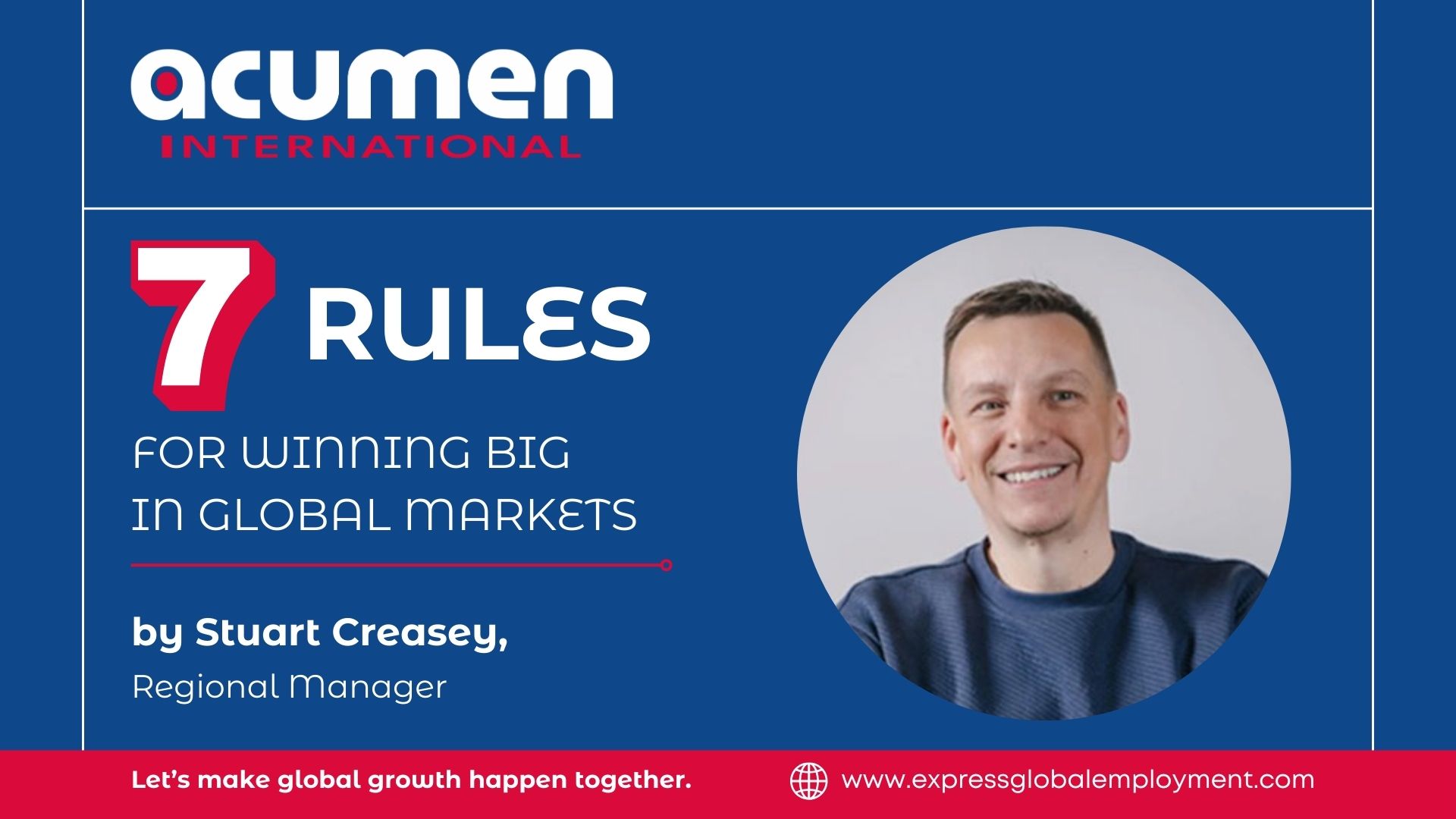
Stuart Creasey explores how global employment solutions evolve from transactional services to strategic partnerships. Drawing from Acumen International’s over 20 years of experience, he highlights that successful international workforce management requires more than technology — it relies on human expertise and a nuanced understanding of each market.

The article outlines principles that guide Acumen’s approach to global expansion. It focuses on aligning closely with client goals, addressing local compliance challenges, and planning proactively for long-term resilience. These insights offer companies a path to establish and sustain a strong international presence, supported by thoughtful, hands-on guidance.

Kazakhstan as Central Asia’s Innovation Hub: A Guide to Growth Opportunities
Kazakhstan is fast emerging as Central Asia’s tech and innovation hub, with government initiatives fostering a pro-innovation environment to diversify its economy beyond oil and gas. Programs like “Digital Kazakhstan” and the establishment of the Astana Hub and the Astana International Financial Centre (AIFC) are paving the way for startups, attracting investment, and nurturing a digital economy.

Kazakhstan’s strategic location between Europe and Asia makes it a key player in the “Digital Silk Road,” enabling access to markets in China and nearby regions.

Major developments, such as Kaspi.kz’s expansion into Turkey, showcase the potential for local tech companies to grow regionally and globally. Sectors like fintech, AI, health tech, and SaaS are seeing increased investment, and government-backed initiatives like Tech Orda aim to build a strong tech talent pipeline.

For companies looking to tap into Central Asia’s growing digital landscape, this guide offers a practical overview of Kazakhstan’s opportunities, investment trends, and the strategic role of a flexible EOR model in easing market entry and expansion.

Global Payroll Calculator – Your Precision Tool for Global Employment Cost Analysis
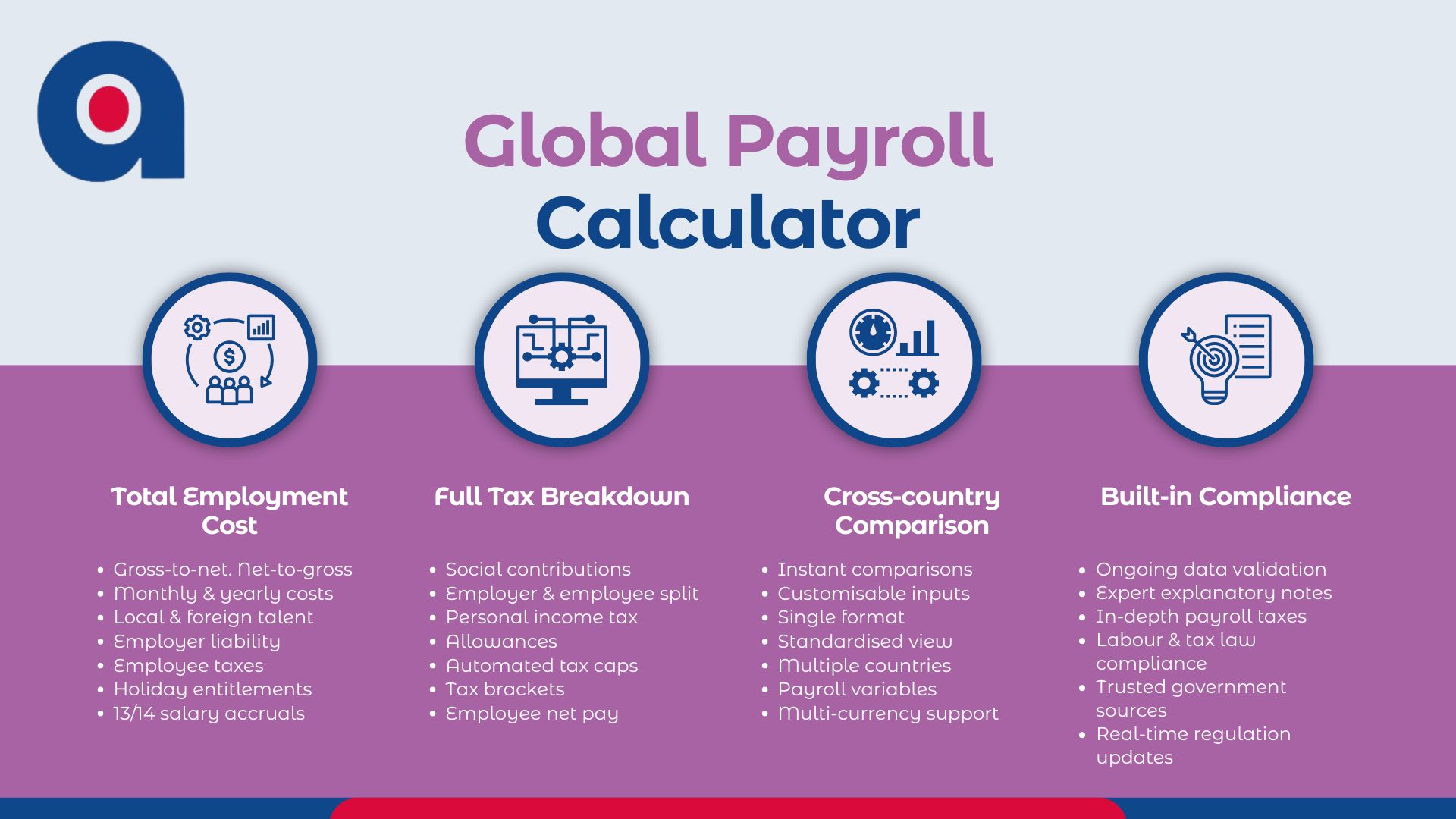
Global Payroll Calculator

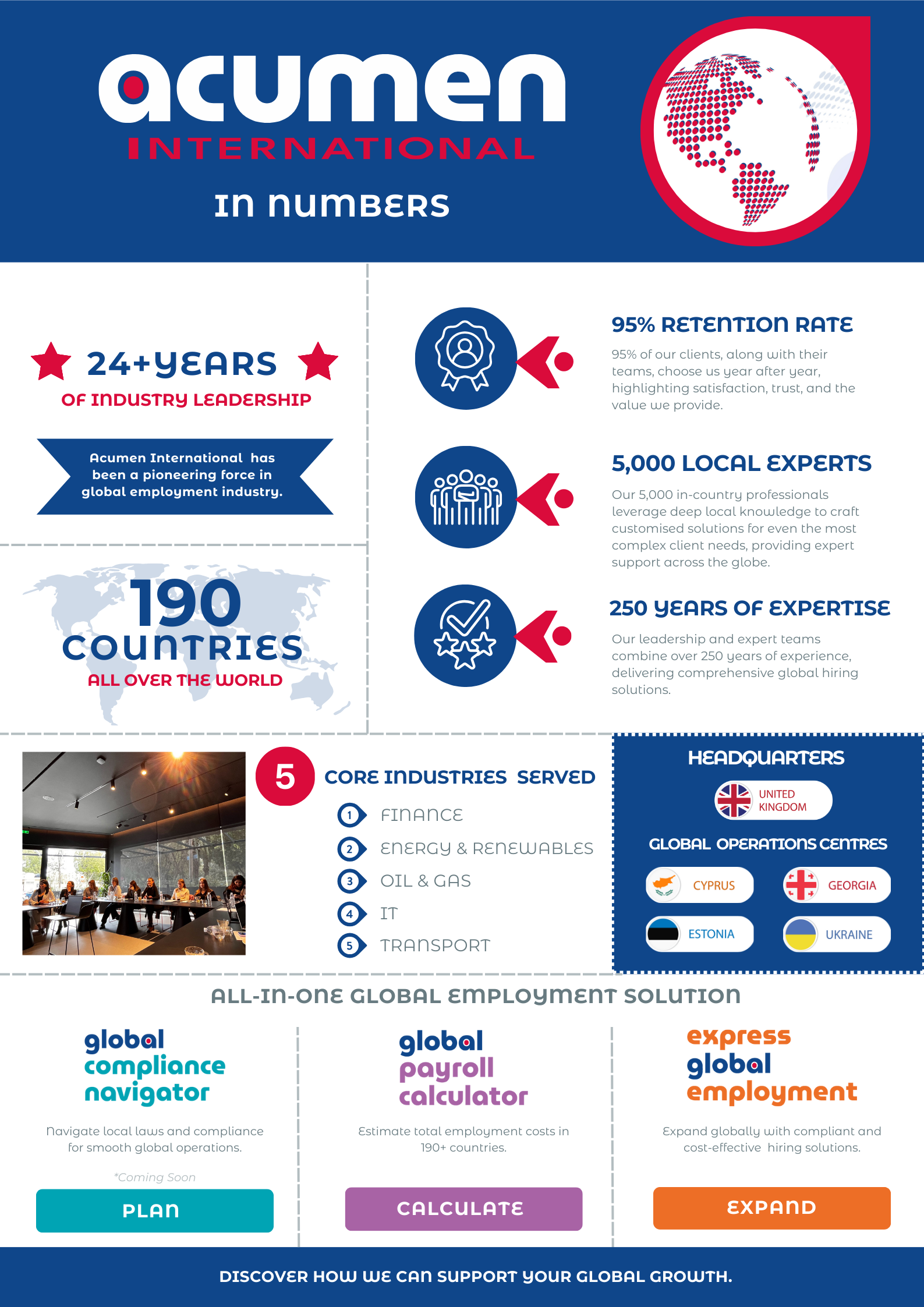
The Global Payroll Calculator (GPC) offers a solution for instantly calculating employment costs across 190+ countries, streamlining your global hiring strategy and ensuring cost-effective decisions.

Key Features & Benefits for International Hiring

  • Instant Cost Calculations: Quickly determine total employment costs, factoring in real-time tax rates and benefits for local and foreign talent in 190+ countries.
  • Precision & Clarity: Achieve precise payroll calculations with detailed breakdowns of all payroll variables, ensuring transparency and preventing unexpected costs.
  • Cross-Country Comparisons: Use GPC to instantly compare employment costs between countries, helping you identify the best locations for hiring.

Subscribe and Stay Connected

Thank you for joining us in this month’s edition! If these insights sparked ideas or helped clarify your global strategy, don’t miss future updates — subscribe to keep learning with us. And if you know someone who’d find this valuable, feel free to share. We’d love to hear your thoughts, so drop us a comment and let’s keep the conversation going.
Blog

Kazakhstan as Central Asia’s Innovation Hub: A Guide to Growth Opportunities

Kazakhstan’s startup landscape is emerging, with the country making significant strides to establish itself as Central Asia’s technological hub. While still reliant on oil and gas, Kazakhstan is actively diversifying into a knowledge-based digital economy. To support this shift, the government is creating a pro-innovation environment with funding opportunities that encourage early-stage startups. As the… Read more Kazakhstan as Central Asia’s Innovation Hub: A Guide to Growth Opportunities

Kazakhstan’s startup landscape is emerging, with the country making significant strides to establish itself as Central Asia’s technological hub. While still reliant on oil and gas, Kazakhstan is actively diversifying into a knowledge-based digital economy. To support this shift, the government is creating a pro-innovation environment with funding opportunities that encourage early-stage startups.

As the economy transitions from natural resources to digital innovation, Kazakhstan’s young and growing population offers a fertile ground for new business models. Companies can leverage the country’s digital infrastructure and supportive ecosystem to expand across Central Asia.

Though Kazakhstan’s startup ecosystem remains in its early stages, the country is committed to fostering entrepreneurship and digital industries to secure its economic future.

Where Continents Converge: A Digital Silk Road

Nestled in the heart of Eurasia, Kazakhstan occupies a pivotal point where continents converge physically and digitally. Its modernised railways and the expanding North-South corridor weave a modern-day Silk Road, facilitating trade and logistics between Europe and Asia. This strategic location is a magnet for businesses seeking access to markets in China and neighbouring countries and a burgeoning domestic consumer base with increasing purchasing power.

Kazakhstan’s connectivity transcends physical infrastructure. The country is cultivating a vibrant digital ecosystem, exemplified by the rise of companies like Kaspi.kz.

Kazakhstan’s Digital Leap: Where Evidence Meets Opportunity

Imagine walking into a co-working space in Almaty, where a local fintech startup processes international transactions through the Astana International Financial Centre (AIFC) while collaborating with developers in Dubai. This isn’t hypothetical — it’s how Kaspi.kz grew from a traditional bank into Kazakhstan’s first unicorn, valued at over $10 billion in 2023.

This fintech pioneer, defying expectations to achieve unicorn status with a valuation exceeding $10 billion in 2023, demonstrates the power of Kazakhstan’s digital infrastructure. Kaspi.kz’s ability to seamlessly process international transactions and collaborate with global partners through platforms like the Astana International Financial Centre (AIFC) paints a vivid picture of the country’s digital potential.

In a move that signals its ambitious expansion plans, Kazakhstan’s leading fintech company, Kaspi.kz, has acquired a majority stake (65.41%) in Hepsiburada.com, one of Turkey’s largest e-commerce platforms. The deal, valued at $1.13 billion, was announced on October 18, 2024, and marks a significant development in the Central Asian and Turkish tech landscape.

Kazakhstan: Economic Outlook

  • GDP Growth: The European Bank for Reconstruction and Development (EBRD) projects Kazakhstan’s GDP to grow by 4.0% in 2024 and 5.5% in 2025. This forecast revised slightly downward from earlier projections, reflects the impact of factors such as floods in certain regions and a slowdown in mining operations. However, public spending on infrastructure recovery and the planned expansion of the Tengiz oil field are expected to support growth in the coming years.
  • Digital Economy Contribution: While pinpointing the exact annual growth rate of Kazakhstan’s digital economy requires further analysis of official statistics, it’s undeniable that the sector is expanding rapidly. The government’s “Digital Kazakhstan” strategy aims to accelerate this growth by promoting e-commerce, digital literacy, and the development of tech startups.
  • Tech Talent Pool: Kazakhstan invests in education and skills development to build a strong tech talent pool. Initiatives such as the Astana Hub International Technopark attract and nurture startups, while programs like Tech Orda aim to train 100,000 IT specialists by 2025. This focus on human capital is crucial for sustained growth in the digital economy.

Government Initiatives Fueling Growth

The government has implemented multiple initiatives to create a supportive ecosystem for startups. These include establishing tech parks, innovation hubs, and accelerator programs critical in nurturing local and international startups.

The National Entrepreneurship Development Project (2021-2025) financially supports entrepreneurs, especially those in smaller towns and rural areas. Another key project, Business Roadmap 2025, targets emerging business ventures across priority industries.

Tech Garden, another major accelerator, provides a platform for startups to connect with resources, mentorship, and funding. This program focuses on high-impact sectors, helping local entrepreneurs gain the skills and support they need to launch and scale their projects.

AIFC as a Catalyst of Investment Growth in Kazakhstan

The Astana International Financial Centre (AIFC) is essential in attracting foreign investment and fostering financial innovation. Its regulatory framework, based on English common law, provides a secure and transparent business environment. The significant growth in cross-border payments through the AIFC indicates increasing investor confidence.

A Startup Ecosystem Blossoms

While relatively young, Kazakhstan’s startup ecosystem is growing. Over recent years, it has gained visibility and climbed in global rankings due to rising investment and increased tech-related ventures.

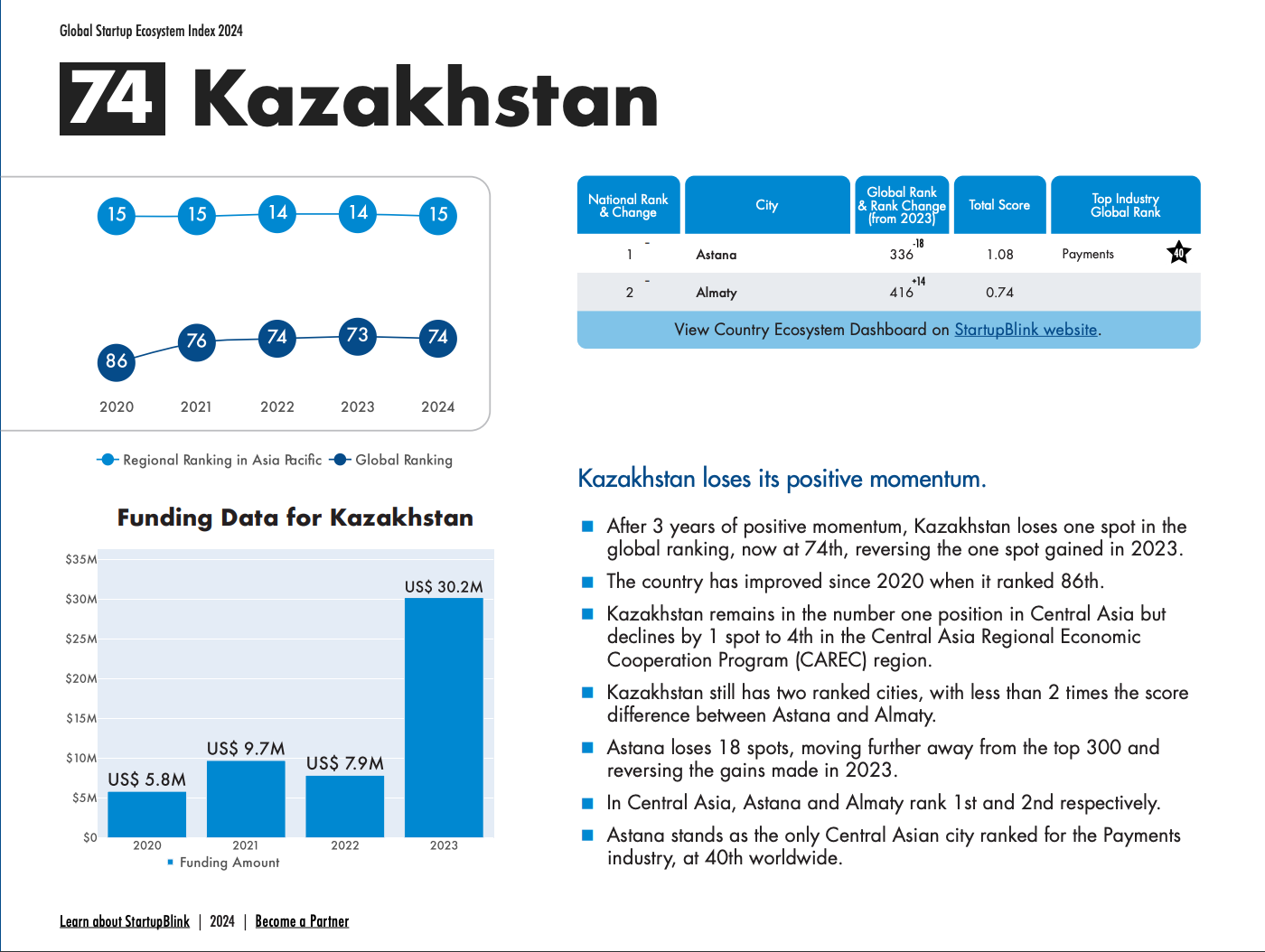
Despite a slight dip in global rankings in 2024, the country retains its position as the leading startup hub in Central Asia, a testament to its consistent progress since 2020.

Source: StartupBlink, Startup Ecosystem Report 2024

According to Startup Ecosystem Report 2024 by StartupBlink, Kazakhstan ranked 74th globally in 2024, a slight drop from its 2023 ranking of 73rd. Despite this decline, Kazakhstan remains the leading startup ecosystem in Central Asia, demonstrating steady improvement since 2020, when it was 86th globally. The country’s progress underscores its ambition to become a competitive player in digital innovation within the region.

Investment Trends

Kazakhstan’s funding landscape has grown significantly, with total investments reaching USD 30.2 million in 2023. This is a substantial increase from previous years: USD 5.8 million in 2020, USD 9.7 million in 2021, and USD 7.9 million in 2022. This upward trend reflects heightened investor interest in the country’s tech and digital sectors, although the ecosystem is still maturing and may be more vulnerable to fluctuations than established markets.

Regional Challenges and Strategic Position of Kazakhstan

Kazakhstan’s ranking within the Central Asia Regional Economic Cooperation (CAREC) region slipped to 4th in 2024, indicating increasing competition among regional peers. The relatively small gap in ecosystem scores between Astana and Almaty highlights the need for further investment in innovation to maintain Kazakhstan’s regional lead.

The country’s strategic location and established financial centres, like the Astana International Financial Centre (AIFC), position it well as a bridge for companies aiming to enter Central Asia.

Astana and Almaty remain the key innovation centres. Astana is the only Central Asian city with a worldwide ranking in the payments industry, underscoring its growing influence in the fintech arena.

Kazakhstan’s Tech Scene Overview: Where Innovation Meets Investment

Kazakhstan’s technology sector is attracting increasing attention from investors seeking to capitalize on the country’s digital transformation. Several key areas drive this interest, offering significant potential for growth and innovation. These are the key sectors attracting investment:

FinTech

Kazakhstan’s burgeoning fintech sector is fueled by a young and tech-savvy population, a growing middle class, and increasing smartphone penetration. Opportunities exist in mobile payments, online lending, and personal finance management.

Artificial Intelligence

With a strong foundation in STEM education and a government committed to supporting AI development, Kazakhstan is poised to become a regional leader in AI applications. Investment potential lies in sectors like healthcare, agriculture, and logistics.

HealthTech

Kazakhstan’s healthcare system is modernising, creating opportunities for health tech solutions that improve access to care, enhance diagnostics, and streamline healthcare delivery.

Real Estate Technologies (PropTech)

As Kazakhstan’s real estate market matures, prop-tech solutions are gaining traction. They offer innovative ways to manage property, facilitate transactions, and improve construction processes.

B2B SaaS

Businesses in Kazakhstan are increasingly adopting cloud-based solutions to improve efficiency and productivity. This creates a growing market for B2B SaaS providers offering solutions like CRM, cybersecurity, and more.

Prominent Startups in Kazakhstan

Kazakhstan’s startup ecosystem has already produced notable companies across various sectors. For example:

  1. QGames (Software & Data), a leader in game development in Astana, is enhancing digital entertainment locally and regionally.
  2. 1Fit (HealthTech) offers a subscription-based fitness app that promotes accessibility to fitness services across Kazakhstan.
  3. Naimi.kz (E-commerce and retail) is a digital platform that facilitates on-demand services to streamline users’ daily tasks.
  4. Auto.kz (E-commerce & Retail) provides a comprehensive automotive product and service platform.
  5. Parqour (Hardware & IoT) specialises in smart parking solutions, supporting urban mobility with digital parking management tools.

Business Roadmap 2025: Aspirations and Realities

To stimulate economic growth beyond major urban centres and support entrepreneurship, Kazakhstan has implemented the Business Roadmap 2025 program. This initiative has been praised for focusing on regional development and aims to help small and medium-sized enterprises (SMEs). However, the program’s impact on business creation and growth remains unclear, highlighting the complex challenges facing Kazakhstan’s entrepreneurial ecosystem. Key issues affecting the program’s effectiveness include:

  1. Bureaucratic Hurdles: Entrepreneurs, especially outside major cities, face significant administrative challenges that impede business formation and expansion.
  2. Limited Access to Finance: Many entrepreneurs struggle to secure funding to start or grow their businesses, particularly in more remote regions.
  3. Regional Disparities: The program’s benefits may not be equally distributed, with urban areas potentially benefiting more due to existing infrastructure and resources.

These challenges underscore the need for continued refinement of policies and programs to support entrepreneurship effectively across all regions of Kazakhstan.

Kazakhstan: Weighing the Risks and Rewards of Market Expansion

  1. Regulatory and Bureaucratic Hurdles: Despite improvements, Kazakhstan’s regulatory environment can still be complex and time-consuming, with bureaucratic processes that may slow down business operations and increase compliance costs.
  2. Political and Economic Risks: While Kazakhstan’s political landscape is relatively stable, it has been marked by occasional unrest and power shifts. Any instability can create uncertainty for businesses. Additionally, the country’s dependency on oil and gas makes it vulnerable to fluctuations in global commodity prices.
  3. Corruption and Transparency Issues: Corruption remains a concern in specific sectors, creating challenges for foreign businesses using more transparent processes. Navigating these issues can require a deep understanding of local customs and business practices.
  4. Currency Volatility: The Kazakhstani Tenge can be volatile, especially given the country’s reliance on oil exports, which are susceptible to global market shifts. This can lead to currency exchange risks for foreign businesses.
  5. Geopolitical Tensions: Kazakhstan’s location between major regional powers places it in a sensitive geopolitical position. Shifts in international relations can influence Kazakhstan’s economic policies and occasionally result in sanctions or trade restrictions that may impact businesses operating within the region.
  6. Infrastructure Gaps Outside Major Cities: While infrastructure in significant hubs like Almaty and Astana has improved, rural areas and some regions may still lack adequate transportation and logistics infrastructure, which can be a hurdle for companies needing nationwide distribution networks.
  7. Limited Domestic Market Size: Despite growth, Kazakhstan’s domestic market size is relatively small compared to other emerging markets. The limited population of around 19 million for consumer-focused businesses may not provide the same growth opportunities as larger neighbouring markets.
  8. Cultural and Language Barriers: Kazakhstan’s cultural landscape blends Central Asian heritage with Western influences, which can present challenges for companies unfamiliar with the region.
  9. Legal and Contractual Challenges: Legal systems in Kazakhstan can differ significantly from those in Western countries, and contract enforcement may be more complex. Intellectual property rights, for instance, may not be as robustly protected, which can be a concern for technology and creative industries.

Streamline Your Kazakhstan Entry with Acumen International

Entering Kazakhstan’s market can be a high-stakes move, with regulatory and economic factors that catch even seasoned companies off-guard.

Labour laws change regionally, foreign worker quotas are strict, and currency volatility is often tied to global oil prices. For businesses without deep local knowledge, these factors can add hidden costs and compliance risks that disrupt operations.

Acumen’s global employment solutions address these complexities head-on, allowing employers to tap into Kazakhstan’s talent pool, manage compliance with shifting regulations, and maintain flexibility in a market where long-term commitments are often risky.

This approach enables a practical, scalable entry, freeing companies to test the market without heavy upfront investments or permanent setups.

Here’s how a strategic Global EOR approach clears the path for seamless, compliant HR operations in Kazakhstan.

1. Navigating Foreign Worker Quotas Effectively

Strict quotas limit the number of foreign hires, particularly for roles where local talent is available. Exceeding these limits can result in fines or forced team restructuring. Strategic workforce planning helps companies meet talent needs while staying within legal boundaries.

2. Managing Industry-Specific Tax Obligations

Tax regulations in Kazakhstan are complex and vary widely across sectors. Errors in compliance, especially across diverse industries, can lead to unexpected liabilities. Streamlined, sector-specific tax management reduces the risk of costly oversights, keeping operations smooth.

3. Testing the Market Without Overcommitting to Entity Setup

Forming a local entity in an emerging market requires heavy commitment and significant investment, which may not align with a company’s long-term plans. Flexible market entry options allow businesses to operate locally without the burden of entity setup, so they can focus on testing the market before full-scale expansion.

4. Maintaining Payroll Stability Amid Currency Volatility

Kazakhstan’s currency, the Tenge, often fluctuates due to its reliance on global oil markets, which can complicate payroll budgeting. By handling payroll processing locally, an Employer of Record ensures that employees are paid accurately in the local currency, reducing administrative friction for companies facing these fluctuations.

5. Facilitating Market Entry Without the Need for Entity Setup

Kazakhstan’s strict work permit and quota systems can be a costly barrier for companies looking to establish a presence. By acting as the legal employer, a Global EOR enables businesses to enter and test the market in Kazakhstan without setting up a local entity. This interim or long-term solution reduces the upfront costs and risks of market entry, allowing companies to onboard talent efficiently and exit smoothly if needed.

6. . Meeting Local Benefits Standards with Ease

Kazakhstan requires employers to offer specific benefits, like social insurance and pensions, which can differ by industry. Acumen’s Global Payroll Calculator provides real-time insights into local payroll costs and benefits requirements, helping companies stay compliant while creating competitive packages that attract top talent. This tool simplifies payroll planning. It ensures full alignment with Kazakhstan’s regulations from day one.

7. Building Strong Teams Through Local Expertise and Cultural Insight

Success in Kazakhstan goes beyond compliance; it demands a deep understanding of local workplace dynamics. Acumen’s in-country experts bring the insights needed to shape HR policies that respect local values and align with cultural expectations, ensuring a more cohesive and engaged team.

By providing hands-on support and adapting swiftly to local developments, we keep your HR operations in sync with Kazakhstan’s unique business environment, fostering trust and alignment within your international team.

8. Ensuring Full Labour and Immigration Compliance

Kazakhstan’s contractual requirements for employment terms, notice periods, and termination processes differ from international norms. CustOperating in Kazakhstan requires attention to specific employment standards, covering everything from contracts to ongoing compliance with local labour and immigration laws.

Employment terms, notice periods, and termination protocols must align with Kazakhstan’s legal requirements, while immigration rules demand regular oversight to manage visas, work permits, and renewals efficiently in Kazakhstan.

Acumen’s expertise and human support ensure that every aspect of employment — from customised contracts to labour and immigration compliance — is managed seamlessly. This reduces the risk of fines or legal issues and allows companies to focus on their strategic goals.

9. Scaling Operations Flexibly to Respond to Market Conditions

Emerging markets require adaptability, as demand can change unexpectedly. Flexible workforce solutions allow companies to adjust staffing based on performance and growth potential without the restrictions of a permanent establishment.

Kazakhstan holds vast potential, and entering the market doesn’t have to be complex. With the right support, companies can move quickly, stay compliant, and adapt as needed. Ready to unlock new opportunities in Central Asia? Contact Acumen International to start your journey with a seamless, risk-free market entry.

Blog

Transforming Global Employment: Trusted Advisor Approach

By Stuart Creasey Enterprise sales have always been complex, especially when dealing with global employment. These deals require managing long approval processes, balancing the interests of multiple stakeholders, and providing personalised, expert guidance.  This model of trust-based advisory relationships is well-established in industries like luxury goods, the energy sector, and technology solutions. However, we now… Read more Transforming Global Employment: Trusted Advisor Approach

By Stuart Creasey

Enterprise sales have always been complex, especially when dealing with global employment. These deals require managing long approval processes, balancing the interests of multiple stakeholders, and providing personalised, expert guidance. 

This model of trust-based advisory relationships is well-established in industries like luxury goods, the energy sector, and technology solutions. However, we now see this approach extend beyond those traditional sectors, reshaping how global employment solutions are sold.

The Shift from Transactional to Strategic Partnerships

Businesses today expect more than basic services. The bar has been raised. This shift reflects the movement from purely transactional engagements to long-term, strategic partnerships. 

Clients expect partners who are invested in their long-term success and offer foresight, adaptability, and a holistic approach to workforce management—solutions that evolve alongside their global needs. 

Positioning ourselves as consultants elevates our standing with clients. They’re no longer just coming to us for services but for advice and guidance. 

We cultivate trust by becoming deeply embedded in our clients’ expansion strategies and providing insights beyond surface-level solutions. Incredible collaboration and results happen when we help clients make complex expansion decisions, not when they are treated as one-time transactions.

Evolving Client Expectations in Enterprise Sales: More Than Just a Footprint

Expanding into new markets requires more than just setting up operations; it involves making strategic choices that drive long-term success. Selecting the right country for expansion requires a deep understanding of current opportunities and future implications. 

Beyond compliance, businesses must factor in total employment costs, tax regimes, and the availability of skilled labour.

Clients need people, experts more than technology to handle employment challenges. They need someone to talk to and to understand what local legislation truly means for their business.

Technology is great for streamlining processes, but human expertise is crucial for navigating complex markets.

Holistic market evaluation means considering financial and legal elements and workforce strategies that align with long-term goals. 

As global employment consultants, we help clients by providing insights that ensure profitability and sustainability while aligning market entry and talent hiring with their broader strategy. 

In the era of globalisation, choosing the right market entry strategy—whether through a local entity or a Global EOR—can make all the difference between swift, scalable success and a slow, costly venture.

The Consultant’s Role: Managing Global Workforces

Global workforce management is an evolving challenge that grows as the business expands. Each country presents its own distinct legal and regulatory landscape. 

Successful international workforce management requires compliance and the agility to adapt to ongoing changes in tax policies, labour laws, and employee expectations. 

With over 20 years of experience at Acumen International, we know exactly where things can go wrong. This deep knowledge allows us to guide our clients, helping them avoid pitfalls.

Some may say experience makes us old-fashioned, but in reality, it equips us with the foresight to prevent significant mistakes.

Consultants play a crucial role in guiding clients through market entry and workforce strategies, ensuring alignment with the company’s overall strategic objectives.

Tax Equalisation and Workforce Costs

Workforce costs aren’t static—tax laws change, and companies must adapt. Consultants help structure tax strategies that deliver immediate savings and prepare businesses for future talent acquisition challenges. 

By aligning tax planning with long-term international workforce needs, companies can scale efficiently while avoiding unexpected regulatory challenges.

The risks of getting compliance wrong can be serious, leading to penalties and operational setbacks. That’s why it is crucial to work with experts who are constantly up to date with the latest legal and regulatory changes, helping clients understand these risks early on to avoid surprises down the road.

Global Mobility and Immigration

Global mobility has become a strategic necessity in global expansion. Moving key personnel across borders requires navigating complex immigration regulations, in-country quotas for certain professions, and local labour market tests. 

In some countries, strict quotas limit the number of work permits for specific job categories, and we need to anticipate these issues to avoid delays or rejections.

Early workforce planning is essential. As consultants, we help businesses anticipate these barriers, plan for immigration timelines, and ensure that immigration and onboardings are smooth,  compliant, and timely. 

Compliance doesn’t end with obtaining permits or visas—we help clients stay vigilant about maintaining legal status and renewing visas for their employees when necessary to avoid disruptions.

Tailored Employee Benefits for Retention: Market-Specific Approach

Retaining talent also requires a market-specific approach to designing competitive and attractive employee benefits packages. Employees in different regions expect different benefits, and what works in one market may not resonate in another. 

For instance, while housing allowances may be crucial in certain emerging markets, health benefits and pension schemes might be more valued in developed regions.

Designing benefit packages that appeal to local needs while maintaining company-wide consistency is challenging but essential. 

Retaining employees means tailoring incentives to align with local expectations while ensuring they fit within the company’s global framework. 

We help businesses craft competitive benefits packages and meet local regulatory requirements, especially when expanding across multiple jurisdictions.

Mitigating Risk: Preparedness Over Reaction

Global expansion presents inevitable risks — changes in tax laws, shifting employment regulations, and geopolitical shifts. 

At Acumen, we don’t just react to risks; we anticipate them. We guide clients through potential issues from the very start, ensuring they’re prepared to adapt as situations evolve.

We work with clients early in the overseas expansion process to consider potential exit strategies, develop contingency plans, and anticipate how regulatory environments may evolve.

By preemptively guiding clients to tackle these issues, we help ensure their global expansion and talent management strategy remains flexible and sustainable. 

The ability to pivot when necessary — whether scaling down operations or shifting focus to another region — prepares our clients for long-term success.

The Importance of a Skilled Team in Global Employment

In global employment, having a well-rounded, expert team is invaluable. 

With so many moving parts — from navigating local regulations to anticipating future challenges — the people behind the service make all the difference.

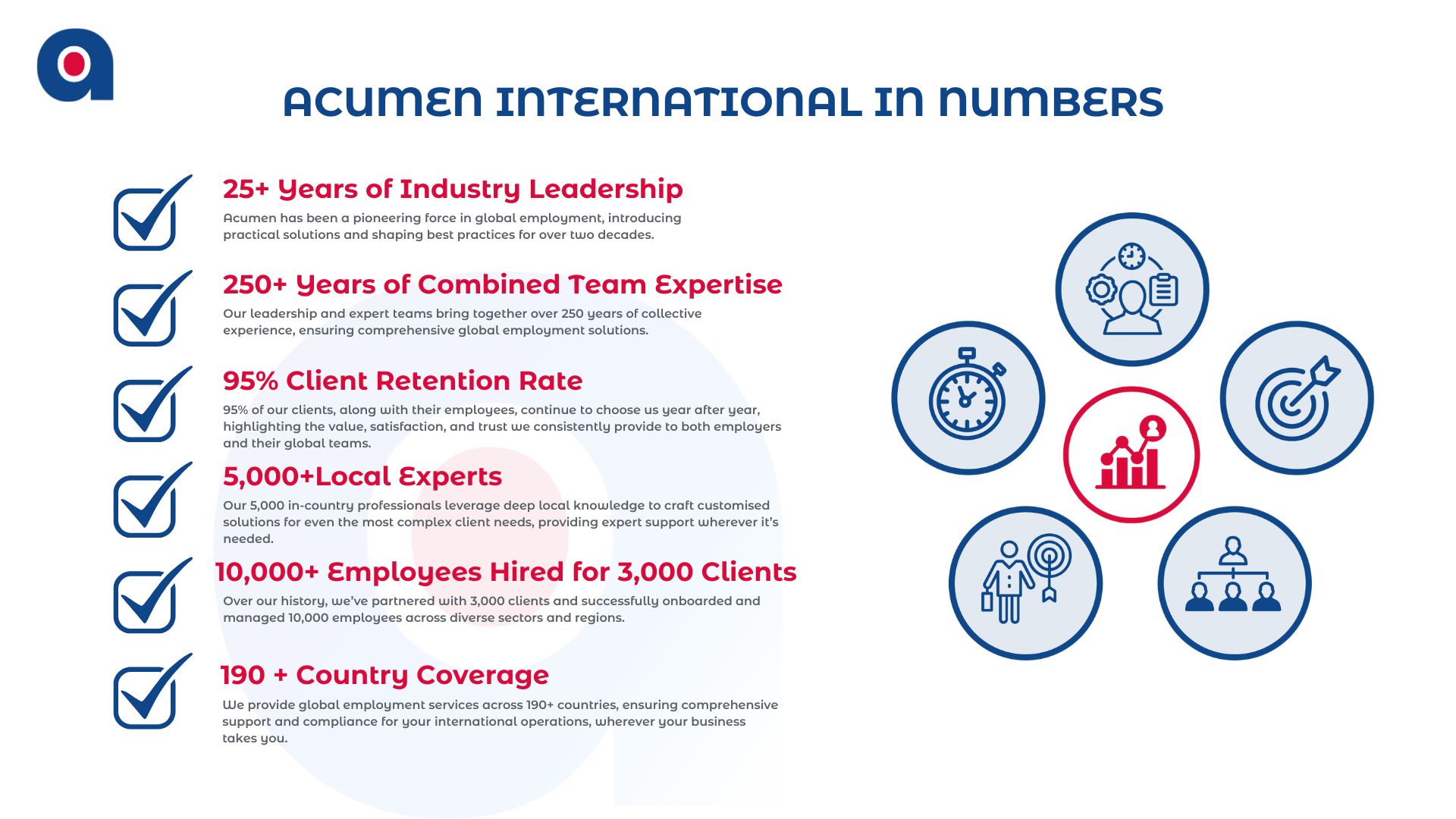
With over 250 years of collective expertise at Acumen International, our professionals help companies grow with confidence, ensuring that all the critical details are handled with care and precision. 

This sets us apart and why our clients trust us to guide them through even the most complex global employment scenarios across over 190 countries.

7 Practical Rules for Guiding Clients Through Global Expansion

With over 20 years of experience supporting organisations across various industries in both the private and public sectors, I have helped and guided businesses, from startups to global enterprises, to manage the challenges of international employment. of international employment. 

Through a consultative approach that prioritises understanding each client’s strategic goals, whether they seek to optimise existing operations or expand into new markets, I align our services, support, localised resources, and global experts to realise their vision. I ensure the implementation of programmes that not only meet but exceed expectations and ensure sustainable and scalable success.

Throughout this process, I leverage insights from my experience and my team’s collective expertise, helping to mitigate risks, suggest alternative approaches, and ensure seamless execution.

I believe in building strong, lasting partnerships founded on trust, which is essential for achieving long-term success.

These experiences have shaped my approach to working with clients today. 

I’ve distilled the most valuable lessons into seven essential principles serving as my North Star. 

1. Think Long-Term

Relationships outlast transactions. Focus on ensuring your solutions evolve alongside your client’s long-term goals, not just immediate needs.

2. Execution Is Everything

A solid strategy is essential, but execution is where success happens. Ensure that operational details—contracts, payroll, and immigration processes—are handled flawlessly on the ground.

3. Flexibility Is Key

Every market operates differently. Build strategies that adapt swiftly to local regulations and hiring dynamics without compromising business outcomes.

4. Plan for the Unexpected

Global markets shift unpredictably. Help clients anticipate changes and be ready to pivot when necessary, developing strategies that keep them agile and resilient.

5. Sustainability Over Speed

Fast growth can lead to operational strain. Focus on sustainable expansion, balancing the need for compliance and workforce retention with long-term market objectives.

6. Manage Risk Like a Pro

From tax obligations to employment law and immigration, global expansion is full of risks. Be the partner who proactively mitigates those risks while ensuring smooth, compliant operations across jurisdictions.

In every conversation with clients across industries and geographies, I focus on the risks involved in doing it wrong and the dangers of choosing a solution that doesn’t deliver. Experience shows that proactive risk management prevents costly errors.

This is where human expertise triumphs. No platform or software can truly match the depth of insight and nuanced understanding needed to mitigate risks effectively. That’s where humans win the game—by recognising what technology cannot foresee or adjust to in real time.

7. Be the Trusted Advisor. Expertise sets you apart. 

Position yourself as a strategic partner.  Offer solutions that anticipate challenges and help clients navigate complexities — delivering beyond expectations.

At the core of my work is the commitment to provide clarity where there is confusion and expertise where there is uncertainty. This is what differentiates a trusted advisor from a typical service provider.

Blog

Local Entity vs. Global EOR: Which is Right for Your Expansion?

Global expansion no longer revolves solely around building physical assets or manufacturing bases. Today, it’s increasingly driven by the need to hire talent across borders to produce intangible products and services. This shift has opened up new avenues for businesses and new challenges in managing regulatory complexity, cost, and risk. When businesses decide to enter… Read more Local Entity vs. Global EOR: Which is Right for Your Expansion?

Global expansion no longer revolves solely around building physical assets or manufacturing bases. Today, it’s increasingly driven by the need to hire talent across borders to produce intangible products and services.

This shift has opened up new avenues for businesses and new challenges in managing regulatory complexity, cost, and risk.

When businesses decide to enter new markets, they often face a critical choice:

  1. Commit fully by establishing local entities, which requires substantial investment, long-term commitment, and careful planning, particularly when testing new markets. If the venture fails, exiting can be costly and complicated.
  2. Alternatively, they can leverage third-party employment services, such as a Global Employer of Record (EOR), which enables agile, low-risk entry into multiple locations without the need for entity setup.

Think of a Global EOR as the shared economy’s solution to global hiring, similar to how platforms like Airbnb allow people to access existing infrastructure without the overhead.

A Global EOR leverages its expertise, legal entities, and established infrastructure across various markets, allowing businesses to “rent” a compliant and ready-to-go global hiring system. This approach gives companies the flexibility to scale, test, and withdraw from markets as needed.

Let’s explore these two strategies more deeply, starting with the traditional approach of establishing local entities to gain full control over operations and market presence.

Establishing Local Entities: A Deep Dive into Full Market Control

In the past, businesses expanding into new markets often had no choice but to establish local entities. This method reflected the realities of an era when economies were more tangible—rooted in physical infrastructure, manufacturing, and the need for face-to-face interactions. Travel, communication, and supply chains were less agile, making it essential for companies to build a permanent, on-the-ground presence to oversee operations and build trust with local stakeholders.

While this approach can be resource-intensive and complex, it is still relevant for businesses seeking full integration within local markets and long-term stability.

Why Businesses Still Choose to Establish Local Entities

  • Deep Local Integration: For companies that require close relationships with customers, suppliers, and government authorities, a local entity builds credibility and signals a strong commitment to the market.
  • Access to Local Incentives: Governments often offer tax breaks, grants, and subsidies to foreign companies establishing a physical presence. These incentives can offset some upfront costs, making the investment more attractive for long-term strategies.
  • Direct Control Over Operations: With a local entity, companies can oversee all aspects of their operations—from hiring to compliance—ensuring they adhere to local laws and standards while maintaining brand consistency.

Curious Fact: Many countries offer attractive incentives to lure foreign investors. In some markets, like Singapore, the UAE, and Ireland, up to 80% of businesses receive tax breaks, grants, and subsidies.

However, the traditional model is tied to a world where physical presence was once critical. Today, with technological advances and the rise of remote work, businesses have more options for global hiring and market entry, reducing the need for costly entity setups.

This approach works well when your business plans to stay in a market for the long term and needs full control over operations, hiring compliance, and local market integration. It’s ideal for companies ready to commit substantially to a specific region, which requires strong, direct engagement with local stakeholders.

The True Cost of Market Exit

Exiting a market is rarely straightforward. Beyond initial investments and day-to-day operations, the decision to withdraw from a region comes with challenges. Liquidating assets, managing severance obligations, and navigating complex tax laws can make the exit process financially draining and administratively demanding.

The hidden burden of market exit often lies in the intricacies of compliance. Jurisdictions with rigid labour laws or punitive tax policies can turn an exit into a prolonged and costly ordeal. The legal and financial responsibilities are extensive, from settling severance payments to dissolving local entities.

For businesses considering a long-term commitment through local entities, it’s critical to weigh the costs of entering a market and the true cost of leaving. Exiting is more than just pulling back operations—it requires careful planning to mitigate potential financial penalties and avoid legal entanglements.

Did You Know? In countries like France and Brazil, strict labour laws can make market exits particularly expensive. For example, severance payments can reach up to 12 months of salary, making it critical for businesses to plan exits carefully to avoid severe financial penalties.s.

Global EOR: A Shared Economy Approach to International Expansion

Just as companies like Uber and Airbnb revolutionised the shared economy by tapping into the latent demand for more flexible access to services, Global Employer of Record (EOR) models have emerged in response to the growing need for outsourced global employment solutions. As businesses increasingly move toward remote work and focus on intangible products and services, the demand for flexible, scalable employment solutions has become more prominent.

The Global EOR model offers an agile alternative for businesses looking to test new markets or expand across multiple regions without the heavy financial burden of setting up legal entities. This model allows companies to hire and manage employees in various countries without local infrastructure.

Just as Uber utilises existing vehicles and Airbnb capitalises on available properties, a Global EOR leverages its own or partner-managed legal entities and local expertise to provide businesses with a fully compliant, ready-to-use global employment infrastructure.

Why Should You Use a Global Employer of Record (EOR)?

A Global Employer of Record (EOR) offers businesses the flexibility to explore new markets with minimal commitment. Instead of the traditional approach of setting up a legal entity in each market, an EOR allows you to test markets, hire talent quickly, and adapt to changing conditions without being locked into long-term infrastructure.

Market Testing Without Long-Term Commitment

Think of the Global EOR model as renting a car before buying. You get to experience the market, build a local team, and gather key insights before deciding whether to fully commit. If the market doesn’t perform as expected, the EOR allows you to pivot and withdraw with minimal financial or legal repercussions. This model is perfect for businesses entering unfamiliar or unpredictable regions with a higher risk of failure or underperformance.

Easy Entry and Exit

With a Global EOR, the barriers to entry are significantly lower. Establishing a legal entity is unnecessary, which means you can enter a market faster and avoid bureaucratic complexities. If the market isn’t right for your business, you can easily exit without dealing with liquidation costs or severance issues typically associated with shutting down a local entity. It’s like living in a rented apartment to get the feel of the place before committing to buy.

Business Transitioning and Scaling

As your business evolves, an EOR gives you the flexibility to scale up or down without long-term commitments. Whether you need to expand into multiple locations simultaneously or transition from one market to another, an EOR acts as a bridge, providing the infrastructure to grow without being tied down. Once you feel confident in a market’s performance, you can transition to a more permanent setup.

Simultaneous Foreign Multi-Market Entry

One of the key advantages of a Global EOR is the ability to expand into multiple countries at once without the need for complex entity setups. You can onboard talent across various regions in a matter of weeks, not months. This is particularly useful for businesses looking to capitalize on time-sensitive opportunities or those testing several markets simultaneously. The EOR’s established infrastructure allows you to enter new markets rapidly, avoiding the delays and costs typically associated with traditional entity setups.

The global employment solution is ideal for businesses with aggressive growth strategies that require rapid market entry across multiple regions or for those looking to test various markets with minimal risk before committing to full-scale operations.

Curious Fact: Payroll compliance violations can be costly. In countries like France and Germany, companies can face fines as high as €300,000 for non-compliance. This highlights the importance of expert guidance when managing international payroll.

Comparing Costs, Time, and Risks: Local Entity vs. Global EOR

When expanding globally, businesses face critical decisions about cost structures, timelines, and the risks of entering new markets. Establishing local entities and leveraging a Global Employer of Record (Global EOR) can facilitate international growth, but their effectiveness depends on the specific market strategy and operational requirements.

The Cost of Establishing and Maintaining Foreign Entities

As covered earlier, creating a legal entity in a new country gives businesses full control over their operations, workforce, and compliance. However, the costs involved—from upfront capital investment to ongoing administrative expenses—are significant. Furthermore, the long timelines associated with entity setup and the complexity of maintaining compliance in multiple jurisdictions can delay market entry and reduce agility.

COST COMPONENTDETAILS
1. Charter FundsEmployer contributions to social security, healthcare, pensions, and other statutory benefits governed by local labour laws.
2. Entity Setup CostsLegal fees, registration with government authorities, incorporation paperwork, and other bureaucratic approvals. Costs vary by market complexity.
3. Ongoing Maintenance CostsLong-term expenses for accounting, annual audits, governance, statutory filings, and board meetings. Recurring costs that depend on local regulations.
4. Corporate TaxesCountry-specific corporate tax rates, with the potential for double taxation if operating in multiple jurisdictions without tax treaties.
5. Employment-Related TaxesEmployer contributions to social security, healthcare, pensions, and other statutory benefits, governed by local labour laws.
6. Legal and Compliance CostsCosts for legal representation, compliance with local labour laws, tax regulations, and business regulations.
7. Exit CostsCosts for exiting a market, including liquidation fees, severance payments, and settling outstanding tax liabilities.
8. Post-Incorporation ExpensesPayroll setup, statutory benefits registration, and compliance with data protection laws. These are mandatory costs for operating in a new market.
9. Banking and Financial SetupEstablishing and maintaining a local bank account, including ongoing banking fees. Compliance with local financial regulations may also be required.
10. Audit and Reporting FeesOngoing bookkeeping, financial reporting, and mandatory audits. Reporting frequency and complexity vary by country, from quarterly to annual.

Comparing Costs, Time, and Risks: Local Entities vs. Global EOR

When deciding between establishing local entities or using a Global Employer of Record (EOR), the key differentiators often boil down to costs, time to market, and risk management.

Cost Considerations

  • Local Entity: Setting up a local entity involves substantial upfront capital—including legal fees, registration, and charter funds. Ongoing costs such as tax filings, audits, and payroll management add complexity. The exit process can also be costly, with potential severance payments, asset liquidation, and tax implications.
  • Global EOR: The Global EOR model reduces upfront costs by eliminating the need for entity setup. Businesses pay service fees covering payroll, HR, and compliance, making this a more cost-effective option for companies with smaller teams or those entering new markets without committing long-term.

Time to Market

  • Local Entity: Establishing a local entity can take 6–12 months, depending on the market’s complexity. This delays your ability to start operations and take advantage of emerging opportunities.
  • Global EOR: Market entry with a Global EOR is much faster—often within a few weeks. This speed is critical for businesses looking to respond to time-sensitive opportunities or those that need to test markets quickly without the burden of local bureaucracy.

Risk Management

  • Local Entity: With full operational control comes increased responsibility for navigating local labour laws, tax regulations, and compliance risks. Mistakes can be costly, and exiting a market can involve significant financial and legal burdens.
  • Global EOR: The EOR takes on the compliance risks and ensures that all employment laws, taxes, and regulations are handled. This reduces your exposure, especially in unfamiliar or volatile markets. However, relying on an EOR may limit your control over certain operational decisions, particularly in markets where you might eventually want to establish a more permanent presence.

Did You Know? Hiring employees through a Global EOR can significantly accelerate your time to market. A Global EOR can help you cut time to market by up to 70% by streamlining the hiring and onboarding process.

Navigating the Risks of Permanent Establishment in Global Expansion

While expanding your business globally offers exciting opportunities, it’s crucial to understand the concept of Permanent Establishment (PE) and its potential tax implications. A PE is a fixed place of business through which a company conducts business in a foreign country. This can trigger corporate tax obligations in that country, even if your company isn’t formally incorporated there.

How Does PE Risk Apply to Different Expansion Strategies?

Establishing Local Entities

Creating a local entity, such as a subsidiary or branch office, inherently creates a PE. This means your company will be subject to corporate taxes in the foreign country. While this is expected with a formal presence, careful tax planning and compliance are essential to optimize your tax liability and avoid penalties.

Using a Global Employer of Record

A Global EOR can help mitigate PE risk, as the EOR becomes the legal employer of your workforce in the foreign country. However, it’s important to remember that your company’s activities can still trigger PE status. Factors such as:

  • Employees with significant decision-making authority: If your employees in the foreign country have the power to conclude contracts on your company’s behalf, it could create a PE.
  • The nature and duration of your activities: Conducting core business activities like sales, marketing, or manufacturing for an extended period can also lead to a PE.

Strategies to Minimise Permanent Establishment Risk

  • Clearly define roles and responsibilities: Ensure your employees working with the Global EOR have clearly defined roles that avoid creating agency Permanent Establishment.
  • Limit activities: Be mindful of the business activities conducted in the foreign country.
  • Short-term assignments: Keep employee assignments in the foreign country short to avoid triggering PE status.
  • Consult with experts: Seek professional advice from tax and legal experts to assess PE risk and develop a compliant expansion strategy.

Understanding and managing PE risk is crucial when choosing your global expansion strategy. By carefully structuring your operations and seeking expert guidance, you can minimise your tax liabilities and ensure a smooth and successful expansion.

Curious Fact: The Global EOR market is experiencing rapid growth, with an estimated annual growth rate of 15%. This surge in demand reflects the increasing need for agile and compliant solutions for managing international workforces.

Checklist for Choosing Between a Foreign Legal Entity and a Global EOR

  1. What are your long-term goals in the target market? Are you aiming for a permanent market presence or simply testing the waters?
  2. How much control do you need over your operations?
    Do you require direct oversight of all functions, or can payroll, HR, and compliance be outsourced?
  3. What is the complexity of local labour and tax laws?
    Would handling local compliance be too resource-intensive, or could a Global EOR navigate this more efficiently?
  4. How quickly do you need to enter the market?
    Is rapid entry critical to your strategy, or can you afford the time it takes to set up a local entity?
  5. What is your budget for expansion?
    Can you manage the higher costs associated with establishing and maintaining a local entity, or does a Global EOR fit better within your financial limits?
  6. What workforce size are you anticipating in this market?
    Will you need a large team to meet local demand, or will you start with a small, agile workforce?
  7. What’s the risk of market failure or underperformance?
    How much would it cost to exit the market if your expansion does not go as planned—especially when comparing the costs of dissolving a local entity versus ending an EOR agreement?
  8. How important is flexibility in scaling your operations?
    Will you need the ability to scale operations up or down quickly based on market demand, and how does each option impact that flexibility?
  9. How important are local tax incentives or subsidies?
    Are there significant tax advantages or government incentives only available if you set up a local entity?
  10. What are the ongoing administrative and compliance costs?
    Can your company handle the long-term administrative burden and compliance responsibilities of maintaining a local entity?
  11. How flexible does your market entry strategy need to be?
    Do you need the option to scale quickly and adjust your presence based on market performance, or is your commitment long-term?
  12. How will local tax regulations affect your operations?
    Are you prepared for the complexities of local tax filings, corporate taxes, and potential risks of double taxation?
  13. How important is your brand’s local market perception?
    Will having a local entity improve your brand’s credibility in the market, or can you operate effectively without this?
  14. How important are direct government relations or incentives?
    Will setting up a local entity give you access to grants, programs, or other government-led initiatives that would benefit your expansion?
  15. How complex is the process of exiting the market?
    Are you prepared for the costs and legal steps of liquidating a local entity, or would the easier exit offered by a Global EOR better suit your risk tolerance?

Conclusion

Global expansion strategies have shifted dramatically. Businesses once relied on setting up local entities for complete control and integration into new markets. While that method still has value, the demands of modern globalisation call for greater flexibility. The Global Employer of Record (EOR) provides a newer alternative, helping companies navigate complex regulations while staying agile in fast-changing markets.

The best path forward depends on your business’s specific goals, market conditions, and capacity for adaptation. By weighing these factors carefully, you can choose a strategy that supports your growth in an increasingly interconnected global market.

Blog

100 Questions to Master Global Hiring: Your Guide to Smart Growth

Bright minds are driven by curiosity. And global expansion is a journey into the unknown. The right questions are your compass, helping you uncover not just the challenges but the hidden opportunities that lie within each new market. This isn’t about simple answers. The questions you ask often matter more than the answers you expect.… Read more 100 Questions to Master Global Hiring: Your Guide to Smart Growth

Bright minds are driven by curiosity. And global expansion is a journey into the unknown. The right questions are your compass, helping you uncover not just the challenges but the hidden opportunities that lie within each new market.

This isn’t about simple answers. The questions you ask often matter more than the answers you expect. These 100 questions are designed to spark critical thinking, challenge your assumptions, and reveal potential blind spots in your strategy. They force you to consider the cultural, legal, and logistical nuances that can make or break your expansion efforts.

At Acumen International, we believe in the power of asking the right questions. We don’t just tell you the rules; we help you anticipate challenges, understand cultural nuances, and develop customised solutions that align with your unique goals. We support you at every step, ensuring your global growth is compliant, strategically sound and sustainable.

1. Strategic Expansion and Market Entry

Expanding into new markets involves more than just setting up operations—it’s about understanding the market, its potential, and the risks involved. Identifying the right entry strategy can save time and resources.

  1. What are the regulatory requirements for entering a new market without establishing a local entity?
  2. How do employment laws affect your ability to hire quickly in a new region?
  3. Are there specific sectors or industries that require different compliance measures?
  4. What are the risks of entering this market from a political, economic, and legal standpoint?
  5. How does local competition affect your hiring and compensation strategy?
  6. What is the best way to scale your workforce in a new market while managing risks?
  7. How do you evaluate a market’s potential before making a full commitment?
  8. What are the legal implications of running a pilot or test phase without setting up a permanent presence?
  9. How do you maintain operational flexibility while exploring new markets?
  10. What is the best way to pivot or exit a market quickly if it proves to be unviable?

2. Legal Compliance and In-country Employment Laws

Expanding into a new market comes with legal challenges that aren’t always obvious. Misunderstanding local laws, even in small ways, can lead to fines, operational delays, or worse. Getting ahead of these issues requires understanding each country’s employment, contracts, and employee rights rules.

  1. What critical employment laws differ between your home country and the new market?
  2. Are you aware of mandatory benefits and protections required for employees in that jurisdiction?
  3. How do local contract laws impact employment agreements?
  4. What are the specific notice periods and termination rights in the new country?
  5. What labour laws, if any, limit employee working hours and overtime?
  6. Are there any industry-specific regulations that need special attention?
  7. Do you understand how unionisation or collective bargaining laws could affect your workforce?
  8. What are the legal consequences of misclassifying workers?
  9. What are the requirements for severance payments and dismissal procedures?
  10. How will you address potential conflicts between corporate policies and local employment laws?

3. Legal Entities, Permanent Establishment Risk, and Worker Classification

Expanding into new markets introduces significant legal considerations that go beyond the surface. Choosing whether to establish a local legal entity or operate without one directly impacts taxation and compliance. Missteps in this area can inadvertently trigger permanent establishment (PE) status, exposing your business to unplanned tax liabilities and complex regulatory requirements. Additionally, classifying workers correctly is essential, as misclassifying employees as independent contractors can lead to legal consequences, financial penalties, and reputational damage.

By understanding and addressing these risks early, you can structure your market entry strategy to be agile, compliant, and scalable while retaining the ability to pivot or exit the market when necessary.

  1. Do you need to establish a legal entity in each country where you plan to hire, or can you operate without one?
  2. What activities could trigger a permanent establishment status in the countries you’re entering?
  3. How can you assess and mitigate the risk of creating a permanent establishment inadvertently?
  4. Are you aware of the tax obligations associated with permanent establishment status in each jurisdiction?
  5. What are the legal and financial implications of operating without a local legal entity?
  6. How do local laws define the difference between an employee and an independent contractor?
  7. What are the risks of misclassifying employees as independent contractors in the countries you’re expanding into?
  8. What processes are in place to ensure correct worker classification across different jurisdictions?
  9. How will you handle payroll, taxes, and benefits for contractors to remain compliant?
  10. What alternatives exist for entering and testing new markets without long-term commitment or heavy investment in case you need to pivot, exit, or handle unexpected changes?

4. Taxation and Payroll Management

Managing payroll across different tax jurisdictions is a complex process. Mistakes can lead to financial penalties, unhappy employees, and damaged relationships with local authorities. Ensuring you meet payroll and tax obligations across multiple countries can protect your business from expensive surprises.

  1. How do tax regulations differ in each country you’re operating in?
  2. Are you clear on the specific payroll reporting requirements for each jurisdiction?
  3. What is the local tax withholding process for employees?
  4. How do you ensure proper tax deductions for remote workers across borders?
  5. Are there any country-specific payroll tax holidays or exemptions to consider?
  6. How will you manage currency exchange rates and cross-border salary payments?
  7. What are the social security and pension obligations in each market?
  8. How do tax equalisation and tax protection schemes apply to expatriates?
  9. What are the penalties for missing local payroll deadlines or tax filings?
  10. Are you prepared to handle tax audits across multiple jurisdictions?

5. Contracts and Agreements

International employment contracts need to account for local regulations. What works in one country may not hold up in another. Drafting contracts that protect your business while complying with local laws is crucial to avoiding disputes and ensuring fair treatment of employees.

  1. What specific clauses must be included in contracts to ensure they are enforceable locally?
  2. How do local contract laws affect the terms of employment agreements? What are the key differences between fixed-term and open-ended contracts in your target country?
  3. Are there mandatory contract terms or benefits that need to be reflected in your agreements?
  4. How do termination clauses vary between regions, and how should they be handled?
  5. What are the requirements for probationary periods in different countries?
  6. How do non-compete or confidentiality agreements differ from country to country?
  7. How will you manage contract renewals in regions with unique employment laws?
  8. What are the risks of using foreign-language contracts, and how should translation be handled?
  9. How do you handle local language requirements for contracts? What contractual protections do you need in case of disputes?
  10. How do you ensure contracts are compliant with regional collective bargaining agreements?

6. Risk Mitigation and Dispute Resolution

Global expansion introduces new risks, such as unforeseen regulatory changes, employee disputes, and market instability. Planning for these challenges in advance helps minimise disruptions to your operations. The right strategy will keep your business stable even when problems arise.

  1. What are the most significant regulatory risks in the markets you’re entering?
  2. How do local laws affect your ability to resolve disputes with employees?
  3. Are there specific legal protections for employees that could lead to disputes?
  4. How will you prepare for changes in employment laws after expansion?
  5. What local arbitration or dispute resolution mechanisms are available?
  6. How will you manage conflicts that arise from cultural misunderstandings?
  7. How do local courts handle employment disputes, and what are the timelines for resolution?
  8. Are there additional risks due to political instability in the regions you’re entering?
  9. What contingency plans are in place for abrupt changes in regulatory requirements?
  10. How will you ensure compliance with laws regarding employee termination in the event of a dispute?

7. Immigration

Securing visas and work permits can slow down or even derail critical hires. Navigating each country’s requirements effectively ensures you can onboard the right talent without delays.

  1. What are the specific visa and work permit requirements for each country?
  2. How long is the average processing time for work permits, and how can it be expedited?
  3. What are the costs associated with securing work permits and visas?
  4. How do changes in local immigration laws affect your ability to hire foreign talent?
  5. How will you manage visa renewals and work permit expirations?
  6. Are there restrictions on hiring expatriates, or do specific quotas apply?
  7. What are the risks of hiring employees before their work permits are approved?
  8. How do dependent visas and family relocation affect your hiring decisions?
  9. What are the implications of hiring remote workers from countries where you don’t have a legal presence?
  10. How do you ensure full compliance with immigration rules for international hires?

8. Employee Benefits and Compensation

Creating an employee benefits package for global teams involves balancing mandatory benefits required by law and voluntary benefits that go beyond the minimum and make your company more competitive. While the legal requirements vary from country to country, offering benefits that employees value—like wellness programs, flexible working arrangements, or retirement plans—can help retain top talent across regions.

  1. What are the mandatory employee benefits in the countries where you’re hiring?
  2. Which voluntary benefits are most valued in the specific regions you’re operating in?
  3. How do local pension and social security systems affect your compensation packages?
  4. Are there tax-efficient benefits you can offer to attract local talent?
  5. How do you tailor voluntary benefits, such as wellness programs or flexible work options, to meet cultural expectations?
  6. What cultural differences in employee expectations around benefits do you need to consider?
  7. How do you handle holiday entitlements and local time-off policies?
  8. Are there any unique voluntary benefits you can offer that stand out from local competitors?
  9. How will you manage salary benchmarks and benefits across different markets to stay competitive?
  10. How do you offer flexible benefits packages that allow employees to customise their perks to meet personal and cultural preferences?

9. Employee Lifecycle Management

Managing international employees involves more than just hiring and firing. It’s about understanding the full employee journey, ensuring compliance at every stage—from onboarding to offboarding.

  1. What are the local onboarding requirements for new hires?
  2. How do you manage probationary periods and performance reviews across different countries?
  3. What specific local laws govern promotions and salary adjustments?
  4. How do you ensure smooth transitions when employees are promoted or transferred across borders?
  5. What are the requirements for managing employee terminations in different jurisdictions?
  6. How do you handle grievances and disciplinary actions while complying with local laws?
  7. What support systems can you implement to improve employee retention in international markets?
  8. How do you ensure local training and development programmes meet corporate and legal standards?
  9. What legal protections must be in place for employees resigning or being terminated?
  10. How do local laws affect severance packages, and what can you do to avoid disputes?

10. Global Workforce Coordination, Support, and Problem Solving

Managing remote and dispersed talent requires more than communication tools—it demands a robust support system capable of addressing both professional and personal challenges as they arise. Whether resolving regulatory or other unexpected issues, employees need reliable, timely, and human-focused support to keep operations running smoothly across borders.

  1. How do you handle urgent employee issues across time zones to ensure timely resolution?
  2. What systems allow employees to access immediate HR, technical, or personal support?
  3. How do you ensure employees in different regions receive localised support relevant to their location?
  4. What processes are established to address unexpected legal or regulatory issues impacting remote employees?
  5. How do you ensure employees feel supported during personal challenges while working remotely?
  6. What steps will you take to create an agile problem-solving framework for your global workforce?
  7. How do you maintain a personal, human touch in resolving issues remotely, ensuring employees feel genuinely supported?
  8. What systems ensure employees know exactly who to contact for urgent issues and can expect a timely, empathetic response?
  9. How will you manage sudden technical challenges that might hinder remote employees’ productivity?
  10. How do you ensure decision-makers are accessible and responsive when critical issues require escalation?

Acumen International: Your Trusted Global EOR Partner

Expanding into global markets presents complex challenges, from legal compliance to navigating local employment laws. Acumen International offers solutions designed to take the uncertainty out of global expansion, enabling businesses to focus on growth while trusting their global employment needs to experienced hands.

With a unique blend of human expertise and technology-driven solutions, Acumen integrates seamlessly with your operations, managing everything from legal compliance to payroll, benefits, and employee lifecycle support. This combination of in-depth local knowledge and global perspective empowers businesses to operate confidently in new markets.

What sets Acumen apart is its comprehensive suite of services tailored to address the complexities of international hiring. Whether it’s ensuring legal compliance through the Global Compliance Navigator, estimating costs through the Global Payroll Calculator, or navigating end-to-end employment solutions with Express Global Employment, Acumen provides businesses with the tools they need to scale globally with confidence.

Acumen takes a people-first approach, recognising that global expansion isn’t just about systems—it’s about ensuring that your employees feel supported and engaged across borders. By combining advanced tools with personalised support, Acumen delivers solutions that ensure compliance and create a smooth, reliable experience for both employers and employees.

Whether your company is in the early stages of global expansion or managing an established international workforce, Acumen International provides the support and resources needed to build a thriving global presence. By partnering with Acumen, businesses gain the confidence to scale globally while efficiently navigating the complexities of international hiring.

Grow with confidence—partner with Acumen International.